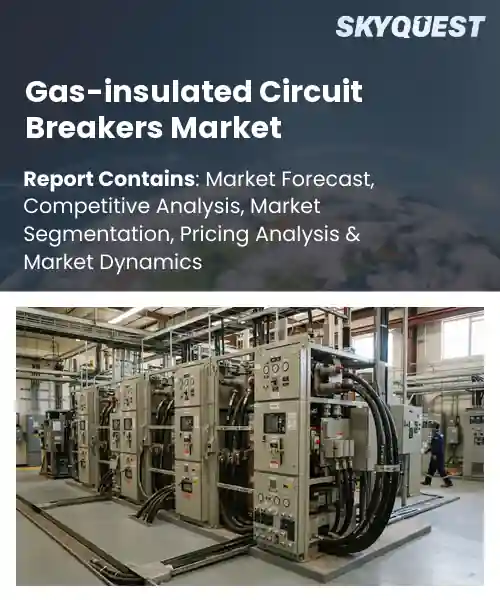
Gas-insulated Circuit Breakers Market
Report ID: SQMIG20E2258
Report ID: SQMIG20E2258
[email protected]
USA +1 351-333-4748
Report ID:
SQMIG20E2258 |
Region:
Global |
Published Date: August, 2026
Pages:
157
|Tables:
149
|Figures:
78


Global Gas-Insulated Circuit Breakers Market size was valued at USD 7.46 Billion in 2024 and is poised to grow from USD 7.94 Billion in 2025 to USD 13.04 Billion by 2033, growing at a CAGR of 6.4% during the forecast period (2026-2033).
Gas‑insulated circuit breakers (GICBs) form the backbone of high‑voltage transmission and distribution networks, providing fault interruption while minimizing arc length and environmental contamination. The market has grown from niche applications in the 1990s, when oil‑filled breakers dominated, to a mainstream solution favored by utilities seeking compact equipment. This shift was propelled by rising renewable integration, which demands reliable protection in densely populated substations where space is scarce. For example, European operators adopted SF6‑filled GICBs to replace bulkier air‑magnetic units, achieving up to 30 % reduction in footprint and maintenance costs. Consequently, the sector now represents a critical enabler for grid resilience. Regulatory scrutiny of SF6, the primary insulating gas in GICBs, now drives the market’s powerful expansion. Stricter emission caps in the United States, Europe, and China compel manufacturers to develop low‑global‑warming‑potential alternatives such as C4‑F7 or vacuum arc technology. This pressure creates two effects: existing installations must be retrofitted, and new projects increasingly require breakers. Illustrating the trend, a Japanese utility began a 2023 program that swapped 1,200 SF6 units for C4‑F7 models, reducing annual emissions by roughly 15 %. The retrofit surge fuels demand for conversion kits, service training, and smart monitoring solutions, opening revenue streams while enhancing grid reliability.
What role does IoT play in predictive maintenance for gas‑insulated circuit breakers?
IoT transforms predictive maintenance for gas‑insulated circuit breakers by embedding smart sensors that continuously track temperature, pressure, and arc‑flash events. The data stream feeds machine‑learning models that flag abnormal patterns before a fault escalates, allowing technicians to schedule interventions during planned outages rather than reacting to sudden failures. This approach reduces unplanned downtime, extends equipment life, and aligns with the broader shift toward digital substations where reliability and efficiency are paramount. As utilities modernize grids, the integration of IoT into breaker health monitoring becomes a cornerstone of operational excellence, supporting the growing demand for resilient, high‑performance power infrastructure.In July 2026 the AC Circuit Breaker Market report highlighted gas‑insulated circuit breakers as the dominant segment, noting that IoT‑enabled health monitoring is accelerating adoption and driving market expansion.
Market snapshot - (2026-2033)
Global Market Size
USD 7.46 Billion
Largest Segment
SF6-Insulated
Fastest Growth
Alternative Gas-Insulated
Growth Rate
6.4% CAGR
To get more insights on this market click here to Request a Free Sample Report
Global gas-insulated circuit breakers market is segmented by insulation type, voltage rating, installation, application, end user and region. Based on insulation type, the market is segmented into SF6-Insulated, Alternative Gas-Insulated, Hybrid Gas-Insulated and Other Insulation Types. Based on voltage rating, the market is segmented into Medium Voltage, High Voltage and Extra-High Voltage. Based on installation, the market is segmented into Indoor and Outdoor. Based on application, the market is segmented into Power Transmission, Power Distribution, Industrial, Renewable Energy, Commercial Infrastructure and Others. Based on end user, the market is segmented into Electric Utilities, Industrial Facilities, Renewable Energy Operators, Commercial & Infrastructure Operators and Others. Based on region, the market is segmented into North America, Europe, Asia Pacific, Latin America and Middle East & Africa.
SF6‑Insulated segment dominates because it offers proven reliability and high dielectric strength that meet stringent utility standards. The mature technology minimizes maintenance requirements and delivers consistent performance across a wide voltage range, fostering confidence among system operators. Its extensive supply chain and established certification pathways further reinforce adoption, making it the default choice for new installations and retrofits in the gas‑insulated circuit breakers market globally and across the industry.
However, Alternative Gas‑Insulated segment is witnessing the strongest growth momentum as environmental regulations drive a shift away from fluorinated gases. Innovations in eco‑friendly mixtures deliver comparable performance while reducing greenhouse impact, prompting utilities to adopt them in new projects. This transition unlocks market opportunities and accelerates expansion of breaker solutions.
Power Transmission segment stands out because it remains the backbone of bulk electricity movement, requiring highly reliable interruption devices. Gas‑insulated circuit breakers in this arena are engineered for extreme current levels and long‑distance network stability, which drives utilities to prioritize them for critical corridors. Their ability to integrate with advanced protection schemes and sustain high fault withstand capability reinforces their central role in modern transmission infrastructure nationally, regionally, and globally.
Meanwhile, Renewable Energy segment emerges as the key growth area as solar and wind farms expand and require protection. Gas‑insulated breakers adapted for generation offer reduced footprint and enhanced reliability under fluctuating loads, prompting project developers to select them over options. This surge fuels design standards and stimulates market diversification.
To get detailed segments analysis, Request a Free Sample Report
Asia Pacific maintains a leading position through a convergence of robust industrial growth, extensive grid modernization, and deep engineering expertise. The region benefits from longstanding partnerships between equipment manufacturers and utilities, fostering rapid adoption of high‑performance gas‑insulated solutions. Strategic emphasis on reliability and compact design aligns with dense urban infrastructure, while strong government focus on resilient power systems drives continuous investment. Furthermore, the presence of world‑class research institutions accelerates innovation in SF6‑free technologies, reinforcing the region’s reputation as a hub for advanced circuit‑breaker development and deployment.
Gas‑insulated Circuit Breakers Market in Japan is shaped by a mature electricity network that prioritizes safety and space efficiency. Domestic manufacturers leverage precision engineering to deliver compact, high‑reliability units suited for seismic considerations. Close collaboration with utilities ensures that designs meet stringent performance standards, while ongoing research into eco‑friendly insulating gases supports the country’s environmental objectives. The market’s focus on long‑term asset durability sustains demand for premium gas‑insulated solutions.
Gas‑insulated Circuit Breakers Market in South Korea thrives on a strong manufacturing base and aggressive grid expansion. The nation’s emphasis on smart grid integration stimulates interest in compact, high‑capacity breakers that support digital monitoring. Local firms benefit from close ties to global suppliers, enabling technology transfer and rapid adoption of next‑generation insulation methods. Policy encouragement for resilient infrastructure further consolidates the market’s growth trajectory.
Europe’s expansion is propelled by rigorous reliability standards, a decisive shift toward sustainable energy, and extensive grid reinforcement across member states. The region’s commitment to decarbonization encourages utilities to adopt compact, low‑maintenance gas‑insulated breakers that support renewable integration and offshore projects. Strong regulatory frameworks mandate high safety margins, prompting investment in advanced insulation technologies. Collaborative research initiatives across the continent foster continuous improvement, while a competitive supplier landscape ensures access to cutting‑edge solutions, collectively reinforcing Europe’s position as a dynamic growth market.
Gas‑insulated Circuit Breakers Market in Germany is characterized by a dominant engineering sector that prioritizes precision and reliability. German utilities favor robust, high‑performance solutions to underpin a dense industrial base and extensive transmission network. Integration with renewable sources drives demand for compact, low‑maintenance breakers that can operate under variable conditions. Ongoing collaboration between manufacturers and research institutes nurtures innovation, reinforcing the market’s leading role in Europe.
Gas‑insulated Circuit Breakers Market in United Kingdom is experiencing the fastest growth as the nation upgrades aging infrastructure and expands offshore wind capacity. Emphasis on space‑saving designs aligns with urban substations and limited site availability. Utilities seek high‑reliability equipment that can support digital grid management, driving adoption of advanced gas‑insulated technologies. Policy incentives for clean energy transition further accelerate market momentum.
Gas‑insulated Circuit Breakers Market in France is emerging through focused investments in grid resilience and renewable integration. The market benefits from collaborative projects that explore eco‑friendly insulating alternatives, aligning with national environmental targets. Utilities prioritize compact, low‑loss solutions to accommodate expanding offshore and onshore wind connections. Strategic partnerships with European manufacturers enhance technology transfer, positioning France as a rising contributor to the regional market.
North America is reinforcing its role by modernizing legacy transmission corridors, embracing digital grid technologies, and prioritizing reliability in a diversified energy landscape. Utilities are replacing conventional breakers with gas‑insulated alternatives to achieve higher fault tolerance and reduced maintenance in harsh environments. Commitment to low‑emission solutions spurs research into alternative insulating gases, while strong domestic manufacturing capabilities ensure a steady supply of advanced equipment. Collaborative initiatives between industry and academia accelerate innovation, supporting the region’s strategic aim to deliver resilient and sustainable power infrastructure.
Gas‑insulated Circuit Breakers Market in United States is driven by extensive grid upgrading programs and a focus on high‑capacity transmission across vast distances. Utilities value the compact footprint and superior arc‑quenching performance of gas‑insulated devices, especially in congested urban substations. Ongoing efforts to incorporate smart monitoring foster greater adoption of digitally enabled breakers. Domestic manufacturers benefit from robust R&D ecosystems, enabling rapid deployment of next‑generation insulation technologies.
Gas‑insulated Circuit Breakers Market in Canada reflects a commitment to reliable power delivery amid challenging climatic conditions. The market emphasizes equipment capable of withstanding low temperatures and remote operation, making gas‑insulated solutions attractive for northern transmission routes. Collaboration with indigenous communities and focus on environmental stewardship drive interest in low‑emission technologies. Investment in research partnerships supports the development of resilient, low‑maintenance breaker designs tailored to Canadian grid needs.
To know more about the market opportunities by region and country, click here to
Buy The Complete Report
Increasing Demand For Reliability
Adoption Of Digital Monitoring
High Initial Capital Costs
Complex Installation And Maintenance
Request Free Customization of this report to help us to meet your business objectives.
The gas‑insulated circuit breaker market is shaped by intense competition among established manufacturers, who are accelerating M&A activity, forming strategic alliances, and investing in advanced SF6‑free technologies to differentiate product portfolios and meet stricter environmental standards. Recent joint development programs focus on digital monitoring, modular designs, and higher voltage ratings, driving faster time‑to‑market and broader geographic reach.
Top Player’s Company Profile
Recent Developments
SkyQuest’s ABIRAW (Advanced Business Intelligence, Research & Analysis Wing) is our Business Information Services team that Collects, Collates, Correlates, and Analyses the Data collected by means of Primary Exploratory Research backed by robust Secondary Desk research. As per SkyQuest analysis, the global gas‑insulated circuit breakers market is propelled primarily by utilities’ growing demand for reliable, compact protection equipment that can handle high fault currents, while a second strong catalyst is the adoption of digital monitoring and IoT‑enabled predictive maintenance which enhances grid efficiency. The market is led by the SF6‑insulated segment, valued for its proven dielectric strength, and Asia Pacific dominates the landscape thanks to rapid grid modernization and strong manufacturing ecosystems. However, high initial capital costs and the need for specialized installation expertise act as a restraint, tempering the pace of adoption in cost‑sensitive regions overall.
| Report Metric | Details |
|---|---|
| Market size value in 2024 | USD 7.46 Billion |
| Market size value in 2033 | USD 13.04 Billion |
| Growth Rate | 6.4% |
| Base year | 2024 |
| Forecast period | (2026-2033) |
| Forecast Unit (Value) | USD Billion |
| Segments covered |
|
| Regions covered | North America (US, Canada), Europe (Germany, France, United Kingdom, Italy, Spain, Rest of Europe), Asia Pacific (China, India, Japan, Rest of Asia-Pacific), Latin America (Brazil, Rest of Latin America), Middle East & Africa (South Africa, GCC Countries, Rest of MEA) |
| Companies covered |
|
| Customization scope | Free report customization with purchase. Customization includes:-
|
To get a free trial access to our platform which is a one stop solution for all your data requirements for quicker decision making. This platform allows you to compare markets, competitors who are prominent in the market, and mega trends that are influencing the dynamics in the market. Also, get access to detailed SkyQuest exclusive matrix.
Table Of Content
Executive Summary
Market overview
Parent Market Analysis
Market overview
Market size
KEY MARKET INSIGHTS
COVID IMPACT
MARKET DYNAMICS & OUTLOOK
Market Size by Region
KEY COMPANY PROFILES
Methodology
For the Gas-insulated Circuit Breakers Market, our research methodology involved a mixture of primary and secondary data sources. Key steps involved in the research process are listed below:
1. Information Procurement: This stage involved the procurement of Market data or related information via primary and secondary sources. The various secondary sources used included various company websites, annual reports, trade databases, and paid databases such as Hoover's, Bloomberg Business, Factiva, and Avention. Our team did 45 primary interactions Globally which included several stakeholders such as manufacturers, customers, key opinion leaders, etc. Overall, information procurement was one of the most extensive stages in our research process.
2. Information Analysis: This step involved triangulation of data through bottom-up and top-down approaches to estimate and validate the total size and future estimate of the Gas-insulated Circuit Breakers Market.
3. Report Formulation: The final step entailed the placement of data points in appropriate Market spaces in an attempt to deduce viable conclusions.
4. Validation & Publishing: Validation is the most important step in the process. Validation & re-validation via an intricately designed process helped us finalize data points to be used for final calculations. The final Market estimates and forecasts were then aligned and sent to our panel of industry experts for validation of data. Once the validation was done the report was sent to our Quality Assurance team to ensure adherence to style guides, consistency & design.
Analyst Support
Customization Options
With the given market data, our dedicated team of analysts can offer you the following customization options are available for the Gas-insulated Circuit Breakers Market:
Product Analysis: Product matrix, which offers a detailed comparison of the product portfolio of companies.
Regional Analysis: Further analysis of the Gas-insulated Circuit Breakers Market for additional countries.
Competitive Analysis: Detailed analysis and profiling of additional Market players & comparative analysis of competitive products.
Go to Market Strategy: Find the high-growth channels to invest your marketing efforts and increase your customer base.
Innovation Mapping: Identify racial solutions and innovation, connected to deep ecosystems of innovators, start-ups, academics, and strategic partners.
Category Intelligence: Customized intelligence that is relevant to their supply Markets will enable them to make smarter sourcing decisions and improve their category management.
Public Company Transcript Analysis: To improve the investment performance by generating new alpha and making better-informed decisions.
Social Media Listening: To analyze the conversations and trends happening not just around your brand, but around your industry as a whole, and use those insights to make better Marketing decisions.
REQUEST FOR SAMPLE
 REQUEST FREE CUSTOMIZATION


Want to customize this report? This report can be personalized according to your needs. Our analysts and industry experts will work directly with you to understand your requirements and provide you with customized data in a short amount of time. We offer $1000 worth of FREE customization at the time of purchase.
Feedback From Our Clients


 USA (+1) 351-333-4748

