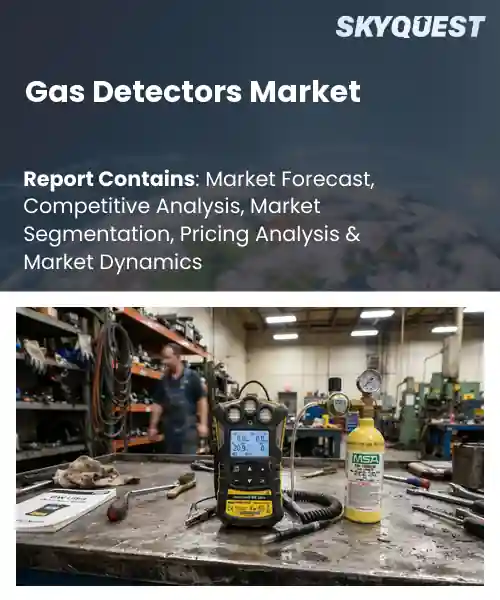
Gas Detectors Market
Report ID: SQMIG20D2868
Report ID: SQMIG20D2868
[email protected]
USA +1 351-333-4748
Report ID:
SQMIG20D2868 |
Region:
Global |
Published Date: August, 2026
Pages:
157
|Tables:
123
|Figures:
77


Global Gas Detectors Market size was valued at USD 3.0 Billion in 2024 and is poised to grow from USD 3.12 Billion in 2025 to USD 4.06 Billion by 2033, growing at a CAGR of 3.4% during the forecast period (2026-2033).
The gas detectors market comprises devices that sense toxic, combustible, and oxygen‑deficient atmospheres, providing safety alerts for industrial and commercial settings. Its importance stems from the need to protect workers in petrochemical plants, mining operations, and confined spaces where undetected leaks can trigger explosions or health crises. Historically, the market was dominated by analog electrochemical sensors, but the decade has shifted toward multisensor units with IoT connectivity, driven by safety regulations in North America and Europe. For example, wireless sensor networks on platforms have reduced inspection cycles and lowered incident rates, illustrating market’s evolution from alarms to integrated monitoring solutions. Building on this shift, IoT and AI analytics drive the gas detectors market, because sensors provide data that powers maintenance and early warnings. When manufacturers embed edge computing, facilities such as oil‑refineries can automatically shut down equipment before a leak grows, illustrated by a 2023 Gulf of Mexico incident where sensor alerts prevented a fire. This capability cuts downtime, lowers insurance costs, and meets stricter emissions reporting, encouraging investors to back platform‑as‑a‑service models that lease sensor networks to plants. Consequently, vendors offering scalable cloud dashboards and API integration are positioned to win contracts as petrochemical parks expand in emerging regions.
How is AI-driven IoT improving safety and accuracy in the gas detectors market?
AI driven IoT is reshaping gas detection by linking sensors to cloud platforms that analyze data in real time. Continuous streams let devices learn normal background levels and instantly flag deviations, reducing false alarms and improving worker safety. Edge processors perform on device diagnostics so calibration can be verified without manual checks. Predictive models forecast leak progression, enabling preemptive shutdowns and targeted ventilation. Integration with mobile dashboards gives supervisors remote visibility and automated compliance reporting. As industries expand and regulatory pressure rises, these capabilities make detectors more reliable and easier to manage, driving broader adoption across heavy industry and confined spaces.In March 2024, a leading gas detector manufacturer introduced an AI enabled IoT platform that continuously self calibrates and predicts sensor drift, boosting safety and accuracy while lowering maintenance cycles, supporting the market’s rapid growth.
Market snapshot - (2026-2033)
Global Market Size
USD 3.0 Billion
Largest Segment
Business Travel
Fastest Growth
Leisure Travel
Growth Rate
3.4% CAGR
To get more insights on this market click here to Request a Free Sample Report
Global gas detectors market is segmented by product type, gas type, technology, end use and region. Based on product type, the market is segmented into Fixed Gas Detectors and Portable Gas Detectors. Based on gas type, the market is segmented into Combustible Gases, Toxic Gases, Oxygen and Multi-Gas. Based on technology, the market is segmented into Electrochemical, Infrared, Catalytic, Photoionization Detection and Other Technologies. Based on end use, the market is segmented into Oil & Gas, Chemicals & Petrochemicals, Mining, Manufacturing, Utilities, Commercial & Residential and Others. Based on region, the market is segmented into North America, Europe, Asia Pacific, Latin America and Middle East & Africa.
Infrared technology segment dominates because its ability to detect a broad range of combustible gases with high specificity and low maintenance drives widespread adoption across critical industries. The non contact measurement principle delivers rapid response and resistance to sensor poisoning, which aligns with stringent safety regulations and operational reliability demands. Consequently manufacturers prioritize infrared solutions, reinforcing its leadership in the gas detectors market and enabling continuous monitoring in remote sites while simplifying integration with digital control systems.
However, Photoionization detection segment emerges as the fastest growing because its unmatched sensitivity to low level volatile organic compounds fuels expanding use in workplace safety and indoor air quality monitoring. The technology’s ability to provide real time alerts drives regulatory compliance investments and spurs innovation, creating new opportunities for market expansion.
Portable gas detectors segment dominates because their handheld design offers immediate situational awareness and personal protection for workers operating in hazardous environments. The mobility enables on‑site leak verification, confined space entry, and emergency response without needing permanent infrastructure. Operators value battery longevity, multi‑gas capability, and intuitive interfaces that reduce training time, aligning with stringent occupational safety standards and driving widespread procurement across diverse industrial sites. They are deployed throughout global supply chains and facilities.
On the other hand, Fixed gas detectors segment is the fastest growing because increasing automation and continuous monitoring requirements in process industries encourage permanent installations. Integration with IoT platforms and advanced analytics enhances plant safety and operational efficiency, prompting capital projects that prioritize fixed solutions, thereby accelerating market expansion and generating new revenue streams for manufacturers.
To get detailed segments analysis, Request a Free Sample Report
North America maintains a leading position in the gas detectors market due to a combination of advanced manufacturing capability, stringent safety regulations, and deep integration of detection technologies across high‑risk industries. The United States benefits from a mature ecosystem of research institutions and a network of suppliers that continuously innovate sensor performance and reliability. Canada adds strong emphasis on occupational health standards and a growing demand from the oil and gas sector, especially in remote extraction zones. Together these factors create a robust demand pipeline, encourage rapid product development cycles, and reinforce the region’s reputation as a benchmark for quality and compliance worldwide. The regulatory landscape encourages proactive adoption of multi‑gas monitoring solutions, while strategic partnerships between OEMs and end‑users accelerate technology transfer and customization. Moreover, the presence of major industrial conglomerates supports large‑scale deployments in petrochemical complexes, power generation facilities, and transportation hubs, further cementing the region’s dominance.
Gas Detectors Market in the United States is characterized by intensive collaboration among leading sensor manufacturers, safety consultants, and end‑users across sectors such as refining, chemicals, and heavy manufacturing. The market benefits from rigorous occupational safety legislation that pushes continuous improvement of detection equipment, while a culture of early technology adoption fuels demand for portable and network‑enabled devices. These dynamics sustain a vibrant ecosystem of innovation and high‑value deployment globally.
Gas Detectors Market in Canada is driven by a strong commitment to workplace safety and an expanding resource extraction industry that operates in challenging environments. Provincial regulations emphasize robust monitoring of volatile organic compounds and combustible gases, prompting adoption of advanced multi‑sensor platforms. Integration with digital control systems enhances real‑time analytics, while support from research institutions nurtures local development of low‑power, ruggedized devices suited for remote installations industry today nationwide.
Europe experiences rapid expansion of the gas detectors market as a result of harmonized safety directives, heightened environmental awareness, and strong engineering expertise across the continent. The European Union framework mandates comprehensive monitoring of hazardous atmospheres in industrial and public settings, prompting manufacturers to deliver highly calibrated, interoperable solutions. Nations such as Germany lead in precision sensor design while the United Kingdom leverages a dynamic startup ecosystem that accelerates deployment of portable and IoT‑connected devices. France contributes emerging capabilities in miniaturized detectors tailored for renewable energy installations. Collaboration between research labs, standards bodies, and industry players fosters continuous improvement, while a culture of proactive risk management ensures that gas detection technologies are integrated early in project lifecycles, reinforcing the region’s momentum.
Gas Detectors Market in Germany benefits from a legacy of precision engineering and a dense network of specialised component suppliers. Stringent occupational safety regulations compel upgrades of detection systems across manufacturing, chemical, and automotive sectors. The market embraces digital twin concepts that link sensor data with process simulations, enhancing predictive maintenance. Collaboration between universities and industry accelerates development of electro‑chemical and infrared sensors, reinforcing Germany’s benchmark for reliability and performance.
Gas Detectors Market in the United Kingdom is propelled by a startup ecosystem and a proactive regulatory stance that emphasizes detection in construction, mining, and transport. The market favors compact battery‑operated devices that integrate with mobile applications for instant alerts, aligning with a preference for digital solutions. Collaboration between academic research centres and industrial partners accelerates rollout of multi‑gas sensors, positioning the United Kingdom as a fast‑moving hub for innovation.
Gas Detectors Market in France is emerging as manufacturers focus on lightweight, miniaturized sensors designed for renewable energy projects and occupational health in small‑scale industries. French regulations encourage adoption of devices that can communicate wirelessly with building management systems, supporting energy efficiency goals. Partnerships between sensor firms and automotive suppliers foster technology transfer, while research initiatives funded by programs drive advances in low‑power chemistry that extend battery life for units.
Asia Pacific is consolidating its role in the gas detectors market through a blend of advanced manufacturing, strategic investment in sensor miniaturization, and growing demand from petrochemical hubs and smart infrastructure projects. Japan leverages its long‑standing expertise in precision electronics to produce highly reliable catalytic and infrared detectors, while also pioneering integration of artificial intelligence for predictive hazard analysis. South Korea pairs rapid adoption of high‑density electronics with government‑backed programs that encourage deployment of networked detection systems in heavy industry and urban transit. Collaboration between leading universities and multinational corporations accelerates development of low‑power, robust sensors suited for harsh environments. This combination of technological innovation, supportive policy frameworks, and expanding end‑use applications propels the region toward a more prominent global standing.
Gas Detectors Market in Japan is shaped by expertise in sensor engineering and a culture of improvement that prioritises reliability in environments. Japanese manufacturers excel at catalytic and infrared technologies, delivering devices that meet industrial standards. Integration with data analytics platforms enables monitoring and predictive maintenance across petrochemical complexes and transport networks. Collaboration between research institutions and firms accelerates development of low‑power sensors, reinforcing Japan’s reputation for quality and leadership.
Gas Detectors Market in South Korea is driven by adoption of electronics and government incentives that promote safety in industry and infrastructure. Korean firms focus on semiconductor‑based sensor platforms that offer form factors and data connectivity. Integration with initiatives enables monitoring of tunnels, subway systems, and manufacturing plants. Ties between universities and conglomerates accelerate research on low‑consumption, high‑sensitivity detectors, positioning South Korea as a contributor to the region’s technological advancement.
To know more about the market opportunities by region and country, click here to
Buy The Complete Report
Increasing Workplace Safety Regulations
Advances In Sensor Technologies
High Initial Capital Expenditure
Complex Calibration and Maintenance Requirements
Request Free Customization of this report to help us to meet your business objectives.
The competitive landscape is shaped by major players intensifying rivalry through strategic M&A and technology partnerships, exemplified by Honeywell and Dräger’s recent launch of IoT‑enabled explosion‑proof gas detectors, which accelerates product differentiation and market penetration. Companies are also leveraging advanced sensor technologies and expanding distribution networks to capture emerging demand in high‑growth regions, reinforcing their positions amid escalating safety regulations and industrial automation trends.
Top Player’s Company Profile
Recent Developments
SkyQuest’s ABIRAW (Advanced Business Intelligence, Research & Analysis Wing) is our Business Information Services team that Collects, Collates, Correlates, and Analyses the Data collected by means of Primary Exploratory Research backed by robust Secondary Desk research. As per SkyQuest analysis, the global gas detectors market is being propelled primarily by tightening workplace safety regulations that compel firms to upgrade legacy monitoring systems, while rapid advances in sensor technology—such as miniaturized infrared and AI‑enabled IoT platforms—provide more accurate, low‑maintenance solutions that further boost adoption. North America remains the dominant region, driven by its strong manufacturing base, stringent safety standards and early technology uptake. Fixed gas detectors lead the segment landscape, reflecting the shift toward continuous, automated monitoring in process industries. However, the market’s expansion is tempered by the high initial capital expenditure required for sophisticated detection equipment, which can deter smaller players.
| Report Metric | Details |
|---|---|
| Market size value in 2024 | USD 3.0 Billion |
| Market size value in 2033 | USD 4.06 Billion |
| Growth Rate | 3.4% |
| Base year | 2024 |
| Forecast period | (2026-2033) |
| Forecast Unit (Value) | USD Billion |
| Segments covered |
|
| Regions covered | North America (US, Canada), Europe (Germany, France, United Kingdom, Italy, Spain, Rest of Europe), Asia Pacific (China, India, Japan, Rest of Asia-Pacific), Latin America (Brazil, Rest of Latin America), Middle East & Africa (South Africa, GCC Countries, Rest of MEA) |
| Companies covered |
|
| Customization scope | Free report customization with purchase. Customization includes:-
|
To get a free trial access to our platform which is a one stop solution for all your data requirements for quicker decision making. This platform allows you to compare markets, competitors who are prominent in the market, and mega trends that are influencing the dynamics in the market. Also, get access to detailed SkyQuest exclusive matrix.
Table Of Content
Executive Summary
Market overview
Parent Market Analysis
Market overview
Market size
KEY MARKET INSIGHTS
COVID IMPACT
MARKET DYNAMICS & OUTLOOK
Market Size by Region
KEY COMPANY PROFILES
Methodology
For the Gas Detectors Market, our research methodology involved a mixture of primary and secondary data sources. Key steps involved in the research process are listed below:
1. Information Procurement: This stage involved the procurement of Market data or related information via primary and secondary sources. The various secondary sources used included various company websites, annual reports, trade databases, and paid databases such as Hoover's, Bloomberg Business, Factiva, and Avention. Our team did 45 primary interactions Globally which included several stakeholders such as manufacturers, customers, key opinion leaders, etc. Overall, information procurement was one of the most extensive stages in our research process.
2. Information Analysis: This step involved triangulation of data through bottom-up and top-down approaches to estimate and validate the total size and future estimate of the Gas Detectors Market.
3. Report Formulation: The final step entailed the placement of data points in appropriate Market spaces in an attempt to deduce viable conclusions.
4. Validation & Publishing: Validation is the most important step in the process. Validation & re-validation via an intricately designed process helped us finalize data points to be used for final calculations. The final Market estimates and forecasts were then aligned and sent to our panel of industry experts for validation of data. Once the validation was done the report was sent to our Quality Assurance team to ensure adherence to style guides, consistency & design.
Analyst Support
Customization Options
With the given market data, our dedicated team of analysts can offer you the following customization options are available for the Gas Detectors Market:
Product Analysis: Product matrix, which offers a detailed comparison of the product portfolio of companies.
Regional Analysis: Further analysis of the Gas Detectors Market for additional countries.
Competitive Analysis: Detailed analysis and profiling of additional Market players & comparative analysis of competitive products.
Go to Market Strategy: Find the high-growth channels to invest your marketing efforts and increase your customer base.
Innovation Mapping: Identify racial solutions and innovation, connected to deep ecosystems of innovators, start-ups, academics, and strategic partners.
Category Intelligence: Customized intelligence that is relevant to their supply Markets will enable them to make smarter sourcing decisions and improve their category management.
Public Company Transcript Analysis: To improve the investment performance by generating new alpha and making better-informed decisions.
Social Media Listening: To analyze the conversations and trends happening not just around your brand, but around your industry as a whole, and use those insights to make better Marketing decisions.
REQUEST FOR SAMPLE
 REQUEST FREE CUSTOMIZATION


Want to customize this report? This report can be personalized according to your needs. Our analysts and industry experts will work directly with you to understand your requirements and provide you with customized data in a short amount of time. We offer $1000 worth of FREE customization at the time of purchase.
Feedback From Our Clients


 USA (+1) 351-333-4748

