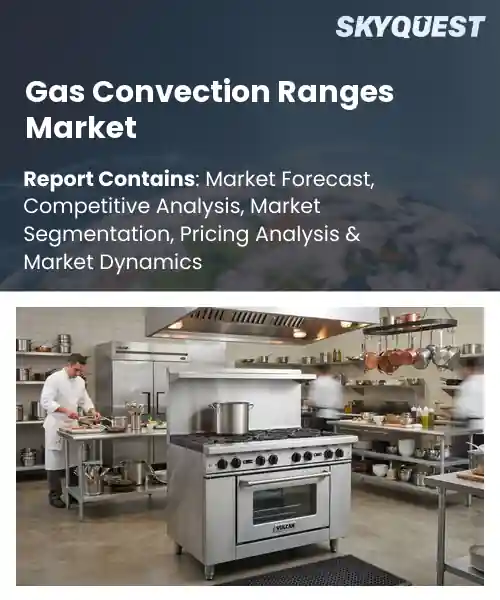
Gas Convection Ranges Market
Report ID: SQMIG25H2185
Report ID: SQMIG25H2185
[email protected]
USA +1 351-333-4748
Report ID:
SQMIG25H2185 |
Region:
Global |
Published Date: August, 2026
Pages:
157
|Tables:
145
|Figures:
78


Global Gas Convection Ranges Market size was valued at USD 5.36 Billion in 2024 and is poised to grow from USD 5.68 Billion in 2025 to USD 8.98 Billion by 2033, growing at a CAGR of 5.9% during the forecast period (2026-2033).
The Global Gas Convection Ranges market tracks sales of oven‑stove units that combine gas burners with forced‑air convection technology, a segment that has expanded as consumers and chefs seek faster, more uniform cooking while lowering energy consumption. Its importance stems from the dual need to meet stringent emissions standards and to satisfy growing culinary preferences for precise temperature control. Historically, the market lagged behind electric equivalents, but the introduction of high‑efficiency burners in the 2010s catalyzed adoption in North America and Europe. Recent regulatory incentives in Canada and Germany further accelerated diffusion, turning the once‑niche product into a mainstream appliance. Building on the regulatory push described earlier, the next decisive factor driving the Global Gas Convection Ranges market is the rising demand for multi‑function kitchen solutions in the hospitality sector, where chefs require rapid heat turnover to meet fast‑casual service models. As restaurants adopt open‑kitchen concepts, the ability of convection gas ovens to reduce baking cycles by up to 30 percent translates into higher table turnover and lower utility bills, creating an economic incentive. Consequently, manufacturers are investing in smart‑connected controls that integrate with restaurant management platforms, opening opportunities for data‑driven maintenance contracts and subscription‑based upgrades, which further expand market size.
How is AI-driven automation influencing design and energy efficiency in the gas convection ranges market?
AI driven automation is reshaping gas convection ranges by embedding intelligent controls that learn cooking patterns and adjust flame intensity in real time. Sensors map heat flow across the oven cavity, allowing the system to fine tune burners for even browning while cutting fuel waste. Designers now prioritize sleek interfaces that hide complex algorithms behind simple knobs, creating a modern aesthetic that appeals to tech savvy consumers. The technology also enables remote monitoring, so users can start preheating from a smartphone and receive alerts when optimal temperature is reached. As a result, manufacturers can offer products that deliver consistent performance with lower energy consumption, strengthening the market’s appeal.Whirlpool announced in June 2023, its AI driven Smart Convection Range that automatically balances flame distribution and reduces gas usage while learning user habits. The voice enabled system delivers smoother cooking and supports the market’s shift toward energy efficient appliances, encouraging broader adoption of intelligent kitchen technology.
Market snapshot - (2026-2033)
Global Market Size
USD 5.36 Billion
Largest Segment
Freestanding
Fastest Growth
Slide-In
Growth Rate
5.9% CAGR
To get more insights on this market click here to Request a Free Sample Report
Global gas convection ranges market is segmented by range type, burner configuration, application, oven capacity, distribution channel and region. Based on range type, the market is segmented into Freestanding, Slide-In and Commercial Gas Convection Ranges. Based on burner configuration, the market is segmented into Four Burner, Six Burner and Eight Burner. Based on application, the market is segmented into Residential, Restaurants, Hotels and Institutional Kitchens. Based on oven capacity, the market is segmented into Up to 4 cu. ft., 4–6 cu. ft. and Above 6 cu. ft.. Based on distribution channel, the market is segmented into Specialty Stores, Online Retail and Commercial Equipment Dealers. Based on region, the market is segmented into North America, Europe, Asia Pacific, Latin America and Middle East & Africa.
Freestanding segment dominates because homeowners prioritize flexibility and aesthetic independence when arranging kitchen layouts, allowing units to be positioned anywhere without cabinetry constraints. This freedom aligns with prevailing design trends that favor modular installations, leading consumers to favor freestanding gas convection ranges for their ease of replacement and upgrade. Additionally, manufacturers emphasize durable construction and diverse finish options, reinforcing the appeal of freestanding models across both new builds and renovation projects.
However, slide in segment emerges as the fastest growing area because open plan living spaces encourage seamless countertop integration, making slide in ranges the preferred choice for sleek built in aesthetics. Consumers seek appliances that disappear into cabinetry, prompting manufacturers to innovate with new designs, expanding adoption in homes and fueling momentum for this configuration.
Six burner segment dominates because it offers a balanced blend of capacity and control that aligns with the cooking requirements of most residential households and mid scale commercial kitchens. The configuration provides enough burners to handle multiple dishes simultaneously while preserving manageable heat distribution, which appeals to cooks seeking efficiency without the complexity of larger arrays. Manufacturers reinforce this appeal through standardized controls and reliable ignition, cementing its leadership in the market.
Meanwhile, eight burner segment emerges as the most rapidly expanding area because home chefs and boutique food concepts increasingly demand higher output and specialized cooking zones. The additional burners enable execution of complex menus, prompting manufacturers to integrate flame modulation and safety features, which broadens appeal and accelerates adoption across residential and commercial settings.
To get detailed segments analysis, Request a Free Sample Report
North America’s dominance stems from a convergence of affluent consumer lifestyles, sophisticated culinary expectations and an entrenched manufacturing ecosystem. Home‑cooking culture emphasizes precision, prompting widespread adoption of convection technology that delivers even heating and speed. Strong retail channels, coupled with a high degree of brand loyalty, enable premium products to reach a broad audience. Regulatory frameworks that prioritize energy efficiency further incentivize manufacturers to innovate, while a well‑developed service network sustains product reliability and aftermarket engagement, reinforcing the region’s leading position.
Gas Convection Ranges Market in United States benefits from robust retail networks and a culture that values professional‑grade cooking equipment. Consumer preference for precise temperature control drives demand for models with advanced convection fans and smart connectivity. Manufacturers leverage extensive R&D capabilities to introduce innovative features, while service infrastructure ensures after‑sales support, reinforcing market depth and brand loyalty across residential and commercial segments and culinary education institutions nationwide through partnerships.
Gas Convection Ranges Market in Canada thrives on a combination of environmentally conscious consumer attitudes and a strong tradition of home cooking. Buyers seek appliances that balance performance with energy stewardship, encouraging manufacturers to embed efficient combustion and advanced airflow systems. Distribution is supported by a wide‑reaching network of specialty retailers, and a proactive service framework sustains product longevity. This synergy of consumer values and supplier responsiveness underpins Canada’s prominent role within the regional landscape.
Europe’s expansion is propelled by heightened culinary sophistication, stringent environmental standards and a mature appliance sector that prioritizes design and functionality. Consumers across the continent are increasingly inclined toward cooking solutions that deliver rapid, uniform heating while aligning with sustainability goals. Regulatory emphasis on low‑emission technologies stimulates innovation, prompting manufacturers to integrate high‑efficiency burners and smart control interfaces. Combined with strong retail visibility and a cultural appreciation for gourmet cooking, these forces accelerate market penetration and reinforce Europe’s competitive stance.
Gas Convection Ranges Market in Germany is anchored by a robust engineering base and a consumer base that values precision cooking. Manufacturers capitalize on a legacy of technical excellence to produce devices featuring refined convection airflow and integrated safety mechanisms. Retail channels emphasize premium branding, while sustainability mandates drive the adoption of low‑emission burners and energy‑saving cycles. This alignment of technological prowess and eco‑conscious demand positions Germany as a dominant market leader.
Gas Convection Ranges Market in United Kingdom experiences swift growth as home chefs embrace appliances that combine speed with even heat distribution. Trend‑forward consumers gravitate toward sleek designs equipped with intuitive digital controls and connectivity features. Retail environments showcase a broad spectrum of models that cater to both compact urban kitchens and larger suburban spaces. The regulatory focus on lower carbon footprints further encourages manufacturers to embed efficient combustion technologies, fostering a dynamic market expansion.
Gas Convection Ranges Market in France is emerging steadily, driven by a culinary heritage that celebrates nuanced cooking techniques. Buyers show enthusiasm for appliances that offer precise temperature modulation and versatile cooking modes. Local distributors highlight products that blend aesthetic elegance with functional performance, aligning with French design sensibilities. Environmental guidelines promote the integration of cleaner gas systems, supporting an upward trajectory for the market within the broader European context.
Asia Pacific is enhancing its market position through rapid urbanization, rising disposable incomes and a growing fascination with international culinary experiences. Consumers in key economies are upgrading kitchen appliances to achieve professional‑grade results at home, creating demand for advanced convection technology. Manufacturers respond with localized designs that accommodate compact living spaces while delivering high‑efficiency performance. Trade shows and digital platforms amplify product awareness, and an expanding service infrastructure ensures after‑sales confidence, collectively elevating the region’s influence in the global arena.
Gas Convection Ranges Market in Japan benefits from a culture that prizes meticulous cooking and space‑efficient design. Producers integrate compact form factors with sophisticated convection fans that ensure uniform heating in limited kitchen layouts. Consumer preference for reliability and quiet operation drives the inclusion of advanced control panels and low‑noise compressors. Retail channels emphasize premium quality, and a comprehensive maintenance network reinforces consumer trust, supporting Japan’s ascending market role.
Gas Convection Ranges Market in South Korea reflects a convergence of tech‑savvy consumers and a desire for high‑performance culinary tools. Manufacturers embed smart connectivity and precise temperature algorithms to meet the expectations of a digitally integrated household. Compact yet powerful units cater to apartment living, while energy‑efficient burners align with national sustainability objectives. Aggressive retail promotions and a proactive after‑sales framework accelerate adoption, reinforcing South Korea’s growing contribution to the regional market.
To know more about the market opportunities by region and country, click here to
Buy The Complete Report
Increasing Demand for Energy Efficiency
Adoption of Smart Cooking Technologies
High Initial Capital Expenditure
Limited Infrastructure Compatibility
Request Free Customization of this report to help us to meet your business objectives.
The global gas convection ranges market is shaped by intense competition among established appliance manufacturers and emerging players leveraging advanced combustion technology, smart connectivity, and energy‑efficiency initiatives. Recent strategic moves include a major appliance group acquiring a specialty burner technology firm to enhance flame‑control precision, while another leading brand formed a partnership with a home‑automation platform to integrate voice‑controlled cooking functions, underscoring the market’s focus on innovation‑driven differentiation.
Top Player’s Company Profile
Recent Developments
SkyQuest’s ABIRAW (Advanced Business Intelligence, Research & Analysis Wing) is our Business Information Services team that Collects, Collates, Correlates, and Analyses the Data collected by means of Primary Exploratory Research backed by robust Secondary Desk research. As per SkyQuest analysis the Global Gas Convection Ranges market is projected to rise to $8.98 billion by 2033, driven primarily by the increasing demand for energy‑efficient appliances that lower fuel use and meet stricter emissions rules. A second strong catalyst is the growing adoption of smart cooking technologies, where IoT‑enabled controls and remote monitoring enhance convenience and further reduce waste. The market is led by North America, where affluent consumers and a robust retail network favor premium models, and the freestanding range type dominates because it offers flexible placement and easy upgrades. However, high initial capital expenditure remains a restraint, slowing uptake among cost‑sensitive buyers.
| Report Metric | Details |
|---|---|
| Market size value in 2024 | USD 5.36 Billion |
| Market size value in 2033 | USD 8.98 Billion |
| Growth Rate | 5.9% |
| Base year | 2024 |
| Forecast period | (2026-2033) |
| Forecast Unit (Value) | USD Billion |
| Segments covered |
|
| Regions covered | North America (US, Canada), Europe (Germany, France, United Kingdom, Italy, Spain, Rest of Europe), Asia Pacific (China, India, Japan, Rest of Asia-Pacific), Latin America (Brazil, Rest of Latin America), Middle East & Africa (South Africa, GCC Countries, Rest of MEA) |
| Companies covered |
|
| Customization scope | Free report customization with purchase. Customization includes:-
|
To get a free trial access to our platform which is a one stop solution for all your data requirements for quicker decision making. This platform allows you to compare markets, competitors who are prominent in the market, and mega trends that are influencing the dynamics in the market. Also, get access to detailed SkyQuest exclusive matrix.
Table Of Content
Executive Summary
Market overview
Parent Market Analysis
Market overview
Market size
KEY MARKET INSIGHTS
COVID IMPACT
MARKET DYNAMICS & OUTLOOK
Market Size by Region
KEY COMPANY PROFILES
Methodology
For the Gas Convection Ranges Market, our research methodology involved a mixture of primary and secondary data sources. Key steps involved in the research process are listed below:
1. Information Procurement: This stage involved the procurement of Market data or related information via primary and secondary sources. The various secondary sources used included various company websites, annual reports, trade databases, and paid databases such as Hoover's, Bloomberg Business, Factiva, and Avention. Our team did 45 primary interactions Globally which included several stakeholders such as manufacturers, customers, key opinion leaders, etc. Overall, information procurement was one of the most extensive stages in our research process.
2. Information Analysis: This step involved triangulation of data through bottom-up and top-down approaches to estimate and validate the total size and future estimate of the Gas Convection Ranges Market.
3. Report Formulation: The final step entailed the placement of data points in appropriate Market spaces in an attempt to deduce viable conclusions.
4. Validation & Publishing: Validation is the most important step in the process. Validation & re-validation via an intricately designed process helped us finalize data points to be used for final calculations. The final Market estimates and forecasts were then aligned and sent to our panel of industry experts for validation of data. Once the validation was done the report was sent to our Quality Assurance team to ensure adherence to style guides, consistency & design.
Analyst Support
Customization Options
With the given market data, our dedicated team of analysts can offer you the following customization options are available for the Gas Convection Ranges Market:
Product Analysis: Product matrix, which offers a detailed comparison of the product portfolio of companies.
Regional Analysis: Further analysis of the Gas Convection Ranges Market for additional countries.
Competitive Analysis: Detailed analysis and profiling of additional Market players & comparative analysis of competitive products.
Go to Market Strategy: Find the high-growth channels to invest your marketing efforts and increase your customer base.
Innovation Mapping: Identify racial solutions and innovation, connected to deep ecosystems of innovators, start-ups, academics, and strategic partners.
Category Intelligence: Customized intelligence that is relevant to their supply Markets will enable them to make smarter sourcing decisions and improve their category management.
Public Company Transcript Analysis: To improve the investment performance by generating new alpha and making better-informed decisions.
Social Media Listening: To analyze the conversations and trends happening not just around your brand, but around your industry as a whole, and use those insights to make better Marketing decisions.
REQUEST FOR SAMPLE
 REQUEST FREE CUSTOMIZATION


Want to customize this report? This report can be personalized according to your needs. Our analysts and industry experts will work directly with you to understand your requirements and provide you with customized data in a short amount of time. We offer $1000 worth of FREE customization at the time of purchase.
Feedback From Our Clients


 USA (+1) 351-333-4748

