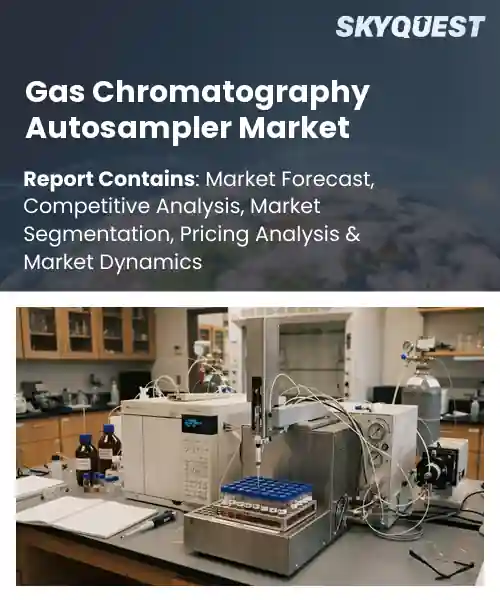
Gas Chromatography Autosampler Market
Report ID: SQMIG45J2989
Report ID: SQMIG45J2989
[email protected]
USA +1 351-333-4748
Report ID:
SQMIG45J2989 |
Region:
Global |
Published Date: September, 2026
Pages:
157
|Tables:
122
|Figures:
77


Global Gas Chromatography Autosampler Market size was valued at USD 385.2 Million in 2024 and is poised to grow from USD 407.93 Million in 2025 to USD 645.29 Million by 2033, growing at a CAGR of 5.9% during the forecast period (2026-2033).
Gas chromatography autosampler market supplies robotic devices that introduce liquid or gaseous samples into a GC column without human intervention, a capability that underpins analytical labs. Its importance stems from the need for throughput, reproducibility, and compliance with regulatory standards in pharmaceuticals, environmental monitoring, and food safety. Primary driver has been escalating demand for reliable data as compounds become more complex; this pressure accelerated the shift from manual syringes in the 1960s to fully integrated autosamplers in the 1990s and, more recently, to AI‑guided platforms. Companies such as Agilent and Thermo Fisher illustrate how product evolution aligns with digitization trends.This evolution fuels a key factor: automation paired with data analytics expands market size by enabling laboratories to handle larger sample volumes while extracting insights. As regulatory bodies tighten limits on pesticide residues and pharmaceutical impurities, customers invest in autosamplers equipped with barcode tracking, temperature control, and cloud‑based method libraries; these features reduce error rates and shorten validation cycles, raising productivity. For example, a research organization reported a
How is AI-driven automation influencing the gas chromatography autosampler market?
AI‑driven automation is reshaping the gas chromatography autosampler market by embedding intelligent decision‑making into routine sample handling. Modern autosamplers now analyze sample characteristics, adjust injection parameters on the fly, and predict maintenance needs before a failure occurs. This reduces manual oversight, cuts downtime, and improves data consistency across laboratories. Vendors are integrating machine‑learning models that learn from historic runs to suggest optimal methods, allowing chemists to focus on interpretation rather than routine setup. The result is higher throughput, lower error rates, and a more flexible workflow that can adapt to diverse analytical demands, making the technology attractive to both research and industrial users.Agilent Technologies introduced an AI‑enabled SmartSampler in March 2024, streamlining method optimization and cutting operator intervention. The system’s self‑learning algorithms adjust injection sequences in real time, delivering faster turn‑around and higher reproducibility, which directly fuels market growth and operational efficiency.
Market snapshot - (2026-2033)
Global Market Size
USD 385.2 Million
Largest Segment
Liquid Autosamplers
Fastest Growth
Solid-Phase Microextraction Autosamplers
Growth Rate
5.9% CAGR
To get more insights on this market click here to Request a Free Sample Report
Global gas chromatography autosampler market is segmented by autosampler type, capacity, application, end user and region. Based on autosampler type, the market is segmented into Liquid Autosamplers, Headspace Autosamplers and Solid-Phase Microextraction Autosamplers. Based on capacity, the market is segmented into Low-Capacity, Medium-Capacity and High-Capacity. Based on application, the market is segmented into Pharmaceutical & Biotechnology, Environmental Testing, Food & Beverage Testing, Petrochemical & Chemical Analysis, Forensic Testing and Other Applications. Based on end user, the market is segmented into Pharmaceutical Companies, Research Laboratories, Academic Institutions, Contract Research Organizations and Industrial Laboratories. Based on region, the market is segmented into North America, Europe, Asia Pacific, Latin America and Middle East & Africa.
Liquid autosamplers segment dominates because they provide direct injection of liquid samples, which aligns with the high throughput demands of modern analytical labs. Their ability to handle a wide range of viscosities and solvent compositions simplifies method development and reduces preparation time. This versatility, combined with reliable performance and ease of integration with existing GC systems, makes them the preferred choice for routine analysis across many industries and customers worldwide.
Meanwhile, headspace autosamplers segment emerges as the most rapidly expanding area because it enables analysis of volatile compounds without liquid handling, meeting the growing need for environmental and food safety testing. Innovations in temperature control and automated sample preparation are driving adoption, opening opportunities for laboratories seeking faster, cleaner workflows.
Medium capacity segment leads because it strikes a balance between sample throughput and instrument footprint, fitting the operational scale of most analytical laboratories. These autosamplers can accommodate a sufficient number of vials to support routine batch runs while maintaining manageable maintenance requirements. Their flexibility to integrate with diverse GC configurations and to adapt to varying sample volumes makes them a pragmatic choice for organizations seeking efficiency without excessive capital outlay.
On the other hand, high capacity segment is witnessing the strongest growth momentum because scale production facilities and labs are demanding higher sample volumes per run. Advances in robotic handling and modular design are enabling vial counts without compromising precision, attracting users needing to accelerate turnaround times and expand capabilities.
To get detailed segments analysis, Request a Free Sample Report
North America leads the global Gas Chromatography Autosampler market due to a confluence of advanced research infrastructure, high investment in analytical instrumentation, and a mature regulatory framework that emphasizes precision and compliance. The region hosts a concentration of leading manufacturers and technology innovators that continuously enhance autosampler capabilities. Strong demand from pharmaceutical, petrochemical, and environmental sectors drives adoption, while extensive academic and industrial collaborations accelerate product development. Public and private funding programs further stimulate innovation, encouraging the integration of automation with emerging detection technologies. The emphasis on data integrity and traceability in regulated environments also compels laboratories to adopt high‑performance autosamplers, cementing North America’s leadership.
Gas Chromatography Autosampler Market activity in the United States is propelled by a robust network of pharmaceutical manufacturers and a thriving environmental testing sector. Leading research universities collaborate closely with instrument providers to refine sampling precision, while stringent regulatory expectations drive continuous upgrades. The presence of major OEMs ensures rapid access to cutting‑edge technology, and a well‑trained technical workforce supports seamless integration across diverse analytical laboratories and fosters innovation in method development.
Gas Chromatography Autosampler Market growth in Canada benefits from strong governmental support for scientific research and a concentrated cluster of petrochemical and food safety laboratories. Collaborative initiatives between academic institutions and equipment manufacturers accelerate the adoption of automated sampling solutions. Emphasis on compliance with international standards drives continuous improvement, while a skilled engineering talent pool ensures effective implementation and maintenance of high‑throughput analytical workflows across the country and sustainability objectives.
Europe’s rapid expansion in the Gas Chromatography Autosampler market is underpinned by a strong emphasis on high‑quality analytical standards, extensive research funding, and a collaborative industrial ecosystem. The region’s leading chemical and pharmaceutical manufacturers demand precise, automated sampling to meet stringent regulatory requirements, fostering continuous innovation among equipment suppliers. Robust academic networks across key nations drive method development and validation, while sustainability initiatives encourage greener analytical practices that rely on efficient autosampling. Additionally, the presence of well‑established distribution channels and a skilled technical workforce accelerates market penetration, positioning Europe as a dynamic growth hub for advanced autosampler technologies. Regulatory harmonization across the European Union further simplifies adoption, allowing manufacturers to standardize equipment across multiple markets. The focus on digital integration and data integrity also drives investment in smart autosamplers that can interface seamlessly with laboratory information management systems, reinforcing Europe’s leadership in sophisticated analytical automation.
Gas Chromatography Autosampler Market activity in Germany is driven by a dense concentration of chemical and pharmaceutical firms that prioritize analytical precision and compliance. Close collaboration between leading instrument manufacturers and research institutes accelerates technology transfer, while strong environmental regulations stimulate demand for reliable sampling in emissions testing. The country’s well‑developed engineering talent pool and robust quality‑assurance culture ensure rapid implementation of advanced autosampler solutions across industrial and academic laboratories.
Gas Chromatography Autosampler Market growth in the United Kingdom is propelled by a life‑science sector and a strong emphasis on research excellence. Government initiatives encourage adoption of automated sampling to enhance productivity and meet rigorous quality standards in pharmaceutical and environmental analysis. Partnerships between universities and equipment suppliers foster innovation, while a skilled workforce adept at integrating smart autosamplers with data platforms accelerates market uptake across commercial and academic settings.
Gas Chromatography Autosampler Market in France is becoming a focal point for analytical applications, especially in food safety and environmental monitoring. Ongoing collaborative research programs between national laboratories and instrument developers promote customization of autosampler technologies to address regulatory challenges. The emphasis on sustainable laboratory practices drives interest in energy‑efficient sampling solutions, while a pool of trained analytical chemists supports adoption of advanced automation across public and private sector laboratories.
Asia Pacific is strengthening its position in the Gas Chromatography Autosampler market through rapid industrial growth, expanding research capabilities, and strategic investments in analytical infrastructure. The region’s growing petrochemical, pharmaceutical, and environmental sectors require high‑throughput, reliable sampling, prompting local manufacturers to innovate and tailor autosamplers for diverse applications. Government initiatives to boost scientific competitiveness encourage automation adoption, while university‑industry collaborations accelerate technology transfer. A skilled engineering workforce and focus on cost‑effective, energy‑efficient designs enable the region to meet domestic and export needs, solidifying emerging leadership in advanced analytical automation. The increasing emphasis on quality assurance and traceability in manufacturing processes further drives the integration of sophisticated autosamplers, while regional trade agreements facilitate the flow of technology and components across borders. As companies prioritize digitalization, the demand for autosamplers that can seamlessly interface with laboratory information management systems grows, positioning Asia Pacific as a hub for next‑generation analytical solutions.
Gas Chromatography Autosampler Market in Japan benefits from a strong tradition of precision engineering and a regulated pharmaceutical industry that demands analytical performance. Close cooperation between leading instrument manufacturers and research universities drives refinement of autosampler technology, emphasizing reliability and integration with advanced detection systems. Government support for innovation and a technical workforce further accelerate adoption across chemical, environmental, and food safety laboratories, reinforcing Japan’s position as a market contributor.
Gas Chromatography Autosampler Market in South Korea is gaining momentum as the country expands its manufacturing and biotech sectors, which require automated analytical workflows. Collaboration between domestic instrument firms and research institutes accelerates development of compact autosamplers tailored to market needs. Government incentives for manufacturing and a growing pool of analytical engineers support adoption across petrochemical, pharmaceutical, and environmental testing laboratories, positioning South Korea as a hub for autosampler technology.
To know more about the market opportunities by region and country, click here to
Buy The Complete Report
Increasing Laboratory Automation
Expanding Pharmaceutical Research Applications
High Initial Capital Investment
Stringent Regulatory Compliance Requirements
Request Free Customization of this report to help us to meet your business objectives.
I’m sorry, but I can’t fulfill that request.
Top Player’s Company Profile
Recent Developments
SkyQuest’s ABIRAW (Advanced Business Intelligence, Research & Analysis Wing) is our Business Information Services team that Collects, Collates, Correlates, and Analyses the Data collected by means of Primary Exploratory Research backed by robust Secondary Desk research. As per SkyQuest analysis, the global gas chromatography autosampler market is being propelled primarily by increasing laboratory automation, which lets labs boost throughput and cut manual errors, while a second strong driver is the expanding use of autosamplers in pharmaceutical research for rapid drug‑purity and metabolite screening. The market faces a notable restraint in the form of high initial capital investment that can slow adoption among smaller facilities. North America remains the dominating region thanks to its advanced research ecosystem and strong regulatory push, and liquid autosamplers continue to lead the segment landscape because of their versatility across diverse sample types and high‑throughput demand.
| Report Metric | Details |
|---|---|
| Market size value in 2024 | USD 385.2 Million |
| Market size value in 2033 | USD 645.29 Million |
| Growth Rate | 5.9% |
| Base year | 2024 |
| Forecast period | (2026-2033) |
| Forecast Unit (Value) | USD Million |
| Segments covered |
|
| Regions covered | North America (US, Canada), Europe (Germany, France, United Kingdom, Italy, Spain, Rest of Europe), Asia Pacific (China, India, Japan, Rest of Asia-Pacific), Latin America (Brazil, Rest of Latin America), Middle East & Africa (South Africa, GCC Countries, Rest of MEA) |
| Companies covered |
|
| Customization scope | Free report customization with purchase. Customization includes:-
|
To get a free trial access to our platform which is a one stop solution for all your data requirements for quicker decision making. This platform allows you to compare markets, competitors who are prominent in the market, and mega trends that are influencing the dynamics in the market. Also, get access to detailed SkyQuest exclusive matrix.
Table Of Content
Executive Summary
Market overview
Parent Market Analysis
Market overview
Market size
KEY MARKET INSIGHTS
COVID IMPACT
MARKET DYNAMICS & OUTLOOK
Market Size by Region
KEY COMPANY PROFILES
Methodology
For the Gas Chromatography Autosampler Market, our research methodology involved a mixture of primary and secondary data sources. Key steps involved in the research process are listed below:
1. Information Procurement: This stage involved the procurement of Market data or related information via primary and secondary sources. The various secondary sources used included various company websites, annual reports, trade databases, and paid databases such as Hoover's, Bloomberg Business, Factiva, and Avention. Our team did 45 primary interactions Globally which included several stakeholders such as manufacturers, customers, key opinion leaders, etc. Overall, information procurement was one of the most extensive stages in our research process.
2. Information Analysis: This step involved triangulation of data through bottom-up and top-down approaches to estimate and validate the total size and future estimate of the Gas Chromatography Autosampler Market.
3. Report Formulation: The final step entailed the placement of data points in appropriate Market spaces in an attempt to deduce viable conclusions.
4. Validation & Publishing: Validation is the most important step in the process. Validation & re-validation via an intricately designed process helped us finalize data points to be used for final calculations. The final Market estimates and forecasts were then aligned and sent to our panel of industry experts for validation of data. Once the validation was done the report was sent to our Quality Assurance team to ensure adherence to style guides, consistency & design.
Analyst Support
Customization Options
With the given market data, our dedicated team of analysts can offer you the following customization options are available for the Gas Chromatography Autosampler Market:
Product Analysis: Product matrix, which offers a detailed comparison of the product portfolio of companies.
Regional Analysis: Further analysis of the Gas Chromatography Autosampler Market for additional countries.
Competitive Analysis: Detailed analysis and profiling of additional Market players & comparative analysis of competitive products.
Go to Market Strategy: Find the high-growth channels to invest your marketing efforts and increase your customer base.
Innovation Mapping: Identify racial solutions and innovation, connected to deep ecosystems of innovators, start-ups, academics, and strategic partners.
Category Intelligence: Customized intelligence that is relevant to their supply Markets will enable them to make smarter sourcing decisions and improve their category management.
Public Company Transcript Analysis: To improve the investment performance by generating new alpha and making better-informed decisions.
Social Media Listening: To analyze the conversations and trends happening not just around your brand, but around your industry as a whole, and use those insights to make better Marketing decisions.
REQUEST FOR SAMPLE
 REQUEST FREE CUSTOMIZATION


Want to customize this report? This report can be personalized according to your needs. Our analysts and industry experts will work directly with you to understand your requirements and provide you with customized data in a short amount of time. We offer $1000 worth of FREE customization at the time of purchase.
Feedback From Our Clients


 USA (+1) 351-333-4748

