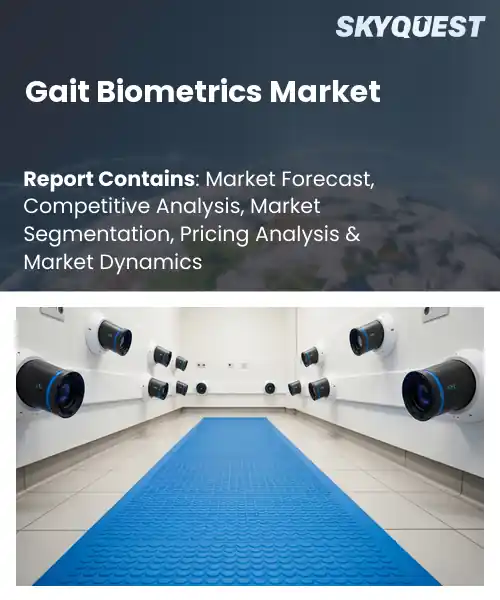
Gait Biometrics Market
Report ID: SQMIG45E2738
Report ID: SQMIG45E2738
[email protected]
USA +1 351-333-4748
Report ID:
SQMIG45E2738 |
Region:
Global |
Published Date: April, 2026
Pages:
157
|Tables:
118
|Figures:
77


Global Gait Biometrics Market size was valued at USD 984.2 Million in 2024 and is poised to grow from USD 1167.26 Million in 2025 to USD 1000.7 Million by 2033, growing at a CAGR of 18.6% during the forecast period (2026-2033).
The primary driver of the gait biometrics market is the convergence of non-contact identification demand and improvements in computer vision and machine learning, which together enable reliable recognition from walking patterns at distance. Gait biometrics refers to technologies that analyze an individual’s locomotion signature captured by cameras or inertial sensors for identification, authentication, or behavioral monitoring, and it matters because it offers unobtrusive surveillance and continuous authentication where fingerprints or face scans are impractical. The market evolved from early gait energy image techniques to deep learning models applied in airports and cities where law enforcement and retailers deploy gait systems.Building on these technical advancements, data availability emerges as a pivotal factor that drives commercial adoption because larger, labeled gait datasets enable more accurate and generalizable models, which in turn lower false positives in crowded environments and increase stakeholder trust. As datasets grow through smart-city cameras and wearable sensors, vendors can fine-tune algorithms for cross-age and cross-clothing variability, causing deployments in border control and contactless access to scale. This creates opportunities for subscription analytics, fusion with facial recognition for multi-modal systems, and healthcare applications where longitudinal gait monitoring translates into early fall risk detection and remote rehabilitation assessment driving revenue.
How is AI improving accuracy and reliability in the gait biometrics market?
AI improves accuracy and reliability in gait biometrics by enabling richer feature extraction and more robust pattern matching. Models learn temporal dynamics of walking and combine skeleton based signatures with silhouette and sensor signals to reduce noise. Advances in deep learning and self supervised training make systems more tolerant of clothing variation occlusion and different camera angles. Engineers also fuse modalities and use data augmentation to avoid bias and improve consistency. These improvements matter as the market moves from research pilots to deployments in security healthcare and access control where continuous contactless authentication and operational resilience are required.NEC September 2024, introduced a gateless biometric authentication system that uses face and movement matching to authenticate people while they are in motion, showing how AI driven gait matching can raise throughput and reliability for large scale security and border control deployments.
Market snapshot - (2026-2033)
Global Market Size
USD 984.2 Million
Largest Segment
Computer Vision-based Gait Recognition
Fastest Growth
Wearable Sensor-based Analysis (IMUs/Accelerometers)
Growth Rate
18.6% CAGR
To get more insights on this market click here to Request a Free Sample Report
Global gait biometrics market is segmented by technology type, application vertical, component layer, end-user and region. Based on technology type, the market is segmented into Computer Vision-based Gait Recognition, Wearable Sensor-based Analysis (IMUs/Accelerometers) and Floor Sensor/Pressure Mat Systems. Based on application vertical, the market is segmented into Security & Surveillance (Criminal Identification), Healthcare (Parkinson's/Elderly Fall Prevention), Sports Science & Athletic Performance and Access Control & Smart Environments. Based on component layer, the market is segmented into High-speed Cameras & Imaging Sensors, AI-based Gait Pattern Algorithms and Data Storage & Management Software. Based on end-user, the market is segmented into Law Enforcement & Intelligence Agencies, Hospitals & Rehabilitation Centers and Retail & Commercial Buildings. Based on region, the market is segmented into North America, Europe, Asia Pacific, Latin America and Middle East & Africa.
Computer Vision-based Gait Recognition segment dominates because its noncontact approach leverages widespread camera infrastructure and advances in deep learning to enable scalable, remote identification and long range surveillance. The ability to extract robust gait signatures from routine video, coupled with improvements in model generalization and edge inference, drives adoption across forensic workflows and surveillance deployments, creating stronger data sets and continuous algorithm refinement that reinforce operational value.
However, Wearable Sensor based Analysis IMUs and Accelerometers is the most rapidly expanding area as demand for continuous, personalized monitoring grows across clinical and consumer use cases. Improved sensor miniaturization, battery life, and mobile integration accelerate field deployments, enabling longitudinal gait analytics and individualized tracking that unlock new care pathways and commercial services while expanding market opportunities.
Healthcare (Parkinson's/Elderly Fall Prevention) segment leads because rising clinical need for objective gait biomarkers has driven rigorous validation, clinical workflow integration, and payer attention that prioritize patient monitoring and rehabilitation outcomes. Collaborations between device makers and medical providers, plus regulatory alignment, focus development on interpretable metrics and repeatable protocols, prompting vendors to tailor sensors, analytics, and service models to meet clinician requirements and long term care strategies.
Meanwhile, Security & Surveillance (Criminal Identification) is experiencing the strongest growth momentum as agencies adopt gait biometrics for noncontact identification in crowded or low visibility environments. Advances in low light imaging, cross modality matching, and investigative system integration expand operational use cases, attracting investment from public safety and private security providers and accelerating commercialization of surveillance grade solutions and analytic services.
To get detailed segments analysis, Request a Free Sample Report
North America dominates the global gait biometrics market due to a convergence of technological leadership, well established institutional demand, and a collaborative innovation ecosystem. Strong presence of leading technology vendors and research institutions accelerates commercialization of gait recognition solutions, while integrated security frameworks in public and private sectors drive adoption across transportation, healthcare, and law enforcement. Robust funding channels and skilled talent facilitate rapid prototype iteration and deployment. Interoperability standards, mature cloud and sensor infrastructure, and proactive industry partnerships further reinforce market leadership by reducing implementation friction and enabling scalable, enterprise grade solutions. A supportive regulatory environment that balances privacy considerations with security imperatives, along with established procurement pathways, lowers barriers for adoption. Continuous academic and industry collaboration yields validated datasets and best practices, enhancing system reliability and trust among end users. Combined demand and strong ecosystem coordination sustain market momentum and make the region a central hub for innovation.
Gait Biometrics Market in the United States benefits from a deep technology supply chain and active collaboration between federal agencies, commercial security operators, and research institutions. Deployment focus centers on high security venues, transportation systems, and healthcare environments where integration with advanced analytics is prioritized. Strong venture funding nurtures innovative vendors, while mature procurement and testing frameworks enable pilots to scale into operational implementations across public and private use cases.
Gait Biometrics Market in Canada is characterized by targeted public sector initiatives and collaborative research programs that emphasize privacy aware deployment and standards alignment. Provincial and national agencies work with private vendors to pilot applications in transportation, healthcare, and campus security, favoring solutions that integrate with existing identity ecosystems. A measured regulatory approach and strong research-practice partnerships support incremental scaling, fostering vendor specialization and cautious adoption in mission critical environments.
Europe rapid expansion in gait biometrics is driven by synergies between regulatory harmonization, advanced surveillance infrastructure, and an expanding industrial ecosystem that prioritizes privacy aware solutions. Investments in smart city programs and transport modernization create demand for non intrusive identification capabilities, while cross border law enforcement collaboration increases interest in interoperable recognition methods. Strong research consortia and public procurement initiatives accelerate technology validation and adoption across multiple sectors. Emphasis on ethical frameworks and data protection has prompted vendors to develop privacy preserving algorithms, facilitating acceptance among stakeholders. Fragmented national markets are increasingly connected through standards work and pilot networks, enabling successful pilots to transition into broader deployments that emphasize reliability, explainability, and operational fit within existing security architectures. Industry collaborations with system integrators and sensor manufacturers streamline deployment, while growing vendor specialization improves solution maturity and total cost of ownership perceptions.
Gait Biometrics Market Germany benefits from a robust engineering and research ecosystem that supports enterprise grade solutions and testing. Deep experience in systems integration and sensor manufacturing enables comprehensive deployments across transportation hubs, industrial facilities, and public safety applications. Privacy compliant design and adherence to European standards foster trust among procurers, while close ties between universities and vendors accelerate algorithm validation and productization, reinforcing its leading role in regional adoption.
Gait Biometrics Market United Kingdom demonstrates adoption driven by a vibrant startup ecosystem, strong private sector demand, and proactive pilot programs across transport and commercial venues. Integration with existing CCTV networks and analytics platforms is a common deployment route, supported by system integrators and technology partners. Emphasis on usability, explainability, and operational readiness helps solutions gain traction with end users, while collaborative trials foster maturation and wider commercial rollout opportunities.
Gait Biometrics Market France is emerging through targeted research programs and cautious public sector experimentation that emphasize privacy and ethical deployment. Local vendors and academic teams focus on explainable algorithms and sensor fusion methods suited to urban environments and transport nodes. Pilot initiatives often prioritize interoperability with national identity frameworks and strong data governance, enabling measured adoption pathways that balance innovation with regulatory compliance and public acceptance and commercial validation.
Asia Pacific is strengthening its position in gait biometrics through concentrated investments in sensor technology, strong electronics manufacturing capabilities, and focused research in machine learning applied to human movement. Leading markets emphasize integration with consumer devices, transportation systems, and smart city initiatives, leveraging local expertise in imaging and embedded systems. Collaborative projects between universities, industry consortia, and system integrators drive algorithm adaptation to regional demographics and environmental conditions. A pragmatic regulatory approach in some markets allows extensive pilot testing, while export oriented vendors tailor solutions for international deployment, reinforcing the region role as both an innovation center and a manufacturing base for scalable gait biometrics solutions. Strong collaborations with telecommunications operators and infrastructure providers enable real time transmission and edge processing, while national testing facilities and certification bodies are emerging to validate system performance and ensure compliance with local data governance norms.
Gait Biometrics Market Japan leverages advanced imaging and sensor manufacturing strengths to produce high fidelity solutions tailored to complex indoor and outdoor environments. Collaboration among electronics firms and robotics specialists fosters robust algorithm development and validation. Applications often target transportation hubs, healthcare monitoring, and enterprise security, with emphasis on unobtrusive sensing and integration into broader automation frameworks. Strong attention to quality and reliability support commercial interest and cross sector deployments.
Gait Biometrics Market South Korea is advancing through strong private sector innovation driven by leading consumer electronics and semiconductor manufacturers. Integration with telecommunications infrastructure and edge processing enables latency analytics for transportation and retail applications. Public and private sector pilots focus on seamless integration with existing surveillance networks and infrastructure. Close collaboration between vendors, carriers, and research institutes accelerates commercialization and positions solutions for both use and international export markets.
To know more about the market opportunities by region and country, click here to
Buy The Complete Report
Advancements In Sensor Technologies
Integration With AI Analytics
Privacy and Data Protection Concerns
High Integration And Deployment Costs
Request Free Customization of this report to help us to meet your business objectives.
Competition in the global gait biometrics market is driven by technology differentiation, government procurement, and consolidation driven by contracts. Vendors pursue M&A and platform integration, for example Thales acquisition of Gemalto, while specialist firms push algorithmic and forensic innovation exemplified by Cursor Insight's court evidence milestone. Partnerships with defence and research bodies such as Ingenious Research working with DRDO and targeted product launches intensify procurement competition.
Top Player’s Company Profile
Recent Developments
SkyQuest’s ABIRAW (Advanced Business Intelligence, Research & Analysis Wing) is our Business Information Services team that Collects, Collates, Correlates, and Analyses the Data collected by means of Primary Exploratory Research backed by robust Secondary Desk research. As per SkyQuest analysis, the global gait biometrics market is driven primarily by advances in computer vision and machine learning that enable reliable, noncontact identification from walking patterns, while growth is tempered by privacy and data protection concerns that complicate deployment and data sharing. North America leads the market thanks to its technology ecosystem and institutional demand, and computer vision based gait recognition is the dominant segment because it leverages existing camera infrastructure and scalable AI models. A second important driver is expanding labeled gait datasets and AI analytics, which improve accuracy, enable multimodal fusion, and unlock healthcare and security use cases across public and private sectors.
| Report Metric | Details |
|---|---|
| Market size value in 2024 | USD 984.2 Million |
| Market size value in 2033 | USD 1000.7 Million |
| Growth Rate | 18.6% |
| Base year | 2024 |
| Forecast period | (2026-2033) |
| Forecast Unit (Value) | USD Million |
| Segments covered |
|
| Regions covered | North America (US, Canada), Europe (Germany, France, United Kingdom, Italy, Spain, Rest of Europe), Asia Pacific (China, India, Japan, Rest of Asia-Pacific), Latin America (Brazil, Rest of Latin America), Middle East & Africa (South Africa, GCC Countries, Rest of MEA) |
| Companies covered |
|
| Customization scope | Free report customization with purchase. Customization includes:-
|
To get a free trial access to our platform which is a one stop solution for all your data requirements for quicker decision making. This platform allows you to compare markets, competitors who are prominent in the market, and mega trends that are influencing the dynamics in the market. Also, get access to detailed SkyQuest exclusive matrix.
Table Of Content
Executive Summary
Market overview
Parent Market Analysis
Market overview
Market size
KEY MARKET INSIGHTS
COVID IMPACT
MARKET DYNAMICS & OUTLOOK
Market Size by Region
KEY COMPANY PROFILES
Methodology
For the Gait Biometrics Market, our research methodology involved a mixture of primary and secondary data sources. Key steps involved in the research process are listed below:
1. Information Procurement: This stage involved the procurement of Market data or related information via primary and secondary sources. The various secondary sources used included various company websites, annual reports, trade databases, and paid databases such as Hoover's, Bloomberg Business, Factiva, and Avention. Our team did 45 primary interactions Globally which included several stakeholders such as manufacturers, customers, key opinion leaders, etc. Overall, information procurement was one of the most extensive stages in our research process.
2. Information Analysis: This step involved triangulation of data through bottom-up and top-down approaches to estimate and validate the total size and future estimate of the Gait Biometrics Market.
3. Report Formulation: The final step entailed the placement of data points in appropriate Market spaces in an attempt to deduce viable conclusions.
4. Validation & Publishing: Validation is the most important step in the process. Validation & re-validation via an intricately designed process helped us finalize data points to be used for final calculations. The final Market estimates and forecasts were then aligned and sent to our panel of industry experts for validation of data. Once the validation was done the report was sent to our Quality Assurance team to ensure adherence to style guides, consistency & design.
Analyst Support
Customization Options
With the given market data, our dedicated team of analysts can offer you the following customization options are available for the Gait Biometrics Market:
Product Analysis: Product matrix, which offers a detailed comparison of the product portfolio of companies.
Regional Analysis: Further analysis of the Gait Biometrics Market for additional countries.
Competitive Analysis: Detailed analysis and profiling of additional Market players & comparative analysis of competitive products.
Go to Market Strategy: Find the high-growth channels to invest your marketing efforts and increase your customer base.
Innovation Mapping: Identify racial solutions and innovation, connected to deep ecosystems of innovators, start-ups, academics, and strategic partners.
Category Intelligence: Customized intelligence that is relevant to their supply Markets will enable them to make smarter sourcing decisions and improve their category management.
Public Company Transcript Analysis: To improve the investment performance by generating new alpha and making better-informed decisions.
Social Media Listening: To analyze the conversations and trends happening not just around your brand, but around your industry as a whole, and use those insights to make better Marketing decisions.
REQUEST FOR SAMPLE
 REQUEST FREE CUSTOMIZATION


Want to customize this report? This report can be personalized according to your needs. Our analysts and industry experts will work directly with you to understand your requirements and provide you with customized data in a short amount of time. We offer $1000 worth of FREE customization at the time of purchase.
Feedback From Our Clients


 USA (+1) 351-333-4748

