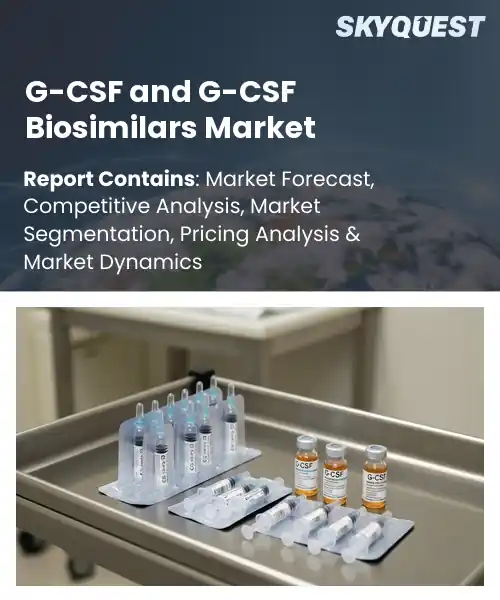
G-CSF and G-CSF Biosimilars Market
Report ID: SQMIG35H2429
Report ID: SQMIG35H2429
[email protected]
USA +1 351-333-4748
Report ID:
SQMIG35H2429 |
Region:
Global |
Published Date: February, 2026
Pages:
157
|Tables:
92
|Figures:
76


Global G-CSF And G-CSF Biosimilars Market size was valued at USD 5.6 Billion in 2024 and is poised to grow from USD 6.03 Billion in 2025 to USD 10.83 Billion by 2033, growing at a CAGR of 7.6% during the forecast period (2026-2033).
Growing incidence of cancer, rising demand for supportive oncology therapies, increasing adoption of biosimilars, and expanding access to cost-effective biologic treatments are driving demand for G-CSF and G-CSF biosimilars.
Patent expiration of various established drugs has led to various regulatory measures in the US and Europe that provided a pathway for validating the comparability and safety of biosimilars, allowing Zarxio and Udenyca to compete in the market, which has shifted its focus towards a price-competitive market that is affordable and clinically relevant. The cost savings that biosimilars offer is also increasing access, allowing clinicians/hospitals to treat more patients with recommended doses of these agents, reducing the risk of infection and hospital stays. Increasing expiration of patents for originator biologics and the urgent need to broaden access to supportive oncology care are expected to primarily drive G-CSF and G-CSF biosimilars market growth in the long run. G-CSF products like filgrastim and pegfilgrastim, which were previously sold under brand names Neupogen and Neulasta, have already established their clinical value and have strong demand worldwide for treating chemotherapy-induced neutropenia.
On the contrary, stringent regulatory approval requirements, complex biologics manufacturing processes, concerns regarding interchangeability and physician acceptance, and intense price competition among biosimilar manufacturers are predicted to impede G-CSF and G-CSF biosimilars market penetration in the future.
What is the Impact of AI Integration in the G-CSF and G-CSF Biosimilars Industry?
AI is reshaping adoption and pricing in the G-CSF and G-CSF biosimilars market by strengthening the connection between clinical confidence and commercial strategy. AI-driven tools help companies model reimbursement scenarios, forecast demand accurately, and optimize production planning, which reduces uncertainty around product launches. The application of AI technology would help in faster generation of real-world evidence, forecasting of demands, and manufacturing/supply chain management.
In November 2025, Sandoz announced that it had entered into an agreement to acquire the capabilities of Just-Evotec Biologics, including its data-driven continuous manufacturing technology. This technology helps in optimizing the manufacturing of biologics through advanced analytics, resulting in cost savings, faster market launches, and competitive product positioning, thereby increasing market efficiency.
Market snapshot - 2026-2033
Global Market Size
USD 5.6 Billion
Largest Segment
G-CSF
Fastest Growth
Biosimilars
Growth Rate
7.6% CAGR
To get more insights on this market click here to Request a Free Sample Report
Global G-CSF and G-CSF biosimilars market is segmented by drug type, therapeutic application, distribution channel, and region. Based on drug type, the market is segmented into G-CSF, Biosimilars, hormones, and others. Based on therapeutic application, the market is segmented into oncology, blood disorders, chronic diseases, endocrine disorders, and others. Based on distribution channel, the market is segmented into online pharmacies and offline. Based on region, the market is segmented into North America, Europe, Asia Pacific, Latin America, and Middle East & Africa.
The G-CSF segment is forecasted to spearhead the global G-CSF and G-CSF biosimilars market revenue generation over the coming years. Established products of originator biologics have a proven clinical history, a safety profile that is well accepted, and an existing relationship with cancer treatment centers and hematology experts. This clinical familiarity of products is what creates inertia for prescribing, inclusion in treatment protocols, and placement on the hospital formulary. Established manufacturer's supply chain and patient support also helps to reinforce their position as market leaders.
However, biosimilars are emerging as the fastest-growing segment as per this G-CSF and G-CSF biosimilars market forecast. With lower acquisition costs, easier regulatory pathways, and growing support from payers, new business opportunity is expected to emerge from this space. The competitive environment increases accessibility to a range of diverse healthcare settings. Manufacturers are encouraged to strengthen their patient support programs to drive adoption and create new commercial opportunity.
The offline segment is predicted to account for the highest global G-CSF and G-CSF biosimilars market share in the future. Conventional channels like hospital pharmacies and clinic dispensaries are responsible for cold chain logistics, clinician-administered dosing, and relationships with specialist prescribers. The trust in face-to-face counselling, on-site dispensing in treatment settings, and relationships with inpatient care pathways ensure consistent demand and drive entrenched purchasing behaviors in healthcare institutions and clinicians, thereby supporting leadership position in the market.
However, the growth of online pharmacies is also increasing rapidly due to the increasing rate of digital prescriptions, home delivery services, and patient demand for convenience. The inclusion of telemedicine services and patient support services extends beyond traditional care settings to ensure timely treatment initiation and adherence. This creates new acquisition options and business models.
To get detailed segments analysis, Request a Free Sample Report
Advanced clinical infrastructure, robust research and development capabilities, and a favorable regulatory environment help this region consolidate the highest demand for G-CSF and G-CSF biosimilars. A high number of contract manufacturers who are highly experienced at providing services to the pharmaceutical industry and have extensive relationships established between clinical research institutions and providers facilitate initial adoption. The high level of familiarity that clinicians have with growth factor products, the purchasing systems in place within hospitals for the acquisition of such product types and participation in clinical research also facilitates continued dominance, thereby creating an ongoing cycle of investment, innovation, and use. Policymaking that promotes a competitive environment for biosimilar product development and implementation and that develops practical, research and evidence-based guidelines has resulted in providing an environment for hospitals and payers/insurance to collaborate on creating and maintaining a treatment algorithm.
G-CSF and G-CSF biosimilars demand in the United States is backed by a dense network of academic hospitals, extensive clinical research activity, and strong commercial infrastructure. The regulatory environment, combined with manufacturers’ capabilities, ensures that G-CSF & G-CSF biosimilars products are accessible in various settings, whereas various strategies adopted by payers, along with clinicians’ familiarity and established treatment protocols, contribute significantly to the overall market for G-CSF & G-CSF biosimilar formulations.
A publicly funded healthcare environment where provincial procurement and formulary decisions are pivotal is shaping G-CSF and G-CSF biosimilars demand in Canada. Collaboration with academic centers and health authorities facilitates evidence generation, and clinician and patient engagement initiatives address confidence and switching considerations among end users. A framework for centralized procurement, with a focus on cost-effective care, involves the evaluation of biosimilar options.
High emphasis on regulatory harmonization, proactive national procurement strategies, and strong local manufacturing capabilities make Europe a steady region for G-CSF and G-CSF biosimilars vendors. Rising awareness among healthcare professionals and patients through focused education, along with the growing partnership between industry and academic centers, facilitates the adoption of biosimilars into mainstream oncology and hematology practice. Cross-border learning and purchasing strategies further facilitate the efficient use of biosimilar products, while the differences in national approaches enable the adoption of biosimilars to local healthcare system and hospital procurement practices, thus sustaining the momentum in Europe. The policy discussions in Europe that focus on access and competition fuel investments in manufacturing scale-up and real-world evidence development, thus sustaining long-term confidence.
Robust industrial base, extensive hospital networks, and established tendering mechanisms are predicted to boost sales of G-CSF and G-CSF biosimilars in Germany. Robust manufacturing capabilities and involvement of regional biotech clusters are in place for supporting production in Germany, along with strategic procurement systems for supporting usage in hospitals. High levels of engagement among clinicians and integration of care pathways are also creating new business scope in the country.
High emphasis on centralized healthcare decision making and strong procurement patterns are anticipated to boost the demand for G-CSF and G-CSF biosimilars in the United Kingdom. Collaborations between health services and industry aids the generation of evidence for cost-effective use. An ethos of outcomes-driven procurement, together with education, aids the integration of biosimilars into treatment pathways.
G-CSF and G-CSF biosimilars demand in France is cautious but evolution driven by health authority guidance and hospital initiatives. Local reimbursement strategies and preference patterns of clinicians also drive the use of biosimilars. Partnerships between academic institutions and industry is helping to drive the generation of real-world data, and greater stakeholder discussion is helping to normalize the use of biosimilars in cancer treatment pathways.
Increase in domestic manufacturing capabilities, evolving regulatory frameworks, and strategic partnerships with multinational firms position Asia Pacific as the most rewarding region. Governments and industry are focused on building up capacity and quality standards in order to help meet global expectations, while the development of local clinical data will continue to build confidence with both clinicians and payers. The investment in biotechnology clusters and technology transfer initiatives will provide means to accelerate the ability to efficiently scale up operations and will create opportunities for cross-border collaborations to share knowledge and to develop export opportunities; thereby enabling the region to play an increasingly important role in the global supply chain and in clinical adoption patterns. The changing market dynamics will also drive the adoption of biosimilars to support cost-effective access to medicines for patients where price and access are critical issues by implementing specific pricing and procurement strategies.
Stringent regulatory standards and a focus on high quality manufacturing are influencing demand for G-CSF and G-CSF biosimilars across Japan. The presence of strong pharmaceutical industries at home, coupled with cooperative research efforts with academic institutions, supports responsible adoption of G-CSF and G-CSF biosimilars in the country through 2033. Reimbursement pathways emphasize evidence generation and real world outcomes to keep the country competitive.
Presence of a dynamic biosimilar industry with strong manufacturing and export orientation is driving sales of G-CSF and G-CSF biosimilars in the country. Regulatory authorities have introduced pragmatic measures to facilitate entry into the market. The pricing and procurement system is designed to be affordable to ensure wider availability both locally and abroad.
To know more about the market opportunities by region and country, click here to
Buy The Complete Report
Increasing Cancer and Chemotherapy Use
The increasing prevalence of cancer and the widespread practice of myelosuppressive chemotherapy have increased the clinical need for agents to prevent and treat chemotherapy-induced neutropenia. This directly impacts the G-CSF & biosimilars market. Clinical practice guidelines and physician practice emphasize the importance of prophylactic and therapeutic use to maintain intensity of chemotherapy and minimize infectious risks. This directly impacts the overall prescription rate. Increasing familiarity of doctors with biosimilar agents is slated to bolster the global G-CSF and G-CSF biosimilars market outlook.
Rising Adoption Of Biosimilars
With the increasing acceptance of biosimilar G-CSF products by clinicians, payers, and hospitals, the growth of the biosimilar G-CSF market is being supported by the increasing access to biosimilars, which is making the treatment more feasible due to the competitive pricing environment. The formulary, procurement, and contracting processes often favor cost-effective biosimilar G-CSF products, which are leading to a switch from the original products, thereby increasing the acceptance of biosimilars in the community and hospital environments. The increasing efforts of the manufacturers are reassuring, which are leading to the growth of biosimilars from the acceptance into the actual prescription growth.
Complex Regulatory Approval Processes
The heterogeneous and rigorous biosimilar regulatory requirements for demonstration of similarity, coupled with diverse national expectations for interchangeability, have introduced another layer of complexity that is discouraging some biosimilarity developers. The need for comparative studies, as well as monitoring activities post-approval, coupled with the changing regulatory environment, has increased the time to develop biosimilars for multiple markets. The complex biosimilar regulatory environment limits the rate at which new biosimilars are introduced to the market.
Pricing and Reimbursement Uncertainty
High pricing competition, as well as the diversity of reimbursement systems, can create challenges for the establishment of a stable revenue base for both innovators and biosimilar developers, which can, in turn, influence the cautiousness of investment decisions. The tendering system, which is often initiated by payers, can create a situation of intense discounting, which can favor large players, making the entry of new players less inclined to increase their commercial footprint. The aforementioned factors can create commercial challenges that can slow the pace of manufacturer commitment, thereby slowing the growth rate of the market.
Request Free Customization of this report to help us to meet your business objectives.
Competition in the G-CSF and G-CSF biosimilars market has intensified as multiple pegfilgrastim and filgrastim biosimilars reach markets, driving tactical responses such as co-development, manufacturing scale-up, and formulary access plays. Examples include Amneal’s FYLNETRA developed with Kashiv and Fresenius Kabi’s U.S. launch of Stimufend, prompting originators and entrants to pursue licensing, coding approvals, and distribution partnerships.
SkyQuest’s ABIRAW (Advanced Business Intelligence, Research & Analysis Wing) is our Business Information Services team that Collects, Collates, Correlates, and Analyses the Data collected by means of Primary Exploratory Research backed by robust Secondary Desk research.
As per SkyQuest analysis, rising incidence of cancer and increasing adoption of supportive oncology therapies are anticipated to drive the demand for G-CSF and G-CSF biosimilars going forward. However, complex biologics manufacturing processes, stringent regulatory requirements, and concerns regarding physician acceptance of biosimilars are slated to slow down the adoption of G-CSF and G-CSF biosimilars in the future. North America is slated to spearhead the demand for G-CSF and G-CSF biosimilars owing to high chemotherapy utilization, strong biosimilar adoption, and presence of a developed healthcare infrastructure. Expansion of biosimilar approvals, increasing payer support for cost-effective biologics, and advancements in biologics manufacturing technologies are anticipated to be key trends driving the G-CSF and G-CSF biosimilars sector over the coming years.
| Report Metric | Details |
|---|---|
| Market size value in 2024 | USD 5.6 Billion |
| Market size value in 2033 | USD 10.83 Billion |
| Growth Rate | 7.6% |
| Base year | 2024 |
| Forecast period | 2026-2033 |
| Forecast Unit (Value) | USD Billion |
| Segments covered |
|
| Regions covered | North America (US, Canada), Europe (Germany, France, United Kingdom, Italy, Spain, Rest of Europe), Asia Pacific (China, India, Japan, Rest of Asia-Pacific), Latin America (Brazil, Rest of Latin America), Middle East & Africa (South Africa, GCC Countries, Rest of MEA) |
| Companies covered |
|
| Customization scope | Free report customization with purchase. Customization includes:-
|
To get a free trial access to our platform which is a one stop solution for all your data requirements for quicker decision making. This platform allows you to compare markets, competitors who are prominent in the market, and mega trends that are influencing the dynamics in the market. Also, get access to detailed SkyQuest exclusive matrix.
Table Of Content
Executive Summary
Market overview
Parent Market Analysis
Market overview
Market size
KEY MARKET INSIGHTS
COVID IMPACT
MARKET DYNAMICS & OUTLOOK
Market Size by Region
KEY COMPANY PROFILES
Methodology
For the G-CSF and G-CSF Biosimilars Market, our research methodology involved a mixture of primary and secondary data sources. Key steps involved in the research process are listed below:
1. Information Procurement: This stage involved the procurement of Market data or related information via primary and secondary sources. The various secondary sources used included various company websites, annual reports, trade databases, and paid databases such as Hoover's, Bloomberg Business, Factiva, and Avention. Our team did 45 primary interactions Globally which included several stakeholders such as manufacturers, customers, key opinion leaders, etc. Overall, information procurement was one of the most extensive stages in our research process.
2. Information Analysis: This step involved triangulation of data through bottom-up and top-down approaches to estimate and validate the total size and future estimate of the G-CSF and G-CSF Biosimilars Market.
3. Report Formulation: The final step entailed the placement of data points in appropriate Market spaces in an attempt to deduce viable conclusions.
4. Validation & Publishing: Validation is the most important step in the process. Validation & re-validation via an intricately designed process helped us finalize data points to be used for final calculations. The final Market estimates and forecasts were then aligned and sent to our panel of industry experts for validation of data. Once the validation was done the report was sent to our Quality Assurance team to ensure adherence to style guides, consistency & design.
Analyst Support
Customization Options
With the given market data, our dedicated team of analysts can offer you the following customization options are available for the G-CSF and G-CSF Biosimilars Market:
Product Analysis: Product matrix, which offers a detailed comparison of the product portfolio of companies.
Regional Analysis: Further analysis of the G-CSF and G-CSF Biosimilars Market for additional countries.
Competitive Analysis: Detailed analysis and profiling of additional Market players & comparative analysis of competitive products.
Go to Market Strategy: Find the high-growth channels to invest your marketing efforts and increase your customer base.
Innovation Mapping: Identify racial solutions and innovation, connected to deep ecosystems of innovators, start-ups, academics, and strategic partners.
Category Intelligence: Customized intelligence that is relevant to their supply Markets will enable them to make smarter sourcing decisions and improve their category management.
Public Company Transcript Analysis: To improve the investment performance by generating new alpha and making better-informed decisions.
Social Media Listening: To analyze the conversations and trends happening not just around your brand, but around your industry as a whole, and use those insights to make better Marketing decisions.
REQUEST FOR SAMPLE
 REQUEST FREE CUSTOMIZATION
Global G-Csf And G-Csf Biosimilars Market size was valued at USD 5.6 Billion in 2024 and is poised to grow from USD 6.03 Billion in 2025 to USD 10.83 Billion by 2033, growing at a CAGR of 7.6% during the forecast period (2026-2033).
Competition in the G-CSF and biosimilars market has intensified as multiple pegfilgrastim and filgrastim biosimilars reach markets, driving tactical responses such as co-development, manufacturing scale-up, and formulary access plays. Examples include Amneal’s FYLNETRA developed with Kashiv and Fresenius Kabi’s U.S. launch of Stimufend, prompting originators and entrants to pursue licensing, coding approvals, and distribution partnerships. 'Amgen Inc.', 'Teva Pharmaceutical Industries Ltd.', 'Sandoz International GmbH', 'Mylan N.V.', 'Pfizer Inc.', 'BioGeneriX AG', 'Intas Pharmaceuticals Ltd.', 'Biocon Limited', 'Celltrion Healthcare Co., Ltd.', 'Fresenius Kabi AG', 'Zydus Cadila', 'Accord Healthcare Limited', 'Hikma Pharmaceuticals PLC', 'Dr. Reddy's Laboratories Ltd.', 'Novartis AG', 'Coherus BioSciences, Inc.', 'Emcure Pharmaceuticals Ltd.', 'Aurobindo Pharma Limited', 'Samsung Bioepis Co., Ltd.', 'GSK plc'
The rising incidence of cancer and widespread use of myelosuppressive chemotherapy have expanded clinical demand for agents that prevent and treat chemotherapy-induced neutropenia, thereby supporting growth in the G-CSF and biosimilars market. Clinical guidelines and physician practice patterns emphasize prophylactic and therapeutic administration to maintain treatment intensity and reduce infectious complications, which in turn increases routine prescribing. Greater clinician familiarity with biosimilar alternatives and institutional protocols that incorporate these agents further translate unmet clinical needs into sustained and broad market uptake.
Expansion Of Outpatient Therapies: Health systems and oncology centers are shifting supportive care, including G CSF administration, to outpatient home based settings to improve patient convenience and lower inpatient demand. This trend encourages manufacturers and providers to design delivery formats, patient support programs, and logistics tailored to ambulatory care. It also fosters partnerships between specialty pharmacies and healthcare providers to ensure adherence and monitoring. The movement toward decentralized care drives expectations for stability, ease of use, and integrated services across G CSF value chain.
Advanced clinical infrastructure, robust research and development capabilities, and a favorable regulatory environment help the North America region consolidate the highest demand for G-CSF and G-CSF biosimilars.


Want to customize this report? This report can be personalized according to your needs. Our analysts and industry experts will work directly with you to understand your requirements and provide you with customized data in a short amount of time. We offer $1000 worth of FREE customization at the time of purchase.
Feedback From Our Clients


 USA (+1) 351-333-4748

