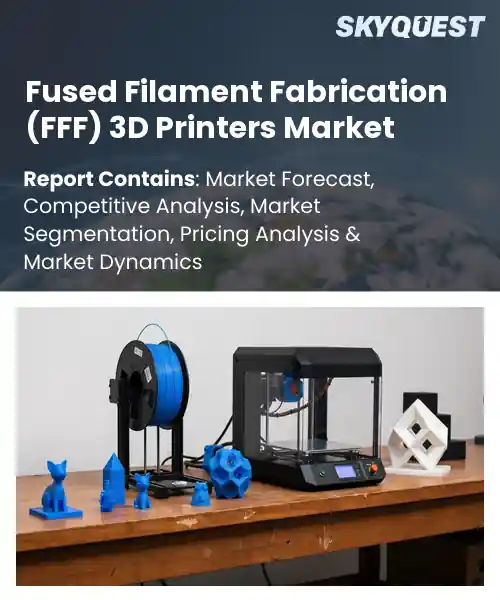
Fused Filament Fabrication (FFF) 3D Printers Market
Report ID: SQMIG45I2357
Report ID: SQMIG45I2357
[email protected]
USA +1 351-333-4748
Report ID:
SQMIG45I2357 |
Region:
Global |
Published Date: February, 2026
Pages:
157
|Tables:
208
|Figures:
80


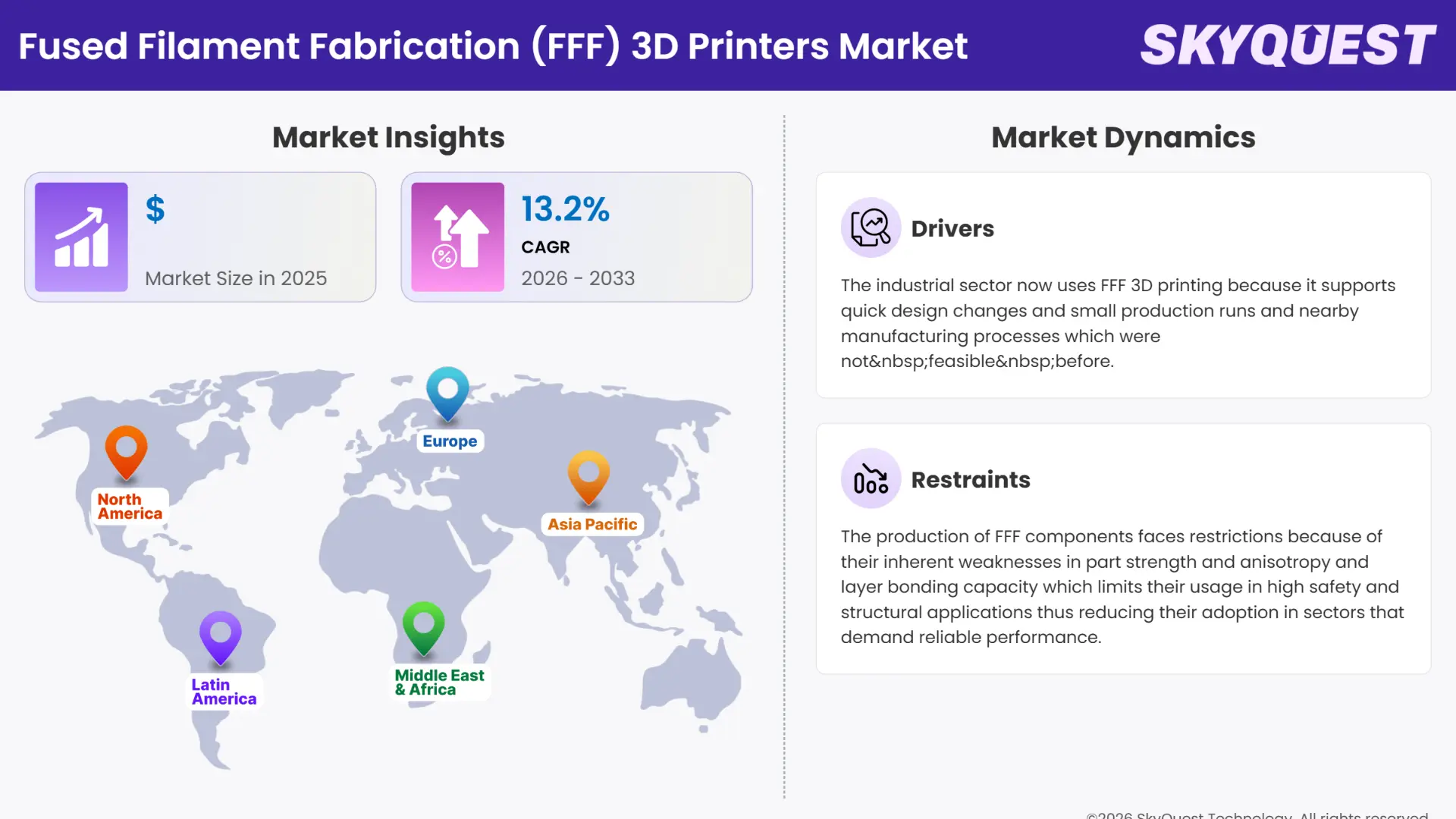
Global Fused Filament Fabrication (Fff) 3D Printers Market size was valued at USD 1.25 Billion in 2024 and is poised to grow from USD 1.42 Billion in 2025 to USD 3.65 Billion by 2033, growing at a CAGR of 13.2% during the forecast period (2026-2033).
Key Takeaways: Market Trends & Insights
The global fused filament fabrication (FFF) 3D printers market growth is driven from hobbyist experiments into a market driven by accessibility and cost efficiency which lowers barriers to entry for designers and educators. The market consists of desktop devices used for prototyping and industrial FFF systems that produce jigs and low-volume parts, and a comprehensive materials ecosystem that includes PLA and ABS and engineering filaments. The process lowers tooling costs while shortening design times which enables businesses to make product improvements at a faster pace and shorter lead times according to evidence from startups that utilize Prusa and Ultimaker printers during product development and automotive and aerospace companies that use industrial FFF for fixture and parts production.
The manufacturing sector relies on two fundamental elements to drive its growth prospect, which requires organizations to develop their infrastructure through stronger engineering filaments and better extruder technology. Manufacturers use industrial FFF printers to produce durable fixtures and end-use housings and short-run replacement parts because they have developed compatibility with carbon-fiber and high-temperature polymers. Rapid tool fabrication and emergency tool replacement during healthcare crises created a functional system which led to emergency response organizations choosing to purchase those products from suppliers who built their products according to established system criteria. The combination of software integrations and distributed manufacturing models generates new revenue streams through three service areas which include on-demand production and localized aftermarket support.
How is AI Enhancing Quality Control in the Fused Filament Fabrication 3D Printers Market?
AI develops real-time defect detection systems for fused filament fabrication by applying in-process monitoring through sensor technology and computer vision and closed loop control. Current systems process thermal or acoustic signals through onboard cameras and lightweight vision models to identify anomalies. The global fused filament fabrication (FFF) 3D printers market outlook has shifted from traditional inspection methods to automated prevention systems because hobbyists and small shops and production farms have adopted intelligent monitoring systems. Vendors and research teams train models and use fleet analytics to surface failure patterns and enable adaptive tuning that raises consistency and reduces material waste.
To get more insights on this market click here to Request a Free Sample Report
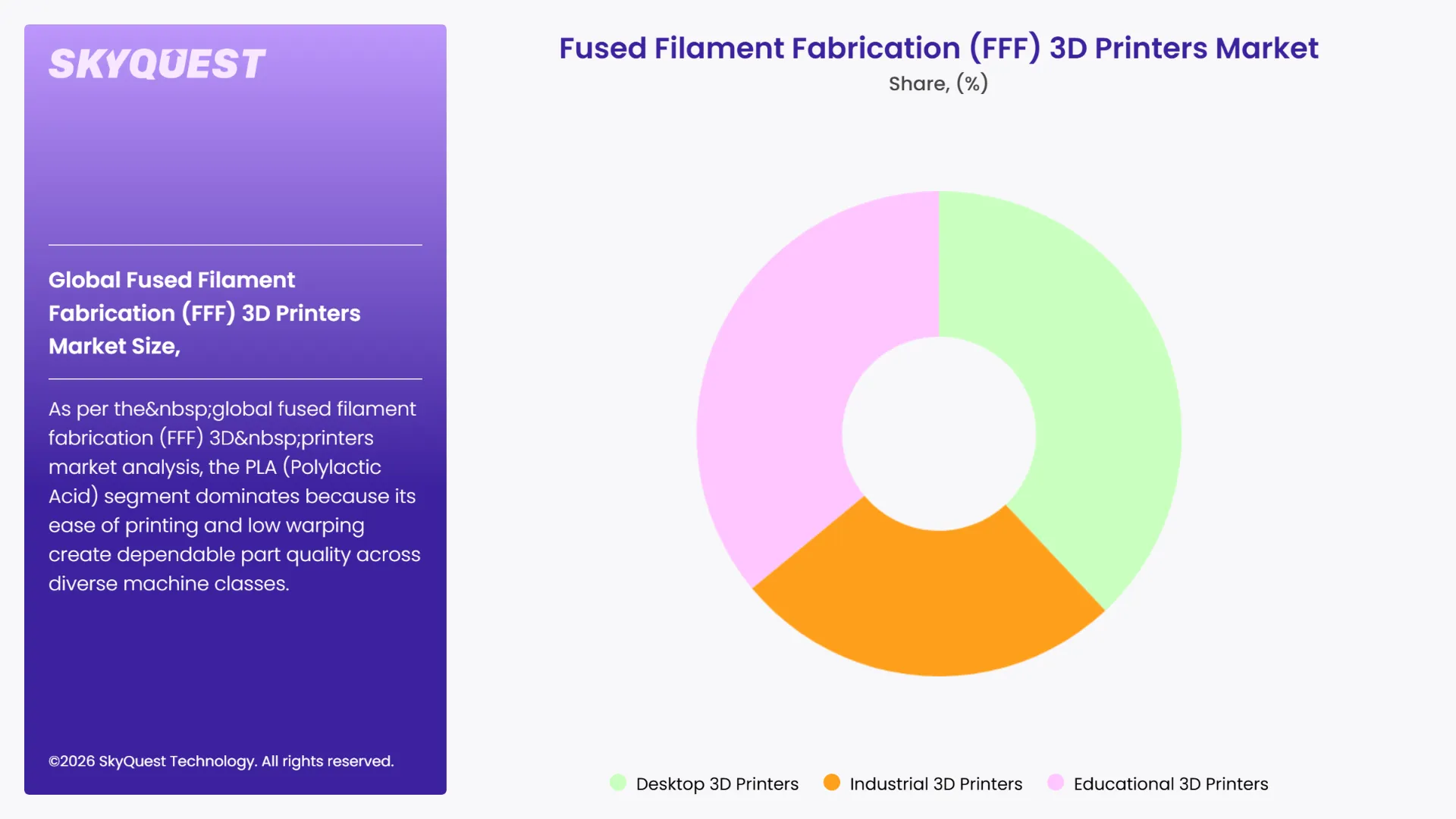
The global fused filament fabrication (FFF) 3D printers market is segmented based on printer type, print bed technology, filament type, application, end-use industry, price tier, distribution channel, and region. By printer type, the market is categorized into desktop 3D printers, industrial 3D printers, and educational 3D printers. Based on print bed technology, it is segmented into heated print beds and non-heated print beds. In terms of filament type, the market includes PLA (polylactic acid), ABS (acrylonitrile butadiene styrene), PETG (polyethylene terephthalate glycol), TPU (thermoplastic polyurethane), composite materials, and others. By application, it is divided into prototyping, production/end-use parts, tooling & fixtures, educational & research, architectural models, art, jewelry & design, and others. Based on end-use industry, the market spans automotive, aerospace & defense, healthcare, consumer electronics, education, architecture & engineering, and other sectors. In terms of price tier, the market is segmented into low-end, mid-range, and high-end categories. By distribution channel, the market is classified into online and offline channels. Geographically, it is segmented into North America, Europe, Asia Pacific, Latin America, and the Middle East & Africa.
As per the global fused filament fabrication (FFF) 3D printers market analysis, the PLA (Polylactic Acid) segment dominates because its ease of printing and low warping create dependable part quality across diverse machine classes. Its biocompatibility and odorless melting behavior enable safe handling while making it usable for research and educational purposes and consumer product development, which printer manufacturers and filament suppliers now support at a broader scale. This reliable processing reduces failed builds and support needs, which leads to ecosystem investment and solidifies PLA as the standard material for FFF workflows.
However, The PETG (polyethylene terephthalate glycol) segment has become the most rapidly developing market segment because its dual benefits of high strength and easy printing create functional products which need no thermal management. The demand for durable chemical-resistant components has caused professional makers and small manufacturers to adopt PETG blends and printer profiles, which create more material-focused opportunities.
According to the global fused filament fabrication (FFF) 3D printers market forecast, the industrial 3D printers segment leads because its robust build systems and higher thermal control and integrated automation create stable production conditions that generate consistent output quality which matches industrial production requirements. Enhanced material handling with engineering grade filaments creates lower process variability because it requires less post processing work, which makes the system appealing to manufacturers who want to scale their additive manufacturing processes. The performance focus leads organizations to invest in proven tooling and quality systems that solidify industrial platforms as the main foundation for production-oriented FFF processes.
However, the desktop 3D printer category is anticipated to have the highest fused filament fabrication (FFF) 3D printers market share because its compact design and lower equipment costs enable more people to access rapid prototyping and distributed manufacturing capabilities. Designers and small manufacturers drive material adoption through reliable software and improved material compatibility which results in increased FFF usage across their fleet of deployments and service models.
To get detailed segments analysis, Request a Free Sample Report
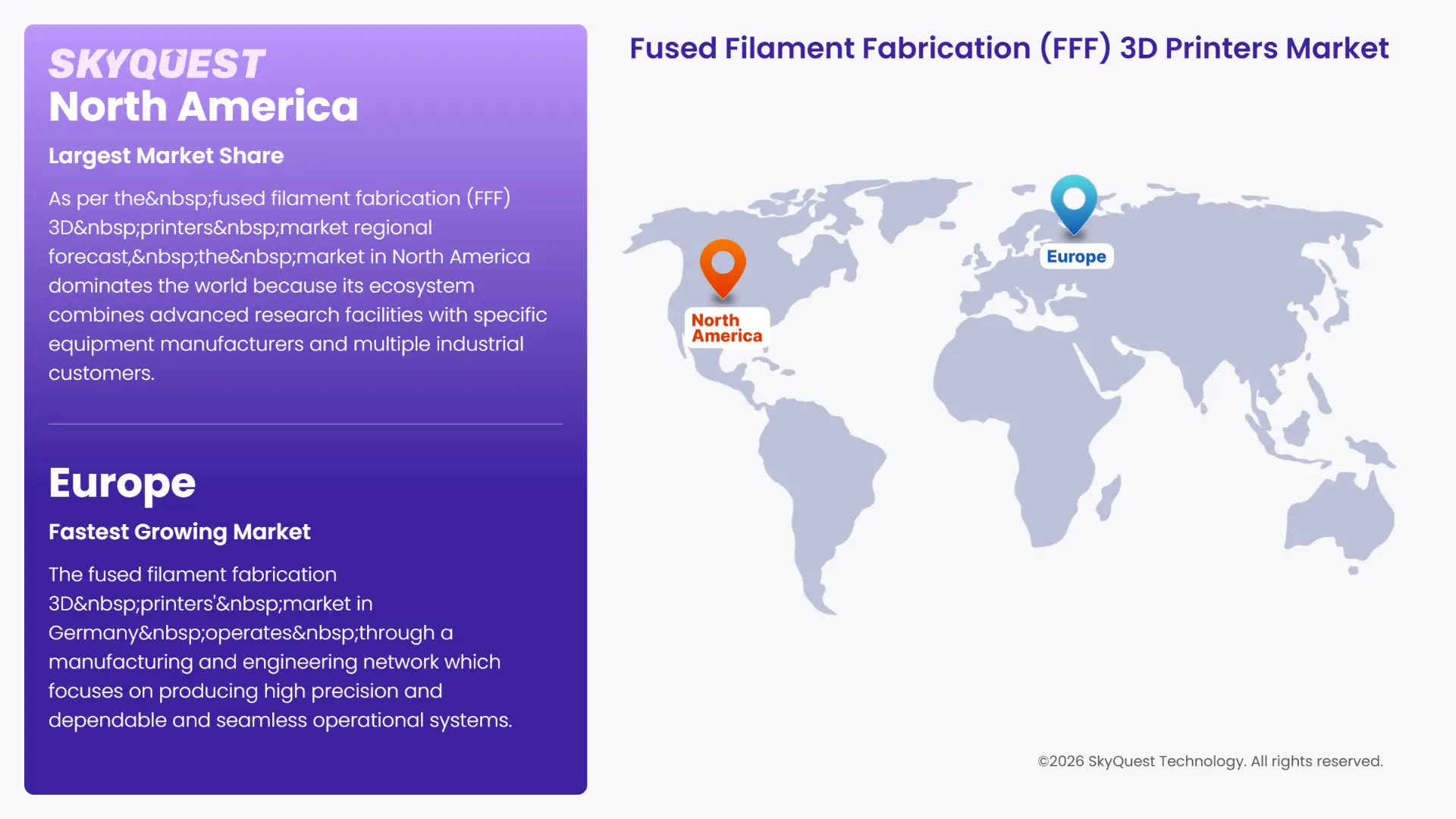
As per the fused filament fabrication (FFF) 3D printers market regional forecast, the market in North America dominates the world because its ecosystem combines advanced research facilities with specific equipment manufacturers and multiple industrial customers. The dense grouping of material developers and software companies together with service bureaus creates advantages that boost product development and market entry. The broad adoption of 3D printing technologies throughout different sectors which includes prototyping and healthcare and aerospace and education, creates an extensive demand base that drives both aftermarket service development and new filament technology. The combination of strong distribution networks and highly skilled workforces together with effective cooperation between original equipment manufacturers and system integrators allows businesses to transition their operations from initial testing to full-scale industrial production. The region maintains its market dominance through effective purchase procedures while developing open platform systems and interoperability standards which shape international industry standards and best practices.
The Fused Filament Fabrication (FFF) 3D Printers sector operates in the United States through a network of original equipment manufacturers and testing facilities and industrial customers. The aerospace industry requires medical tooling and product design which drives innovation in hardware and materials development. Established service bureaus and reseller networks support adoption across enterprises and institutions. The combination of quality control procedures and compliance frameworks together with digital workflow connectivity makes the solution suitable for advanced manufacturing and specialized use cases.
The Fused Filament Fabrication (FFF) 3D Printers industry in Canada is characterized by collaborative research networks, materials development, and a concentration of medium sized manufacturers. The public procurement process together with institutional adoption in higher education and medical research facilities promotes technology deployment and workforce education. The open platform hardware systems together with the localized supply chain systems and sustainability requirements drive both innovation and niche product development. Service providers and resellers together expand the range of industrial and educational services while driving intersectoral partnerships.
The European Fused Filament Fabrication (FFF) 3D printers market expands rapidly because industrial modernization and digital manufacturing policy support and material and equipment supplier networks all contribute to market growth. The diverse manufacturing base, which includes global leaders and agile small and medium sized enterprises, creates a demand for both flexible production systems and quick prototyping capabilities. Academic research collaboration with vocational training and industrial partnerships enables organizations to transfer skills while adopting commercial solutions. The focus on material recycling together with the development of sustainable filaments drives companies to invest in eco-friendly alternatives. The manufacturing sector benefits from cross-border partnerships which establish cluster ecosystems that create service bureau networks to provide expert knowledge. Public procurement policies together with regulatory harmonization create a stable market environment.
The fused filament fabrication 3D printers' market in Germany operates through a manufacturing and engineering network which focuses on producing high precision and dependable and seamless operational systems. The development of advanced filament formulations and machine durability depends on the strong research ties between original equipment manufacturers and materials scientists and research institutes. High-performance systems have become necessary for automotive component prototyping and toolmaking because they constitute essential applications. The combination of thorough vocational training programs and established industry standards enables companies to use industrial systems at a scalable level.
The Fused Filament Fabrication (FFF) 3D Printers Market in the United Kingdom operates through a startup network which includes multiple design centers and healthcare and creative industry sectors that are increasingly adopting new technologies. The desktop and industrial FFF solutions provide entrepreneurs and small manufacturers with flexible business options. The connection between universities and makerspaces and industry partners enables organizations to develop their skills while creating rapid prototypes. The deployment of service bureau networks together with institutional procurement procedures provides organizations with better access to commercial resources while serving multiple industries.
The Fused Filament Fabrication (FFF) 3D Printers Market in France expands through collaborative efforts to modernize industrial sectors and create digital solutions. The development of materials research together with healthcare solutions and aerospace prototype testing drives the adoption of both desktop and industrial FFF systems. The innovation hub network and cluster initiatives create a platform for knowledge exchange which leads to successful market entry. The existing focus on sustainable materials and local production creates supply chain resilience while attracting manufacturers who require adaptable and environmentally friendly production methods to meet their current operational needs.
Asia Pacific strengthens its Fused Filament Fabrication 3D printers market through its factory operations and its development of specific materials and its fast adoption of automation systems. The dense electronics and components supply chain enables secure production of machine hardware and peripheral devices because manufacturers create products that range from entry level items to industrial grade systems. Research centers and engineering talent pools boost progress in developing filament materials and control technology and reliable manufacturing methods. The industrial parks and regional initiatives create environments which develop additive manufacturing centers that produce prototypes for medical devices and automotive parts and consumer electronics products. The combination of cross border partnerships and localized service networks creates tailored solutions which deliver immediate support for various industrial requirements to enhance adoption rates.
The Japanese Fused Filament Fabrication 3D Printers market develops through its precision engineering traditions and its practice of materials research and its operation of automation and control systems. Local manufacturers establish their machine reliability standards through motion control technology and their selection of high-quality components to serve industrial customers who have strict operational needs. medical device development and specialized tooling have all adopted the technology. The partnership between universities, industrial research institutes and equipment suppliers creates better innovation results which provide efficient aftermarket support for operational deployments.
The South Korean Fused Filament Fabrication 3D Printers market benefits from the country s strong electronics components industry and its commitment to technological development and its ongoing material research efforts. Domestic manufacturers develop space efficient systems which achieve high precision and provide seamless connections to automated processes. The collaboration between research institutes and technology companies and adopters produces customization which benefits manufacturers of consumer electronics during both prototyping and production processes. The network of service providers and training programs keeps expanding to help users adopt the system while receiving dependable maintenance support.
To know more about the market opportunities by region and country, click here to
Buy The Complete Report
Growing Adoption in Industrial Manufacturing
The industrial sector now uses FFF 3D printing because it supports quick design changes and small production runs and nearby manufacturing processes which were not feasible before. The accessible nature of filament materials together with easy machine operation allows manufacturers to create complex prototypes which can be used for design validation in shorter development periods. These advantages improve product development speed. The system availability of existing production systems combined with its easy entry requirements drives demand for both desktop and industrial scale FFF printers across various manufacturing industries.
Expansion of Materials and Filaments
The FFF 3D printers market is expanding because engineered filaments and compostable flexible materials and high-performance materials are now more widely accessible for new applications in end use part manufacturing. The material innovation process allows users to achieve their mechanical and thermal and aesthetic goals while cutting down on the need for additional manufacturing processes. The development of material ecosystems increases design teams and producers' trust in functional prototyping and small-scale production, which leads them to use FFF solutions for various product lines and industry applications.
Limitations in Mechanical Properties
The production of FFF components faces restrictions because of their inherent weaknesses in part strength and anisotropy and layer bonding capacity which limits their usage in high safety and structural applications thus reducing their adoption in sectors that demand reliable performance. The need for engineers and designers to use post processing or different manufacturing techniques to achieve precise standards creates additional tasks which raise expenses and make FFF less appealing for production of final products. The dual limitations of material and process present obstacles which prevent industries from successfully acquiring certified components that deliver superior performance. The prototyping phase becomes slower when customers want to switch to the product creation phase.
High Perceived Total Cost
The cost of building FFF systems for large scale operations becomes a financial obstacle for potential users because they must acquire special filaments and handle maintenance work and operator training and post processing activities even though desktop machine prices have decreased. The total cost of ownership for production technologies will compel organizations to postpone equipment purchases until they can forecast expenses with certainty. The high lifecycle cost perception leads to slower procurement processes which restrict market access for buyers with limited capital and those who avoid taking risks. The process raises return on investment requirements.
Request Free Customization of this report to help us to meet your business objectives.
The current competitive situation among companies which manufacture FFF 3D printers for international markets is becoming more intense because established firms use specific acquisition strategies and vertical business partnerships to counter competition from hardware and materials companies which provide distinct speed and workflow improvements. The recent M&A activities and product integration between Desktop Metal and EnvisionTEC and Polymaker and AMESOS demonstrate that companies use consolidation and co-development as their primary methods to obtain market competition advantage.
AI-driven Print Optimization: AI driven software automates slicer settings and material selection and real time print monitoring to improve part quality and decrease failed builds. Machine learning models study print behavior with material features to suggest optimal parameters while developing the ability to handle variations and reduce qualification times. The trend allows non-expert users to adopt the technology while it supports handling complex geometries and leads vendors to create intelligent systems that work across their entire hardware and software framework. Software developers and material suppliers create strategic partnerships that drive faster innovation because they build ecosystems which guarantee performance and repeatable results.
Localized on Demand Manufacturing: Companies use FFF systems to create localized production, which allows them to create shorter supply chains that fulfill custom orders while they simplify logisticsoperations. Service bureaus use networked printers to produce parts closer to point of use, which enables agile inventory management and quick design process improvements. The shift toward distributed manufacturing establishes standardized workflows which create certification pathways and partnerships that connect digital ordering systems with local 3D printing facilities. Ecosystem providers build strategic platform investments together with their quality assurance processes to maintain service efficiency while developing new customer service delivery models which depend on geographic proximity to customers.
SkyQuest’s ABIRAW (Advanced Business Intelligence, Research & Analysis Wing) is our Business Information Services team that Collects, Collates, Correlates, and Analyses the Data collected by means ofPrimary Exploratory Research backed by robust Secondary Desk research.
As per SkyQuest analysis, the global FFF 3D printers market grows because manufacturers gain access to new functional applications which stem from advanced material and extruder technology development. The second driver of market growth comes from AI print optimization tools which decrease printing errors while making it easier to operate machines in remote locations. The fused filament fabrication (FFF) 3D printers market penetration faces major challenges because of inherent mechanical constraints which include anisotropy and layer adhesion that limit structural applications and require finishing work. North America remains in the dominating region due to a dense ecosystem of OEMs, service bureaus, and industrial users. Industrial 3D printers dominate the market because they provide effective thermal control, and they operate automated systems which work with engineering filaments during industrial production processes.
| Report Metric | Details |
|---|---|
| Market size value in 2024 | USD 1.25 Billion |
| Market size value in 2033 | USD 3.65 Billion |
| Growth Rate | 13.2% |
| Base year | 2024 |
| Forecast period | 2026-2033 |
| Forecast Unit (Value) | USD |
| Segments covered |
|
| Regions covered | North America (US, Canada), Europe (Germany, France, United Kingdom, Italy, Spain, Rest of Europe), Asia Pacific (China, India, Japan, Rest of Asia-Pacific), Latin America (Brazil, Rest of Latin America), Middle East & Africa (South Africa, GCC Countries, Rest of MEA) |
| Companies covered |
|
| Customization scope | Free report customization with purchase. Customization includes:-
|
To get a free trial access to our platform which is a one stop solution for all your data requirements for quicker decision making. This platform allows you to compare markets, competitors who are prominent in the market, and mega trends that are influencing the dynamics in the market. Also, get access to detailed SkyQuest exclusive matrix.
Table Of Content
Executive Summary
Market overview
Parent Market Analysis
Market overview
Market size
KEY MARKET INSIGHTS
COVID IMPACT
MARKET DYNAMICS & OUTLOOK
Market Size by Region
KEY COMPANY PROFILES
Methodology
For the Fused Filament Fabrication (FFF) 3D Printers Market, our research methodology involved a mixture of primary and secondary data sources. Key steps involved in the research process are listed below:
1. Information Procurement: This stage involved the procurement of Market data or related information via primary and secondary sources. The various secondary sources used included various company websites, annual reports, trade databases, and paid databases such as Hoover's, Bloomberg Business, Factiva, and Avention. Our team did 45 primary interactions Globally which included several stakeholders such as manufacturers, customers, key opinion leaders, etc. Overall, information procurement was one of the most extensive stages in our research process.
2. Information Analysis: This step involved triangulation of data through bottom-up and top-down approaches to estimate and validate the total size and future estimate of the Fused Filament Fabrication (FFF) 3D Printers Market.
3. Report Formulation: The final step entailed the placement of data points in appropriate Market spaces in an attempt to deduce viable conclusions.
4. Validation & Publishing: Validation is the most important step in the process. Validation & re-validation via an intricately designed process helped us finalize data points to be used for final calculations. The final Market estimates and forecasts were then aligned and sent to our panel of industry experts for validation of data. Once the validation was done the report was sent to our Quality Assurance team to ensure adherence to style guides, consistency & design.
Analyst Support
Customization Options
With the given market data, our dedicated team of analysts can offer you the following customization options are available for the Fused Filament Fabrication (FFF) 3D Printers Market:
Product Analysis: Product matrix, which offers a detailed comparison of the product portfolio of companies.
Regional Analysis: Further analysis of the Fused Filament Fabrication (FFF) 3D Printers Market for additional countries.
Competitive Analysis: Detailed analysis and profiling of additional Market players & comparative analysis of competitive products.
Go to Market Strategy: Find the high-growth channels to invest your marketing efforts and increase your customer base.
Innovation Mapping: Identify racial solutions and innovation, connected to deep ecosystems of innovators, start-ups, academics, and strategic partners.
Category Intelligence: Customized intelligence that is relevant to their supply Markets will enable them to make smarter sourcing decisions and improve their category management.
Public Company Transcript Analysis: To improve the investment performance by generating new alpha and making better-informed decisions.
Social Media Listening: To analyze the conversations and trends happening not just around your brand, but around your industry as a whole, and use those insights to make better Marketing decisions.
REQUEST FOR SAMPLE
 REQUEST FREE CUSTOMIZATION
Global Fused Filament Fabrication (Fff) 3D Printers Market size was valued at USD 1.25 Billion in 2024 and is poised to grow from USD 1.39 Billion in 2025 to USD 3.33 Billion by 2033, growing at a CAGR of 11.5% during the forecast period (2026-2033).
Competitive rivalry in the global FFF 3D printers market is intensifying as incumbents deploy targeted acquisitions and vertical partnerships while hardware and materials challengers push differentiated speed and workflow innovations. Recent M&A and product integration moves, such as Desktop Metal’s acquisition of EnvisionTEC and Polymaker’s partnership with AMESOS, show consolidation and co development are central competitive strategies. 'Stratasys', 'Ultimaker', 'Prusa Research', 'Raise3D', 'LulzBot', 'Anycubic', 'FlashForge', 'Creality', 'BCN3D', 'MatterHackers', 'Formlabs', 'SainSmart', 'Monoprice', 'TEVO', 'Zortrax', 'Dremel', 'Snapmaker', 'Artillery 3D', 'Wanhao', '3D Systems'
Wide adoption of FFF 3D printing by industrial manufacturers is expanding the market by enabling rapid iteration, low volume customization, and localized production workflows that were previously impractical. Manufacturers leverage accessible filament materials and simpler machine operation to prototype complex parts and validate designs in shortened development cycles, which enhances product development agility. The technology’s compatibility with existing production systems and its lower barrier to entry encourage broader departmental use, fostering demand for both desktop and industrial scale FFF printers across diverse manufacturing sectors.
Ai Driven Print Optimization: AI driven software increasingly automates slicer settings, material selection and real time print monitoring to boost part quality and reduce failed builds. Machine learning models analyze print behavior and material characteristics to recommend optimized parameters, adapt to variability, and shorten qualification cycles. This trend enables adoption among nonexpert users, supports complex geometries, and encourages vendors to embed intelligence across hardware and software stacks. Strategic partnerships between software developers and material suppliers accelerate innovation, creating ecosystems centered on performance and reproducibility.
North America Dominate the Global Fused Filament Fabrication (FFF) 3D Printers Market?
The market is primarily driven by increasing demand for rapid prototyping, cost-effective manufacturing solutions, and the growing adoption of 3D printing across industries such as automotive, aerospace, and healthcare. Additionally, the ability to produce customized and on-demand products is accelerating market growth.
Some key challenges include:
Limited material options compared to traditional manufacturing, Slower production speed for mass manufacturing, Quality consistency and standardization issues.


Want to customize this report? This report can be personalized according to your needs. Our analysts and industry experts will work directly with you to understand your requirements and provide you with customized data in a short amount of time. We offer $1000 worth of FREE customization at the time of purchase.
Feedback From Our Clients


 USA (+1) 351-333-4748

