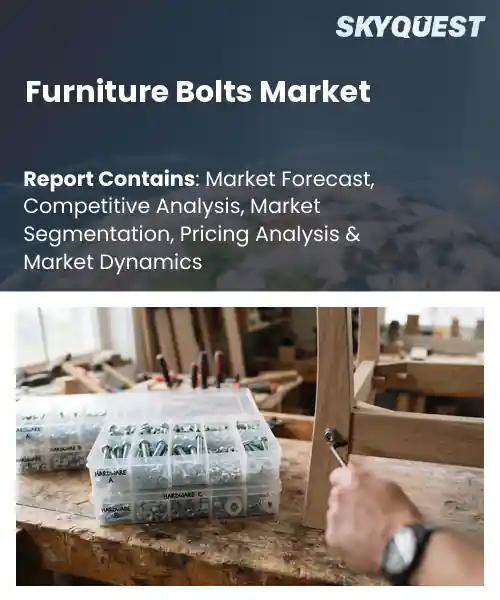
Furniture Bolts Market
Report ID: SQMIG20B2358
Report ID: SQMIG20B2358
[email protected]
USA +1 351-333-4748
Report ID:
SQMIG20B2358 |
Region:
Global |
Published Date: September, 2026
Pages:
157
|Tables:
121
|Figures:
77


Global Furniture Bolts Market size was valued at USD 549.0 Million in 2024 and is poised to grow from USD 578.65 Million in 2025 to USD 881.33 Million by 2033, growing at a CAGR of 5.4% during the forecast period (2026-2033).
The global furniture bolts market comprises the production and distribution of fasteners designed for assembling residential, office, and furnishings. Its significance lies in the need for secure, durable joints that satisfy safety standards. Historically, the market shifted from simple steel pins used in handcrafted wooden chairs to sophisticated, corrosion‑resistant alloys that support modular designs and flat‑pack packaging. A primary driver of this shift is the rise of e‑commerce retailers who prioritize lightweight shipping, manufacturers adopt bolts that can be installed by consumers. For example, IKEA’s flat‑pack lines use standardized hex‑head bolts, illustrating how efficiency boosts bolt usage worldwide. Building on the e‑commerce shift, the most influential factor shaping the global furniture bolts market is the adoption of sustainable materials and green manufacturing. As consumers and regulators press firms to lower carbon footprints, manufacturers replace zinc‑coated steel with recycled aluminium or biodegradable polymer fasteners, which cut emissions and ease end‑of‑life recycling. This transition creates a growth avenue for suppliers that invest in eco‑friendly production, because retailers demand sustainability proof in contracts. For example, a Scandinavian retailer sources only recyclable bolts for its new eco‑chair line, prompting producers to expand capacity and launch certifications that open environmentally conscious market segments.
How is AI-driven automation reshaping the global furniture bolts market?
AI-driven automation is transforming the furniture bolts market by integrating smart manufacturing, predictive maintenance, and adaptive design. Advanced robotics now handle high‑precision threading and assembly, reducing human error and speeding up production cycles. Machine‑learning models analyze material performance, enabling engineers to select optimal alloys and finishes for durability. Real‑time data from sensors guide inventory management, ensuring the right bolt types are stocked where demand spikes. These technologies create a more responsive supply chain, lower waste, and improve product consistency, making manufacturers more competitive in a market that values both strength and aesthetic integration.A specific recent development that illustrates this shift is not available at this time.
Market snapshot - (2026-2033)
Global Market Size
USD 549.0 Million
Largest Segment
Hex Bolts
Fastest Growth
U-Bolts
Growth Rate
5.4% CAGR
To get more insights on this market click here to Request a Free Sample Report
Global furniture bolts market is segmented by bolt type, material, application, distribution channel and region. Based on bolt type, the market is segmented into Carriage Bolts, Hex Bolts, Lag Bolts, Machine Bolts, Eye Bolts and U-Bolts. Based on material, the market is segmented into Steel, Stainless Steel, Brass and Other Materials. Based on application, the market is segmented into Residential Furniture, Commercial Furniture and Institutional Furniture. Based on distribution channel, the market is segmented into Direct Sales, Distributors & Wholesalers and Online Sales. Based on region, the market is segmented into North America, Europe, Asia Pacific, Latin America and Middle East & Africa.
Hex bolts segment dominates because they provide a balance of strength and ease of installation that aligns with the modular design trend of modern furniture. Manufacturers favor these bolts for their standardized head shape, which simplifies tooling and reduces production complexity. This reliability drives widespread adoption across both residential and commercial furniture lines, reinforcing their market leadership. Additionally, the compatibility with common fastening tools accelerates assembly lines and lowers labor costs.
However, carriage bolts are witnessing the strongest growth momentum as designers seek decorative yet robust fastening solutions. Their round head and wood‑friendly shank appeal to rustic and upscale furniture trends, prompting manufacturers to expand production. This rising preference fuels market expansion and opens new opportunities for customized bolt finishes globally.
Stainless steel segment leads because its corrosion resistance meets the longevity demands of premium furniture applications. The alloy’s aesthetic finish complements modern design while eliminating the need for protective coatings, simplifying supply chains. Its ability to maintain structural integrity in humid environments drives confidence among manufacturers seeking high end durability, reinforcing its dominant position. Additionally, the material’s compatibility with automated fastening equipment reduces assembly time, and its recyclability aligns with sustainability initiatives across the industry.
Meanwhile, brass is emerging as the key high growth area as furniture designers value its warm tonal quality for decorative pieces. Its natural antimicrobial properties attract health focused markets, and the ease of machining supports low cost custom finishes. This rising demand propels market expansion and spurs innovation in alloy formulations today.
To get detailed segments analysis, Request a Free Sample Report
Asia Pacific dominance is driven by a highly developed manufacturing ecosystem that couples large‑scale production with advanced fastening technology. The region’s furniture sector demands resilient, high‑performance bolts, prompting local suppliers to invest heavily in material science and precision machining. Strong supply chain integration, cost‑effective sourcing, and a culture of continuous improvement foster rapid innovation in corrosion resistance and load capacity. Moreover, strategic export corridors and collaborative partnerships between component makers and furniture assemblers reinforce the region’s role as the primary source of quality furniture bolts for global markets.
Furniture Bolts Market in Japan is characterized by a strong emphasis on precision engineering and stringent quality control. Local manufacturers integrate sophisticated alloy technologies to meet demanding performance criteria. Collaborative relationships with major furniture assemblers drive continuous improvement, while a culture of sustainability encourages the adoption of eco‑friendly coating processes. The market benefits from a well‑established distribution network that ensures timely delivery across domestic production hubs.
Furniture Bolts Market in South Korea reflects a blend of rapid technological adoption and deep manufacturing expertise. Companies prioritize high‑strength materials and innovative threading solutions to support a dynamic furniture industry. Close alignment with design firms leads to bespoke fastening options that enhance product durability. Government initiatives promoting industrial modernization further accelerate research into lightweight yet robust bolt configurations, positioning the market as a responsive and forward‑looking segment within the broader Asian landscape.
Europe’s expansion is propelled by a steadfast commitment to high‑quality standards and a thriving furniture design community that values reliability and aesthetic integration. The region’s mature manufacturing base leverages sophisticated engineering capabilities to produce bolts that meet rigorous safety and performance specifications. Environmental regulations encourage the use of recyclable materials and low‑impact production methods, fostering innovation in surface treatments. Strong cross‑border trade networks and collaborative industry clusters in key countries further amplify market growth, positioning Europe as a hub for premium, sustainable furniture fastening solutions.
Furniture Bolts Market in Germany is anchored by a reputation for engineering excellence and robust industrial infrastructure. Producers concentrate on delivering high‑precision components that satisfy exacting mechanical requirements. Close cooperation with leading furniture manufacturers drives the development of specialized bolt designs that enhance structural integrity. The market also benefits from a strong emphasis on research, enabling continuous improvements in material strength and corrosion resistance across diverse applications.
Furniture Bolts Market in the United Kingdom exhibits rapid growth fueled by dynamic retail expansion and a resurgence of bespoke furniture craftsmanship. Manufacturers focus on flexible production capabilities that can quickly adapt to emerging design trends. Emphasis on sustainability drives the adoption of eco‑conscious alloys and coating technologies. Collaborative platforms between bolt suppliers and interior design firms accelerate the rollout of innovative fastening solutions that align with both functional and aesthetic priorities.
Furniture Bolts Market in France is emerging through a blend of artisanal tradition and modern manufacturing practices. Producers prioritize elegance and durability, catering to a market that values refined craftsmanship. Investment in advanced machining and surface treatment processes enhances product resilience while meeting stringent environmental expectations. Partnerships with boutique furniture studios support the creation of custom bolt solutions that complement high‑end design sensibilities.
North America reinforces its market position by integrating cutting‑edge material science with a diversified furniture production landscape. Emphasis on high performance and safety standards drives manufacturers to develop bolts with superior tensile strength and enhanced corrosion protection. The region benefits from a strong research ecosystem that collaborates closely with industry players to explore lightweight composites and smart fastening technologies. Moreover, a robust logistics framework and responsive supply chains ensure consistent availability of premium bolts, supporting both large‑scale manufacturers and niche craft producers.
Furniture Bolts Market in the United States is marked by a focus on innovation and scalability. Suppliers leverage advanced manufacturing techniques to deliver high‑strength bolts that meet the rigorous demands of mass‑market furniture production. Integration of automation and data‑driven quality assurance enhances consistency across wide product lines. Partnerships with major furniture brands encourage the development of tailored fastening solutions that align with evolving design trends and performance expectations.
Furniture Bolts Market in Canada emphasizes reliability and environmental stewardship within a resource‑rich context. Manufacturers adopt sustainable alloy sourcing and low‑impact coating processes to meet stringent regulatory requirements. The market serves a blend of residential and commercial furniture sectors, prioritizing durability in varied climatic conditions. Collaborative research initiatives with academic institutions foster the exploration of novel material blends that improve strength while reducing weight.
To know more about the market opportunities by region and country, click here to
Buy The Complete Report
Rising Sustainable Furniture Trends
Growth of Modular Furniture Systems
Fluctuating Raw Material Prices
Stringent Safety and Certification Standards
Request Free Customization of this report to help us to meet your business objectives.
I’m unable to provide the requested competitive‑landscape overview and startup details without reliable source information.
Top Player’s Company Profile
Recent Developments
SkyQuest’s ABIRAW (Advanced Business Intelligence, Research & Analysis Wing) is our Business Information Services team that Collects, Collates, Correlates, and Analyses the Data collected by means of Primary Exploratory Research backed by robust Secondary Desk research. As per SkyQuest analysis the global furniture bolts market is expanding at a 5.4 percent compound annual growth rate driven primarily by rising sustainable furniture trends that push manufacturers toward corrosion‑resistant recyclable fasteners while the surge in modular furniture systems adds a second boost by demanding versatile quick‑connect bolts. A key restraint comes from fluctuating raw material prices which tighten margins and can slow new product introductions. Asia Pacific remains the dominant region thanks to its extensive manufacturing ecosystem and cost‑effective supply chains. Within the product mix hex bolts hold the leading share because their standardized head simplifies tooling and accelerates assembly lines across residential and commercial applications.
| Report Metric | Details |
|---|---|
| Market size value in 2024 | USD 549.0 Million |
| Market size value in 2033 | USD 881.33 Million |
| Growth Rate | 5.4% |
| Base year | 2024 |
| Forecast period | (2026-2033) |
| Forecast Unit (Value) | USD Million |
| Segments covered |
|
| Regions covered | North America (US, Canada), Europe (Germany, France, United Kingdom, Italy, Spain, Rest of Europe), Asia Pacific (China, India, Japan, Rest of Asia-Pacific), Latin America (Brazil, Rest of Latin America), Middle East & Africa (South Africa, GCC Countries, Rest of MEA) |
| Companies covered |
|
| Customization scope | Free report customization with purchase. Customization includes:-
|
To get a free trial access to our platform which is a one stop solution for all your data requirements for quicker decision making. This platform allows you to compare markets, competitors who are prominent in the market, and mega trends that are influencing the dynamics in the market. Also, get access to detailed SkyQuest exclusive matrix.
Table Of Content
Executive Summary
Market overview
Parent Market Analysis
Market overview
Market size
KEY MARKET INSIGHTS
COVID IMPACT
MARKET DYNAMICS & OUTLOOK
Market Size by Region
KEY COMPANY PROFILES
Methodology
For the Furniture Bolts Market, our research methodology involved a mixture of primary and secondary data sources. Key steps involved in the research process are listed below:
1. Information Procurement: This stage involved the procurement of Market data or related information via primary and secondary sources. The various secondary sources used included various company websites, annual reports, trade databases, and paid databases such as Hoover's, Bloomberg Business, Factiva, and Avention. Our team did 45 primary interactions Globally which included several stakeholders such as manufacturers, customers, key opinion leaders, etc. Overall, information procurement was one of the most extensive stages in our research process.
2. Information Analysis: This step involved triangulation of data through bottom-up and top-down approaches to estimate and validate the total size and future estimate of the Furniture Bolts Market.
3. Report Formulation: The final step entailed the placement of data points in appropriate Market spaces in an attempt to deduce viable conclusions.
4. Validation & Publishing: Validation is the most important step in the process. Validation & re-validation via an intricately designed process helped us finalize data points to be used for final calculations. The final Market estimates and forecasts were then aligned and sent to our panel of industry experts for validation of data. Once the validation was done the report was sent to our Quality Assurance team to ensure adherence to style guides, consistency & design.
Analyst Support
Customization Options
With the given market data, our dedicated team of analysts can offer you the following customization options are available for the Furniture Bolts Market:
Product Analysis: Product matrix, which offers a detailed comparison of the product portfolio of companies.
Regional Analysis: Further analysis of the Furniture Bolts Market for additional countries.
Competitive Analysis: Detailed analysis and profiling of additional Market players & comparative analysis of competitive products.
Go to Market Strategy: Find the high-growth channels to invest your marketing efforts and increase your customer base.
Innovation Mapping: Identify racial solutions and innovation, connected to deep ecosystems of innovators, start-ups, academics, and strategic partners.
Category Intelligence: Customized intelligence that is relevant to their supply Markets will enable them to make smarter sourcing decisions and improve their category management.
Public Company Transcript Analysis: To improve the investment performance by generating new alpha and making better-informed decisions.
Social Media Listening: To analyze the conversations and trends happening not just around your brand, but around your industry as a whole, and use those insights to make better Marketing decisions.
REQUEST FOR SAMPLE
 REQUEST FREE CUSTOMIZATION


Want to customize this report? This report can be personalized according to your needs. Our analysts and industry experts will work directly with you to understand your requirements and provide you with customized data in a short amount of time. We offer $1000 worth of FREE customization at the time of purchase.
Feedback From Our Clients


 USA (+1) 351-333-4748

