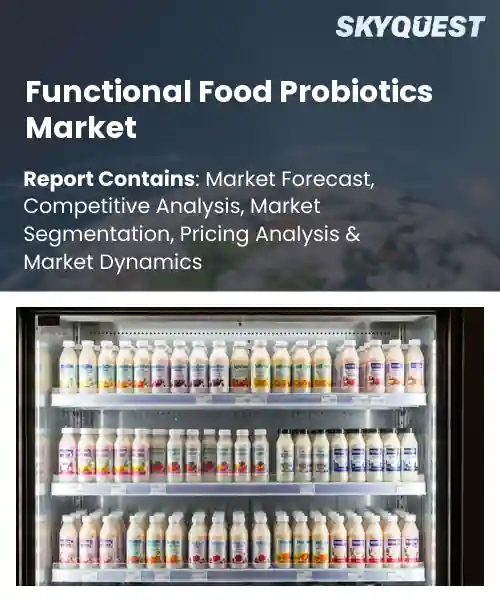
Functional Food Probiotics Market
Report ID: SQMIG30I2917
Report ID: SQMIG30I2917
[email protected]
USA +1 351-333-4748
Report ID:
SQMIG30I2917 |
Region:
Global |
Published Date: May, 2026
Pages:
157
|Tables:
190
|Figures:
79


Global Functional Food Probiotics Market size was valued at USD 55.3 Billion in 2024 and is poised to grow from USD 59.28 Billion in 2025 to USD 103.39 Billion by 2033, growing at a CAGR of 7.2% during the forecast period (2026-2033).
As the primary driver, expanding scientific understanding of the human microbiome and rising health consciousness have propelled the functional food probiotics market into mainstream nutrition. This market comprises foods and beverages fortified with live microbial strains designed to confer health benefits beyond basic nutrition, such as yogurts, fermented drinks, fortified snacks and nutrition products. It matters because shifts from disease treatment to prevention alter consumer purchases and health service demand.
The key factor driving expansion is robust clinical validation and clear regulatory frameworks, because demonstrated efficacy enables precise marketing and wider institutional adoption. When manufacturers fund randomized trials that show a defined strain reduces antibiotic associated diarrhea, hospitals and prescribers incorporate those products into protocols, which increases procurement and consumer trust. Consequently brands invest in targeted formats such as infant formulas with probiotic strains linked to immune outcomes and senior nutrition bars supporting gut health, creating commercial scale. This cause and effect unlocks opportunities in personalized regimens, microbiome diagnostics partnerships, and formulation for travel nutrition.
How is AI enhancing product development in the functional food probiotics market?
AI is reshaping product development in the functional food probiotics market by accelerating strain discovery enabling in silico screening of candidate microbes and informing formulation choices that preserve viability taste and consumer appeal. Tools now predict microbe host interactions model shelf stability and guide encapsulation and delivery strategies which tightens the link between lab research and commercial product design. On the manufacturing side AI and robotics tune fermentation media and process parameters to improve consistency and scale which helps reduce technical risk during scale up. These advances align with growing market interest in science backed functional foods.
Differential Bio in February 2026, demonstrated robotics and AI guided media optimization for a commercial L reuteri strain which shortened development cycles and improved production consistency. This innovation shows how AI reduces scale up uncertainty and speeds commercialization supporting faster functional food probiotics market growth.
Market snapshot - (2026-2033)
Global Market Size
USD 55.3 Billion
Largest Segment
Probiotic Dairy Products
Fastest Growth
Probiotic Non-Dairy Beverages
Growth Rate
7.2% CAGR
To get more insights on this market click here to Request a Free Sample Report
Global functional food probiotics market is segmented by product type, ingredient type, form, application, distribution channel, end user and region. Based on product type, the market is segmented into Probiotic Dairy Products, Probiotic Non-Dairy Beverages, Probiotic Dietary Supplements, Probiotic Functional Foods, Infant Formula with Probiotics, Probiotic Snacks & Cereals and Others. Based on ingredient type, the market is segmented into Lactobacillus, Bifidobacterium, Streptococcus, Bacillus, Saccharomyces, Multi-Strain Probiotics and Others. Based on form, the market is segmented into Liquid, Powder, Capsules & Tablets, Gummies & Chewables and Others. Based on application, the market is segmented into Digestive Health, Immunity Enhancement, Weight Management, Women’s Health, Pediatric Health, Cardiovascular Health, Sports Nutrition and General Wellness. Based on distribution channel, the market is segmented into Supermarkets & Hypermarkets, Pharmacies & Drug Stores, Specialty Stores, Convenience Stores, Online Retail and Others. Based on end user, the market is segmented into Adults, Children & Infants, Elderly Population and Athletes & Fitness Consumers. Based on region, the market is segmented into North America, Europe, Asia Pacific, Latin America and Middle East & Africa.
Probiotic dietary supplements segment with large functional food probiotics market share dominates because concentrated, clinically oriented delivery formats meet consumer and clinician expectations for predictable dosing and measurable outcomes. Their leadership is driven by clear formulation pathways, regulatory familiarity, and ease of integration into daily routines, which reduce commercialization risk for manufacturers. This causes prioritization by brands seeking credible health claims, stable shelf life, and streamlined distribution through health-focused channels.
As per functional food probiotics market outlook, probiotic non-dairy beverages is emerging as the key high-growth area due to strong on-the-go appeal and dairy-free positioning that attract wider consumer groups. Innovation in flavored, plant-based, and shelf-stable matrices enhances trial and accessibility for lactose-intolerant and vegan consumers, expanding retail placement and creating rapid formulation and marketing opportunities for manufacturers.
As per functional food probiotics market analysis, lactobacillus segment dominates because strains from this genus offer extensive clinical evidence, technological robustness, and adaptability across carrier types, making them a preferred choice for formulators and regulators. Their recognized safety and sensory compatibility simplify product development, enabling consistent fermentation or inclusion in diverse matrices and fostering manufacturer confidence in delivering repeatable health benefits across functional foods, beverages, and supplement offerings.
As per functional food probiotics market forecast, multi-strain probiotics is emerging as the most rapidly expanding area as blended cultures promise broader functional coverage and synergistic effects that appeal to both scientists and consumers. Rising formulation expertise, targeted combination research, and marketing emphasis on comprehensive gut and immune support accelerate adoption, enabling new product claims, platform innovation, and cross-application opportunities.
To get detailed segments analysis, Request a Free Sample Report
As per functional food probiotics market regional outlook, Asia Pacific is leading the market due to mix of advanced consumer awareness, strong traditional dietary practices that include fermented products, supportive regulatory frameworks that promote innovation, and dense concentration of research capabilities and ingredient manufacturers. Health conscious consumers’ high acceptance of functional foods and local brands’ swift product adaptation facilitate broad market penetration. Close ties between academic institutions and industry speed up the development of formulations and their clinical validation. Manufacturing scale and efficient supply chains in major regions accelerate time to market and enable a broad range of products in fermented dairy, beverages, supplements and staple foods, reinforcing leadership in the global probiotics landscape. Digital health communication and retail innovation are fueling interest among younger groups, driving trial and repeat purchase, while private and public investment in microbiome science is leading to continued product variety. Cultural familiarity with fermented foods helps to build consumer trust and trial of new delivery forms.
As per functional food probiotics market regional forecast, Japan has a deep cultural acceptance of fermented foods and a sophisticated consumer base open to scientific claims. Local manufacturers prioritize quality, strain specificity and regulatory compliance and work closely with clinical researchers. Positioning is supported by a mix of traditional outlets, modern health stores and ecommerce platforms as retail channels. Innovation is driven by specialized formulations for digestive wellness and immunological support, using brand legacy and strong supply chain capabilities.
As per functional food probiotics industry analysis, South Korea is impacted by significant customer interest in preventive health and quick product innovation from companies, suggests functional food probiotics industry analysis. The manufacturers focus on the strains research, optimization and convenience formats for the urban lifestyles. Industry and research institutes work together to back up functional claims with clinical evidence. Diverse retail ecosystems, including ecommerce and health specialist stores, encourage the adoption of new probiotic beverages, fermented snacks and supplement formats adapted to local preferences.
In North America, the rapid growth is driven by increased consumer awareness of digestive wellness and immune resilience, and a rigorous science-based ecosystem that validates product efficacy. Food producers and supplement makers invest in strain research and clinical partnerships to translate findings into distinctive products and credible health communications. Robust retail infrastructure and advanced e-commerce channels provide for extensive product exposure and consumer education. Cross sector alliances with health care experts and digital health platforms provide customisation and informed suggestions. Transparent sourcing, clean label positioning and convenient delivery methods are attractive to mainstream customers, but also enable premium offers and continuing innovation across market segments. Demographic changes and wellness-oriented lifestyles broaden receptive customer groups and active interaction with regulators and expanding private investment further enhance product development pipelines.
United States is characterized by strong consumer demand for science backed products and a vibrant landscape of start ups and brands. Manufacturers focus on clinically validated strains, innovative delivery formats, and transparent labeling. Distribution spans mainstream grocery, specialty health retailers, and digital platforms facilitating personalized solutions. Collaboration with healthcare professionals and investment in microbiome research underpin product credibility, while marketing emphasizes wellness integration and convenience.
Canada shows growing consumer interest in preventive nutrition and collaborative approach among manufacturers, research institutions and regulatory stakeholders. Emphasis on clean label formulations, natural ingredients and substantiated claims guides product development. Retail channels combine conventional grocery, specialty health stores, and online marketplaces that support informed purchasing. Manufacturers focus on strain transparency and formulation stability while partnerships with healthcare professionals help integrate probiotics into wellness recommendations.
Europe is strengthening its role through strong scientific research, coordinated regulatory interaction and a wide consumer base that values preventative nutrition. European manufacturers are prioritizing strain characterisation, clinical validation and clean label clarity to satisfy discriminating market expectations. Working with universities, contract manufacturers and ingredient suppliers helps produce high quality products and provide traceability to the supply chain. Retail innovation combines traditional grocery, health specialty channels and digital platforms to support consumer education and product exploration. Cultural acceptance is encouraged by highlighting traditional fermented foods in modern delivery systems, while cross-border partnerships and trade networks enable knowledge sharing and coordinated market expansion. Increasing emphasis on sustainability, ingredient traceability and sourcing from local regions makes it more attractive for environmentally aware customers, while endorsements from professionals and incorporation into nutritional guidelines boosts its mainstream legitimacy and usage.
Germany benefits from rigorous scientific standards, strong clinical research networks, and consumer trust. Manufacturers prioritize strain documentation, product stability, and transparent labeling to meet regulatory and consumer expectations. Retail channels combine pharmacy led advice with mainstream grocery and health outlets, supporting informed purchasing. Collaborative initiatives among industry and research institutions drive continued product quality, while innovation focuses on functional dairy alternatives, beverages, and supplement formulations.
United Kingdom driven by consumer interest in digestive wellness and a vibrant innovation ecosystem. Companies engage in clinical studies and clear labeling to promote trust and manufacturers work together to develop new formulas. The retail mix comprises mainstream supermarket, health stores and online outlets to enable tailored communication. Endorsement by nutritionists and clinicians aids increased popularity; product development is focused on practical formats and culturally relevant flavors.
France has a culinary legacy and a growing interest in functional nutrition. For producers, the focus is on product originality, strain quality and matching gourmet preferences while research offers clinical insights. Distribution includes specialty food outlets, pharmacies and online platforms that advocate informed choices. Artisan producers and larger manufacturers can work together to provide a wide range of products, with marketing emphasis on natural ingredients, flavor integrity, and the ability to include probiotics into everyday meals and drinks.
To know more about the market opportunities by region and country, click here to
Buy The Complete Report
Rising Consumer Health Awareness
Innovation In Product Formulation
Regulatory Complexity And Variability
Supply Chain And Stability Challenges
Request Free Customization of this report to help us to meet your business objectives.
Competitive pressure in the global functional food probiotics industry centers on strain differentiation, ingredient licensing, and rapid retail scale up. Firms pursue acquisitions and equity stakes to secure proprietary strains for targeted claims, exemplified by Probi's strategic stake and partnership activity, while biomanufacturing innovators commercialize fermentation platforms to reduce costs. Direct to consumer and retail partnerships accelerate adoption, as shown by recent CPG roll outs.
SkyQuest’s ABIRAW (Advanced Business Intelligence, Research & Analysis Wing) is our Business Information Services team that Collects, Collates, Correlates, and Analyses the Data collected by means of Primary Exploratory Research backed by robust Secondary Desk research. As per SkyQuest analysis, the global functional food probiotics market is being driven primarily by expanding scientific understanding of the human microbiome and rising consumer health awareness, which boost demand for microbiome-focused foods and supplements. A second key driver is growing clinical validation and clearer regulatory pathways that enable credible claims and institutional adoption. However, regulatory complexity and variability across jurisdictions remain an important restraint, increasing compliance costs and slowing cross-border rollout. Asia Pacific currently dominates the market due to cultural familiarity with fermented foods, strong manufacturing capabilities, and supportive research ecosystems, while Probiotic Dietary Supplements lead product portfolios because of predictable dosing, regulatory familiarity, and ease of consumer use.
| Report Metric | Details |
|---|---|
| Market size value in 2024 | USD 55.3 Billion |
| Market size value in 2033 | USD 103.39 Billion |
| Growth Rate | 7.2% |
| Base year | 2024 |
| Forecast period | (2026-2033) |
| Forecast Unit (Value) | USD Billion |
| Segments covered |
|
| Regions covered | North America (US, Canada), Europe (Germany, France, United Kingdom, Italy, Spain, Rest of Europe), Asia Pacific (China, India, Japan, Rest of Asia-Pacific), Latin America (Brazil, Rest of Latin America), Middle East & Africa (South Africa, GCC Countries, Rest of MEA) |
| Companies covered |
|
| Customization scope | Free report customization with purchase. Customization includes:-
|
To get a free trial access to our platform which is a one stop solution for all your data requirements for quicker decision making. This platform allows you to compare markets, competitors who are prominent in the market, and mega trends that are influencing the dynamics in the market. Also, get access to detailed SkyQuest exclusive matrix.
Table Of Content
Executive Summary
Market overview
Parent Market Analysis
Market overview
Market size
KEY MARKET INSIGHTS
COVID IMPACT
MARKET DYNAMICS & OUTLOOK
Market Size by Region
KEY COMPANY PROFILES
Methodology
For the Functional Food Probiotics Market, our research methodology involved a mixture of primary and secondary data sources. Key steps involved in the research process are listed below:
1. Information Procurement: This stage involved the procurement of Market data or related information via primary and secondary sources. The various secondary sources used included various company websites, annual reports, trade databases, and paid databases such as Hoover's, Bloomberg Business, Factiva, and Avention. Our team did 45 primary interactions Globally which included several stakeholders such as manufacturers, customers, key opinion leaders, etc. Overall, information procurement was one of the most extensive stages in our research process.
2. Information Analysis: This step involved triangulation of data through bottom-up and top-down approaches to estimate and validate the total size and future estimate of the Functional Food Probiotics Market.
3. Report Formulation: The final step entailed the placement of data points in appropriate Market spaces in an attempt to deduce viable conclusions.
4. Validation & Publishing: Validation is the most important step in the process. Validation & re-validation via an intricately designed process helped us finalize data points to be used for final calculations. The final Market estimates and forecasts were then aligned and sent to our panel of industry experts for validation of data. Once the validation was done the report was sent to our Quality Assurance team to ensure adherence to style guides, consistency & design.
Analyst Support
Customization Options
With the given market data, our dedicated team of analysts can offer you the following customization options are available for the Functional Food Probiotics Market:
Product Analysis: Product matrix, which offers a detailed comparison of the product portfolio of companies.
Regional Analysis: Further analysis of the Functional Food Probiotics Market for additional countries.
Competitive Analysis: Detailed analysis and profiling of additional Market players & comparative analysis of competitive products.
Go to Market Strategy: Find the high-growth channels to invest your marketing efforts and increase your customer base.
Innovation Mapping: Identify racial solutions and innovation, connected to deep ecosystems of innovators, start-ups, academics, and strategic partners.
Category Intelligence: Customized intelligence that is relevant to their supply Markets will enable them to make smarter sourcing decisions and improve their category management.
Public Company Transcript Analysis: To improve the investment performance by generating new alpha and making better-informed decisions.
Social Media Listening: To analyze the conversations and trends happening not just around your brand, but around your industry as a whole, and use those insights to make better Marketing decisions.
REQUEST FOR SAMPLE
 REQUEST FREE CUSTOMIZATION
Global Functional Food Probiotics Market size was valued at USD 55.3 Billion in 2024 and is poised to grow from USD 59.28 Billion in 2025 to USD 103.39 Billion by 2033, growing at a CAGR of 7.2% during the forecast period (2026-2033).
Competitive pressure in the global functional food probiotics market centers on strain differentiation, ingredient licensing, and rapid retail scale up. Firms pursue acquisitions and equity stakes to secure proprietary strains for targeted claims, exemplified by Probi's strategic stake and partnership activity, while biomanufacturing innovators commercialize fermentation platforms to reduce costs. Direct to consumer and retail partnerships accelerate adoption, as shown by recent CPG roll outs. 'Danone', 'Nestlé', 'Yakult Honsha', 'Chr. Hansen Holding', 'BioGaia', 'Kerry Group', 'Lallemand', 'DSM-Firmenich', 'Probi AB', 'Morinaga Milk Industry', 'Meiji Holdings', 'Arla Foods', 'General Mills', 'Lifeway Foods', 'Fonterra Co-operative Group', 'International Flavors & Fragrances', 'Sabinsa Corporation', 'Ganeden', 'DuPont Nutrition & Biosciences', 'PepsiCo'
Consumers increasingly prioritize digestive and immune wellness, prompting demand for functional foods fortified with probiotics. As awareness of links between gut health and overall wellbeing spreads, manufacturers respond by formulating accessible probiotic options within everyday products, expanding category appeal beyond traditional supplements. This shift encourages investment in research, marketing, and product innovation to meet evolving preferences. Retailers allocate shelf space and promote such items, reinforcing visibility and normalizing consumption. Together these dynamics support sustained expansion by converting health interest into regular purchasing behavior.
Personalized Gut Health Solutions: Manufacturers and brands are shifting toward individualized probiotic offerings that align with consumer-specific gut health needs and lifestyle preferences. This trend emphasizes tailored strain selection, bespoke formulations, and partnerships with diagnostics and healthcare providers to deliver targeted benefits and improved perceived efficacy. Personalized positioning enables deeper consumer engagement, premiumization, and longer lifecycles for products, prompting investment in clinical validation, customized dosing, and adaptive marketing strategies that highlight personal relevance rather than one-size-fits-all claims and foster sustained consumer loyalty and referrals.
Why does Asia Pacific Dominate the Global Functional Food Probiotics Market? |@12


Want to customize this report? This report can be personalized according to your needs. Our analysts and industry experts will work directly with you to understand your requirements and provide you with customized data in a short amount of time. We offer $1000 worth of FREE customization at the time of purchase.
Feedback From Our Clients


 USA (+1) 351-333-4748

