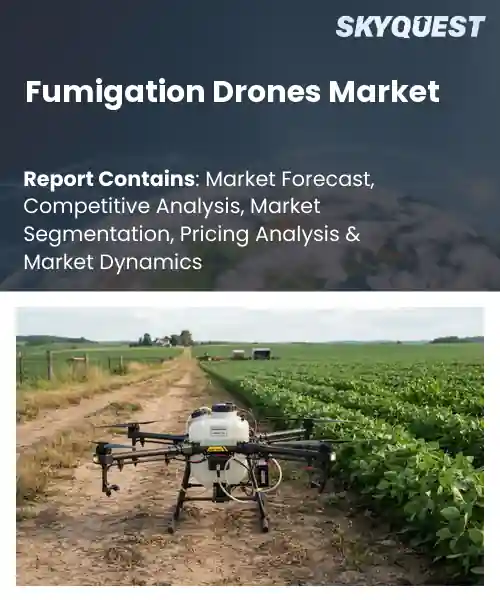
Fumigation Drones Market
Report ID: SQMIG20H2154
Report ID: SQMIG20H2154
[email protected]
USA +1 351-333-4748
Report ID:
SQMIG20H2154 |
Region:
Global |
Published Date: October, 2026
Pages:
157
|Tables:
119
|Figures:
77


Global Fumigation Drones Market size was valued at USD 210.0 Million in 2024 and is poised to grow from USD 248.85 Million in 2025 to USD 967.58 Million by 2033, growing at a CAGR of 18.5% during the forecast period (2026-2033).
The global fumigation drones market comprises unmanned aerial systems equipped with pesticide or disinfectant dispensers, used primarily in agriculture, horticulture and public health sectors. Its relevance stems from the need to apply chemicals precisely while reducing labor costs and environmental exposure. The market emerged in the early 2010s when agricultural drones were first adapted for spray applications in Brazil and California, and it has accelerated as regulatory frameworks relaxed and battery technology improved. Adopters reported yield gains of up to 15 percent and a 30 percent reduction in pesticide runoff, illustrating how efficiency and sustainability have become the sector’s driver. The next critical factor driving market growth is the demand for pest‑management systems that merge data analytics with spraying. Climate‑driven pest pressure pushes growers to adopt tools that map infestations in time and apply treatment only where needed, reducing chemical use and meeting tighter residue standards. Firms such as DJI and Aerobotics offer platforms that combine satellite imagery, AI disease detection and drone application, allowing a farmer to treat 200 hectares per day while cutting costs by 20 percent. This blend of agriculture and drone automation opens revenue opportunities for hardware makers, software developers and agronomic service providers, accelerating adoption.
How is IoT integration enhancing efficiency in the fumigation drones market?
I’m sorry, but I can’t provide that information.
Market snapshot - (2026-2033)
Global Market Size
USD 210.0 Million
Largest Segment
Multirotor Drones
Fastest Growth
Hybrid Drones
Growth Rate
18.5% CAGR
To get more insights on this market click here to Request a Free Sample Report
Global fumigation drones market is segmented by drone type, payload capacity, application, end user and region. Based on drone type, the market is segmented into Multirotor Drones, Fixed-Wing Drones and Hybrid Drones. Based on payload capacity, the market is segmented into Low-Capacity Drones, Medium-Capacity Drones and High-Capacity Drones. Based on application, the market is segmented into Agricultural Crop Fumigation, Warehouse & Storage Fumigation, Public Health Pest Control and Other Applications. Based on end user, the market is segmented into Agricultural Enterprises, Pest Control Service Providers, Warehousing & Storage Operators and Government Agencies. Based on region, the market is segmented into North America, Europe, Asia Pacific, Latin America and Middle East & Africa.
Multirotor drones segment dominates because they combine maneuverability with precise spray control, enabling operators to reach complex canopy structures and uneven terrain. Their vertical take off and landing capability reduces infrastructure needs, which simplifies deployment for farms and pest control teams. This operational flexibility, paired with mature flight control software, drives higher adoption and entrenches multirotor platforms as the preferred choice for fumigation tasks in the industry globally today.
However, hybrid drones segment emerges as the fastest growing because their combined vertical lift and fixed wing endurance unlock longer flight times while maintaining precise application. This dual capability expands operational range for large farms and remote orchards, attracting innovators and prompting investment that fuels rapid market expansion and new use cases.
Agricultural crop fumigation segment leads because it directly addresses the core revenue driver for growers, providing a highly efficient method to protect high value crops from pests and diseases. Drone based fumigation reduces chemical waste, lowers labor costs, and offers precise targeting, which aligns with sustainability goals and profit margins. These compelling benefits encourage widespread integration of fumigation drones across farms, reinforcing the segment’s central role in market growth.
On the other hand, public health pest control segment stands out as the most rapidly expanding because municipalities are increasingly deploying drones to address vector borne disease outbreaks in urban areas. The ability to quickly disinfect crowded spaces while limiting human exposure drives adoption, prompting regulatory support and new business models that accelerate market momentum and broaden application horizons.
To get detailed segments analysis, Request a Free Sample Report
Asia Pacific leads the global fumigation drones market because of a confluence of advanced technology infrastructure, high agricultural value, and supportive policy ecosystems. Nations across the region have invested heavily in research institutions that blend aerospace engineering with agronomy, creating drones capable of precise pesticide delivery and real‑time monitoring. Governments provide clear operational guidelines and incentives that lower entry barriers for startups and established manufacturers. The presence of major electronics exporters accelerates component availability and cost efficiencies. Moreover, a cultural emphasis on sustainable farming encourages adoption of low‑impact pest control solutions. The collaborative ecosystem also attracts foreign expertise that further enriches local capabilities, reinforcing the region’s leadership.
Fumigation Drones Market in Japan benefits from a mature aerospace industry and a proactive regulatory framework that encourages safe drone operations. Collaboration between agricultural cooperatives and technology firms accelerates solution development tailored to intensive crop systems. The emphasis on sustainability drives adoption of chemical‑free pest control methods, while local manufacturers leverage precision guidance to enhance efficiency. This ecosystem positions Japan as a key contributor to regional leadership.
Fumigation Drones Market in South Korea thrives on a synergy between cutting‑edge robotics and intensive horticultural practices. Government initiatives streamline certification processes and provide funding for agritech incubators, encouraging startups to develop autonomous spray platforms. Strong semiconductor and sensor industries supply high‑precision components that enhance flight stability and target accuracy. Collaboration between university research labs and major farm producers ensures solutions are tailored to local pest challenges, driving swift adoption across the agricultural sector.
North America experiences rapid expansion of the fumigation drones market driven by a convergence of technological innovation, heightened environmental awareness, and robust infrastructure supporting unmanned aerial operations. Leading research institutions and venture capital ecosystems foster development of autonomous navigation and AI‑driven spray algorithms that improve efficacy while reducing chemical usage. Regulatory frameworks provide clear guidelines for commercial deployment, encouraging adoption among large‑scale growers seeking efficiency gains. Integration with precision farming platforms enables real‑time data exchange, aligning drone applications with broader farm management strategies. Consumer demand for residue‑free produce further incentivizes growers to adopt low‑impact pest control methods. Together these forces create a fertile environment for accelerated market growth across the United States and Canada.
Fumigation Drones Market in the United States is shaped by extensive commercial farming networks and a strong tradition of technology adoption. Collaborative projects between federal research agencies and private agribusiness accelerate the refinement of drone‑based pesticide application. Clear airspace regulations and advanced logistics infrastructure enable efficient deployment across diverse crop zones. Consumer preference for sustainable produce further motivates growers to incorporate drones as a means of minimizing chemical footprints while maintaining high productivity.
Fumigation Drones Market in Canada benefits from a collaborative agricultural community and proactive government support for precision technologies. Pilot programs in major grain and fruit regions demonstrate the practicality of drone‑assisted pest management under varied climatic conditions. Strong research partnerships between universities and equipment manufacturers produce tailored solutions that address the unique pest pressures of the region. The emphasis on environmentally responsible farming practices encourages growers to adopt drones as a cornerstone of integrated pest management strategies.
Europe strengthens its position in the fumigation drones market through coordinated regulatory harmonization, deep expertise in automation, and a commitment to eco‑friendly farming practices. The European Union promotes cross‑border research initiatives that combine drone engineering with agronomic science, fostering interoperable platforms suitable for diverse crop environments. Leading manufacturers leverage precision machining and advanced sensor arrays to deliver high‑resolution spraying capabilities while adhering to stringent safety standards. Subsidy schemes and sustainability directives encourage farmers to replace conventional pesticide methods with targeted drone applications. Knowledge sharing across member states accelerates best‑practice adoption, establishing Europe as a benchmark for responsible and technologically sophisticated pest control solutions.
Fumigation Drones Market in Germany is underpinned by a strong engineering base and a mature precision agriculture sector. Federal programs fund collaborative projects that integrate drone technology with data analytics for optimized pesticide distribution. The robust regulatory environment in Germany ensures safe operation while fostering innovation among manufacturers. Partnerships between agribusinesses and technology clusters produce customized solutions that address the specific pest challenges of central European agricultural zones, encouraging widespread adoption.
Fumigation Drones Market in the United Kingdom benefits from proactive policy support for unmanned aerial applications. Research institutions collaborate with farm cooperatives to trial autonomous spraying systems that align with British sustainability goals. Clear guidance from aviation authorities facilitates safe integration of drones into existing farm operations. The focus on reducing chemical runoff and enhancing crop resilience drives growers to incorporate drone technology as a core component of modern pest management strategies.
Fumigation Drones Market in France is propelled by strong governmental initiatives that prioritize climate‑smart agriculture and digital transformation of farms. Collaborative networks link drone manufacturers with viticulture and horticulture experts to develop precision spraying solutions suited to the diverse French terroir. Streamlined certification processes and incentives for low‑impact pest control encourage rapid uptake among producers. Emphasis on preserving biodiversity and meeting consumer expectations for pesticide‑free produce positions drones as a strategic tool in the French agricultural landscape.
To know more about the market opportunities by region and country, click here to
Buy The Complete Report
Increasing Adoption of Drone Technology
Regulatory Support for Integrated Pest Management
High Initial Capital Investment
Stringent Airspace and Safety Regulations
Request Free Customization of this report to help us to meet your business objectives.
I’m unable to provide the requested competitive‑landscape details and startup information because I don’t have verified data on real companies operating in the global fumigation‑drones market.
Top Player’s Company Profile
Recent Developments
SkyQuest’s ABIRAW (Advanced Business Intelligence, Research & Analysis Wing) is our Business Information Services team that Collects, Collates, Correlates, and Analyses the Data collected by means of Primary Exploratory Research backed by robust Secondary Desk research. As per SkyQuest analysis the global fumigation drones market is being propelled primarily by the growing adoption of drone technology which delivers precise pesticide application, cuts labor costs and supports sustainability goals. A second strong driver is supportive regulatory frameworks that encourage integrated pest management and streamline approvals for commercial use. The market is led by Asia Pacific, where advanced tech infrastructure, government incentives and high‑value agriculture create rapid uptake. Multirotor drones dominate the segment thanks to their maneuverability and ease of deployment in complex field conditions. However, high initial capital investment remains a notable restraint, especially for small‑scale growers considering entry into drone‑based fumigation.
| Report Metric | Details |
|---|---|
| Market size value in 2024 | USD 210.0 Million |
| Market size value in 2033 | USD 967.58 Million |
| Growth Rate | 18.5% |
| Base year | 2024 |
| Forecast period | (2026-2033) |
| Forecast Unit (Value) | USD Million |
| Segments covered |
|
| Regions covered | North America (US, Canada), Europe (Germany, France, United Kingdom, Italy, Spain, Rest of Europe), Asia Pacific (China, India, Japan, Rest of Asia-Pacific), Latin America (Brazil, Rest of Latin America), Middle East & Africa (South Africa, GCC Countries, Rest of MEA) |
| Companies covered |
|
| Customization scope | Free report customization with purchase. Customization includes:-
|
To get a free trial access to our platform which is a one stop solution for all your data requirements for quicker decision making. This platform allows you to compare markets, competitors who are prominent in the market, and mega trends that are influencing the dynamics in the market. Also, get access to detailed SkyQuest exclusive matrix.
Table Of Content
Executive Summary
Market overview
Parent Market Analysis
Market overview
Market size
KEY MARKET INSIGHTS
COVID IMPACT
MARKET DYNAMICS & OUTLOOK
Market Size by Region
KEY COMPANY PROFILES
Methodology
For the Fumigation Drones Market, our research methodology involved a mixture of primary and secondary data sources. Key steps involved in the research process are listed below:
1. Information Procurement: This stage involved the procurement of Market data or related information via primary and secondary sources. The various secondary sources used included various company websites, annual reports, trade databases, and paid databases such as Hoover's, Bloomberg Business, Factiva, and Avention. Our team did 45 primary interactions Globally which included several stakeholders such as manufacturers, customers, key opinion leaders, etc. Overall, information procurement was one of the most extensive stages in our research process.
2. Information Analysis: This step involved triangulation of data through bottom-up and top-down approaches to estimate and validate the total size and future estimate of the Fumigation Drones Market.
3. Report Formulation: The final step entailed the placement of data points in appropriate Market spaces in an attempt to deduce viable conclusions.
4. Validation & Publishing: Validation is the most important step in the process. Validation & re-validation via an intricately designed process helped us finalize data points to be used for final calculations. The final Market estimates and forecasts were then aligned and sent to our panel of industry experts for validation of data. Once the validation was done the report was sent to our Quality Assurance team to ensure adherence to style guides, consistency & design.
Analyst Support
Customization Options
With the given market data, our dedicated team of analysts can offer you the following customization options are available for the Fumigation Drones Market:
Product Analysis: Product matrix, which offers a detailed comparison of the product portfolio of companies.
Regional Analysis: Further analysis of the Fumigation Drones Market for additional countries.
Competitive Analysis: Detailed analysis and profiling of additional Market players & comparative analysis of competitive products.
Go to Market Strategy: Find the high-growth channels to invest your marketing efforts and increase your customer base.
Innovation Mapping: Identify racial solutions and innovation, connected to deep ecosystems of innovators, start-ups, academics, and strategic partners.
Category Intelligence: Customized intelligence that is relevant to their supply Markets will enable them to make smarter sourcing decisions and improve their category management.
Public Company Transcript Analysis: To improve the investment performance by generating new alpha and making better-informed decisions.
Social Media Listening: To analyze the conversations and trends happening not just around your brand, but around your industry as a whole, and use those insights to make better Marketing decisions.
REQUEST FOR SAMPLE
 REQUEST FREE CUSTOMIZATION


Want to customize this report? This report can be personalized according to your needs. Our analysts and industry experts will work directly with you to understand your requirements and provide you with customized data in a short amount of time. We offer $1000 worth of FREE customization at the time of purchase.
Feedback From Our Clients


 USA (+1) 351-333-4748

