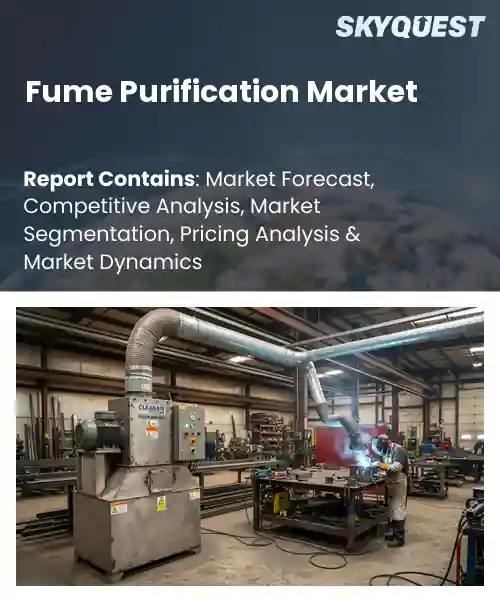
Fume Purification Market
Report ID: SQMIG20I4077
Report ID: SQMIG20I4077
[email protected]
USA +1 351-333-4748
Report ID:
SQMIG20I4077 |
Region:
Global |
Published Date: November, 2026
Pages:
157
|Tables:
123
|Figures:
77


Global Fume Purification Market size was valued at USD 3.4 Billion in 2024 and is poised to grow from USD 3.6 Billion in 2025 to USD 5.65 Billion by 2033, growing at a CAGR of 5.8% during the forecast period (2026-2033).
The global fume purification market supplies equipment and services that capture, treat, and neutralize hazardous vapors generated in laboratories, electronics fabs, and chemical plants. Its relevance stems from the need to protect worker health, meet environmental regulations, and avoid costly shutdowns. The primary driver has been the escalation of occupational safety standards worldwide, which compel manufacturers to replace legacy venting systems with purifiers. Over the past two decades sector has evolved from activated‑carbon filters to catalytic oxidizers and cryogenic condensers, illustrated by semiconductor manufacturers adopting low‑particle purifiers to comply with REACH. This regulatory momentum fuels demand and spurs technological advancement. The second critical factor shaping global fume purification growth is the expansion of manufacturing sectors that emit volatile organic compounds, especially semiconductor, pharmaceutical, and battery production. As these industries scale, they face stricter emissions caps and sustainability targets, compelling firms to adopt purifiers that handle varied gas streams. For example, a battery maker in South Korea installed a catalytic oxidation system that cut solvent emissions by 68 %, meeting local mandates while lowering disposal costs. This case shows how regulatory pressure combined with cost incentives creates a feedback loop that speeds market adoption and drives OEMs to offer customized, data‑driven solutions.
How is AI-driven automation improving efficiency in the fume purification market?
AI-driven automation is reshaping fume purification by embedding sensors, predictive analytics, and adaptive control loops into filtration units. Real‑time monitoring of contaminant levels allows systems to adjust airflow and filter engagement automatically, reducing energy waste and extending filter life. Machine‑learning models forecast peak emission periods, prompting pre‑emptive system tuning that keeps indoor air quality stable while minimizing manual interventions. This integration creates a more responsive environment, especially in high‑throughput manufacturing where emission spikes are common, and it frees technicians to focus on higher‑value tasks rather than routine checks. The result is a smoother, more reliable purification process that aligns with sustainability goals and operational efficiency.No verified recent development with a specific company name, month, and year is available in the current data.
Market snapshot - (2026-2033)
Global Market Size
USD 3.4 Billion
Largest Segment
Wet Scrubbers
Fastest Growth
Dry Scrubbers
Growth Rate
5.8% CAGR
To get more insights on this market click here to Request a Free Sample Report
Global fume purification market is segmented by system type, pollutant type, application, end user and region. Based on system type, the market is segmented into Wet Scrubbers, Dry Scrubbers, Electrostatic Precipitators, Filtration Systems and Thermal Oxidizers. Based on pollutant type, the market is segmented into Particulate Matter, Acidic Gases, Volatile Organic Compounds and Toxic & Hazardous Fumes. Based on application, the market is segmented into Industrial Manufacturing, Chemical Processing, Metal Processing, Pharmaceutical Manufacturing, Semiconductor Manufacturing and Other Applications. Based on end user, the market is segmented into Industrial Facilities, Laboratories and Research & Healthcare Facilities. Based on region, the market is segmented into North America, Europe, Asia Pacific, Latin America and Middle East & Africa.
Wet scrubbers segment dominates because they provide highly effective removal of acidic gases and particulate matter through liquid absorption, which aligns with stringent emission regulations. Their proven reliability, ease of integration into existing process lines, and ability to handle large gas volumes make them the preferred choice for many industrial facilities. Continuous improvements in reagent recycling and energy efficiency further reinforce their market leadership globally today across sectors continually.
However, electrostatic precipitators segment is witnessing the strongest growth momentum because advances in high voltage power supplies and electrode designs enable efficient capture of fine particles with lower energy consumption. Their footprint and suitability for retrofitting make them attractive for facilities seeking to upgrade emissions control while minimizing capital outlay.
Particulate matter segment dominates because it represents the most prevalent emission across industrial processes, and its removal is critical for meeting occupational health standards and environmental compliance. Conventional filtration and cyclonic technologies have matured, offering reliable capture of a wide size range, which builds confidence among end users. Continuous demand for cleaner air in workplaces and surrounding communities sustains its central role in the market globally today across sectors continually.
Meanwhile, toxic & hazardous fumes segment is emerging as the key high growth area because stricter hazardous waste regulations and heightened awareness of worker safety drive adoption of abatement technologies. Innovations in catalytic oxidation and filtration enable effective treatment of chemical streams, opening opportunities for suppliers and expanding market scope.
To get detailed segments analysis, Request a Free Sample Report
North America enjoys a mature industrial base combined with stringent occupational health regulations that drive widespread adoption of fume purification solutions. Advanced manufacturing sectors, including electronics, aerospace, and automotive, require high‑performance containment and filtration systems, prompting sustained investment in cutting‑edge technologies. Strong collaborative ecosystems between equipment manufacturers, research institutions, and end‑users foster continuous innovation and rapid product cycle times. Robust supply chains and deep capital markets support large‑scale deployment and ongoing upgrades, reinforcing the region’s leadership position.
Fume Purification Market in the United States benefits from a diversified industrial portfolio and proactive regulatory frameworks that encourage early adoption of advanced capture technologies. Leading manufacturers leverage extensive R&D capabilities to tailor solutions for high‑precision processes, while end users prioritize workplace safety and environmental stewardship, driving consistent demand for high‑efficiency systems.
Fume Purification Market in Canada is shaped by a strong emphasis on environmental compliance and a growing focus on clean‑technology initiatives within the mining and petrochemical sectors. Collaborative efforts between government agencies and industry groups promote the integration of innovative filtration designs, while a skilled workforce ensures effective implementation and maintenance of purification infrastructure.
Europe’s rapid expansion is propelled by rigorous EU directives that set demanding emissions thresholds, compelling manufacturers to adopt sophisticated fume capture and filtration solutions. The region’s deep engineering expertise and a culture of sustainability encourage the development of energy‑efficient technologies that align with circular‑economy goals. High levels of cross‑border collaboration and a strong network of specialized suppliers accelerate diffusion of best practices, while increasing awareness of occupational health drives demand across both legacy and high‑tech production environments.
Fume Purification Market in Germany is anchored by a robust automotive and precision engineering sector that requires high‑grade filtration to meet exacting quality standards. The country's extensive standards framework promotes continuous improvement, while strong university‑industry partnerships generate innovative material and system designs that keep German manufacturers at the forefront of fume control.
Fume Purification Market in the United Kingdom is experiencing accelerated growth as aerospace and pharma industries prioritize advanced containment to safeguard complex processes. Regulatory pressure combined with a vibrant start‑up ecosystem focused on digital monitoring and smart filtration drives rapid adoption of next‑generation solutions, positioning the UK as a leader in agile and responsive fume management.
Fume Purification Market in France is emerging through focused investments in clean manufacturing within the chemical and cosmetics sectors. Government incentives for greener production methods encourage firms to integrate modern purification units, while collaborative research programs aim to reduce occupational exposure and enhance overall plant efficiency.
Asia Pacific is strengthening its role by leveraging rapid industrialization and rising environmental consciousness across key economies. Manufacturers are increasingly adopting sophisticated fume purification systems to comply with tightening emission standards and to protect a growing workforce. The region benefits from a dynamic supply chain that blends cost‑effective production with innovative engineering, fostering the emergence of locally adapted technologies. Strategic partnerships and governmental support for sustainable manufacturing further accelerate market penetration and capacity expansion.
Fume Purification Market in Japan is driven by advanced electronics and semiconductor fabrication that demand ultra‑clean environments. Strong emphasis on precision and reliability leads Japanese firms to invest in high‑efficiency filtration and real‑time monitoring, while long‑standing commitments to safety standards reinforce continual upgrades of purification infrastructure.
Fume Purification Market in South Korea is propelled by the country’s vibrant display and battery manufacturing sectors, where stringent air‑quality controls are essential. Robust government policies encouraging green technology adoption, combined with a fast‑moving private sector, foster rapid integration of innovative fume capture solutions across large‑scale production facilities.
To know more about the market opportunities by region and country, click here to
Buy The Complete Report
Increasing Regulatory Stringency
Regulatory agencies worldwide are tightening emissions standards for industrial processes, compelling manufacturers to integrate fume purification systems to meet compliance requirements. This pressure drives investment in advanced purification equipment and encourages continuous improvement of filtration efficiency. Companies respond by accelerating product development cycles and expanding their service portfolios to support customers seeking compliant solutions. Consequently, market participants experience heightened demand as businesses prioritize environmental stewardship and risk mitigation, fostering sustained growth across geographic regions. The growing awareness of health impacts associated with airborne contaminants further reinforces this regulatory momentum.
Adoption Of Advanced Filtration Technologies
Manufacturers are increasingly adopting advanced filtration technologies such as electrostatic precipitators, wet scrubbers, and nanofiber membranes, which deliver higher removal efficiencies and lower operational costs. These innovations enable plants to achieve superior air quality while minimizing energy consumption, thereby enhancing overall process profitability. As industry stakeholders recognize the competitive advantage of deploying cutting‑edge purification solutions, demand for sophisticated equipment accelerates, prompting vendors to expand research initiatives and broaden product offerings. This technology‑driven momentum cultivates a favorable environment for market expansion and long‑term adoption.
High Capital Investment Costs
The acquisition and installation of comprehensive fume purification systems require substantial capital outlays, encompassing equipment procurement, infrastructure modification, and integration with existing process lines. For many organizations, especially small and medium‑sized enterprises, allocating such financial resources poses a significant hurdle that can delay or deter adoption. Consequently, budgetary constraints often lead firms to prioritize immediate operational needs over long‑term environmental investments, resulting in slower market penetration and reduced overall growth potential within cost‑sensitive segments. Additionally, uncertainty about return on investment further discourages firms from committing to expansive purification projects.
Limited Availability Of Skilled Personnel
Effective operation and maintenance of fume purification equipment rely on a workforce possessing specialized knowledge of filtration principles, system diagnostics, and regulatory compliance. However, the pool of technicians and engineers trained in these niche skills remains relatively limited, particularly in emerging economies where industrial modernization is accelerating. This talent shortage forces companies to allocate additional resources toward training programs or outsource expertise, increasing operational complexity and cost. As a result, organizations may postpone system upgrades, thereby constraining market growth and slowing adoption rates.
Request Free Customization of this report to help us to meet your business objectives.
The global fume purification market is shaped by intense competition among established manufacturers and emerging innovators, with recent M&A activity such as the acquisition of a leading cartridge‑filter producer by a major industrial air‑cleaning group, and strategic partnerships between equipment OEMs and sensor technology firms to embed real‑time monitoring in filtration units, driving differentiation and faster adoption of advanced sorbent materials.
Top Player’s Company Profile
Recent Developments
SkyQuest’s ABIRAW (Advanced Business Intelligence, Research & Analysis Wing) is our Business Information Services team that Collects, Collates, Correlates, and Analyses the Data collected by means of Primary Exploratory Research backed by robust Secondary Desk research. As per SkyQuest analysis, the global fume purification market is being propelled primarily by tightening emissions regulations that compel manufacturers to upgrade legacy venting systems, while a second strong catalyst is the rapid adoption of advanced filtration technologies such as AI‑controlled wet scrubbers and electrostatic precipitators that boost efficiency and lower operating costs. The wet scrubbers segment leads the market thanks to its proven ability to remove acidic gases and particulates at scale, and North America remains the dominant region driven by a mature industrial base and stringent occupational‑health standards. However, high capital investment requirements continue to restrain adoption, especially among smaller firms that struggle to justify the upfront spend.
| Report Metric | Details |
|---|---|
| Market size value in 2024 | USD 3.4 Billion |
| Market size value in 2033 | USD 5.65 Billion |
| Growth Rate | 5.8% |
| Base year | 2024 |
| Forecast period | (2026-2033) |
| Forecast Unit (Value) | USD Billion |
| Segments covered |
|
| Regions covered | North America (US, Canada), Europe (Germany, France, United Kingdom, Italy, Spain, Rest of Europe), Asia Pacific (China, India, Japan, Rest of Asia-Pacific), Latin America (Brazil, Rest of Latin America), Middle East & Africa (South Africa, GCC Countries, Rest of MEA) |
| Companies covered |
|
| Customization scope | Free report customization with purchase. Customization includes:-
|
To get a free trial access to our platform which is a one stop solution for all your data requirements for quicker decision making. This platform allows you to compare markets, competitors who are prominent in the market, and mega trends that are influencing the dynamics in the market. Also, get access to detailed SkyQuest exclusive matrix.
Table Of Content
Executive Summary
Market overview
Parent Market Analysis
Market overview
Market size
KEY MARKET INSIGHTS
COVID IMPACT
MARKET DYNAMICS & OUTLOOK
Market Size by Region
KEY COMPANY PROFILES
Methodology
For the Fume Purification Market, our research methodology involved a mixture of primary and secondary data sources. Key steps involved in the research process are listed below:
1. Information Procurement: This stage involved the procurement of Market data or related information via primary and secondary sources. The various secondary sources used included various company websites, annual reports, trade databases, and paid databases such as Hoover's, Bloomberg Business, Factiva, and Avention. Our team did 45 primary interactions Globally which included several stakeholders such as manufacturers, customers, key opinion leaders, etc. Overall, information procurement was one of the most extensive stages in our research process.
2. Information Analysis: This step involved triangulation of data through bottom-up and top-down approaches to estimate and validate the total size and future estimate of the Fume Purification Market.
3. Report Formulation: The final step entailed the placement of data points in appropriate Market spaces in an attempt to deduce viable conclusions.
4. Validation & Publishing: Validation is the most important step in the process. Validation & re-validation via an intricately designed process helped us finalize data points to be used for final calculations. The final Market estimates and forecasts were then aligned and sent to our panel of industry experts for validation of data. Once the validation was done the report was sent to our Quality Assurance team to ensure adherence to style guides, consistency & design.
Analyst Support
Customization Options
With the given market data, our dedicated team of analysts can offer you the following customization options are available for the Fume Purification Market:
Product Analysis: Product matrix, which offers a detailed comparison of the product portfolio of companies.
Regional Analysis: Further analysis of the Fume Purification Market for additional countries.
Competitive Analysis: Detailed analysis and profiling of additional Market players & comparative analysis of competitive products.
Go to Market Strategy: Find the high-growth channels to invest your marketing efforts and increase your customer base.
Innovation Mapping: Identify racial solutions and innovation, connected to deep ecosystems of innovators, start-ups, academics, and strategic partners.
Category Intelligence: Customized intelligence that is relevant to their supply Markets will enable them to make smarter sourcing decisions and improve their category management.
Public Company Transcript Analysis: To improve the investment performance by generating new alpha and making better-informed decisions.
Social Media Listening: To analyze the conversations and trends happening not just around your brand, but around your industry as a whole, and use those insights to make better Marketing decisions.
REQUEST FOR SAMPLE
 REQUEST FREE CUSTOMIZATION


Want to customize this report? This report can be personalized according to your needs. Our analysts and industry experts will work directly with you to understand your requirements and provide you with customized data in a short amount of time. We offer $1000 worth of FREE customization at the time of purchase.
Feedback From Our Clients


 USA (+1) 351-333-4748

