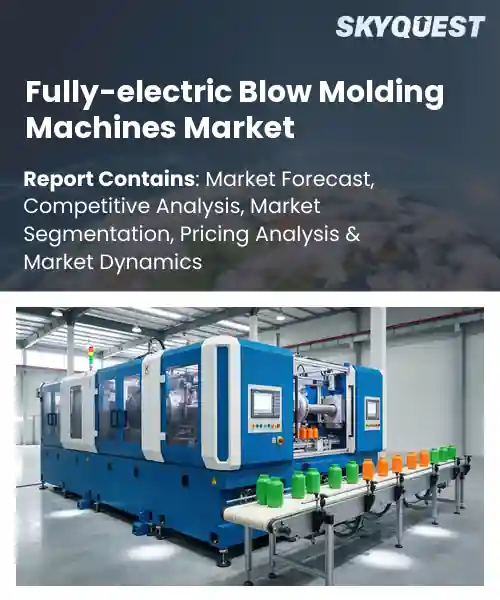
Fully-electric Blow Molding Machines Market
Report ID: SQMIG20I2775
Report ID: SQMIG20I2775
[email protected]
USA +1 351-333-4748
Report ID:
SQMIG20I2775 |
Region:
Global |
Published Date: March, 2026
Pages:
157
|Tables:
116
|Figures:
76


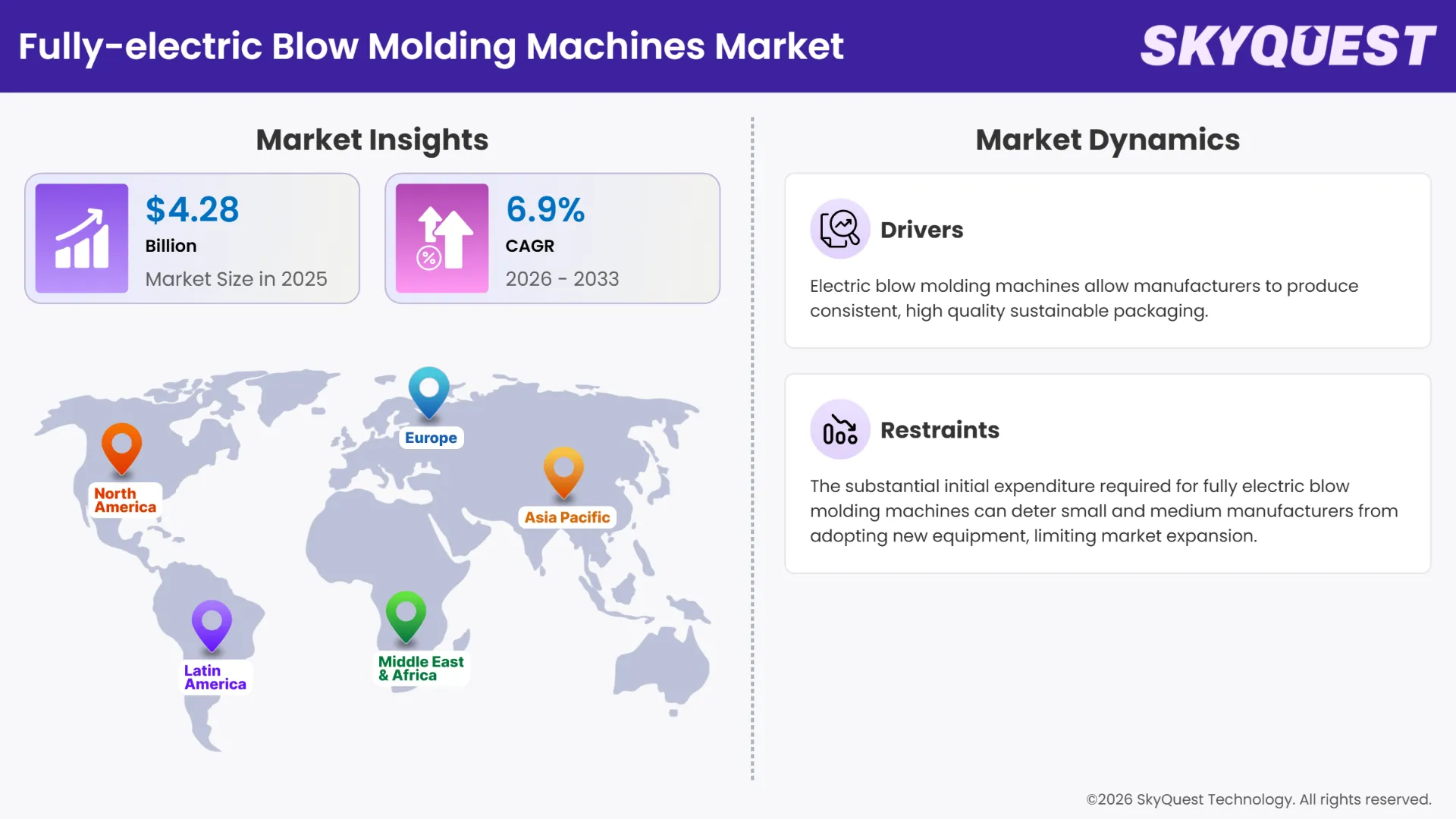
Global Fully-Electric Blow Molding Machines Market size was valued at USD 4.0 Billion in 2024 and is poised to grow from USD 4.28 Billion in 2025 to USD 7.29 Billion by 2033, growing at a CAGR of 6.9% during the forecast period (2026-2033).
Key Takeaways: Market Trends & Insights
The primary driver behind the fully-electric blow molding machines market is operational efficiency allied with sustainability pressures, which has reshaped demand across packaging sectors. This market consists of equipment that forms plastic parts using electric servo motors rather than hydraulic systems, and it matters because manufacturers obtain faster cycles, cleaner output and lower energy use. Over the last decade, the sector shifted from hydraulic platforms to small electric architectures as a result of increased energy prices and more stringent emission restrictions. As evidenced by beverage and pharmaceutical companies adopting electric equipment in order to manufacture lighter PET containers and medical containers, they are reducing the amount of waste produced and increasing their volume of production significantly.
The key trend driving global fully-electric blow molding machines sector is digital integration, because machines connected to IoT platforms enable predictive maintenance and process optimization that materially cut downtime and warranty costs. By implementing sensors and cloud-based analytics, manufacturers can detect mold wear and material inconsistencies earlier, resulting in improved yield, reduced lifecycle costs, and fewer unplanned stoppages and faster change overs at a beverage plant that has implemented real-time monitoring. Additionally, the connectivity provided by these technologies enables manufacturers to provide remote diagnostics and batch traceability, which can open up new aftermarket service opportunities, subscription services, and retrofitting in emerging markets where capital budgets are more likely to support modular upgrades vs. complete replacements.
How is AI Enhancing Quality Control in the Fully-Electric Blow Molding Machines Market?
Fully electric blow molding machines combine precise servo drives, oil free operation and advanced digital controls which create ideal conditions for AI driven quality control. AI systems ingest high resolution vision data and multi sensor feeds to detect subtle surface defects, material inconsistencies and process drift. These models enable real time statistical process control and closed loop adjustments that reduce manual inspection and improve uptime. Vendors are integrating predictive maintenance and operator guidance so manufacturers in beverage, medical and industrial packaging achieve cleaner output and more consistent parts while speeding changeovers and lowering waste.
In October 2025, ST BlowMoldingunveiled a fully electric 220 L drum machine at K 2025 that embeds IO Link sensors and OPC UA connectivity and supports AI assisted in line inspection and SPC to reduce rejects and shorten changeovers, boosting production efficiency and market appeal.
To get more insights on this market click here to Request a Free Sample Report
Global fully-electric blow molding machines market is segmented by machine type, drive system component, production output/capacity, end-use industry and region. Based on machine type, the market is segmented into all-electric stretch blow molding and all-electric extrusion blow molding. Based on drive system component, the market is segmented into servo-electric motors & drives, precision ball screws and integrated motion controllers. Based on production output/capacity, the market is segmented into low-cavity machines and high-speed multi-cavity systems. Based on end-use industry, the market is segmented into beverage & liquid food packaging, personal care & cosmetic containers, pharmaceutical & medical bottles and household chemical packaging. Based on region, the market is segmented into North America, Europe, Asia Pacific, Latin America and Middle East & Africa.
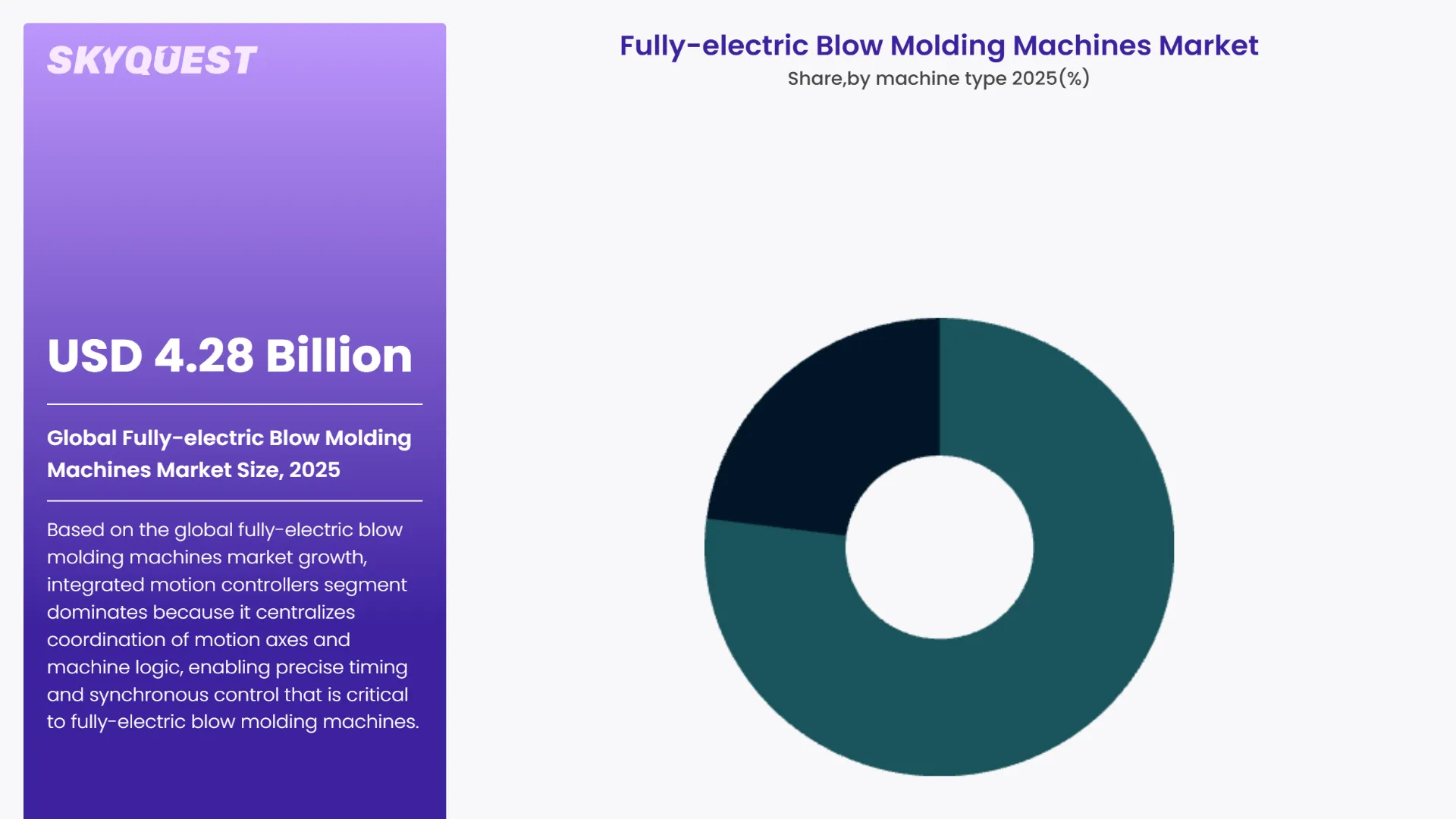
Based on the global fully-electric blow molding machines market growth, integrated motion controllers segment dominates because it centralizes coordination of motion axes and machine logic, enabling precise timing and synchronous control that is critical to fully-electric blow molding machines. The centralized intelligence decreases the cycle time variation and allows for more advanced diagnosis, which increases the uptime and assures consistent quality of parts that are produced. By providing a tightly integrated supervisory control system, changeovers are simpler, automation is more scalable, and predictive maintenance is facilitated; thus creating a preference from buyers for machines that offer smarter control capabilities.
However, servo-electric motors & drives is the most rapidly expanding area, driven by demand for energy-efficient, high-torque actuators that enable faster cycle profiles and lower operating energy. The increasing use of compact servos is making for easier machine designs and improved replicability while implementing new opportunity processes for controlling machines and their efficiency through advanced ways of moving them.
All-electric stretch blow molding segment leads because its process delivers superior molecular orientation and thin-wall distribution that meet brand demands for lightweight, high clarity containers. By allowing quicker production of beverage containers while maintaining consistent dimensional and surface finish, this technology reduces material used and energy required to produce each part and because of its proven ability to work in high-volume production facilities, it attracts both investments from original equipment manufacturers (OEMs) and aftermarket (AM) support, therefore lowering the total cost of ownership.
However, all-electric extrusion blow molding is the most rapidly expanding area, driven by demand for larger, complex hollow containers and flexible polymer formulations requiring extrusion processing. Innovations in screw design and process control expand its use across industrial and personal care packaging, creating opportunities through lower tooling needs and wider material compatibility.
To get detailed segments analysis, Request a Free Sample Report
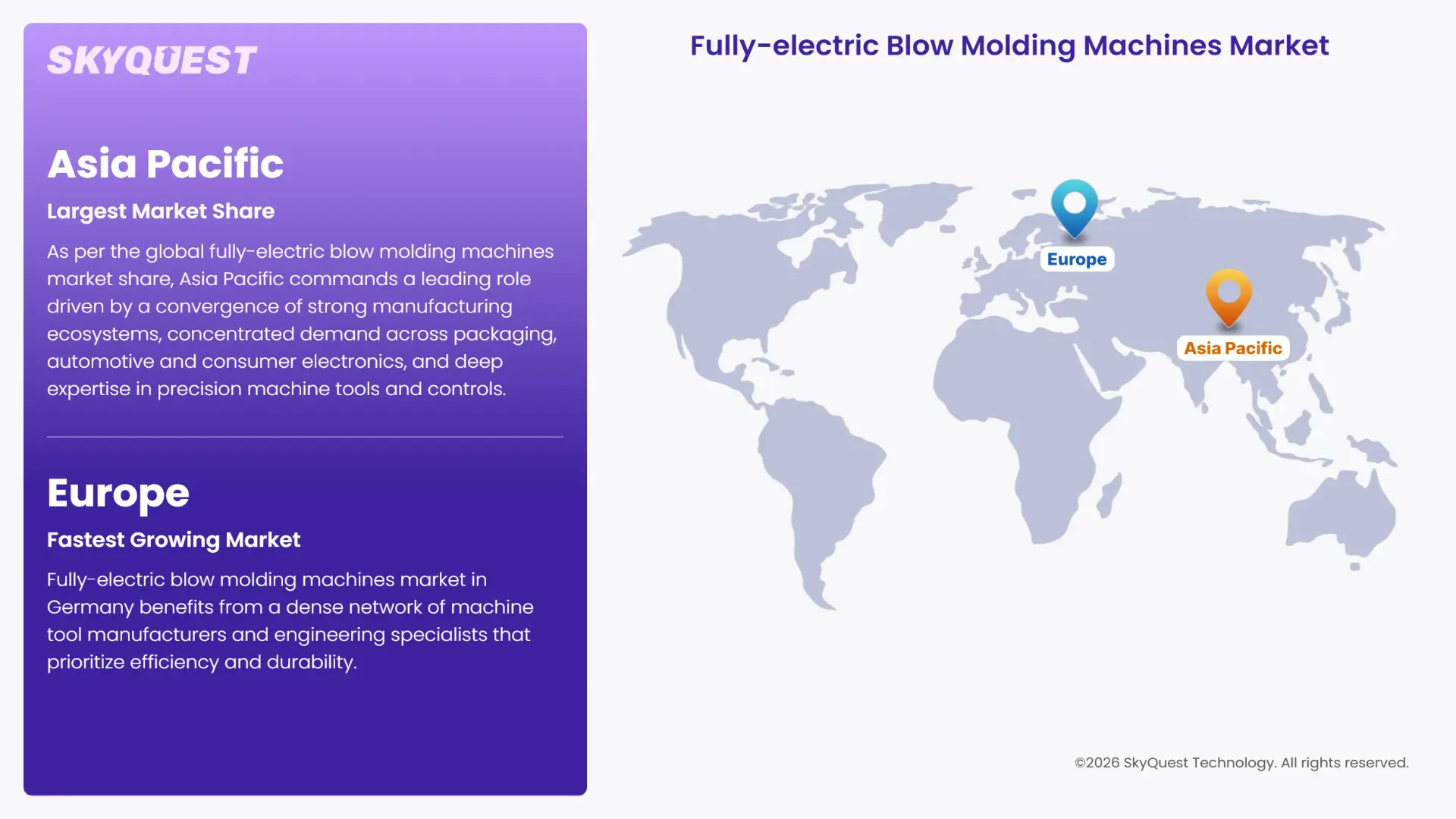
As per the global fully-electric blow molding machines market share, Asia Pacific commands a leading role driven by a convergence of strong manufacturing ecosystems, concentrated demand across packaging, automotive and consumer electronics, and deep expertise in precision machine tools and controls. Companies located in both South Korea and Japan are developing more efficient servo systems that have compact designs, are energy-efficient, and meet demanding quality standards. Because of this, the lead time of components is reduced, and local manufacturers can customize their products. The local after-sales service networks and emphasis on continuous improvement provide manufacturers with rapid feedback as well as the ability to adjust quickly based on field experience. The local manufacturers produce at low enough costs that they are able to compete internationally by exporting their production facilities to other countries. The result is a market environment where innovation, volume capability and service excellence reinforce each other, sustaining dominance in fully-electric blow molding equipment deployment.
Fully-electric blow molding machines market benefits from a mature precision engineering ecosystem and a concentration of high technology suppliers focused on energy efficient automation. Close cooperation between OEMs (Original Equipment Manufacturers) and their end users, creates customized solutions for the extremely complicated packaging and auto components. A strong service network and commitment to quality and reliability, maintains a premium position for the OEMs, however, continuous innovations in the controls and servo drive technologies, allow them to continue to maintain their position at the top of the domestic market and globally for exporting.
Fully-electric blow molding machines market in leverages strong electronics manufacturing capability and system integration expertise to support versatile machine designs suited for diverse polymer applications. Local manufacturers of machines focus on having compact designs with fast setup times and digital connectivity that attracts contract packagers and consumer goods manufacturers. Collaborative research between the machine manufacturers and material suppliers helps to increase the adoption of servo systems and predictive maintenance systems, which in turn improves the efficiency of operations and competitiveness throughout the supply chain.
Based on global fully-electric blow molding machines market regional forecast, Europe is experiencing rapid expansion propelled by regulatory emphasis on energy efficiency, sustainability mandates and a strong drive toward circular packaging systems that favor fully-electric platforms. The focus of machine manufacturers and brand owners will continue to be on reducing operational energy usage for machines and creating compatibility with recycled polymer materials to drive machine upgrades and new investment across the continent. Germany has strong engineering capabilities, and innovation hubs and service providers in western Europe assist with the integration of systems and digitalization. Financing approaches through retrofit channels will support a more accessible entry to converter companies for conversion and collaborative networks of equipment suppliers, materials suppliers, and research organizations will help facilitate faster implementation of practical electric blow molding systems.
Fully-electric blow molding machines market in Germany benefits from a dense network of machine tool manufacturers and engineering specialists that prioritize efficiency and durability. End-users in the automotive and packaging industries typically choose customized solutions that include sophisticated controls and include the ability to recover energy in the form of heat. By providing strong customer support through an integrated vendor and component supplier, a company can establish itself as a leader in the industrial value chain.
Fully-electric blow molding machines market in United Kingdom is characterized by growing interest from contract packagers and boutique manufacturers seeking flexible, low energy solutions. Additionally, strong support for machine retrofitting and digitalization projects are provided through services and consulting offered by suppliers. Innovation in optimizing processes and using materials efficiently throughout networks results from collaborative efforts between suppliers, academic research centers, and systems integrators.
Fully-electric blow molding machines market in France is shaped by an accelerating shift toward low energy and circular packaging solutions, with manufacturers and brands prioritizing machine performance that supports recycled material processing. Equipment vendors deliver solutions that are focused on providing a solution designed for optimal material handling and the gentle processing of plastics. In collaboration with machine manufacturers, converters and sustainable design consultants work together on projects to execute their plans as well as grow the business, creating a supportive environment that encourages the quick adoption of new technologies while aligning their entire ecosystem.
As per global fully-electric blow molding machines market regional outlook, North America is strengthening its position through a combination of manufacturing modernization, demand for high quality packaging in regulated sectors and supplier focus on automation and lifecycle support. Equipment upgrades and new capital projects are all being driven by requirements for energy savings, as well as for better process control and greater availability of assets, with some focus on uses in the medical and food packaging markets. Domestic original equipment manufacturers (OEMs) work collaboratively with system integrators and their own end-user customers to create modular platforms and provide integrated digital monitoring capabilities. Resiliency of supply chain and occasional resourcing activities to the United States are increasing capital investment into flexible manufacturing technologies and having strong aftermarket service ecosystems and training support networks help to ensure long-term operating reliability.
Fully-electric blow molding machines market in United States is influenced by medical, beverage and packaging demand for energy efficient systems with precise process control. Systems integrators and OEMs provide modular platforms that facilitate automation and enable predictive maintenance. Equipment upgrades due both to a substantial retrofit industry and emphasis on supply chain resilience, coupled with end users working alongside machine suppliers to accelerate the adoption of digital monitoring and lifetime support service programs drive innovation in the industry.
Fully-electric blow molding machines market in Canada is shaped by concentration of small and medium converters seeking flexible, energy conscious equipment that supports recycled content and sustainable packaging initiatives. We relied upon local suppliers and original equipment manufacturers (OEMs) to deliver a compact, low-maintenance platform that offers strong after-sales support and diagnostic capabilities. In addition to focusing on providing reliable processes, we collaborated closely with our raw materials suppliers on the variability of the polymers used in these products.
To know more about the market opportunities by region and country, click here to
Buy The Complete Report
Rising Demand For Sustainable Packaging
Electric blow molding machines allow manufacturers to produce consistent, high quality sustainable packaging. For these manufacturers, the risk of contamination is reduced and materials will be better controlled by using electric blow molding machines. This reduction of risk aligns with consumer demand for eco-friendly products. Eco-friendly products are offered through precise process controls, lower energy profiles during production and the use of recycled resins. Converting to electric blow molding machines allows brand owners to meet sustainability and improve their supply chain's ability to have visibility over their products. A majority of manufacturers are driven to convert to electric blow molding due to the desire to have a reduced lifecycle environmental impact and increased product differentiation.
The latest improvements to electric drive systems and other components of motion control and machine design have improved both production efficiency and production flexibility; as a result, it is now possible for manufacturers to produce multiple container designs in a shorter period of time with greater reliability than ever before. Also, by using improved energy management systems along with fewer service outages due to lower maintenance requirements, total cost of ownership is kept lower while at the same time making electric machines, even with their increased initial purchase price and more appealing than legacy technologies.
High Upfront Capital Investment
The substantial initial expenditure required for fully electric blow molding machines can deter small and medium manufacturers from adopting new equipment, limiting market expansion. A larger capital commitment will create competition with other operational priorities, extending procurement cycles, especially when external finance solutions are limited. As decision makers prefer to upgrade rather than replace existing Pneumatic and/or Hydraulic systems, fleet churn will be slower. This financial barrier creates a very cautious purchase environment whereby only companies with evident long-term cost and sustainability strategy will progress with the purchase, limiting short-term market growth.
Limited Skilled Workforce Availability
Adoption of fully electric systems requires specialized maintenance skills and familiarity with advanced motion control and software that many manufacturers currently lack, creating operational risk and hesitancy. Training and upskilling programs demand time and organizational resources, and reliance on external service providers can increase operational costs and response times. Concerns about troubleshooting and keeping production running smoothly without experienced personnel discourage firms from switching, particularly where in house expertise is limited, thereby slowing replacement cycles and limiting broader market penetration and adoption rates.
Request Free Customization of this report to help us to meet your business objectives.
Competition in the global fully-electric blow molding machines market outlook is concentrated among established OEMs that use acquisitions, targeted partnerships, and rapid product launches to defend share and add capabilities. SIPA recently introduced the entry level Start Blow fully electric line, Bekum expanded electric and hybrid model ranges while boosting service and retrofit offerings, and major suppliers pursued joint ventures to accelerate lightweighting and circular packaging solutions.
SkyQuest’s ABIRAW (Advanced Business Intelligence, Research & Analysis Wing) is our Business Information Services team that Collects, Collates, Correlates, and Analyses the Data collected by means of Primary Exploratory Research backed by robust Secondary Desk research.
As per SkyQuest analysis, the global fully-electric blow molding machines industry is being driven primarily by operational efficiency and sustainability pressures that reduce energy use and improve throughput, while a second driver is digital integration and IoT-enabled predictive maintenance that cuts downtime and enables new service models. A key restraint remains the high upfront capital investment required, which slows adoption among small and medium converters. Due to their established manufacturing bases, connected supply chain partners, and fast post-sale service, the Asia Pacific region has the largest share in the market, with integrated motion controllers being by far the largest product area since central control allows for enhanced repeatability throughout a production cycle, improved diagnosis and enhanced scalability across high-end electric systems.
| Report Metric | Details |
|---|---|
| Market size value in 2024 | USD 4.0 Billion |
| Market size value in 2033 | USD 7.29 Billion |
| Growth Rate | 6.9% |
| Base year | 2024 |
| Forecast period | 2026-2033 |
| Forecast Unit (Value) | USD Billion |
| Segments covered |
|
| Regions covered | North America (US, Canada), Europe (Germany, France, United Kingdom, Italy, Spain, Rest of Europe), Asia Pacific (China, India, Japan, Rest of Asia-Pacific), Latin America (Brazil, Rest of Latin America), Middle East & Africa (South Africa, GCC Countries, Rest of MEA) |
| Companies covered |
|
| Customization scope | Free report customization with purchase. Customization includes:-
|
To get a free trial access to our platform which is a one stop solution for all your data requirements for quicker decision making. This platform allows you to compare markets, competitors who are prominent in the market, and mega trends that are influencing the dynamics in the market. Also, get access to detailed SkyQuest exclusive matrix.
Table Of Content
Executive Summary
Market overview
Parent Market Analysis
Market overview
Market size
KEY MARKET INSIGHTS
COVID IMPACT
MARKET DYNAMICS & OUTLOOK
Market Size by Region
KEY COMPANY PROFILES
Methodology
For the Fully-electric Blow Molding Machines Market, our research methodology involved a mixture of primary and secondary data sources. Key steps involved in the research process are listed below:
1. Information Procurement: This stage involved the procurement of Market data or related information via primary and secondary sources. The various secondary sources used included various company websites, annual reports, trade databases, and paid databases such as Hoover's, Bloomberg Business, Factiva, and Avention. Our team did 45 primary interactions Globally which included several stakeholders such as manufacturers, customers, key opinion leaders, etc. Overall, information procurement was one of the most extensive stages in our research process.
2. Information Analysis: This step involved triangulation of data through bottom-up and top-down approaches to estimate and validate the total size and future estimate of the Fully-electric Blow Molding Machines Market.
3. Report Formulation: The final step entailed the placement of data points in appropriate Market spaces in an attempt to deduce viable conclusions.
4. Validation & Publishing: Validation is the most important step in the process. Validation & re-validation via an intricately designed process helped us finalize data points to be used for final calculations. The final Market estimates and forecasts were then aligned and sent to our panel of industry experts for validation of data. Once the validation was done the report was sent to our Quality Assurance team to ensure adherence to style guides, consistency & design.
Analyst Support
Customization Options
With the given market data, our dedicated team of analysts can offer you the following customization options are available for the Fully-electric Blow Molding Machines Market:
Product Analysis: Product matrix, which offers a detailed comparison of the product portfolio of companies.
Regional Analysis: Further analysis of the Fully-electric Blow Molding Machines Market for additional countries.
Competitive Analysis: Detailed analysis and profiling of additional Market players & comparative analysis of competitive products.
Go to Market Strategy: Find the high-growth channels to invest your marketing efforts and increase your customer base.
Innovation Mapping: Identify racial solutions and innovation, connected to deep ecosystems of innovators, start-ups, academics, and strategic partners.
Category Intelligence: Customized intelligence that is relevant to their supply Markets will enable them to make smarter sourcing decisions and improve their category management.
Public Company Transcript Analysis: To improve the investment performance by generating new alpha and making better-informed decisions.
Social Media Listening: To analyze the conversations and trends happening not just around your brand, but around your industry as a whole, and use those insights to make better Marketing decisions.
REQUEST FOR SAMPLE
 REQUEST FREE CUSTOMIZATION
Global Fully-Electric Blow Molding Machines Market size was valued at USD 4.0 Billion in 2024 and is poised to grow from USD 4.28 Billion in 2025 to USD 7.29 Billion by 2033, growing at a CAGR of 6.9% during the forecast period (2026-2033).
Competition in the global fully electric blow molding machines market is concentrated among established OEMs that use acquisitions, targeted partnerships, and rapid product launches to defend share and add capabilities. SIPA recently introduced the entry level Start Blow fully electric line, Bekum expanded electric and hybrid model ranges while boosting service and retrofit offerings, and major suppliers pursued joint ventures to accelerate lightweighting and circular packaging solutions. 'Krones AG', 'Sacmi Imola S.C.', 'SIPA S.p.A.', 'Aoki Technical Laboratory', 'Nissei ASB Machine', 'Kautex Maschinenbau', 'Bekum Maschinenfabriken', 'SMI S.p.A.', 'Uniloy Inc.', 'Jomar Corporation', 'ST BlowMoulding', 'PET Technologies', 'Meccanoplastica S.R.L.', 'Parker Plastic Machinery', 'Jagmohan Pla-Mach', 'Shyam Plastic Machinery', 'Chumpower Machinery', 'Yankang Plastic Machinery', 'ZQ Machinery'
Fully electric blow molding machines enable manufacturers to produce consistent, high quality sustainable packaging with reduced contamination risk and greater material control, which aligns with consumer demand for eco friendly products. By providing precise process control, lower energy profiles during production, and compatibility with recycled resins, these machines help brand owners meet sustainability commitments and improve supply chain visibility. Adoption is often driven by the desire to reduce lifecycle environmental impact and enhance product differentiation, prompting investment in electric equipment across packaging manufacturers seeking competitive advantage.
Sustainable Material Innovation: Manufacturers and converters are prioritizing compatibility with recycled and bio-based polymers, prompting machine makers to optimize thermal profiles, mold design flexibility, and gentle handling to preserve material properties. This shift supports closed-loop packaging and reduces dependence on virgin resins by enabling consistent output quality with diverse feedstocks. Suppliers emphasize modular machine platforms that accommodate material variability and facilitate rapid changeovers. The market values equipment that aligns with corporate sustainability targets while maintaining productivity and minimizing material degradation across production cycles.
Asia Pacific Dominate the Global Fully-electric Blow Molding Machines Market.
The All-electric Stretch Blow Molding segment holds the largest market share due to its extensive use in PET bottle production for beverages, pharmaceuticals, and consumer goods packaging.
All-electric Stretch Blow Molding is also expected to witness the fastest growth, supported by rising demand for lightweight, sustainable, and high-quality plastic packaging solutions.
AI is enhancing quality control through real-time defect detection, predictive maintenance, process optimization, and automated production adjustments. These capabilities help manufacturers reduce waste, improve consistency, and minimize downtime.


Want to customize this report? This report can be personalized according to your needs. Our analysts and industry experts will work directly with you to understand your requirements and provide you with customized data in a short amount of time. We offer $1000 worth of FREE customization at the time of purchase.
Feedback From Our Clients


 USA (+1) 351-333-4748

