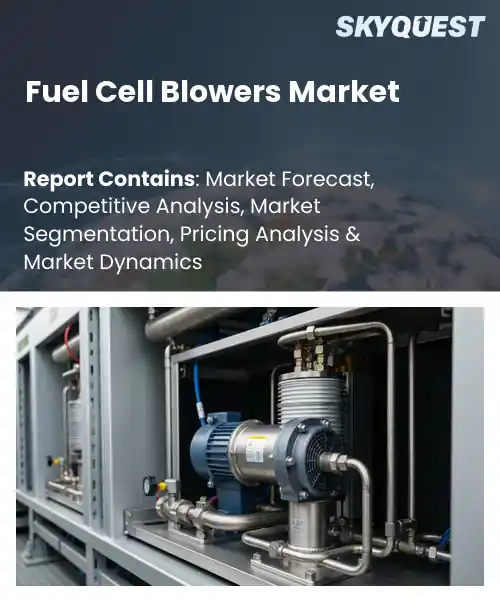
Fuel Cell Blowers Market
Report ID: SQMIG20D2485
Report ID: SQMIG20D2485
[email protected]
USA +1 351-333-4748
Report ID:
SQMIG20D2485 |
Region:
Global |
Published Date: February, 2026
Pages:
157
|Tables:
113
|Figures:
77


Global Fuel Cell Blowers Market size was valued at USD 0.76 Billion in 2024 and is poised to grow from USD 0.87 Billion in 2025 to USD 2.53 Billion by 2033, growing at a CAGR of 14.3% during the forecast period (2026-2033).
Fuel cell blowers market is driven by accelerating deployment of proton exchange membrane and solid oxide fuel cells across automotive and stationary applications. These blowers supply and regulate oxygen and air pressure necessary for electrochemical reactions, making them a critical balance of plant component that directly affects efficiency and reliability. The market matters because blower performance reduces system cost and enables higher power density, which in turn influences manufacturer adoption and end user economics. Over the last decade innovations shifted from generic centrifugal fans to high-precision corrosion‑resistant turbo blowers in automotive PEMFC such as Toyota Mirai and backup power systems.Building on advances in blower precision and materials, economies of scale and emissions regulations are key factors accelerating market growth. As automakers, telecom operators and stationary power integrators demand compact durable blowers to meet performance and warranty targets, suppliers invest in mass production and control algorithms which lowers unit costs and broadens adoption. For example, automotive OEMs incorporate high-speed blowers to improve cold start performance, causing higher volumes and enabling suppliers to offer variants for backup power at data centers and telecom towers. The result is a virtuous cycle where performance-driven demand reduces prices and expands use cases across sectors.
How is AI improving performance of fuel cell blowers?
AI is improving fuel cell blower performance by making design and operation smarter and more adaptive. Key aspects include AI driven aerodynamic design which finds quieter and more efficient impeller shapes, adaptive control that matches blower speed and pressure to stack demand in real time, and predictive analytics that spot faults before they reduce output. Today manufacturers and system integrators are adopting these techniques as fuel cell deployments expand in transport and stationary power. Practical instances range from generative design producing novel prototypes to machine learning based control that stabilizes humidity and pressure for longer stack life.MAHLE April 2025, showcased an AI optimized bionic blower that used machine learning to generate impeller shapes and refine airflow and noise performance. This technology reduces energy use and simplifies packaging which helps make fuel cell systems more efficient and easier to integrate, supporting market growth.
Market snapshot - (2026-2033)
Global Market Size
USD 0.76 Billion
Largest Segment
Proton Exchange Membrane
Fastest Growth
Proton Exchange Membrane
Growth Rate
14.3% CAGR
To get more insights on this market click here to Request a Free Sample Report
Global fuel cell blowers market is segmented by fuel cell type, blower design, application area, end user and region. Based on fuel cell type, the market is segmented into Proton Exchange Membrane and Solid Oxide Fuel Cells. Based on blower design, the market is segmented into Centrifugal Blowers and Positive Displacement. Based on application area, the market is segmented into Transportation and Power Integration. Based on end user, the market is segmented into Automotive Industry and Energy Sector. Based on region, the market is segmented into North America, Europe, Asia Pacific, Latin America and Middle East & Africa.
Proton Exchange Membrane segment dominates because its low-temperature operation, rapid start and stop capability, and vehicle-oriented design create persistent demand for compact, responsive blowers in the Fuel Cell Blowers Market. OEM integration requirements and established supply chains drive standardized blower specifications, while sensitivity to humidification, transient load control, and thermal management forces manufacturers to prioritize high-performance, precisely controllable blower architectures that align with automotive reliability and packaging constraints and cost targets.
However, Solid Oxide Fuel Cells are emerging as the fastest growing area as innovations lowering operating temperatures and rising demand for stationary high-efficiency power increase need for blowers that tolerate higher thermal stresses and varied oxidant flows. Expansion in industrial and power integration use cases is creating new specialized blower opportunities.
Centrifugal Blowers segment dominates because their ability to deliver stable, high-pressure air flow with compact axial footprint meets the performance and packaging demands of both transportation and power integration applications in the Fuel Cell Blowers Market. Proven manufacturing scalability and lower acoustic signatures reduce integration risk for OEMs, while predictable aerodynamic behavior simplifies control strategies, enabling suppliers to standardize designs across multiple fuel cell platforms and support broad adoption.
However, Positive Displacement blowers are the fastest growing design choice as applications demand precise, pulsation-tolerant pressurization and reliable operation under variable loads. Material and seal advances enable compact, efficient positive displacement units for niche transportation and distributed energy use cases, creating retrofit and aftermarket opportunities that broaden supplier roles.
To get detailed segments analysis, Request a Free Sample Report
Asia Pacific dominates the global fuel cell blowers market due to a combination of industrial depth, concentrated demand, and coordinated policy support. Large automotive manufacturers and stationary power integrators in the region drive sustained demand for high reliability and efficiency, encouraging local production and scale advantages. Established component suppliers and specialized OEMs create dense supply chains that lower integration friction and accelerate innovation. Strategic government programs and collaborative research and development between industry and research institutes support component optimization and qualification. Regional investments in hydrogen infrastructure and refueling ecosystems further stimulate adoption across mobility and distributed generation segments. Proximity to major stack manufacturers and export oriented production hubs reinforce cost competitiveness and shorten development cycles, maintaining a leadership position in technology refinement and commercial deployment.
Fuel Cell Blowers Market in Japan is characterized by close collaboration between automotive OEMs, component manufacturers, and research institutions, fostering integration of optimized blower technology into fuel cell systems. Strong focus on durability and compact design aligns with automotive and residential applications, while quality assurance standards and supplier networks support localized manufacturing. Ongoing refinement of system integration and testing protocols helps align blower performance with strict reliability expectations and niche deployments.
Fuel Cell Blowers Market in South Korea benefits from integration with fuel cell stack producers and a concentrated manufacturing ecosystem that emphasizes high performance and miniaturization. Domestic suppliers focus on engineering solutions tailored to mobility and stationary power use cases, supported by collaborative development cycles with system integrators. Emphasis on materials optimization and thermal management enhances blower efficiency, while export orientation and alignment with regional standards support broader commercial adoption.
Rapid expansion in Europe is being driven by coordinated industrial strategies, strong commitments to low emission technologies, and active engagement from major automotive and energy companies. Demand from transport electrification programs and a growing focus on clean distributed generation create a diverse set of use cases that require reliable, efficient blowers. German industrial leadership, combined with specialized manufacturing clusters, supports component qualification and large scale testing. Policy frameworks and funding mechanisms encourage demonstration projects and supplier partnerships, while a growing ecosystem of integrators and stack manufacturers fosters interoperability and standardization. Emphasis on system safety, noise reduction, and lifecycle sustainability is encouraging the adoption of advanced blower designs that meet stringent regulatory and customer expectations across urban and commercial deployments. Cross border collaboration and harmonized standards accelerate market scaling and reduce barriers to supplier entry.
Fuel Cell Blowers Market in Germany is led by deep industrial expertise and close integration with automotive and energy equipment manufacturers. Engineering capabilities and specialized production facilities support rigorous qualification and performance validation of blower components. Supply chain maturity and precision manufacturing facilitate prototyping and iterative improvements. Collaboration between research centers and industry accelerates development of low noise and high reliability solutions, aligning blower performance with stringent operational and regulatory expectations across key applications.
Fuel Cell Blowers Market in United Kingdom is driven by innovation and a growing ecosystem of startups, integrators, and research centers accelerating adoption. Emphasis on demonstration programs and public private partnerships encourages system validation and market entry for advanced blower designs. Manufacturers prioritize compactness, noise reduction, and energy efficiency for urban deployments. Focus on cross sector collaboration and export oriented strategies helps convert pilot projects into broader commercial opportunities across transport and distributed energy applications.
Fuel Cell Blowers Market in France is emerging through targeted industrial initiatives and engagement from energy and transport integrators. Emphasis on system optimization and lifecycle sustainability encourages the adoption of quieter, more durable blower solutions suited to urban and stationary settings. Local manufacturers are refining designs to meet integration needs, while collaboration with academic centers supports material and efficiency improvements. Interest from fleet operators and distributed energy providers is fostering gradual commercial expansion.
North America is strengthening its position through a blend of technology driven innovation, strategic industrial partnerships, and targeted commercialization efforts that bridge laboratory advances with market ready products. Active collaboration between stack manufacturers, blower OEMs, and system integrators accelerates validation across diverse applications including heavy duty, stationary backup, and distributed generation. Investment in manufacturing capacity and supply chain resilience encourages localized production and faster response to customer requirements. Focus on standardization, performance testing, and interoperability reduces integration barriers and shortens time to deployment. Market actors are prioritizing noise abatement, reliability, and serviceability to meet demanding operational contexts. Cross border collaboration and knowledge sharing between United States and Canada support a complementary regional approach that leverages distinct industrial strengths. Demonstration projects and fleet trials provide practical feedback loops that inform design refinement and support early commercial uptake across key sectors.
Fuel Cell Blowers Market in United States is driven by a convergence of research innovation and industrial partnerships focused on heavy duty transport and stationary power. Blower manufacturers work closely with integrators to meet stringent reliability and serviceability expectations for demanding operational profiles. Emphasis on modular designs and maintainability supports fleet and backup power applications, while investment in localized manufacturing and testing facilities enables faster iteration and alignment with customer performance requirements.
Fuel Cell Blowers Market in Canada emphasizes niche applications and collaborative development that leverage strengths in clean energy integration. Domestic suppliers concentrate on tailored blower solutions for remote power backup and industrial stationary systems, prioritizing robustness and ease of maintenance. Collaboration with research institutions and pilot deployments provides practical performance data to inform design enhancement. Export oriented strategies and partnerships with regional integrators help translate Canadian innovations into wider commercial opportunities.
To know more about the market opportunities by region and country, click here to
Buy The Complete Report
Increasing Demand For Clean Energy
Advancements In Fan And Motor Technology
High Component Complexity And Integration
Supply Chain And Manufacturing Challenges
Request Free Customization of this report to help us to meet your business objectives.
Competition in the global fuel cell blowers market is intensifying as Tier 1 suppliers and system startups deploy advanced recirculation blowers and high speed air compressors to improve fuel utilization and stack durability. Growth is driven by strategic partnerships and technology transfers for turbomachinery and gas bearing motors, illustrated by ZF and Eaton product launches and recent IP acquisitions following Hyzon’s restructuring.
Top Player’s Company Profile
Recent Developments
SkyQuest’s ABIRAW (Advanced Business Intelligence, Research & Analysis Wing) is our Business Information Services team that Collects, Collates, Correlates, and Analyses the Data collected by means of Primary Exploratory Research backed by robust Secondary Desk research. As per SkyQuest analysis, the global fuel cell blowers market is positioned for robust expansion driven first by increasing demand for clean energy and fuel cell deployments and second by rapid advances in fan and motor technology and AI-enabled design and control which improve efficiency and integration. Growth is tempered by the high component complexity and integration requirements that lengthen development cycles and raise technical risk for suppliers. Asia Pacific remains the dominant region thanks to strong automotive and stationary power ecosystems, while Proton Exchange Membrane applications lead the market due to their vehicle focus and standardized blower specifications that support scale and reliability.
| Report Metric | Details |
|---|---|
| Market size value in 2024 | USD 0.76 Billion |
| Market size value in 2033 | USD 2.53 Billion |
| Growth Rate | 14.3% |
| Base year | 2024 |
| Forecast period | (2026-2033) |
| Forecast Unit (Value) | USD Billion |
| Segments covered |
|
| Regions covered | North America (US, Canada), Europe (Germany, France, United Kingdom, Italy, Spain, Rest of Europe), Asia Pacific (China, India, Japan, Rest of Asia-Pacific), Latin America (Brazil, Rest of Latin America), Middle East & Africa (South Africa, GCC Countries, Rest of MEA) |
| Companies covered |
|
| Customization scope | Free report customization with purchase. Customization includes:-
|
To get a free trial access to our platform which is a one stop solution for all your data requirements for quicker decision making. This platform allows you to compare markets, competitors who are prominent in the market, and mega trends that are influencing the dynamics in the market. Also, get access to detailed SkyQuest exclusive matrix.
Table Of Content
Executive Summary
Market overview
Parent Market Analysis
Market overview
Market size
KEY MARKET INSIGHTS
COVID IMPACT
MARKET DYNAMICS & OUTLOOK
Market Size by Region
KEY COMPANY PROFILES
Methodology
For the Fuel Cell Blowers Market, our research methodology involved a mixture of primary and secondary data sources. Key steps involved in the research process are listed below:
1. Information Procurement: This stage involved the procurement of Market data or related information via primary and secondary sources. The various secondary sources used included various company websites, annual reports, trade databases, and paid databases such as Hoover's, Bloomberg Business, Factiva, and Avention. Our team did 45 primary interactions Globally which included several stakeholders such as manufacturers, customers, key opinion leaders, etc. Overall, information procurement was one of the most extensive stages in our research process.
2. Information Analysis: This step involved triangulation of data through bottom-up and top-down approaches to estimate and validate the total size and future estimate of the Fuel Cell Blowers Market.
3. Report Formulation: The final step entailed the placement of data points in appropriate Market spaces in an attempt to deduce viable conclusions.
4. Validation & Publishing: Validation is the most important step in the process. Validation & re-validation via an intricately designed process helped us finalize data points to be used for final calculations. The final Market estimates and forecasts were then aligned and sent to our panel of industry experts for validation of data. Once the validation was done the report was sent to our Quality Assurance team to ensure adherence to style guides, consistency & design.
Analyst Support
Customization Options
With the given market data, our dedicated team of analysts can offer you the following customization options are available for the Fuel Cell Blowers Market:
Product Analysis: Product matrix, which offers a detailed comparison of the product portfolio of companies.
Regional Analysis: Further analysis of the Fuel Cell Blowers Market for additional countries.
Competitive Analysis: Detailed analysis and profiling of additional Market players & comparative analysis of competitive products.
Go to Market Strategy: Find the high-growth channels to invest your marketing efforts and increase your customer base.
Innovation Mapping: Identify racial solutions and innovation, connected to deep ecosystems of innovators, start-ups, academics, and strategic partners.
Category Intelligence: Customized intelligence that is relevant to their supply Markets will enable them to make smarter sourcing decisions and improve their category management.
Public Company Transcript Analysis: To improve the investment performance by generating new alpha and making better-informed decisions.
Social Media Listening: To analyze the conversations and trends happening not just around your brand, but around your industry as a whole, and use those insights to make better Marketing decisions.
REQUEST FOR SAMPLE
 REQUEST FREE CUSTOMIZATION


Want to customize this report? This report can be personalized according to your needs. Our analysts and industry experts will work directly with you to understand your requirements and provide you with customized data in a short amount of time. We offer $1000 worth of FREE customization at the time of purchase.
Feedback From Our Clients


 USA (+1) 351-333-4748

