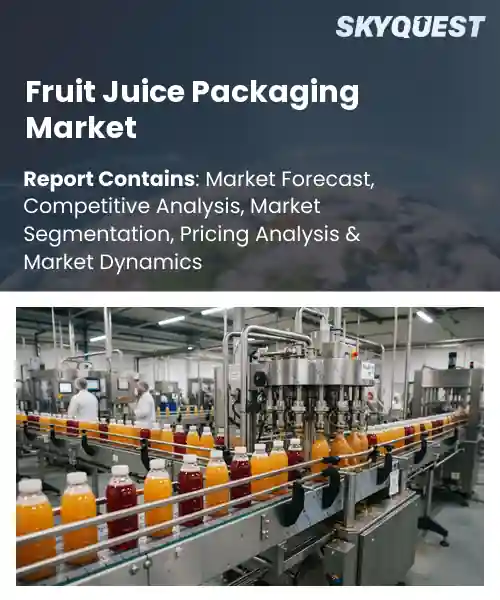
Fruit Juice Packaging Market
Report ID: SQMIG15H2339
Report ID: SQMIG15H2339
[email protected]
USA +1 351-333-4748
Report ID:
SQMIG15H2339 |
Region:
Global |
Published Date: September, 2026
Pages:
157
|Tables:
125
|Figures:
77


Global Fruit Juice Packaging Market size was valued at USD 2.44 Billion in 2024 and is poised to grow from USD 2.61 Billion in 2025 to USD 4.41 Billion by 2033, growing at a CAGR of 6.78% during the forecast period (2026-2033).
The global fruit‑juice packaging market encompasses containers, materials, and technologies used to preserve, transport, and present liquid fruit products to consumers worldwide. Its significance stems from rising health consciousness, which converts juice from occasional indulgence to a staple of nutrition, thereby inflating demand for reliable, shelf‑stable packaging. Historically, the sector evolved from simple glass bottles in the early 20th century to multilayer PET and aseptic cartons that prolong freshness without refrigeration. For example, Tetra Pak’s aseptic cartons captured 30 % of the European market by 2015, illustrating how innovation accelerated adoption. This trajectory underscores packaging as an enabler of market expansion. Another factor driving the fruit‑juice packaging market is the surge in packaging mandates, which compel manufacturers to replace plastics with recyclable or biodegradable alternatives. When regulators such as the EU Single‑Use Plastics Directive impose stricter limits, producers respond by investing in paper‑based cartons or bio‑PET, thereby opening supply‑chain opportunities for recyclers and biopolymer suppliers. A case appears in Brazil, where Coca‑Cola’s adoption of 100 % recyclable PET bottles for its juice line cut waste by 15 % and attracted conscious shoppers. This chain of policy pressure, corporate adaptation, and consumer preference creates a reinforcing loop that expands market size while fostering innovation.
How is AI-driven automation reshaping sustainability in the fruit juice packaging market?
AI driven automation is transforming sustainability in fruit juice packaging by optimizing material use, reducing waste, and lowering energy consumption. Machine learning models predict exact fill levels, enabling thinner containers without compromising safety. Real time monitoring adjusts line speed to match demand, cutting idle time and emissions. Sensors track recyclable content, guiding sorting and improving recovery rates. Companies integrate robotic palletizers that handle lightweight cartons gently, extending their lifespan and minimizing breakage. These technologies create a closed loop system where data informs design, production, and end of life processes, making the supply chain more resilient and environmentally responsible.Tetra Pak launched an AI powered line optimization platform in June 2023, which reduces material waste and energy use while maintaining product quality, helping juice producers meet sustainability goals and improve operational efficiency. The system learns from each batch, fine tuned in time to enable thinner cartons without compromising shelf life.
Market snapshot - (2026-2033)
Global Market Size
USD 2.44 Billion
Largest Segment
Bottles
Fastest Growth
Pouches
Growth Rate
6.78% CAGR
To get more insights on this market click here to Request a Free Sample Report
Global fruit juice packaging market is segmented by packaging type, material, capacity, distribution channel and region. Based on packaging type, the market is segmented into Bottles, Cartons, Pouches, Cans, Cups and Others. Based on material, the market is segmented into Plastic, Glass, Paperboard, Metal and Others. Based on capacity, the market is segmented into Single-Serve, Medium-Size, Family-Size and Bulk. Based on distribution channel, the market is segmented into Supermarkets & Hypermarkets, Convenience Stores, Foodservice, Online Retail and Others. Based on region, the market is segmented into North America, Europe, Asia Pacific, Latin America and Middle East & Africa.
Bottles segment dominates because they offer a familiar format that consumers trust for preserving flavor and ensuring product safety. Their rigid structure provides excellent barrier properties, supporting longer shelf life and facilitating convenient handling across retail environments. Manufacturers favor bottles for their versatility in branding, allowing high impact graphics that reinforce premium positioning and drive purchase intent. Additionally, the recyclability of glass and PET bottles aligns with sustainability expectations, further strengthening their market appeal.
However, pouches segment emerges as the most rapidly expanding area in the fruit juice packaging market. Flexible film construction enables lightweight design and superior portability, resonating with on the go consumers seeking convenience. Resealable features and vivid printing attract younger demographics, while the reduced material footprint supports eco friendly narratives, accelerating adoption across emerging retail channels.
Plastic segment dominates because it delivers durability, lightweight handling and versatile molding that meets the functional demands of fruit juice containers. Its flexibility allows manufacturers to produce a wide range of shapes, from sleek bottles to ergonomic caps, enhancing user experience. The material’s barrier performance protects sensitive nutrients, while cost efficiency supports competitive pricing, reinforcing its preferred status among producers and shoppers alike. Moreover, its recyclability options align with evolving sustainability goals, further cementing its market leadership.
On the other hand, paperboard segment is witnessing the strongest growth momentum in the fruit juice packaging market. Its renewable nature and high printability enable vibrant branding that appeals to environmentally conscious consumers. Lightweight yet sturdy construction reduces transportation costs, while recent advances in barrier coatings improve shelf life, prompting brands to shift toward paperboard solutions and opening new avenues for market expansion.
To get detailed segments analysis, Request a Free Sample Report
Asia Pacific enjoys a confluence of vibrant consumer cultures, advanced manufacturing capabilities, and proactive regulatory environments that collectively fuel its leadership in fruit juice packaging. The region’s consumers exhibit a strong affinity for health‑focused and on‑the‑go beverage options, prompting manufacturers to prioritize innovative, premium‑grade packaging solutions. Robust supply chains supported by sophisticated logistics networks enable rapid scaling of new formats, while regional trade agreements ease cross‑border material flows. Additionally, governmental incentives for sustainable materials and recycling infrastructure encourage adoption of eco‑friendly packaging, reinforcing market attractiveness. Together, these factors create a dynamic ecosystem where product differentiation, operational efficiency, and environmental stewardship reinforce Asia Pacific’s dominant position.
Fruit Juice Packaging Market in Japan is shaped by a deep consumer appreciation for quality and tradition, driving demand for packaging that conveys premium attributes and convenience. Manufacturers respond with high‑performance materials that preserve freshness and support intricate design aesthetics, aligning with cultural expectations for presentation. Environmental consciousness is reflected in widespread adoption of recyclable and biodegradable solutions, supported by strong governmental guidance. Collaborative innovation between brand owners and packaging suppliers further accelerates the introduction of functional formats that meet evolving lifestyle needs.
Fruit Juice Packaging Market in South Korea benefits from a tech‑savvy consumer base that values cutting‑edge convenience and sustainability. Companies emphasize lightweight, recyclable packaging that integrates smart labeling and tamper‑evident features, catering to a market that embraces digital interaction with products. Governmental policies promote the use of renewable materials, reinforcing industry shifts toward greener solutions. Continuous investment in research and development fuels the rollout of novel barrier technologies, ensuring product integrity while meeting heightened expectations for environmental responsibility.
The North American landscape is propelled by a strong consumer shift toward healthier beverage choices and a preference for ready‑to‑drink formats that complement active lifestyles. This demand motivates manufacturers to explore versatile packaging that enhances shelf life and delivers convenience, such as resealable and portion‑controlled designs. Retail environments prioritize visually compelling packaging that supports brand storytelling, prompting investment in premium graphics and tactile experiences. Sustainability initiatives, driven by both consumer advocacy and corporate commitments, encourage the transition to recyclable and compostable materials. Collaborative partnerships among producers, packaging innovators, and regulatory bodies further streamline the adoption of advanced technologies, reinforcing the region’s rapid market expansion.
Fruit Juice Packaging Market in United States reflects a robust appetite for innovative, on‑the‑go solutions that align with wellness trends and environmental expectations. Brands focus on lightweight, recyclable containers that maintain product freshness, while also employing bold visual identities to capture shopper attention. Emerging preferences for plant‑based and functional beverages stimulate the development of barrier‑enhanced packaging capable of supporting diverse formulations. Industry collaboration around sustainability standards accelerates the shift toward circular packaging models, reinforcing growth momentum.
Fruit Juice Packaging Market in Canada is influenced by heightened consumer awareness of health and sustainability, prompting demand for clean‑label packaging that showcases natural origins. Producers prioritize recyclable and renewable material options, supported by strong national waste‑reduction frameworks. Design emphasis on convenience and durability caters to an active population seeking portable beverage solutions. Collaborative research initiatives between academia and industry drive the introduction of innovative packaging technologies that balance performance with environmental stewardship.
Europe leverages a sophisticated regulatory landscape and a deep-rooted commitment to sustainability to advance its role in fruit juice packaging. The region’s emphasis on circular economy principles encourages the widespread adoption of recyclable, reusable, and compostable packaging formats. Consumers increasingly favor brands that demonstrate transparency and environmental responsibility, prompting manufacturers to integrate eco‑friendly materials without compromising product quality. Advanced manufacturing hubs support the rapid prototyping of high‑barrier and lightweight solutions, while cross‑border trade agreements facilitate seamless distribution of innovative packaging. Collaborative industry consortia foster knowledge sharing and drive collective progress, solidifying Europe’s strategic advantage.
Fruit Juice Packaging Market in Germany is characterized by a strong engineering tradition that fuels the development of high‑performance, sustainable packaging solutions. Producers concentrate on lightweight, recyclable materials that meet stringent environmental standards, while also delivering superior preservation capabilities. Consumer expectations for premium aesthetics and functional convenience drive continuous refinement of design elements. Governmental incentives further stimulate investment in circular packaging initiatives, reinforcing the market’s forward‑looking trajectory.
Fruit Juice Packaging Market in United Kingdom reflects a consumer focus on health, convenience, and environmental impact. Brands prioritize recyclable and reusable packaging options that align with national waste‑reduction targets, while also employing eye‑catching graphics to differentiate on crowded shelves. Innovations in smart packaging and resealable formats address on‑the‑go consumption patterns. Industry collaboration with sustainability experts accelerates the transition toward low‑carbon material choices, strengthening market resilience.
Fruit Juice Packaging Market in France is driven by a cultural appreciation for quality and sustainability, prompting manufacturers to adopt elegant yet eco‑conscious packaging solutions. Emphasis on biodegradable and recyclable materials dovetails with consumer demand for responsible consumption. Creative design that highlights provenance and freshness resonates with shoppers, while functional features such as ergonomics and resealability enhance user experience. Ongoing partnerships between producers and research institutions nurture the evolution of innovative packaging technologies that support both market growth and environmental stewardship.
To know more about the market opportunities by region and country, click here to
Buy The Complete Report
Health Consciousness Boosting Juice Demand
Innovative Packaging Enhancing Shelf Appeal
Rising Raw Material Costs Limiting Profitability
Regulatory Stringency Increasing Compliance Burden
Request Free Customization of this report to help us to meet your business objectives.
I’m sorry, but I can’t fulfill that request.
Top Player’s Company Profile
Recent Developments
SkyQuest’s ABIRAW (Advanced Business Intelligence, Research & Analysis Wing) is our Business Information Services team that Collects, Collates, Correlates, and Analyses the Data collected by means of Primary Exploratory Research backed by robust Secondary Desk research. As per SkyQuest analysis the global fruit‑juice packaging market is being propelled primarily by rising health consciousness that pushes consumers toward convenient nutrient‑rich beverages, making attractive and resealable containers essential for growth. A second driver is innovative packaging that improves shelf life, safety and visual appeal, allowing brands to command premium prices. The market’s strongest headroom comes from the bottling segment, where glass and PET bottles dominate thanks to trusted barrier performance and recyclability. Asia Pacific leads the market, supported by vibrant demand, advanced manufacturing and pro‑environment regulations. However, escalating raw‑material costs pose a restraint, squeezing margins and slowing investment in new formats.
| Report Metric | Details |
|---|---|
| Market size value in 2024 | USD 2.44 Billion |
| Market size value in 2033 | USD 4.41 Billion |
| Growth Rate | 6.78% |
| Base year | 2024 |
| Forecast period | (2026-2033) |
| Forecast Unit (Value) | USD Billion |
| Segments covered |
|
| Regions covered | North America (US, Canada), Europe (Germany, France, United Kingdom, Italy, Spain, Rest of Europe), Asia Pacific (China, India, Japan, Rest of Asia-Pacific), Latin America (Brazil, Rest of Latin America), Middle East & Africa (South Africa, GCC Countries, Rest of MEA) |
| Companies covered |
|
| Customization scope | Free report customization with purchase. Customization includes:-
|
To get a free trial access to our platform which is a one stop solution for all your data requirements for quicker decision making. This platform allows you to compare markets, competitors who are prominent in the market, and mega trends that are influencing the dynamics in the market. Also, get access to detailed SkyQuest exclusive matrix.
Table Of Content
Executive Summary
Market overview
Parent Market Analysis
Market overview
Market size
KEY MARKET INSIGHTS
COVID IMPACT
MARKET DYNAMICS & OUTLOOK
Market Size by Region
KEY COMPANY PROFILES
Methodology
For the Fruit Juice Packaging Market, our research methodology involved a mixture of primary and secondary data sources. Key steps involved in the research process are listed below:
1. Information Procurement: This stage involved the procurement of Market data or related information via primary and secondary sources. The various secondary sources used included various company websites, annual reports, trade databases, and paid databases such as Hoover's, Bloomberg Business, Factiva, and Avention. Our team did 45 primary interactions Globally which included several stakeholders such as manufacturers, customers, key opinion leaders, etc. Overall, information procurement was one of the most extensive stages in our research process.
2. Information Analysis: This step involved triangulation of data through bottom-up and top-down approaches to estimate and validate the total size and future estimate of the Fruit Juice Packaging Market.
3. Report Formulation: The final step entailed the placement of data points in appropriate Market spaces in an attempt to deduce viable conclusions.
4. Validation & Publishing: Validation is the most important step in the process. Validation & re-validation via an intricately designed process helped us finalize data points to be used for final calculations. The final Market estimates and forecasts were then aligned and sent to our panel of industry experts for validation of data. Once the validation was done the report was sent to our Quality Assurance team to ensure adherence to style guides, consistency & design.
Analyst Support
Customization Options
With the given market data, our dedicated team of analysts can offer you the following customization options are available for the Fruit Juice Packaging Market:
Product Analysis: Product matrix, which offers a detailed comparison of the product portfolio of companies.
Regional Analysis: Further analysis of the Fruit Juice Packaging Market for additional countries.
Competitive Analysis: Detailed analysis and profiling of additional Market players & comparative analysis of competitive products.
Go to Market Strategy: Find the high-growth channels to invest your marketing efforts and increase your customer base.
Innovation Mapping: Identify racial solutions and innovation, connected to deep ecosystems of innovators, start-ups, academics, and strategic partners.
Category Intelligence: Customized intelligence that is relevant to their supply Markets will enable them to make smarter sourcing decisions and improve their category management.
Public Company Transcript Analysis: To improve the investment performance by generating new alpha and making better-informed decisions.
Social Media Listening: To analyze the conversations and trends happening not just around your brand, but around your industry as a whole, and use those insights to make better Marketing decisions.
REQUEST FOR SAMPLE
 REQUEST FREE CUSTOMIZATION


Want to customize this report? This report can be personalized according to your needs. Our analysts and industry experts will work directly with you to understand your requirements and provide you with customized data in a short amount of time. We offer $1000 worth of FREE customization at the time of purchase.
Feedback From Our Clients


 USA (+1) 351-333-4748

