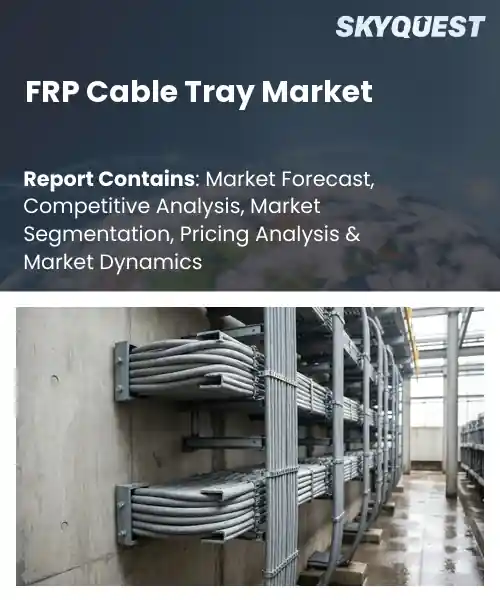
FRP Cable Tray Market
Report ID: SQMIG25A2749
Report ID: SQMIG25A2749
[email protected]
USA +1 351-333-4748
Report ID:
SQMIG25A2749 |
Region:
Global |
Published Date: June, 2026
Pages:
157
|Tables:
179
|Figures:
79


Global FRP Cable Tray Market size was valued at USD 921.21 Million in 2024 and is poised to grow from USD 986.62 Million in 2025 to USD 1707.91 Million by 2033, growing at a CAGR of 7.1% during the forecast period (2026-2033).
The global FRP cable tray industry is made up of manufacturers and suppliers of fiber‑reinforced polymer (FRP) systems that are used to support electrical wiring in industrial, commercial, and infrastructure projects. People care about it because FRP has corrosion resistance, it stays light, and the strength‑to‑weight ratio is a win, so installation can be done even in harsh places like offshore platforms, chemical plants, and coastal substations.
Now, the major factor driving the FRP cable tray market growth is renewable‑energy projects, which act like the main catalyst. The logic is simple: non‑conductive FRP doesn’t take saltwater corrosion as badly and it also fits the reliability standards of offshore wind and solar farms. When developers swap out steel trays—which need regular repainting and can run into galvanic degradation, with FRP units, they can reach roughly 30 percent lower life‑cycle costs. That shift also gives manufacturers room to pitch modular, quickly installable designs, while operators get less downtime during maintenance. Because of this, countries pushing hard decarbonization plans, especially the United States and Germany, are seeing higher demand, and that supports the market’s upward trajectory.
AI‑driven automation is changing the FRP cable tray market in a direct way, mostly by speeding up and smoothing design, manufacturing, and installation. With intelligent design tools, teams can generate optimized tray layouts, and that reduces material waste, plus it shortens engineering timelines, sometimes more than expected. In the factories, robotic handling combined with vision systems helps make cutting, molding and assembly more precise, which boosts consistency and reduces how much manual labor is needed. Then during installation, AI‑guided planning can map routes and predict interferences, so projects move faster, especially on complex sites. On top of that, predictive maintenance platforms can look at sensor data from already installed trays and tip operators off about potential failures ahead of time. Overall these tools speed up project schedules, improve product quality, and add supply‑chain agility, so FRP trays become even more appealing for large‑scale construction and infrastructure initiatives.
Market snapshot - (2026-2033)
Global Market Size
USD 921.21 Million
Largest Segment
Ladder Type FRP Cable Trays
Fastest Growth
Solid Bottom FRP Cable Trays
Growth Rate
7.1% CAGR
To get more insights on this market click here to Request a Free Sample Report
The global FRP cable tray market is segmented by product type, resin type, installation type, application, end-use industry, distribution channel, and region. Based on product type, the market is categorized into ladder type FRP cable trays, perforated FRP cable trays, trough FRP cable trays, solid bottom FRP cable trays, and others. By resin type, the market is segmented into polyester resin, vinyl ester resin, epoxy resin, and others. Based on installation type, the market is divided into indoor installation and outdoor installation. By application, the market is classified into power distribution, industrial wiring, telecommunication cables, data center infrastructure, and others. Based on end-use industry, the market serves oil and gas, power generation and utilities, chemicals and petrochemicals, construction and infrastructure, telecommunications and data centers, and other sectors. By distribution channel, the market is segmented into direct sales, electrical equipment distributors, EPC contractors, and others. Regionally, the market is analyzed across North America, Europe, Asia Pacific, Latin America, and the Middle East & Africa.
As per the FRP cable tray market analysis, the ladder type segment dominates overall, because that open style gives better load distribution and it also makes maintenance a lot easier, so it becomes the preferred pick for large scale power distribution projects. Engineers seem to like this architecture too, since it stays flexible for routing more circuits, and the track record durability in harsh places keeps reinforcing the market leadership. On top of that, the material’s corrosion resistance helps lower lifecycle costs, so adoption stays strong across utilities, plus industrial facilities all around the world today, in a noticeable way.
Still, the perforated segment is showing up as the key high-growth spot in the FRP cable tray market. Designers are looking for lighter-weight solutions, but they still want adequate ventilation for cable heat dissipation. That mesh style supports rapid installation, especially in confined spaces, which is pushing demand in modular construction and retrofit work.
According to the FRP cable tray market forecast, the Vinyl ester segment leads, largely because its chemical resistance is stronger and it works like a solid barrier against aggressive acids and salts that show up in industrial settings. This resistance helps maintain a long service life, it cuts down on maintenance stoppages, and it also fits with strict safety requirements. As a result, it becomes the material of choice for critical infrastructure, where reliability is the main point across sectors like petrochemical processing, offshore platforms, and wastewater treatment. That combination keeps reinforcing the widespread adoption trend right now, globally significantly.
Meanwhile, the epoxy segment is seeing the strongest growth momentum as manufacturers focus on ultra high strength solutions for aerospace and high voltage applications. The resin’s thermal stability, along with its fire resistance, creates new openings for cutting edge builds, and that’s prompting more investment in advanced resin formulations, which then helps expand the market beyond only traditional industries.
To get detailed segments analysis, Request a Free Sample Report
As per the FRP cable tray market regional forecast, Asia Pacific is leading the market for a mix of reasons, like advanced manufacturing chops, steady pull from renewable energy expansions and offshore jobs, plus a regulatory mood that leans toward light weight, corrosion resistant options. The area also has a deep pool of engineering talent, so product improvement never stops, and because production stays cost effective, pricing stays competitive. At the same time, lots of infrastructure building is happening in both older, mature economies and in fast growing markets, so adoption speeds up, since project owners usually want durability, and also less maintenance hassle. On top of that, regional trade agreements make cross-border buying easier, letting manufacturers reach a wider client circle without too much friction. And, the push for sustainable building matches what FRP already offers environmentally, so its appeal spreads across different sectors in a more natural way.
Japan FRP Cable Tray Market
The FRP Cable Tray market outlook in Japan is shaped by a serious, high quality standard mindset and a clear focus on maritime plus petrochemical installations. Japan based manufacturers lean into precision engineering to make trays that stand out on corrosion resistance and lightweight performance, which helps meet tough requirements for offshore wind farms, as well as heavy industry facilities. Customers seem to favor long life solutions, so uptake is steady, and there is also cooperation between industry associations and research institutes, leading to extra product refinement over time. Innovation keeps moving, actually.
South Korea FRP Cable Tray Market
In South Korea, the FRP Cable Tray industry is helped by industrial modernization, along with an emphasis on export oriented manufacturing. Local makers blend advanced composite know how with cost efficient processes, producing trays that can handle harsh settings like chemical plants and renewable energy locations. The market gets an extra nudge from governmental incentives that back lightweight infrastructure, so adoption grows across domestic builds and even international contracts. Partnerships with external players also support stronger design capacity, and keep the direction aligned with changing safety requirements.
The European FRP cable tray market penetration is pushed forward by strict safety rules, a strong preference for sustainable construction, and a well established industrial base that cares about long term reliability. The region’s attention on lowering carbon impact lines up with FRP being lightweight and corrosion resistant, so it becomes a go to option for demanding infrastructure work. Collaboration shows up a lot too, between engineering groups and material manufacturers, which keeps innovation alive, while contractors gain confidence as newer installation standards get adopted. Germany keeps a strong manufacturing ecosystem that basically sets a quality baseline, and the United Kingdom sees faster uptake due to growing renewable energy activity and smart grid programs. France is also showing more interest, because older facilities are being modernized. Overall, the combined focus on safety, efficiency and environmental stewardship keeps Europe in a strong leadership role for FRP cable tray adoption.
Germany FRP Cable Tray Market
The German FRP cable tray sector benefits from a longstanding culture, plus on the ground experience in several sectors. Local manufacturers tend to focus on precision casting and strict quality checks, so trays can meet tough requirements for chemical processing operations and power generation plants. The market also gets support from industry associations, which encourage practical improvements, and research programs that aim to strengthen durability and fire resistance. These pieces together lock in Germany’s reputation as a benchmark for FRP cable management solutions.
United Kingdom FRP Cable Tray Market
In the United Kingdom, the FRP cable tray market is picking up speed, supported by renewable energy rollout and a regulatory push toward safer, low maintenance infrastructure. Domestic suppliers focus on modular design, and on installation techniques that fit within the UK construction standards. When projects run alongside operators, adoption improves, especially for grid modernization and offshore wind farm deployments. Sustainability and cost effectiveness, both together, help make FRP solutions the preferred option, putting the United Kingdom among the Europe growth leaders.
France FRP Cable Tray Market
The France’s FRP cable tray market is starting to look more active as industrial sites modernize, and as new initiatives start gathering momentum. Local manufacturers highlight production capability and compliance with European safety directives, producing trays that work well for chemical processing and transportation infrastructure. Partnerships between research institutes and industry groups also help speed up material improvements, particularly for fire retardancy and recyclability. Lifecycle cost awareness tends to pull customers in, so adoption rises, and France is becoming a noticeable hub for FRP cable management solutions across Europe.
The North America’s FRP cable tray market keeps getting stronger, mostly because there’s so much industrial activity happening, plus stricter safety rules, and also more attention on sustainable infrastructure. Across oil and gas, power distribution, and transportation, people want systems that are lighter yet resistant to corrosion. That basically helps cut those long term upkeep costs , which is a real selling point. On top of that, manufacturers have better production capabilities now, so they can scale quickly and customize, even when big projects ask for very specific layouts and finishes. Regulatory expectations that emphasize fire resistance and environmental compliance also make it easier for buyers to say yes. And there are partnerships between suppliers and engineering groups that speed up adoption, especially when the installations get complicated. Meanwhile ongoing material research keeps pushing durability and overall performance upward. Together, these drivers put North America in a leading spot for FRP cable management innovation and on-the-ground deployment. The region also leans into digital design tools, and that makes planning and execution smoother, or at least faster in practice.
United States FRP Cable Tray Market
In the United States, the FRP cable tray market does well because of energy infrastructure needs, along with a regulatory landscape that pushes lightweight, fire-resistant choices. Producers often use composite technologies to build trays used in transmission lines, petrochemical sites, and data center environments. Utility providers and consultants tend to collaborate early in the process, which speeds up acceptance of FRP solutions. At the same time, research spending supports better material endurance, and better thermal performance under stress. This whole network, more or less, helps the United States stay a pivotal market for FRP cable management across many distinct applications.
Canada FRP Cable Tray Market
The Canadian FRP cable tray market share grows on energy integration goals plus environmental rules that favor modern infrastructure. Manufacturers focus on both production quality and fire safety compliance, and they supply trays for wind farm connections, hydroelectric facilities, and mining operations. Some producers also build partnerships with universities, which supports innovation around material resilience and recyclability. Project owners who are more aware of lifecycle cost advantages tend to adopt sooner. As a result, Canada plays a notable role in the North American FRP cable tray ecosystem, more than just on paper but in actual purchasing decisions too.
To know more about the market opportunities by region and country, click here to
Buy The Complete Report
Growing Preference for Corrosion Resistance
Adoption of Modular Construction Techniques
Higher Initial Material Costs
Limited Awareness in Emerging Markets
Request Free Customization of this report to help us to meet your business objectives.
The FRP cable tray market is being shaped by stiff competition among established manufacturers and newer polymer specialists. This situation pushes companies toward faster product differentiation and also toward aggressive cost efficiencies that are aggressive. In the last stretch, more M&A than usual is witnessed, with a major FRP tray producer buying a smaller polymer firm in 2025, so its portfolio is broader now. At the same time, strategic partnerships with big construction firms helped adoption, especially for lightweight, corrosion-resistant trays in infrastructure work.
Top Player’s Company Profile
Recent Developments in the FRP Cable Tray Market
SkyQuest’s ABIRAW (Advanced Business Intelligence, Research & Analysis Wing) is our Business Information Services team that Collects, Collates, Correlates, and Analyses the Data collected by means of Primary Exploratory Research backed by robust Secondary Desk research.
As per SkyQuest analysis, the FRP cable tray market is being propelled mostly by the growing preference for corrosion‑resistant lightweight trays that reduce maintenance cycles, but there’s also a second driver that matters modular construction. That approach leans on the easy handling and rapid assembly of FRP components, even if the upfront cost can feel higher for the composite material. Cost is still the main restraint, and in some regions it slows adoption because budgets get locked on initial spend, not lifetime benefits. Asia Pacific leads the market, largely due to strong manufacturing bases and more renewable‑energy projects, and within the product mix the ladder type trays tend to dominate because their open design helps with load distribution and makes service access simpler, overall.
| Report Metric | Details |
|---|---|
| Market size value in 2024 | USD 921.21 Million |
| Market size value in 2033 | USD 1707.91 Million |
| Growth Rate | 7.1% |
| Base year | 2024 |
| Forecast period | (2026-2033) |
| Forecast Unit (Value) | USD Million |
| Segments covered |
|
| Regions covered | North America (US, Canada), Europe (Germany, France, United Kingdom, Italy, Spain, Rest of Europe), Asia Pacific (China, India, Japan, Rest of Asia-Pacific), Latin America (Brazil, Rest of Latin America), Middle East & Africa (South Africa, GCC Countries, Rest of MEA) |
| Companies covered |
|
| Customization scope | Free report customization with purchase. Customization includes:-
|
To get a free trial access to our platform which is a one stop solution for all your data requirements for quicker decision making. This platform allows you to compare markets, competitors who are prominent in the market, and mega trends that are influencing the dynamics in the market. Also, get access to detailed SkyQuest exclusive matrix.
Table Of Content
Executive Summary
Market overview
Parent Market Analysis
Market overview
Market size
KEY MARKET INSIGHTS
COVID IMPACT
MARKET DYNAMICS & OUTLOOK
Market Size by Region
KEY COMPANY PROFILES
Methodology
For the FRP Cable Tray Market, our research methodology involved a mixture of primary and secondary data sources. Key steps involved in the research process are listed below:
1. Information Procurement: This stage involved the procurement of Market data or related information via primary and secondary sources. The various secondary sources used included various company websites, annual reports, trade databases, and paid databases such as Hoover's, Bloomberg Business, Factiva, and Avention. Our team did 45 primary interactions Globally which included several stakeholders such as manufacturers, customers, key opinion leaders, etc. Overall, information procurement was one of the most extensive stages in our research process.
2. Information Analysis: This step involved triangulation of data through bottom-up and top-down approaches to estimate and validate the total size and future estimate of the FRP Cable Tray Market.
3. Report Formulation: The final step entailed the placement of data points in appropriate Market spaces in an attempt to deduce viable conclusions.
4. Validation & Publishing: Validation is the most important step in the process. Validation & re-validation via an intricately designed process helped us finalize data points to be used for final calculations. The final Market estimates and forecasts were then aligned and sent to our panel of industry experts for validation of data. Once the validation was done the report was sent to our Quality Assurance team to ensure adherence to style guides, consistency & design.
Analyst Support
Customization Options
With the given market data, our dedicated team of analysts can offer you the following customization options are available for the FRP Cable Tray Market:
Product Analysis: Product matrix, which offers a detailed comparison of the product portfolio of companies.
Regional Analysis: Further analysis of the FRP Cable Tray Market for additional countries.
Competitive Analysis: Detailed analysis and profiling of additional Market players & comparative analysis of competitive products.
Go to Market Strategy: Find the high-growth channels to invest your marketing efforts and increase your customer base.
Innovation Mapping: Identify racial solutions and innovation, connected to deep ecosystems of innovators, start-ups, academics, and strategic partners.
Category Intelligence: Customized intelligence that is relevant to their supply Markets will enable them to make smarter sourcing decisions and improve their category management.
Public Company Transcript Analysis: To improve the investment performance by generating new alpha and making better-informed decisions.
Social Media Listening: To analyze the conversations and trends happening not just around your brand, but around your industry as a whole, and use those insights to make better Marketing decisions.
REQUEST FOR SAMPLE
 REQUEST FREE CUSTOMIZATION
Global Frp Cable Tray Market size was valued at USD 921.21 Million in 2024 and is poised to grow from USD 986.62 Million in 2025 to USD 1707.91 Million by 2033, growing at a CAGR of 7.1% during the forecast period (2026-2033).
The FRP cable tray market is shaped by intense competition among established manufacturers and emerging polymer specialists, driving rapid product differentiation and cost efficiencies. Recent M&A activity saw a leading FRP tray producer acquire a niche polymer firm in 2025, expanding its portfolio, while strategic partnerships with large construction firms have accelerated adoption of lightweight, corrosion‑resistant trays in infrastructure projects. 'Atkore Inc.', 'Legrand SA', 'Schneider Electric SE', 'Eaton Corporation', 'Panduit Corporation', 'MP Husky', 'Indiana Group', 'Marco Cable Management', 'Ferrotech International', 'National Plastics & Rubber', 'RPPL Industries', 'Bedford Reinforced Plastics', 'Fibrolux GmbH', 'Mita Manufacturing', 'Valmont Industries', 'Niedax Group', 'Ritz Instrument Transformers', 'Elecon Engineering', 'Saudi Arabian Amiantit Company', 'Kukdong Fiberglass'
Growing demand for lightweight, corrosion‑resistant cable trays is prompting designers to select FRP solutions for industrial and commercial projects. The material’s inherent resistance to moisture, chemicals, and temperature fluctuations reduces maintenance cycles, thereby extending service life. This reliability encourages specification in new construction and retrofit initiatives, fostering broader acceptance across sectors that prioritize durability and safety. Stakeholders also appreciate the ease of installation, which minimizes labor requirements and accelerates project timelines.
Rapid Adoption In Green Buildings: Architects and facility managers are specifying FRP cable trays for their corrosion resistance, lightweight profile, and ease of installation, especially in sustainable construction projects targeting energy efficiency and reduced carbon footprints. The material’s non‑conductive properties align with stringent fire safety and environmental certifications, prompting developers to prefer FRP solutions over traditional metal alternatives. This shift is accelerating demand across commercial skyscrapers, hospitals, and data centers where long service life and low maintenance are critical throughout the building’s operational lifecycle effectively.
Why does Asia Pacific Dominate the Global FRP Cable Tray Market? |@12


Want to customize this report? This report can be personalized according to your needs. Our analysts and industry experts will work directly with you to understand your requirements and provide you with customized data in a short amount of time. We offer $1000 worth of FREE customization at the time of purchase.
Feedback From Our Clients


 USA (+1) 351-333-4748

