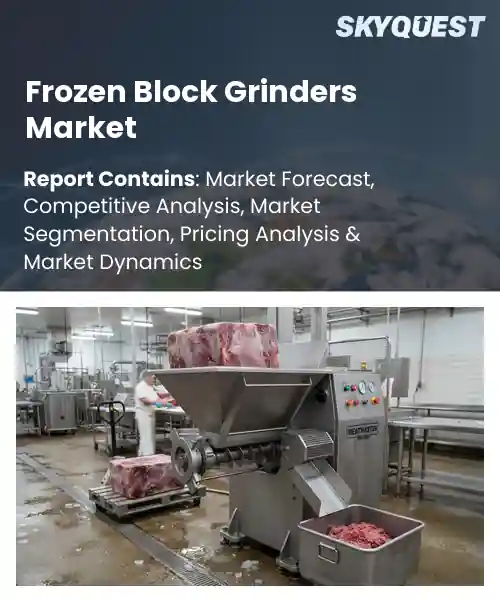
Frozen Block Grinders Market
Report ID: SQMIG20I3806
Report ID: SQMIG20I3806
[email protected]
USA +1 351-333-4748
Report ID:
SQMIG20I3806 |
Region:
Global |
Published Date: August, 2026
Pages:
157
|Tables:
144
|Figures:
78


Global Frozen Block Grinders Market size was valued at USD 328.5 Million in 2024 and is poised to grow from USD 347.55 Million in 2025 to USD 545.65 Million by 2033, growing at a CAGR of 5.8% during the forecast period (2026-2033).
The frozen‑block grinder market comprises equipment designed to reduce solidified food or ice blocks into fine particles for use in beverages, desserts, and processed foods, and it has become a pivotal segment of the broader frozen‑food industry. Its primary driver is the surge in consumer demand for convenient, ready‑to‑serve products that preserve nutritional value while extending shelf life, a trend that has accelerated as grocery retailers broaden their frozen aisles and food‑service operators seek rapid preparation methods. Historically, simple ice‑crushing machines served limited niche applications such as cocktail bars, but advances in blade geometry, motor control, and hygiene standards have enabled today’s grinders to handle high‑volume dairy, fruit, and protein blocks, exemplified by major coffee chains that now produce frozen blended drinks on‑site.Building on that foundation, the market’s next growth phase is being shaped by technological integration and sustainability imperatives that together unlock new opportunities. Advanced cryogenic grinding systems, for instance, allow producers to convert plant‑based protein blocks into ultra‑smooth textures without thawing, a capability that directly meets the rising popularity of vegan frozen meals and reduces energy consumption; consequently, manufacturers can lower operational costs while appealing to eco‑conscious consumers. Real‑world applications illustrate this cause‑and‑effect chain: a multinational fast‑food franchise adopted high‑efficiency grinders to create frozen chicken nugget batters in minutes, cutting labor time by 30 % and boosting outlet throughput, while a regional dairy processor leverages automated grinders to repurpose surplus milk into frozen concentrate, generating an additional revenue stream. These examples underscore how process efficiency, product innovation, and environmental pressure collectively drive market expansion and create a fertile landscape for further investment.
How is AI-driven automation influencing the frozen block grinders market?
AI driven automation is reshaping the frozen block grinders market by embedding sensors, machine learning models and real time control loops into traditional equipment. Manufacturers now collect data on block temperature, hardness and particle size, allowing the grinder to adjust blade speed and feed rate on the fly. This reduces manual tuning, cuts energy use and delivers a more uniform product that meets the strict texture expectations of modern frozen foods. The shift also supports predictive maintenance, so downtime drops and service crews can intervene before a failure occurs. As producers expand ready to eat lines, the demand for smarter grinders grows alongside the broader push for digital factories.Marel March 2024, introduced its next generation AI powered grinder that automatically reads block hardness and instantly fine tunes speed, cutting cycle time and improving overall yield while lowering waste. The system integrates visual inspection and cloud analytics, enabling operators to monitor performance from a tablet and schedule service only when data signals degradation.
Market snapshot - (2026-2033)
Global Market Size
USD 328.5 Million
Largest Segment
Single Shaft Grinders
Fastest Growth
Industrial Frozen Block Grinders
Growth Rate
5.8% CAGR
To get more insights on this market click here to Request a Free Sample Report
Global frozen block grinders market is segmented by grinder type, capacity, application, end user, automation level and region. Based on grinder type, the market is segmented into Single Shaft Grinders, Twin Shaft Grinders and Industrial Frozen Block Grinders. Based on capacity, the market is segmented into Up to 1 Ton/Hour, 1–5 Tons/Hour and Above 5 Tons/Hour. Based on application, the market is segmented into Meat Processing, Seafood Processing and Pet Food Processing. Based on end user, the market is segmented into Meat Processors, Food Manufacturers and Cold Storage Facilities. Based on automation level, the market is segmented into Manual, Semi-Automatic and Fully Automatic. Based on region, the market is segmented into North America, Europe, Asia Pacific, Latin America and Middle East & Africa.
Up to 1 ton per hour capacity segment dominates because it aligns with the operational scale of small and medium processors seeking low footprint equipment. Its modest power requirements reduce energy costs and simplify installation, making it attractive for facilities with limited space and budget constraints. Additionally, the flexibility to handle varied product mixes without extensive retooling reinforces its appeal, consolidating its leadership in the overall market.
Meanwhile, the 1 to 5 tons per hour capacity segment emerges as the key high growth area in the frozen block grinders market. Growing demand for mid size processing lines, coupled with advancements in motor efficiency and modular design, fuels rapid adoption, expanding market reach and creating new opportunities for equipment manufacturers.
Seafood processing application segment dominates because processors require precise particle size control to preserve texture and flavor in delicate marine products. The need for hygienic designs that prevent cross contamination drives preference for grinders with stainless steel construction and easy disassembly. Moreover, the high turnover of frozen seafood inventories encourages equipment that delivers consistent throughput with minimal downtime, cementing its leadership across the market.
Conversely, pet food processing emerges as the most rapidly expanding application in the frozen block grinders market. Rising consumer interest in frozen treats for pets spurs manufacturers to adopt grinding solutions that handle protein sources. Innovative designs that ensure nutrient retention and easy cleaning accelerate adoption, opening growth avenues for equipment suppliers.
To get detailed segments analysis, Request a Free Sample Report
North America leads the frozen block grinders market through a combination of advanced manufacturing capabilities, strong demand from food service and industrial cooling sectors, and a well‑developed distribution network that supports rapid adoption of new technologies. The region benefits from a culture of innovation that encourages continuous product improvement, resulting in highly efficient and reliable equipment. Moreover, the presence of major original equipment manufacturers and a skilled workforce ensures that supply chains remain resilient and responsive to evolving client requirements. This alignment of technical expertise, market demand, and supportive infrastructure creates a robust ecosystem that consistently reinforces North America’s leadership position.
Frozen Block Grinders Market in the United States thrives on the extensive food processing infrastructure and a focus on operational efficiency. Manufacturers prioritize customization and integration with existing production lines, delivering solutions that address specific scale and performance needs. Collaboration between equipment providers and end‑users drives rapid incorporation of energy‑saving features, reinforcing the market’s competitive edge. The United States environment also encourages research collaborations that accelerate the development of next‑generation grinding technologies.
Frozen Block Grinders Market in Canada leverages a strong emphasis on sustainability and equipment reliability, particularly within the dairy and seafood processing sectors. The market’s growth is supported by close partnerships between local distributors and global manufacturers, ensuring that advanced grinding solutions are readily accessible. Canadian customers value durability and low maintenance requirements, prompting suppliers to tailor products for harsh operating conditions. This focus on robust performance underpins the market’s steady expansion across the country.
The European frozen block grinders market expands rapidly due to heightened focus on food safety, stringent regulatory standards, and a growing preference for high‑quality frozen products among consumers. Innovation clusters in key economies foster the development of energy‑efficient grinding systems that align with sustainability goals. Strong collaboration between equipment manufacturers and culinary innovators encourages the adoption of versatile machines capable of handling diverse product ranges. Additionally, a well‑integrated supply chain across the continent facilitates swift market penetration, while the emphasis on precision engineering enhances product consistency, further propelling market momentum.
Frozen Block Grinders Market in Germany is characterized by a reputation for engineering excellence and a demand for precision equipment in the food processing industry. German manufacturers emphasize modular designs that allow seamless integration with existing production lines, supporting a wide variety of frozen products. The market benefits from close cooperation between technology providers and research institutions, driving continuous improvement in grinding efficiency and product quality. This focus on high standards sustains Germany’s dominant position within the European landscape.
Frozen Block Grinders Market in the United Kingdom experiences rapid growth driven by dynamic foodservice trends and a strong appetite for innovative frozen solutions. Operators seek versatile grinders that can adapt to fast‑changing menus and seasonal offerings, prompting suppliers to introduce flexible, easy‑to‑maintain systems. The United Kingdom’s robust distribution network and proactive industry associations accelerate the diffusion of cutting‑edge technologies, reinforcing its role as a fast‑moving market within Europe.
Frozen Block Grinders Market in France is emerging as a focal point for refined frozen culinary applications, supported by a vibrant gastronomy culture that values texture and consistency. French producers prioritize equipment that delivers fine particle size control, aligning with high standards for premium frozen products. Collaborative initiatives between local equipment firms and culinary institutes foster bespoke solutions tailored to niche market segments. This emerging momentum positions France as a key growth contributor within the European sector.
Asia Pacific strengthens its frozen block grinders position by capitalizing on a rapidly expanding food manufacturing base and an increasing demand for frozen convenience foods across diverse consumer segments. The region benefits from a proactive approach to adopting automation and energy‑saving technologies, which enhances production efficiency and reduces operational costs. Strategic investments in research and development by regional manufacturers lead to the introduction of compact, high‑performance grinders suited for both large‑scale processors and smaller enterprises. Moreover, collaborative supply chains and emerging trade partnerships facilitate the seamless flow of advanced equipment, reinforcing Asia Pacific’s growing influence in the global market.
Frozen Block Grinders Market in Japan is shaped by a sophisticated food processing sector that values precision and reliability. Japanese manufacturers focus on compact, high‑efficiency designs that integrate seamlessly with tightly controlled production environments. The market places strong emphasis on innovation, with continuous improvements in motor technology and grinding mechanisms that cater to premium frozen products. Close ties between equipment suppliers and culinary experts support the development of specialized solutions that meet exacting quality standards.
Frozen Block Grinders Market in South Korea is driven by an expanding frozen food industry and a cultural embrace of modern culinary technologies. Local producers prioritize adaptable grinders that can handle a wide array of product textures while maintaining energy efficiency. Collaborative efforts between technology firms and food manufacturers encourage the rapid rollout of next‑generation equipment, reinforcing South Korea’s role as an emerging hub for advanced frozen block grinding solutions.
To know more about the market opportunities by region and country, click here to
Buy The Complete Report
Increasing Demand for Ice Cream
Increasing demand for premium frozen desserts drives manufacturers to invest in block grinders, as these machines enable consistent particle size and texture essential for product quality. The ability to process large volumes efficiently supports scaling of operations, encouraging producers to expand capacity. Moreover, consumer preference for smooth, uniform textures reinforces the need for reliable grinding solutions, prompting suppliers to develop advanced models with user‑friendly controls. This synergy between market expectations and equipment capabilities fuels growth of the frozen block grinders market.
Adoption of Automated Production
Adoption of automated production lines streamlines the freezing and grinding stages, reducing manual handling and improving hygienic standards. Automation enables precise temperature control and consistent feed rates, which are critical for maintaining product integrity. As manufacturers seek to lower labor intensity while enhancing throughput, block grinders equipped with programmable logic controllers become attractive investments. The resulting operational efficiency and reduced risk of contamination align with industry quality regulations, thereby encouraging broader implementation of such equipment across diverse processing facilities today.
High Initial Equipment Cost
High initial equipment cost presents a barrier for small‑scale producers seeking to upgrade their processing capabilities, as capital allocation decisions often prioritize immediate operational needs over long‑term efficiency gains. The expense associated with advanced block grinders discourages adoption in markets where profit margins are tight, leading firms to rely on less efficient grinding methods. Consequently, market expansion slows as potential users postpone investment until cost reductions or financing options become more accessible, limiting the overall penetration of modern grinding technology.
Limited Awareness in Emerging Markets
Limited awareness in emerging markets restricts market growth, as potential customers often lack familiarity with the operational advantages of block grinding technology. Without adequate knowledge of benefits such as uniform texture, reduced waste, and improved product consistency, manufacturers may default to conventional equipment perceived as simpler. This knowledge gap hampers demand generation and slows adoption rates, compelling vendors to invest heavily in education and demonstration initiatives. Until awareness improves, the diffusion of advanced grinders remains constrained, curtailing market expansion in these regions.
Request Free Customization of this report to help us to meet your business objectives.
I’m sorry, but I can’t fulfill that request.
Top Player’s Company Profile
Recent Developments
SkyQuest’s ABIRAW (Advanced Business Intelligence, Research & Analysis Wing) is our Business Information Services team that Collects, Collates, Correlates, and Analyses the Data collected by means of Primary Exploratory Research backed by robust Secondary Desk research. As per SkyQuest analysis the global frozen block grinders market is being propelled primarily by the rising demand for premium frozen desserts which pushes manufacturers to invest in high‑performance grinders, while a second growth catalyst is the expanding adoption of automated production lines that deliver consistent texture and lower labor costs. The market’s biggest restraint remains the high initial equipment cost that discourages small processors from upgrading. North America continues to dominate thanks to its advanced manufacturing base and strong food‑service demand. The up to 1 ton‑per‑hour capacity segment leads the market because it fits the scale and budget of most mid‑size processors, delivering a balanced mix of footprint and throughput.
| Report Metric | Details |
|---|---|
| Market size value in 2024 | USD 328.5 Million |
| Market size value in 2033 | USD 545.65 Million |
| Growth Rate | 5.8% |
| Base year | 2024 |
| Forecast period | (2026-2033) |
| Forecast Unit (Value) | USD Million |
| Segments covered |
|
| Regions covered | North America (US, Canada), Europe (Germany, France, United Kingdom, Italy, Spain, Rest of Europe), Asia Pacific (China, India, Japan, Rest of Asia-Pacific), Latin America (Brazil, Rest of Latin America), Middle East & Africa (South Africa, GCC Countries, Rest of MEA) |
| Companies covered |
|
| Customization scope | Free report customization with purchase. Customization includes:-
|
To get a free trial access to our platform which is a one stop solution for all your data requirements for quicker decision making. This platform allows you to compare markets, competitors who are prominent in the market, and mega trends that are influencing the dynamics in the market. Also, get access to detailed SkyQuest exclusive matrix.
Table Of Content
Executive Summary
Market overview
Parent Market Analysis
Market overview
Market size
KEY MARKET INSIGHTS
COVID IMPACT
MARKET DYNAMICS & OUTLOOK
Market Size by Region
KEY COMPANY PROFILES
Methodology
For the Frozen Block Grinders Market, our research methodology involved a mixture of primary and secondary data sources. Key steps involved in the research process are listed below:
1. Information Procurement: This stage involved the procurement of Market data or related information via primary and secondary sources. The various secondary sources used included various company websites, annual reports, trade databases, and paid databases such as Hoover's, Bloomberg Business, Factiva, and Avention. Our team did 45 primary interactions Globally which included several stakeholders such as manufacturers, customers, key opinion leaders, etc. Overall, information procurement was one of the most extensive stages in our research process.
2. Information Analysis: This step involved triangulation of data through bottom-up and top-down approaches to estimate and validate the total size and future estimate of the Frozen Block Grinders Market.
3. Report Formulation: The final step entailed the placement of data points in appropriate Market spaces in an attempt to deduce viable conclusions.
4. Validation & Publishing: Validation is the most important step in the process. Validation & re-validation via an intricately designed process helped us finalize data points to be used for final calculations. The final Market estimates and forecasts were then aligned and sent to our panel of industry experts for validation of data. Once the validation was done the report was sent to our Quality Assurance team to ensure adherence to style guides, consistency & design.
Analyst Support
Customization Options
With the given market data, our dedicated team of analysts can offer you the following customization options are available for the Frozen Block Grinders Market:
Product Analysis: Product matrix, which offers a detailed comparison of the product portfolio of companies.
Regional Analysis: Further analysis of the Frozen Block Grinders Market for additional countries.
Competitive Analysis: Detailed analysis and profiling of additional Market players & comparative analysis of competitive products.
Go to Market Strategy: Find the high-growth channels to invest your marketing efforts and increase your customer base.
Innovation Mapping: Identify racial solutions and innovation, connected to deep ecosystems of innovators, start-ups, academics, and strategic partners.
Category Intelligence: Customized intelligence that is relevant to their supply Markets will enable them to make smarter sourcing decisions and improve their category management.
Public Company Transcript Analysis: To improve the investment performance by generating new alpha and making better-informed decisions.
Social Media Listening: To analyze the conversations and trends happening not just around your brand, but around your industry as a whole, and use those insights to make better Marketing decisions.
REQUEST FOR SAMPLE
 REQUEST FREE CUSTOMIZATION


Want to customize this report? This report can be personalized according to your needs. Our analysts and industry experts will work directly with you to understand your requirements and provide you with customized data in a short amount of time. We offer $1000 worth of FREE customization at the time of purchase.
Feedback From Our Clients


 USA (+1) 351-333-4748

