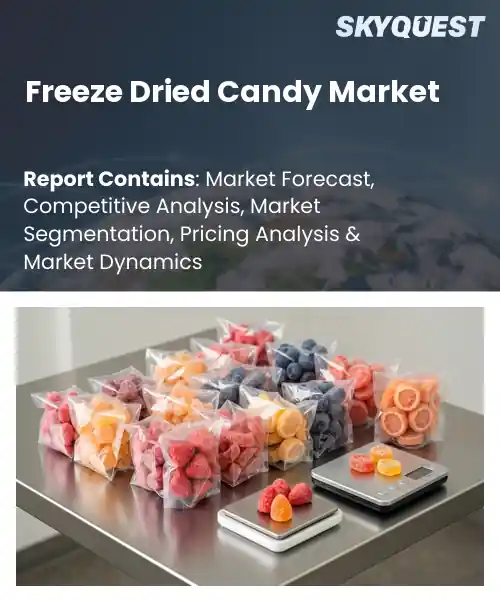
Freeze Dried Candy Market
Report ID: SQMIG30I2842
Report ID: SQMIG30I2842
[email protected]
USA +1 351-333-4748
Report ID:
SQMIG30I2842 |
Region:
Global |
Published Date: February, 2026
Pages:
157
|Tables:
148
|Figures:
78


Global Freeze-dried Candy Market size was valued at USD 1.5 Billion in 2024 and is poised to grow from USD 1.63 Billion in 2025 to USD 3.2 Billion by 2033, growing at a CAGR of 8.8% during the forecast period (2026-2033).
Increased demand for differentiated confectionery experiences, growing demand for indulgent snacks that are shelf-stable, and increased popularity of clean label ingredients, as well as technological advancements in freeze-dried technology, are contributing factors for the sale of freeze-dried candies.
As consumers become more interested in gifting options and travel snacks, and as consumers increasingly demand clean label ingredients in their foods, this will help drive demand for freeze-dried candies. With the rise of e-commerce and consumer-direct business models, access to freeze-dried candies has become more convenient than ever. The increasing influence of social media and rising popularity of artisanal and boutique confectionery brands are also promoting freeze-dried candy consumption. Changing consumer demand for unique textures and experiential snacking coupled with the shift toward premium confectionery is expected to primarily drive freeze-dried candy market growth.
On the contrary, high production and equipment costs, limited scalability, challenges in maintaining product consistency, and regulatory concerns regarding labeling and ingredient transparency are expected to impede freeze-dried candy market penetration through 2033.
How is AI Transforming Demand Forecasting in the Freeze-dried Candy Market?
AI is improving demand forecasting in the freeze-dried candy market by combining data from point-of-sale systems, social media trends, and promotional calendars. This helps create more accurate and adaptive forecasting models. These models can pick up on viral trends and regional tastes, helping small producers make plans for small-batch production and adjust their packaging accordingly. Retailers can make better use of online product launches in relation to in-store inventory and adjust their sourcing strategies accordingly.
In January 2026, M&M's indicated consumer interest in freeze-dried candies among the mainstream public, which further fueled demand volatility. This has made the accuracy of AI-based forecasting even more important for scheduling production runs and coordinating retailer rollouts, as well as responding to viral trends and preventing waste.
Market snapshot - (2026-2033)
Global Market Size
USD 1.5 Billion
Largest Segment
Gummy Candies
Fastest Growth
Novelty Candies
Growth Rate
8.8% CAGR
To get more insights on this market click here to Request a Free Sample Report
The global freeze-dried candy market is segmented by product type, flavors, distribution channel, consumer age group, packaging type, and region. Based on product type, the market is segmented into fruit-based candies, chocolate-based candies, gummy candies, novelty candies, and combination candies. Based on flavors, the market is segmented into sweet, sour, and others. based on distribution channel, the market is segmented into online retailers and offline retailers. Based on consumer age group, the market is segmented into children, teens, young adults, middle-aged adults, and seniors. Based on packaging type, the market is segmented into individual packets, bulk packaging, gift sets, and eco-friendly packaging. Based on region, the market is segmented into North America, Europe, Asia Pacific, Latin America, and Middle East & Africa.
The fruit-based candies segment is slated to hold the highest global freeze-dried candy market share in the future. Freeze drying intensifies natural fruit flavor and creates a distinctive light, crunchy texture that aligns with consumer demand for clean label products thereby cementing the dominance of this segment. This leads to manufacturers placing more emphasis on fruit formulation, variety in SKU range, and investment in flavor innovation, which in turn boosts retailer range and marketing support. Supply chain knowledge of fruit ingredients and ease of development of seasonal or limited-edition flavors also adds to shelf presence and consumer awareness.
However, gummy candies are the most rapidly expanding segment as per this freeze-dried candy market forecast. Freeze drying converts chewy textures into novel crunchy experiences that strongly appeal to younger demographics, which helps create new business scope. Product creativity in terms of shapes, flavor infusions, and co-branded collaborations generates more trial and repeat consumption, whereas portability/snackability enables wider channel acceptability to drive new product introductions and create premium snack occasions.
The eco-friendly packaging segment is estimated to lead the global freeze-dried candy market revenue generation in the long run. Increasing consumer and retailer emphasis on sustainability has made recyclable and compostable formats a key purchase criterion, which helps this segment hold sway over others. The manufacturers are working to adapt the products to maintain low moisture content along with a crisp texture, thus satisfying consumer requirements in terms of sustainability too. This provides a clear platform to differentiate products on the shelf, thus gaining support from retailers too.
On the other hand, individual packets are increasingly being recognized as the key high growth segment, driven by the convenience of single-serve packages, and on-the-go consumption that aligns with the attributes of freeze-dried candies. Brands are using individually packed formats for sampler packs, subscription packs, and impulse packs, thereby expanding distribution channels, improving trial conversion, and speeding up product innovation and purchase frequency.
To get detailed segments analysis, Request a Free Sample Report
Established combination of consumer familiarity with novelty confectionery, a strong retail infrastructure, and a well developed ingredient and processing supply chain helps this region maintain its lead. Investments in product innovation as well as an experimental nature with multiple flavor and packaging options, as well as having good collaboration and communication between manufacturers and retailers to ensure fast and efficient distribution of their products. In addition, fast growth in private label brands and an extensive network of specialty and traditional retail outlets will allow for rapid availability of products, while marketing and creating an experience in retail stores to stimulate consumer demand/curiosity. Furthermore, according to various regulatory approvals regarding the technology and process, all players in the market will be able to provide consistently high quality products, which creates a very stable environment for this market to operate under, and creates opportunities for the North American region in the long run.
Sophisticated consumer demand for novel textures and premium ingredients, supported by retail reach allows for high sales of freeze-dried candy in the United States. Brands are using experiential marketing, working with confectionery artisans, and e-commerce to build awareness. They are partnering in retail and food service to encourage trials, as well as innovation pipelines that are focused on flavor variety and making products more portable and attractive on shelf.
Adventurous consumer palates and a focus on quality ingredients are shaping freeze-dried candy consumption in Canada. Manufacturers are working to meet consumers’ demands through clean label ingredients and local sourcing, which are complemented by collaboration to expand into mainstream retail stores. Seasonal products are also available to meet consumers’ interest in seasonal products. Investments in logistics and innovative packaging are made to maintain sensory attributes to reach a wider range of consumers.
Evolving consumer tastes, a strong culture of confectionery innovation, and increasing retailer willingness to feature experiential snacks help boost the sales of freeze-dried candy across Europe. The growth is complemented by differentiation strategies, including unique flavor profiles, premiumization, and partnerships between traditional confectionery players and start-ups. The trend is further driven by retailers and online communities, especially for traditional retailers. Regulatory alignment for key geographies is also aiding market growth by removing barriers for cross-border trade. The focus on sustainability and sourcing is another factor that is gaining traction, and as a result, manufacturers are focusing on clean label and sustainable sourcing. Investment is being made in production capabilities and partnerships for logistics providers, thereby aiding consumption of freeze-dried candy across European countries through 2033.
Presence of a mature confectionery industry, strong manufacturing expertise and export channels are helping drive freeze-dried candy demand in Germany. The interest of consumers in premium artisanal confectionery products, along with their high standards of quality in terms of products, has resulted in brands focusing on improving the texture and flavor of their products. The partnership of ingredient providers and processors can aid in the development of product innovations, along with efficient structures for new products to come into the market.
High consumer adoption of freeze-dried candy driven by trend focused consumers and high digital engagement is creating new business scope in the United Kingdom. Brands leverage their reach through social media and influencer partnerships, direct-to-consumer channels which help speed up trial. Retailers provide seasonal offerings and limited selection, while innovative manufacturers launch new and adventurous flavor profiles and formats through rapid start-ups and efficient distribution capabilities.
A robust heritage of gourmet confectionery and strong artisan craftsmanship is responsible for shaping freeze-dried candy sales in France. Emphasis is placed on refined taste, quality ingredients, and sophisticated product design. Patisseries and concept stores are used as incubators for innovation and quality perceptions through collaborations with chefs. Early adoption in urban areas is a sign of interest beyond niche markets.
New business opportunities for freeze-dried candies in this region are provided by localized innovation, increasing consumer interest in new textures, and targeted channel development. Companies in this region are changing the flavor profile of their products according to regional consumer preferences and introducing concepts such as fusion for consumers. Innovation in technology and collaboration with international suppliers are adding value to the products. E-commerce and modern trade channels are further making products more easily available to consumers. Collaborations of freeze-dried candy manufacturers with regional confectionery companies for internationalizing their product portfolio are also gaining traction. Premiumization and product packaging are adding further value to the products, and quality assurance is instilling trust in the products among the consumers. Manufacturers in the region are entering into strategic alliances for new market development and are maturing the market further.
An established culture of refinement and novelty, and the prominence of convenience store advertising of innovative products, also helps increase the demand for freeze-dried candies in Japan. There is a focus on distinct taste nuances, seasonal branding, and packaging that meets consumer aesthetic needs. Working with candy craftsmen and tech companies helps improve texture and durability, as well as special edition and gift pack options, which help encourage consumer trial in both domestic and tourism markets.
The increase in consumption of freeze-dried candy in South Korea can be attributed to the trends set by youths and the influence of digital marketing. Social campaigns are used to create viral marketing effects, whereas manufacturers focus on innovative taste profiles and designs. Focus on ingredient quality and export preparedness enables positioning for local consumption/local interest.
To know more about the market opportunities by region and country, click here to
Buy The Complete Report
Rising Consumer Preference for Novel Snacks
Perceived Health and Nutrient Retention
High Production And Capital Costs
Limited Consumer Awareness In Some Regions
Request Free Customization of this report to help us to meet your business objectives.
Competitive landscape in the global freeze-dried candy market is shaped by large incumbents moving to capture social media driven novelty and by nimble D2C startups scaling artisanal offerings. Concrete competitive drivers include major brand product launches, supplier consolidation and distributor partnerships. Examples include a major confectioner launching a freeze-dried variant, ingredient suppliers pursuing M&A to increase capacity, and regional distributors extending retail reach.
SkyQuest’s ABIRAW (Advanced Business Intelligence, Research & Analysis Wing) is our Business Information Services team that Collects, Collates, Correlates, and Analyses the Data collected by means of Primary Exploratory Research backed by robust Secondary Desk research.
As per SkyQuest analysis, rising demand for novel confectionery experiences and increasing preference for shelf-stable indulgent snacks are anticipated to drive the demand for freeze-dried candy going forward. However, high production costs, limited scalability, and challenges in maintaining product consistency are slated to slow down the adoption of freeze-dried candy in the future. North America is slated to spearhead the demand for freeze-dried candy owing to strong presence of innovative confectionery brands and high consumer inclination toward premium and novelty snacks. Integration of AI-driven demand forecasting and advancements in freeze-drying technologies are anticipated to be key trends driving the freeze-dried candy sector in the future.
| Report Metric | Details |
|---|---|
| Market size value in 2024 | USD 1.5 Billion |
| Market size value in 2033 | USD 3.2 Billion |
| Growth Rate | 8.8% |
| Base year | 2024 |
| Forecast period | (2026-2033) |
| Forecast Unit (Value) | USD Billion |
| Segments covered |
|
| Regions covered | North America (US, Canada), Europe (Germany, France, United Kingdom, Italy, Spain, Rest of Europe), Asia Pacific (China, India, Japan, Rest of Asia-Pacific), Latin America (Brazil, Rest of Latin America), Middle East & Africa (South Africa, GCC Countries, Rest of MEA) |
| Companies covered |
|
| Customization scope | Free report customization with purchase. Customization includes:-
|
To get a free trial access to our platform which is a one stop solution for all your data requirements for quicker decision making. This platform allows you to compare markets, competitors who are prominent in the market, and mega trends that are influencing the dynamics in the market. Also, get access to detailed SkyQuest exclusive matrix.
Table Of Content
Executive Summary
Market overview
Parent Market Analysis
Market overview
Market size
KEY MARKET INSIGHTS
COVID IMPACT
MARKET DYNAMICS & OUTLOOK
Market Size by Region
KEY COMPANY PROFILES
Methodology
For the Freeze Dried Candy Market, our research methodology involved a mixture of primary and secondary data sources. Key steps involved in the research process are listed below:
1. Information Procurement: This stage involved the procurement of Market data or related information via primary and secondary sources. The various secondary sources used included various company websites, annual reports, trade databases, and paid databases such as Hoover's, Bloomberg Business, Factiva, and Avention. Our team did 45 primary interactions Globally which included several stakeholders such as manufacturers, customers, key opinion leaders, etc. Overall, information procurement was one of the most extensive stages in our research process.
2. Information Analysis: This step involved triangulation of data through bottom-up and top-down approaches to estimate and validate the total size and future estimate of the Freeze Dried Candy Market.
3. Report Formulation: The final step entailed the placement of data points in appropriate Market spaces in an attempt to deduce viable conclusions.
4. Validation & Publishing: Validation is the most important step in the process. Validation & re-validation via an intricately designed process helped us finalize data points to be used for final calculations. The final Market estimates and forecasts were then aligned and sent to our panel of industry experts for validation of data. Once the validation was done the report was sent to our Quality Assurance team to ensure adherence to style guides, consistency & design.
Analyst Support
Customization Options
With the given market data, our dedicated team of analysts can offer you the following customization options are available for the Freeze Dried Candy Market:
Product Analysis: Product matrix, which offers a detailed comparison of the product portfolio of companies.
Regional Analysis: Further analysis of the Freeze Dried Candy Market for additional countries.
Competitive Analysis: Detailed analysis and profiling of additional Market players & comparative analysis of competitive products.
Go to Market Strategy: Find the high-growth channels to invest your marketing efforts and increase your customer base.
Innovation Mapping: Identify racial solutions and innovation, connected to deep ecosystems of innovators, start-ups, academics, and strategic partners.
Category Intelligence: Customized intelligence that is relevant to their supply Markets will enable them to make smarter sourcing decisions and improve their category management.
Public Company Transcript Analysis: To improve the investment performance by generating new alpha and making better-informed decisions.
Social Media Listening: To analyze the conversations and trends happening not just around your brand, but around your industry as a whole, and use those insights to make better Marketing decisions.
REQUEST FOR SAMPLE
 REQUEST FREE CUSTOMIZATION
Global Freeze Dried Candy Market size was valued at USD 1.5 Billion in 2024 and is poised to grow from USD 1.63 Billion in 2025 to USD 3.2 Billion by 2033, growing at a CAGR of 8.8% during the forecast period (2026-2033).
Competitive landscape in the global freeze dried candy market is shaped by large incumbents moving to capture social media driven novelty and by nimble D2C startups scaling artisanal offerings. Concrete competitive drivers include major brand product launches, supplier consolidation and distributor partnerships. Examples include a major confectioner launching a freeze dried variant, ingredient suppliers pursuing M&A to increase capacity, and regional distributors extending retail reach. 'Freeze Dried USA', 'Sow Good', 'Candy Copia', 'Jolly Rancher', 'Nerds', 'Airheads', 'Zollipops', 'Natierra', 'Mother Earth Products', 'Planters', 'Augason Farms', 'Super Garden', 'YumEarth', 'Sarah's Candy Factory', 'Treatly', 'SpaceSweets', 'Unwrapped Candies', 'Ice Age Candy Company LLC', 'Happy Candy UK', 'Mythical Candy Factory'
Freeze dried candies deliver intense, concentrated flavors and unique, airy textures that appeal to consumers seeking novel snacking experiences. This sensory differentiation supports product trial and premium positioning, enabling manufacturers to command higher margins and retailers to expand shelf assortments. As shoppers increasingly value experiential and differentiated treats, the distinct eating experience of freeze dried confectionery encourages innovation, brand extension, and targeted marketing, which together bolster product availability and consumer interest, reinforcing steady expansion of distribution and product lines across retail and online channels.
Premiumization And Flavor Innovation: Consumers are trading commodity confections for premium freeze dried candies that emphasize artisanal flavors, novel textures and clean-label ingredients. Brands are collaborating with culinary talent and leveraging limited-edition flavor drops to create perceived scarcity and desirability. Premium packaging and gifting positioning elevate occasion-based purchases, while storytelling about origin and processing reinforces quality perceptions. This trend supports higher margins and brand differentiation by aligning product innovation with lifestyle and wellness narratives that resonate across diverse demographic segments seeking novel indulgences today.
Established combination of consumer familiarity with novelty confectionery, a strong retail infrastructure, and a well developed ingredient and processing supply chain helps the North America region maintain its lead.


Want to customize this report? This report can be personalized according to your needs. Our analysts and industry experts will work directly with you to understand your requirements and provide you with customized data in a short amount of time. We offer $1000 worth of FREE customization at the time of purchase.
Feedback From Our Clients


 USA (+1) 351-333-4748

