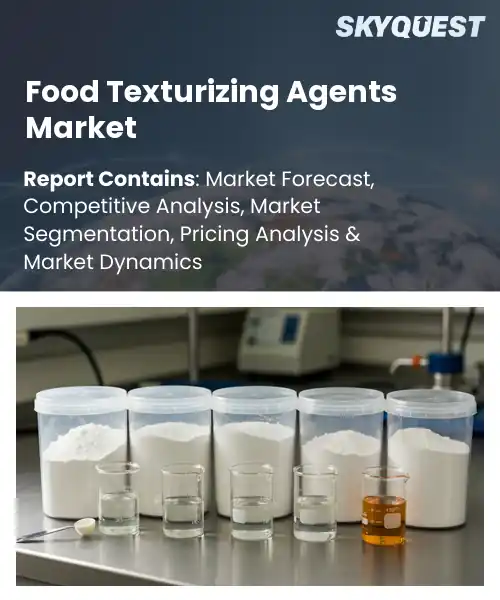
Food Texturizing Agents Market
Report ID: SQMIG30I2830
Report ID: SQMIG30I2830
[email protected]
USA +1 351-333-4748
Report ID:
SQMIG30I2830 |
Region:
Global |
Published Date: February, 2026
Pages:
157
|Tables:
91
|Figures:
76


Global Food Texturizing Agents Market size was valued at USD 14.08 Billion in 2024 and is poised to grow from USD 14.72 Billion in 2025 to USD 21.07Billion by 2033, growing at a CAGR of 4.58% during the forecast period (2026-2033).
The global food texturizing agents market growth is driven because consumers want different sensory experiences while they prefer clean-label products and food that offers fast preparation. The market contains starches and hydrocolloids and proteins and emulsifiers which create changes in viscosity and gelation and mouthfeel properties because texture determines whether products succeed in acceptance and shelf stability and processing.
Moreover, the global food texturizing agents industry developed from its initial use of native starches to adopt modified starches and engineered hydrocolloids which became the standard after processing technology and regulatory inspection operations improved major examples include xanthan and pectin which replaced controversial carrageenan and tapioca starch that had been transformed into resistant starches for nutritional purposes. The global market experiences major changes because plant-based and reduced-fat products require sophisticated texturizers to create animal-like mouthfeel while they maintain water and fat distribution in their intricate formulations. The demand in the market for multifunctional hydrocolloids and protein-based texturizers grows because manufacturers want to create cleaner labels and better nutrition, which leads to increased research and development and new partnerships that build ingredient portfolios. The demand for vegan burger products leads food manufacturers to use methylcellulose and pea protein isolates which create juiciness, while low-fat dressings need xanthan and modified starch blends to recreate creaminess, which creates business opportunities in both retail and foodservice throughout the world.
How is AI Enhancing Formulation Efficiency in the Food Texturizing Agents' Market?
AI helps the food texturizing agents market outlook to change because it uses data-driven models to show how different ingredients will affect sensory outcomes. The project uses virtual prototyping and predictive sensory modeling plus processing condition simulation as essential components. The current state shows formulators narrowing candidate blends with machine learning before lab trials. AI helps companies handle clean label requirements while developing multiple texture options by cutting down testing needs and maintaining desirable mouthfeel throughout production and speeding up the creation of trustworthy product designs. AI guided hydrocolloid pairing and process simulation help achieve better initial results while making the transition to large scale production easier.
Market snapshot - (2026-2033)
Global Market Size
USD 14.7 Billion
Largest Segment
Plant-Based
Fastest Growth
Plant-Based
Growth Rate
4.8% CAGR
To get more insights on this market click here to Request a Free Sample Report
The global food texturizing agents' market is segmented based on source, function, application, and region. By source, the market is categorized into plant-based and animal-based segments. Based on function, it is divided into emulsifiers, stabilizers, thickeners, and gelling agents. In terms of application, the market is segmented into dairy products, bakery products, meat products, and beverages. Regionally, the market is classified into North America, Europe, Asia Pacific, Latin America, and the Middle East & Africa.
According to the global food texturizing agents market analysis, the plant-based segment leads the market because consumers prefer natural and sustainable ingredients which drive manufacturers to select plant-based texturizers which provide clean label benefits and multiple functional advantages. The food system includes intrinsic fiber and protein matrices which can create texture changes and emulsification effects and moisture retention capabilities in different food systems, which allows for easier formulation and decreases the need for synthetic materials. The industry now uses ingredient diversification to expand its applications because procurement flexibility and supplier innovation enable companies to obtain multiple ingredient options.
However, the animal-based sector now grows faster than any other market because its components can replicate genuine textures and mouthfeel qualities which are essential in premium dairy and meat products. The market for tailored hydrocolloids and enzyme modified proteins now advances by unlocking new product formats and premiumization opportunities, which manufacturers use to create indulgent sensory experiences.
As per the global food texturizing agents market forecast, the emulsifier segment leads the market because these functional agents create stable fat and water dispersion, which enables manufacturers to regulate product texture in reduced fat and aerated and spreadable products. Their capacity to interact with proteins and polysaccharides improves mouthfeel and shelf stability, which lets formulators reach specific sensory targets while making processing easier. The development of mild emulsifiers which meet label requirements enables usage in dairy products and bakery items and beverages,and meat formulations.
Whereas the gelling agent segment shows the highest growth potential because formulators want to create plant-based products with smooth textures,and they also create new snack products. The development of versatile hydrocolloids and enzyme activation processes and processing compatibility has created new structured food products which showcase innovative mouthfeel and product stability and product differentiation capabilities to create new formulation pathways and business opportunities.
To get detailed segments analysis, Request a Free Sample Report
As per the food texturizing agents market regional forecast, Asia Pacific achieves its leading market position because of its strong demand patterns, its wide range of culinary practices, and its powerful manufacturing capabilities which enable companies to adopt texturizing solutions on a large scale. The food industry uses thickeners and stabilizers and gelling agents at high rates because ingredient formulation advances and supplier-producer cooperation and new processed foods become available. The region develops its specialized texturizing technologies because it produces both plant-based and fermented goods. The existing supply chains together with the increasing domestic raw material production create a system that enables companies to acquire materials at lower costs. The market maintains its leading position through two factors which include regulatory frameworks that promote new product development and consumer preference for texture-rich ready-to-eat products.
The Japanese food texturizing agents industry focuses on delivering high quality products through their dedication to developing innovative solutions which enhance texture for both traditional and contemporary culinary styles. Consumers today want products which have clear ingredient labels and multiple functions because of their modern needs. Research centers and ingredient suppliers work together to develop new seafood and confectionery and ready meal products. The culinary heritage and discerning taste of consumers create a market for premium texturizing products which are currently undergoing reformulation to achieve better mouthfeel stability.
The South Korean Food Texturizing Agents Market shows how consumer preferences are shifting toward convenient products which combine different culinary traditions and snack items. Local companies provide customized solutions for products used in instant meals and dairy alternatives and meat substitutes. Companies now adopt hydrocolloids and enzyme-based systems because they want products with clean labels and functional benefits. The shift towards urban living with changing consumer preferences creates sustained demand for products which deliver sophisticated taste experiences and long-lasting performance.
The North American market experiences rapid growth because health-conscious customers and specialty foods and plant-based products and natural ingredients and clean-label products have all emerged as driving factors. Food manufacturers require texturizing agents which provide desirable mouthfeel characteristics while they create products with reduced fat and sugar and allergen-free properties. The product development process and scale-up activities proceed more rapidly when ingredient suppliers maintain close contact with food processing companies. The market for multifunctional thickeners and stabilizers expands because regulatory requirements for product quality and performance are fulfilled. The distribution network enables texture modulation innovation because it supports research activities and all culinary fields and dairy products and bakery items and meat substitutes, and convenient food products. The demand for sensory experiences from consumers together with the need for longer-lasting retail products leads manufacturers to integrate advanced texturizers into their product lines.
The United States food texturizing agents sector exists because food manufacturers need clean-label products while specialty ingredient suppliers provide continual product innovation. Developers choose multifunctional hydrocolloids and protein-based systems because these products help them create reduced-fat and plant-based formulations. Consumer demand for premium texture experiences and advanced retail processing methods drive manufacturers to create diverse formulas which combine multiple texturizing solutions for various food categories and product stability.
The Canadian food texturizing agents market focuses on natural ingredients with multifunctional properties which meet consumer demand for clean labels and authentic textures. Local manufacturers team up with suppliers to create texturizers which work best in dairy and bakery and plant-based product categories. The industry needs hydrocolloids and fiber-based systems because customers want to know about ingredient origins and product formulation details. Innovation happens through two elements which include regional taste diversity and the need to create products with stable mouthfeel and extended shelf-life and efficiency.
Europe uses its scientific expertise and sustainability efforts to create products that match the natural and functional ingredient needs of modern consumers. The region's ingredient developers create new texturizing solutions that serve both artisanal makers and industrial producers to achieve traditional culinary tastes through contemporary processing standards. The use of circular sourcing together with cleaner production methods enables the development of high-quality texture modifiers. Research institutions and suppliers, and food manufacturers work together to create products that meet various application needs. The combined effect of unified regulatory systems and a consumer market that prefers products with strong sensory properties drives texture-based product differentiation in the dairy and bakery and meat substitute and confectionery industries.
The German food texturizing agents market displays vigorous formulation development through its emphasis on sustainability and its close partnership between ingredient developers and food manufacturers. The developers work on thickening agents and texturizing products which help them create cleaner labels and streamline their production processes. The bakery and meat processing and dairy industries adopt the new systems because they provide testing and performance dependability. The need for scalable texture solutions drives demand for advanced texture solutions because of companies' dedication to circular sourcing and energy-efficient manufacturing practices.
The United Kingdom food texturizing agents market uses its established artisanal techniques to create plant-based food products which require customized texture solutions. Clean-label hydrocolloids and new protein systems are available through suppliers who provide solutions which deliver authentic mouthfeel results. The collaboration between chefs and development teams creates solutions which help execute specific taste requirements for sauces and baked goods and meat replacement products. The global adoption of diverse texturizers that generate consistent sensory and processing results receives support from three key factors which are sustainability and product traceability and customer transparency.
The French food texturizing agents market operates under three core principles which include the country’s culinary history and its strict ingredient standards and its strong demand for artisanal food products which require sophisticated texture features. The suppliers create custom texturizers which apply to sauces and dairy desserts and baked goods to achieve genuine mouthfeel maintenance. The practice of using natural solutions matches what consumers want. The collaboration between culinary experts and ingredient scientists continues to develop new formulations which preserve traditional taste standards while satisfying manufacturing needs and shelf-life requirements and quality standards.
To know more about the market opportunities by region and country, click here to
Buy The Complete Report
Growing Preference for Clean Labels
Manufacturers are reformulating products to meet consumer demand for recognizable, minimally processed ingredients, prompting increased use of natural gums, native and modified starches, and plant derived hydrocolloids as texturizing agents. The suppliers increase their product range and develop clean label ingredient processing with food brands to create texture solutions that keep mouthfeel while cutting down artificial content. Natural texture solutions lead to product launches which drive greater adoption in the bakery and dairy and meat analog markets to create ongoing market growth.
Innovation in Hydrocolloid Technologies
Producers use hydrocolloid research and formulation progress to create products which match specific needs for viscosity and gelation and stability by controlling texture properties without needing various additives. Improved methods for ingredient purification and fractionation create standardized products which enable all batch processes to run smoothly into complicated product formulas. The technical advancements enable food manufacturers to create plant-based products and low-fat items which provide appealing mouthfeel and product durability through their use of modern texturizing agents.
Regulatory Complexity for Novel Ingredients
The existing regulatory frameworks which govern food additives and novel ingredients create commercial uncertainty that inhibits the development of new texturizing agents. The manufacturers face major expenses to fulfill safety testing requirements and labeling rules and approval procedures because different regions have different compliance needs. The regulatory system creates challenges that prevent smaller companies from entering the market while it limits product distribution across international markets and leads companies to depend on existing ingredients which slows down the acceptance of novel texturizers in the food industry.
Supply Chain Raw Material Volatility
The food texturizing agents market relies on agricultural products which include gums and starches and plant-derived hydrocolloids resulting in supply shortages due to climate changes and harvest periods and sourcing problems which affect the constant flow of ingredients and their quality. The procurement process becomes complicated for manufacturers who need to acquire materials because they must either maintain higher inventory levels or certify new suppliers. Food producers avoid using new products which need unpredictable materials because it creates risk for their manufacturing processes, which leads to decreased investment in new texturizers and decelerates market growth.
Request Free Customization of this report to help us to meet your business objectives.
The global food texturizing agents market creates its competitive environment through established ingredient suppliers who retain market power and through nimble startup companies who compete to deliver affordable functional systems which meet clean-label requirements for textural needs. Companies conduct M&A activities through its acquisition of Quantum Hi-Tech by Tate & Lyle while launching new texture platforms which include Motif FoodWorks' APPETEX and Hemami and through its business realignment to texture business units which drive success in winning over formulators.
Plant Based Texture Innovation: The demand for plant-based foods drives developers to create new texturizing agents which replicate the mouthfeel and functional attributes of animal-derived products. Manufacturers prefer plant-based proteins together with advanced starches and hydrocolloids which achieve creaminess and juiciness and thermal stability while allowing for clean processing methods. Ingredient suppliers work together with food formulators to develop sensory-driven solutions that can be scaled up to solve problems related to protein network formation and emulsification and fat replacement. The current trend leads to increased investment in extraction technologies and multifunctional blends which can match sensory authenticity with processing efficiency and clarity.
Clean Label Transparency Demand: Consumers prefer to choose food texturizing agents which contain visible elements that have undergone minimal processing. Brands require customers to buy nature-derived hydrocolloids and fermentation-produced polysaccharides and enzymatically modified proteins, which modern consumers want as alternatives to chemically altered food substances together with transparent ingredient sourcing and straightforward product labels. Supply chains require traceability while they need supplier communication to prove their marketing claims and fulfill regulatory requirements. The product team chooses between sensory performance and authenticity proof which requires them to work with research and development, procurement, and marketing teams to fulfill clean label demands which have changed since yesterday.
SkyQuest’s ABIRAW (Advanced Business Intelligence, Research & Analysis Wing) is our Business Information Services team that Collects, Collates, Correlates, and Analyses the Data collected by means of Primary Exploratory Research backed by robust Secondary Desk research.
As per SkyQuest analysis, the global food texturizing agents market experiences growth because consumers demand different sensory experiences and products that have clean-label characteristics, while the regulatory hurdles for new ingredients create a major obstacle which delays product introduction into the market. Asia Pacific maintains its dominant position because it has strong manufacturing capabilities together with its wide range of culinary requirements, while plant-based sources lead the market because of consumer demand for sustainable products that use clean-label ingredients. Hydrocolloid technology innovation drives growth by allowing companies to create custom solutions which deliver specific viscosity and gelation and multifunctional performance capabilities for both plant-based and reduced-fat products. The combination of these factors leads to increased research and development activities together with strategic partnerships and formulation developments which determine how markets develop and how suppliers compete.
| Report Metric | Details |
|---|---|
| Market size value in 2024 | USD 14.7 Billion |
| Market size value in 2033 | USD 22.42 Billion |
| Growth Rate | 4.8% |
| Base year | 2024 |
| Forecast period | (2026-2033) |
| Forecast Unit (Value) | USD Billion |
| Segments covered |
|
| Regions covered | North America (US, Canada), Europe (Germany, France, United Kingdom, Italy, Spain, Rest of Europe), Asia Pacific (China, India, Japan, Rest of Asia-Pacific), Latin America (Brazil, Rest of Latin America), Middle East & Africa (South Africa, GCC Countries, Rest of MEA) |
| Companies covered |
|
| Customization scope | Free report customization with purchase. Customization includes:-
|
To get a free trial access to our platform which is a one stop solution for all your data requirements for quicker decision making. This platform allows you to compare markets, competitors who are prominent in the market, and mega trends that are influencing the dynamics in the market. Also, get access to detailed SkyQuest exclusive matrix.
Table Of Content
Executive Summary
Market overview
Parent Market Analysis
Market overview
Market size
KEY MARKET INSIGHTS
COVID IMPACT
MARKET DYNAMICS & OUTLOOK
Market Size by Region
KEY COMPANY PROFILES
Methodology
For the Food Texturizing Agents Market, our research methodology involved a mixture of primary and secondary data sources. Key steps involved in the research process are listed below:
1. Information Procurement: This stage involved the procurement of Market data or related information via primary and secondary sources. The various secondary sources used included various company websites, annual reports, trade databases, and paid databases such as Hoover's, Bloomberg Business, Factiva, and Avention. Our team did 45 primary interactions Globally which included several stakeholders such as manufacturers, customers, key opinion leaders, etc. Overall, information procurement was one of the most extensive stages in our research process.
2. Information Analysis: This step involved triangulation of data through bottom-up and top-down approaches to estimate and validate the total size and future estimate of the Food Texturizing Agents Market.
3. Report Formulation: The final step entailed the placement of data points in appropriate Market spaces in an attempt to deduce viable conclusions.
4. Validation & Publishing: Validation is the most important step in the process. Validation & re-validation via an intricately designed process helped us finalize data points to be used for final calculations. The final Market estimates and forecasts were then aligned and sent to our panel of industry experts for validation of data. Once the validation was done the report was sent to our Quality Assurance team to ensure adherence to style guides, consistency & design.
Analyst Support
Customization Options
With the given market data, our dedicated team of analysts can offer you the following customization options are available for the Food Texturizing Agents Market:
Product Analysis: Product matrix, which offers a detailed comparison of the product portfolio of companies.
Regional Analysis: Further analysis of the Food Texturizing Agents Market for additional countries.
Competitive Analysis: Detailed analysis and profiling of additional Market players & comparative analysis of competitive products.
Go to Market Strategy: Find the high-growth channels to invest your marketing efforts and increase your customer base.
Innovation Mapping: Identify racial solutions and innovation, connected to deep ecosystems of innovators, start-ups, academics, and strategic partners.
Category Intelligence: Customized intelligence that is relevant to their supply Markets will enable them to make smarter sourcing decisions and improve their category management.
Public Company Transcript Analysis: To improve the investment performance by generating new alpha and making better-informed decisions.
Social Media Listening: To analyze the conversations and trends happening not just around your brand, but around your industry as a whole, and use those insights to make better Marketing decisions.
REQUEST FOR SAMPLE
 REQUEST FREE CUSTOMIZATION
Global Food Texturizing Agents Market size was valued at USD 14.7 Billion in 2024 and is poised to grow from USD 15.41 Billion in 2025 to USD 22.42 Billion by 2033, growing at a CAGR of 4.8% during the forecast period (2026-2033).
Competitive landscape in the global food texturizing agents market is shaped by incumbent ingredient suppliers and agile startups competing to supply clean-label, cost-effective functional systems for texture. Firms execute M&A such as Tate & Lyle's acquisition of Quantum Hi-Tech, commercialize new texture platforms like Motif FoodWorks' APPETEX and Hemami, and reorganize around texture business units to win formulators. 'DuPont', 'Cargill', 'ADM', 'Tate & Lyle', 'Kerry Group', 'Ingredion', 'FMC Corporation', 'BASF', 'CP Kelco', 'ICL Group', 'Ashland Global Holdings', 'Wacker Chemie', 'Mitsubishi Chemical', 'DSM', 'Naturex', 'Nissin Foods', 'Gelita', 'SensoryEffects', 'Solvay', 'Givaudan'
Manufacturers are reformulating products to meet consumer demand for recognizable, minimally processed ingredients, prompting increased use of natural gums, native and modified starches, and plant derived hydrocolloids as texturizing agents. This preference encourages suppliers to expand portfolios, invest in sourcing and processing of clean label ingredients, and collaborate with food brands to develop tailored textures that maintain mouthfeel while reducing artificial additives. As a result, product launches emphasize natural texture solutions, driving broader adoption across bakery, dairy, and meat analog categories and supporting sustained market momentum.
Plant Based Texture Innovation: Demand for plant based foods is accelerating innovation in texturizing agents that recreate animal derived mouthfeel and functional performance. Manufacturers prioritize plant derived proteins, novel starches and hydrocolloids engineered to deliver creaminess, juiciness and thermal stability while enabling clean processing. Collaboration between ingredient suppliers and food formulators emphasizes scalable, sensory driven solutions that address protein network formation, emulsification and fat replacement. This trend stimulates investment in extraction technologies and multifunctional blends that balance sensory authenticity with processing efficiency and clarity.
As per the food texturizing agents market regional forecast, Asia Pacific achieves its leading market position because of its strong demand patterns, its wide range of culinary practices, and its powerful manufacturing capabilities which enable companies to adopt texturizing solutions on a large scale.


Want to customize this report? This report can be personalized according to your needs. Our analysts and industry experts will work directly with you to understand your requirements and provide you with customized data in a short amount of time. We offer $1000 worth of FREE customization at the time of purchase.
Feedback From Our Clients


 USA (+1) 351-333-4748

