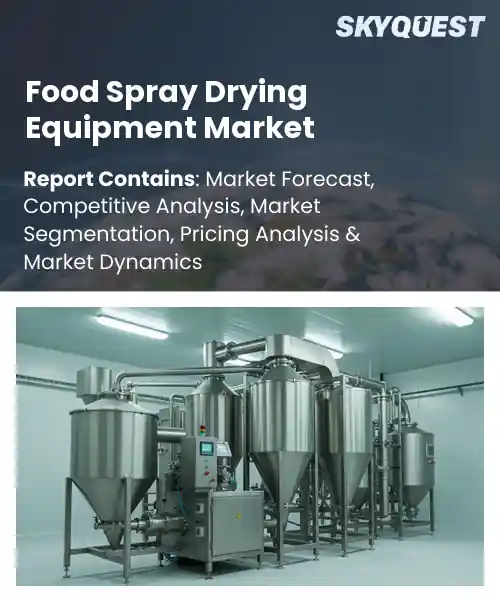
Food Spray Drying Equipment Market
Report ID: SQMIG20D2461
Report ID: SQMIG20D2461
[email protected]
USA +1 351-333-4748
Report ID:
SQMIG20D2461 |
Region:
Global |
Published Date: February, 2026
Pages:
157
|Tables:
119
|Figures:
77


Global Food Spray Drying Equipment Market size was valued at USD 15.63 Billion in 2024 and is poised to grow from USD 16.50 Billion in 2025 to USD 25.41 Billion by 2033, growing at a CAGR of 5.55% during the forecast period (2026-2033).
The primary driver for the global food spray drying equipment market growth is rising demand for shelf-stable, nutrient-preserved food ingredients which have reshaped processing strategies across the food industry. Spray drying transforms liquid concentrates into powder form which allows products to be stored for extended periods while decreasing transportation expenses and making dairy products and coffee and flavors and probiotics easier to formulate. The technology is important because it protects heat-sensitive compounds while their functional properties remain intact, enabling manufacturers to create clean-label products which fulfill consumer needs for convenient products.
Over two decades, investment in continuous automated spray dryers and gains in energy efficiency have expanded capacity and lowered unit costs, as seen when dairy processors upgraded systems. Building on those equipment upgrades, a key driver of global growth is technological innovation in spray dryer design that increases yield while decreasing energy per kilogram, thereby reducing operating costs and expanding applicability. For example, improved atomizers and tight process controls enable the encapsulation of probiotics and other heat-sensitive nutrients, allowing the creation of functional powders that are stable for use in applications such as infant formulas, sport nutrition, and savory seasonings. As sustainability regulations and unpredictable logistics costs increase, manufacturers are adopting compact, energy-efficient dryers that help to shorten supply chains and lower emissions, providing suppliers with an opportunity to drive aftermarket revenues through retrofit services and digital monitoring.
How is IoT Enabling Predictive Maintenance in the Food Spray Drying Equipment Market?
IoT enables predictive maintenance in food spray drying by fitting dryers with continuous sensors for temperature pressure vibration and flow. Edge devices collect signals which they process before sending the data to cloud analytics and machine learning systems which identify slow equipment failures that occur before nozzle fouling and pump performance decline. OEMs and processors in the present market have shifted their approach from handling problems after they occur to performing maintenance at scheduled timeswhich helps maintain product quality and complies with all hygiene requirements. The system decreases the number of unplanned production halts while it increases the lifespan of all equipment. Control logic receives input from actual systems which enables dryers to modify their operational patterns while they produce diagnostic information that helps maintenance teams to conduct precise repairs which minimize production downtime.
GEA introduced InsightPartner EvoHDry in September 2025 to monitor equipment condition through its pre alarm system which provides early warnings for vacuum pump and rotating equipment problems that occur in spray dryers. By converting IoT data into actionable maintenance plans, this development helps operators increase uptime to protect product quality and improve operational efficiency.
Market snapshot - (2026-2033)
Global Market Size
USD 6.4 Billion
Largest Segment
Centrifugal Spray Dryers
Fastest Growth
Pneumatic Spray Dryers
Growth Rate
5.0% CAGR
To get more insights on this market click here to Request a Free Sample Report
The global food spray drying equipment market is segmented based on spray dryer type, technology, application, end-use industry, and region. By spray dryer type, the market is categorized into centrifugal spray dryers, pneumatic spray dryers, and rotary spray dryers. Based on technology, it is segmented into single-stage drying, multi-stage drying, and hybrid drying systems. By application, the market includes dairy & egg products, pharmaceuticals, chemicals, cosmetics & personal care, and other applications. Based on end-use industry, it is divided into food & beverage, healthcare, and other industries. Regionally, the market is analyzed across North America, Europe, Asia Pacific, Latin America, and the Middle East & Africa.
As per the global food spray drying equipment market analysis, the centrifugal spray dryer system operates as the primary food spray drying system because it can process large volumes and it maintainsparticle size distribution while delivering efficient performance for high-volume dairy and infant formula production. Dairy processors around the world use these systems to manufacture milk powder products. GEA Group supplies centrifugal spray drying equipment to many dairy industries throughout the world. The market segment maintains its leadership position because these solutions provide low energy consumption while delivering high product quality.
However, the specialty of food and nutraceutical industry requires advanced drying capabilities which will drive market growth for rotary spray dryers during the projection period. Their ability to work with heat-sensitive materials is making them increasingly attractive. The company SPX FLOW now uses advanced rotary drying technology for its food processing operations that create added value.
According to the global food spray drying equipment market forecast, the single-stage drying method is the preferred drying method for food and dairy powder production because of its cost-effective and easy-to-use characteristics. The method provides maximum efficiency for large-scale production of identical products. Tetra Pak uses single-stage spray drying systems for dairy processing to produce milk powder with high speed and dependable performance which reduces their equipment and maintenance costs.
Whereas the multi-stage drying systems category is expected to have the highest food spray drying equipment market share because consumers now prefer products that use less energy and powders which have better solubility and higher density. The technology enhances product quality while decreasing thermal stress on the system. The Buhler Group has created multi-stage drying systems which help dairy products and specialty foods achieve better environmental sustainability and operational efficiency.
To get detailed segments analysis, Request a Free Sample Report
As per the food spray drying equipment market regional forecast, Asia Pacific achieves its status through three elements which include strong food processing demand, extensive manufacturing networks, and quick adoption of new spray drying systems. The regional markets operate extensive delivery networks which link food ingredient suppliers with contract manufacturing partners who produce powdered products for dairy, beverages, flavors and convenience foods. Food companies work with local equipment makers and global original equipment manufacturers to create tailored compact systems which provide high-capacity equipment designed for local product requirements. The combination of accessible industrial supply chains and skilled engineering resources and dedicated research institutions and export-oriented business models creates better opportunities for deploying and maintaining service networks. The combination of affordable manufacturing costs and strong product development and flexible financing options allows spray drying technologies to reach both major industrial users and smaller traditional processors which strengthens the region's market position.
The food spray drying equipment industry in Japan combines precision engineering and stringent quality practices to serve specialty ingredient and dairy processors. The established equipment manufacturers develop their products according to compact and hygienic and energy-efficient design principles through their collaboration with food enterprises to create specific drying profiles. Processors achieve product consistency through their dedication to automation and maintenance support and ongoing small-scale product enhancements which enable them to fulfill demanding domestic and international quality standards and improve their competitiveness in export markets.
The food spray drying equipment sector in South Korea benefits from agile adoption of processing technologies and a strong focus on compact, high-performance systems for instant and convenience food producers. The domestic market for manufacturers and integrators focuses on developing quick prototyping solutions which clients can adapt through direct technical assistance. The cooperation between food technology startups and established companies results in creating new applications for powdered ingredients while the strong export orientation helps equipment and service offerings develop their features through continuous improvement processes.
The North American market expands because food and beverage producers need powdered ingredients while the established manufacturing sector values efficiency and safety and compliance with regulations. The market requires scalable spray drying solutions and aftermarket services because large ingredient manufacturers and contract packers and private label manufacturers form the industry base. The industry promotes advanced equipment and retrofitting through its emphasis on process automation and hygienic design and energy management systems. Equipment suppliers team up with processors to develop custom solutions which benefit from service providers and technology partners who help with both implementation and equipment maintenance throughout the product lifecycle. Processors need to enhance their systems because sustainability and innovative ingredients and adaptable production processes become their main priorities for achieving better productivity and lower power consumption. The availability of skilled process engineers and centralized supply chains enables faster progression from pilot projects to full manufacturing operations.
The food spray drying equipment market in the United States is shaped by large ingredient manufacturers, extensive contract manufacturing and an emphasis on process validation and food safety. Equipment suppliers work closely with research and development teams to tailor drying profiles for nutritional and functional ingredients. The business focuses on automation and expanding platforms and supporting clients after purchasing to create quick technology adoption. The company provides equipment solutions which enable active business areas to create custom solutions which provide businesses with ongoing operational improvements for their drying systems.
The Canadian food spray drying equipment market operates through dairy processing and specialty ingredient processing centers which supply products to international markets. The equipment providers develop hygienic equipment which operates at high energy efficiency while their systems can transform between multiple ingredient characteristics. Equipment providers work together with processors to create operational processes which move from pilot testing to full production capacity. The service network in the region together with engineering capabilities provides support to maintain equipment functionality while meeting market standards and sustainability requirements of drying systems.
European countries enhance their territorial dominance through their strict enforcement of quality and safety regulations combined with their solid engineering foundation and their targeted development of energy-saving sustainable processing systems. The design of equipment by manufacturers centers on modular components that provide easy maintenance and the ability to update systems through non-invasive production system modifications. Research institutions work together with ingredient companies and equipment suppliers to create new powder technologies which enable the production of plant-basedproteins and dairy alternatives and specialty flavors. Processors can now give priority to yield and product stability and environmental footprint reduction because of the market consolidation of solution providers and the growing demand for aftermarket maintenance services and the increasing focus on lifecycle performance evaluation.
The food spray drying equipment market in Germany aligns with engineering strengths and industrial fabric, delivering robust, energy efficient drying solutions. Domestic manufacturers focus on modular designs that simplify maintenance and enable retrofits for modern processing needs. The supplier ecosystem together with automation expertise allows businesses to operate on complex formulations while achieving maximum production capacity. Processors achieve productivity maintenance through lifecycle service emphasis and performance testing and adherence to rigorous standards which enable them to work with equipment destined for export markets.
The food spray drying equipment market in United Kingdom benefits from a strong services and innovation ecosystem, with contract manufacturers and research centers collaborating to develop powder solutions for novel applications. Equipment integrators develop systems that maintain flexibility and hygiene to function in production of both artisanal products and large-scale products. The quick commercialization of new ingredients depends on pilot facilities and formulation support and regulatory alignment. Through its aftermarket service networks and consultancy services, the company delivers ongoing support for performance monitoring and process improvement.
The food spray drying equipment market in France leverages dairy tradition to prioritize systems that preserve flavor and functional properties. The design of equipment involves custom solutions for both artisanal producers and industrial customers by creating drying solutions that use gentle drying methods and maintain design cleanliness. The company develops equipment solutions through its collaborations with ingredient developers and research centers which focus on specific formulation requirements. Processors use sustainability and energy efficiency and service as tools to protect their traditional product quality while creating modern production capabilities for international selling.
To know more about the market opportunities by region and country, click here to
Buy The Complete Report
Rising Demand for Nutrient-Dense Ingredients
The process of spray drying turns liquid products which contain essential nutrients into powdered products that can be stored indefinitely while keeping their original taste and nutritional attributes. This technology enables manufacturers to produce new products with different characteristics because it delivers three essential functions which include maintaining identical particle dimensions and achieving moisture control and enabling simple integration into their product development process. The technology helps companies to extend their product shelf life because it keeps bioactive materials intact through its adaptable features which support various types of raw materials.
Expansion of Ready to Use Powders
The rising demand among consumers for easily accessible food products which can be stored without refrigeration has led food manufacturers to create more ready-to-use powder products which require dependable spray drying systems for their production process. The systems enable controlled drying of raw materials which produce uniform powders that maintain their natural qualities, which makes storage and distribution easier for companies to handle while enabling recipe standardization. The need for modern spray drying equipment arises because brands require on-the-go products together with clean-label products to produce consistent products while increasing their production capacity to match market needs.
High Capital Expenditure and Maintenance Costs
The high cost of this advanced spray drying equipment, along with operational and maintenance requirements, also inhibits the adoption of these technologies by small and mid-sized businesses, owing to the operational requirement for high levels of expertise and planned downtime for servicing, thereby increasing overall operational expenses. The presence of limited capital resources together with the focus on immediate financial returns leads to delayed procurement processes and reduced capacity expansion, which subsequently hinders the food spray drying equipment market penetration and technology adoption.
Stringent Food Safety and Regulatory Compliance
Manufacturers must comply with strict environmental regulations, which require them to maintain clean production facilities while ensuring their products meet established food safety standards. The guidelines which regulate emissions of control, contamination control, and product traceability include requirements which manufacturers must follow. The compliance requirements need you to finish extra validation procedures together with documentation tasks and system changes. The complexity of regulations causes manufacturers to incur higher production expenses because they must wait longer for their equipment to receive certification, which affects exporters who need to comply with different international laws in multiple countries.
Request Free Customization of this report to help us to meet your business objectives.
The leading OEMs in the global food spray drying equipment market use specialized mergers and acquisitions together with regional partnerships and product development to obtain permanent contracts in the food and dairy sectors. The GEA Group developed an aseptic pharmaceutical spray drier to increase the frequency of high-value applications. SPX FLOW used its regional partnership programs to improve their operational performance of drying lines which operated at low temperatures. Buchi enhanced its lab-scale products through automated features which it introduced in 2025 while Dover Corporation acquirednew assets to improve its drying operations. The industry advancements require suppliers to develop modular solutions which consume less energy and offer more serviceable features to maintain their market position.
Demand For Clean Label Products: Manufacturers prefer equipment which maintains original ingredients while enabling clean label products which leads to increased demand for spray dryers that provide gentle drying combined with exact encapsulation and need for few formulation additives. Product integrity and sensory quality require design solutions that protect heat-sensitive compounds while enhancing their solubility and preserving their flavor and color through natural methods without synthetic carriers. Equipment suppliers and ingredient producers and brands work together to create transparent and traceable powders which fit consumer demands for natural and simple and healthy food products across all categories.
Integration Of Digital Process Control: Producers now use digital control systems together with sensor integration to enhance their spray drying processes which provide them with real-time process monitoring and precise control of processes and they can adjust their recipes according to their production requirements. Advanced analytics together with connectivity enable systems to make predictive adjustments which result in uniform powder quality while improving the speed of technical support services through remote access capabilities. The control systems that suppliers provide help processors maintain product quality while they scale their recipes because the systems include quality and safety standards. The shift toward digitalization improves operational capabilities through enhanced process tracking and establishment of standardized procedures across multiple facilities and development work which vendors and food manufacturers conduct together.
SkyQuest’s ABIRAW (Advanced Business Intelligence, Research & Analysis Wing) is our Business Information Services team that Collects, Collates, Correlates, and Analyses the Data collected by means ofPrimary Exploratory Research backed by robust Secondary Desk research.
As per SkyQuest analysis, the global food spray drying equipment market is being driven primarily by rising demand for shelf-stable, nutrient-preserved powders, while technological innovation in dryer design that improves yields and energy efficiency serves as a second strong growth engine. The processing industry for smaller companies faces adoption difficulties because their systems need expensive initialinvestments, and their operations require continuous maintenance. Asia Pacific leads market development because it possesses both manufacturing capacity and technology which develops at an accelerated rate, while centrifugal spray dryers offer high-volume food processors essential particle management capabilities and dependable nonstop operational capacity. The suppliers who concentrate on developing energy-efficient digital ready retrofits will experience the most success in market expansion.
| Report Metric | Details |
|---|---|
| Market size value in 2024 | USD 6.4 Billion |
| Market size value in 2033 | USD 9.93 Billion |
| Growth Rate | 5.0% |
| Base year | 2024 |
| Forecast period | (2026-2033) |
| Forecast Unit (Value) | USD Billion |
| Segments covered |
|
| Regions covered | North America (US, Canada), Europe (Germany, France, United Kingdom, Italy, Spain, Rest of Europe), Asia Pacific (China, India, Japan, Rest of Asia-Pacific), Latin America (Brazil, Rest of Latin America), Middle East & Africa (South Africa, GCC Countries, Rest of MEA) |
| Companies covered |
|
| Customization scope | Free report customization with purchase. Customization includes:-
|
To get a free trial access to our platform which is a one stop solution for all your data requirements for quicker decision making. This platform allows you to compare markets, competitors who are prominent in the market, and mega trends that are influencing the dynamics in the market. Also, get access to detailed SkyQuest exclusive matrix.
Table Of Content
Executive Summary
Market overview
Parent Market Analysis
Market overview
Market size
KEY MARKET INSIGHTS
COVID IMPACT
MARKET DYNAMICS & OUTLOOK
Market Size by Region
KEY COMPANY PROFILES
Methodology
For the Food Spray Drying Equipment Market, our research methodology involved a mixture of primary and secondary data sources. Key steps involved in the research process are listed below:
1. Information Procurement: This stage involved the procurement of Market data or related information via primary and secondary sources. The various secondary sources used included various company websites, annual reports, trade databases, and paid databases such as Hoover's, Bloomberg Business, Factiva, and Avention. Our team did 45 primary interactions Globally which included several stakeholders such as manufacturers, customers, key opinion leaders, etc. Overall, information procurement was one of the most extensive stages in our research process.
2. Information Analysis: This step involved triangulation of data through bottom-up and top-down approaches to estimate and validate the total size and future estimate of the Food Spray Drying Equipment Market.
3. Report Formulation: The final step entailed the placement of data points in appropriate Market spaces in an attempt to deduce viable conclusions.
4. Validation & Publishing: Validation is the most important step in the process. Validation & re-validation via an intricately designed process helped us finalize data points to be used for final calculations. The final Market estimates and forecasts were then aligned and sent to our panel of industry experts for validation of data. Once the validation was done the report was sent to our Quality Assurance team to ensure adherence to style guides, consistency & design.
Analyst Support
Customization Options
With the given market data, our dedicated team of analysts can offer you the following customization options are available for the Food Spray Drying Equipment Market:
Product Analysis: Product matrix, which offers a detailed comparison of the product portfolio of companies.
Regional Analysis: Further analysis of the Food Spray Drying Equipment Market for additional countries.
Competitive Analysis: Detailed analysis and profiling of additional Market players & comparative analysis of competitive products.
Go to Market Strategy: Find the high-growth channels to invest your marketing efforts and increase your customer base.
Innovation Mapping: Identify racial solutions and innovation, connected to deep ecosystems of innovators, start-ups, academics, and strategic partners.
Category Intelligence: Customized intelligence that is relevant to their supply Markets will enable them to make smarter sourcing decisions and improve their category management.
Public Company Transcript Analysis: To improve the investment performance by generating new alpha and making better-informed decisions.
Social Media Listening: To analyze the conversations and trends happening not just around your brand, but around your industry as a whole, and use those insights to make better Marketing decisions.
REQUEST FOR SAMPLE
 REQUEST FREE CUSTOMIZATION
Global Food Spray Drying Equipment Market size was valued at USD 6.4 Billion in 2024 and is poised to grow from USD 6.72 Billion in 2025 to USD 9.93 Billion by 2033, growing at a CAGR of 5.0% during the forecast period (2026-2033).
The competitive landscape of the global food spray drying equipment market is concentrated and tactical, driven by OEMs using targeted M&A, strategic partnerships and product innovation to lock in large food and dairy contracts; examples include GEA’s aseptic pharmaceutical spray dryer launch, SPX FLOW’s regional partnership programs for low temperature lines, Dover’s 2025 asset acquisition to broaden drying capabilities and Buchi’s lab-scale automation upgrades, all forcing suppliers to offer modular, energy efficient and serviceable systems. 'GEA Group', 'Bühler Group', 'SPX Flow', 'Fitzpatrick', 'Mikro Pulverizer', 'Krones AG', 'Coperion', 'Anhydro', 'Schenck Process', 'FSD Solutions', 'Sierra Instruments', 'Huttlin', 'Kason Corporation', 'SODECA', 'Isco', 'ACG Worldwide', 'Niro', 'Grizzly Industrial', 'AARDX', 'Craemer Group'
Spray drying enables the transformation of nutrient-rich liquids into stable, shelf-ready powders that retain flavor and functional properties, which encourages manufacturers to invest in advanced equipment. This capability supports product diversification and innovation across functional food, infant nutrition, and plant-based segments by facilitating consistent particle size, controlled moisture, and ease of incorporation into formulations. As producers seek efficient methods to preserve bioactive compounds and extend product shelf life, the technology’s versatility and compatibility with diverse raw materials drive increased equipment adoption and process optimization.
As per the food spray drying equipment market regional forecast, Asia Pacific achieves its status through three elements which include strong food processing demand, extensive manufacturing networks, and quick adoption of new spray drying systems.


Want to customize this report? This report can be personalized according to your needs. Our analysts and industry experts will work directly with you to understand your requirements and provide you with customized data in a short amount of time. We offer $1000 worth of FREE customization at the time of purchase.
Feedback From Our Clients


 USA (+1) 351-333-4748

