Food Processing Workwear and Uniforms Market
Report ID: SQMIG25K2166
Report ID: SQMIG25K2166
[email protected]
USA +1 351-333-4748
Report ID:
SQMIG25K2166 |
Region:
Global |
Published Date: March, 2026
Pages:
157
|Tables:
115
|Figures:
77


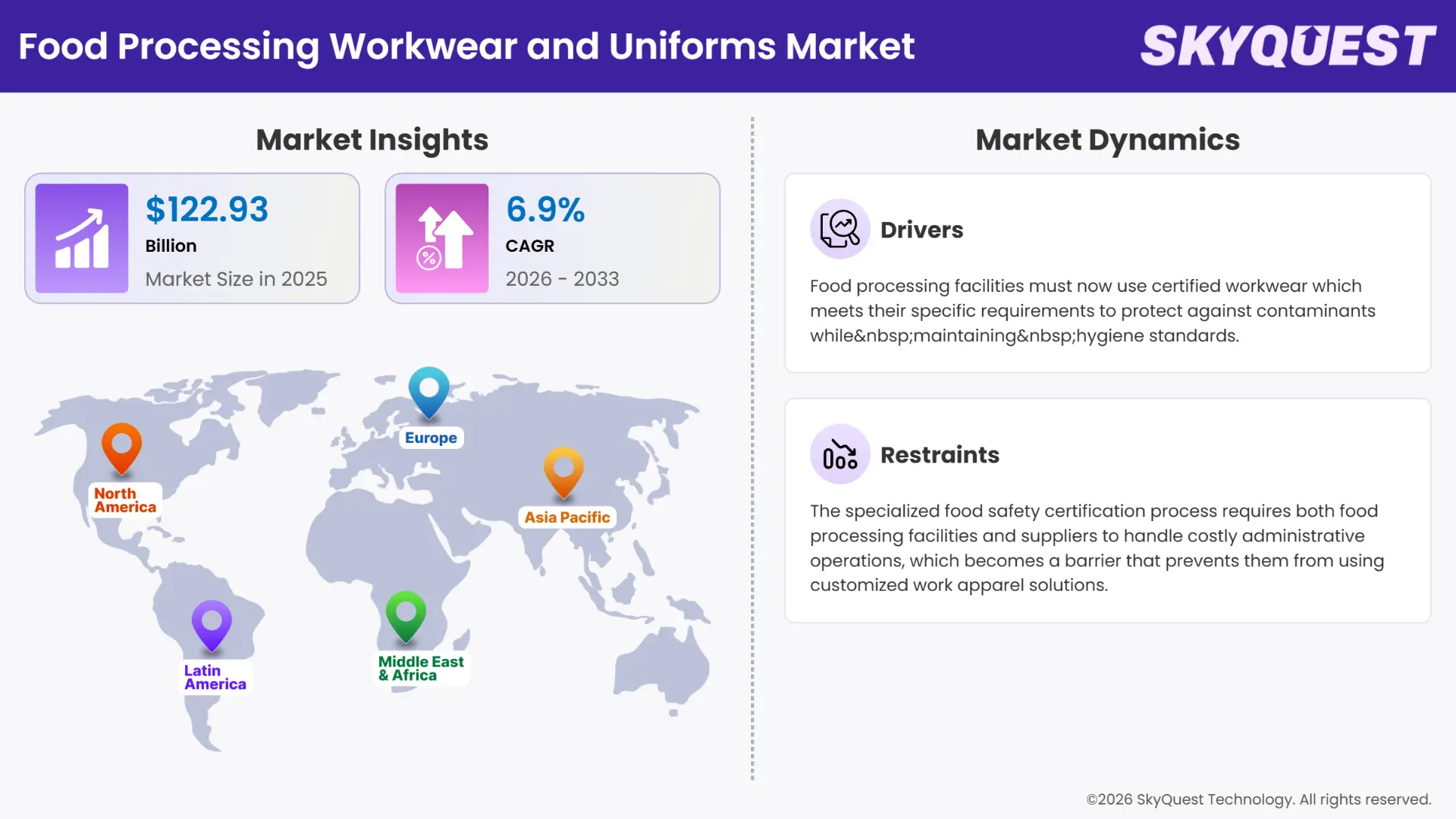
Global Food Processing Workwear and Uniforms Market size was valued at USD 115.0 Billion in 2024 and is poised to grow from USD 122.93 Billion in 2025 to USD 209.65 Billion by 2033, growing at a CAGR of 6.9% during the forecast period (2026-2033).
Key Takeaways: Market Trends & Insights
Regulatory pressure and food safety concerns have been the primary driver that shaped the food processing workwear and uniforms market outlook, which required operators to focus on both contamination control and worker protection. The market provides specialized garments which include cleanroom suits and antimicrobial aprons and hairnets and disposable gloves, which help to minimize microbial transfer while meeting all hazard protection requirements. The market has shifted from basic cotton uniforms to advanced engineered fabrics and color-coded systems and washable materials, which help processors establish hygienic standards for their operations.
Moreover, the global food processing workwear and uniforms market growth depends on textile technology and lifecycle management, which create business advantages that comply with safety regulations and market requirements. The combination of antimicrobial finishes and breathable stain-resistant fabrics plus cut-resistant sleeves with RFID-enabled tracking delivers protection against contamination while reducing processing time, which results in lower recall risks and cost savings for processors, who also gain more comfortable work environments. Rental companies deliver RFID-tagged garments to major meat and dairy facilities with proof of their washing history, while processors use color segregation and sensor-equipped PPE in automated lines, which makes procurement shift towards value-based partnerships that generate new revenue streams and expand global service offerings.
How is IoT Enhancing Traceability in the Food Processing Workwear and Uniforms Market?The Internet of Things technology enables food processing workwear and uniforms to achieve better traceability through its ability to track every garment as an individual asset. The system requires RFID or washable tags together with sensors to record location and washing History plus process zone entry data, which gets stored in cloud platforms that present all data for audits and operational needs. The market requires hygienic products which meet regulatory standards, leading uniform suppliers and laundering companies to adopt Internet of Things technology for their inventory management and laundry operations. The system decreases cross contamination threats while making it easier to trace back products, which enables managers to track their garments through all cleaning processes, thus simplifying regulatory compliance and quality management. Cintas announced its acquisition of UniFirst on March 2026 to focus on developing tracking systems for their clothing inventory. The food processing workwear and uniforms industry moves towards consolidation because companies use IoT traceability to track assets while RFID equipped uniforms enable food processors to verify laundry contents through faster ways, which results in better loss management and quicker compliance evidence gathering.
To get more insights on this market click here to Request a Free Sample Report
The global food processing workwear and uniforms market is segmented by product category, material properties, consumer demographic, service model, and region. Based on product category, the market is divided into protective apparel, hygiene wear, and thermal or cold storage workwear. In terms of material properties, it is categorized into antimicrobial and liquid-repellent fabrics, high-visibility materials, and breathable or lightweight synthetic blends. By consumer demographic, the market includes men’s workwear and women’s ergonomic workwear. Based on the service model, the segmentation comprises direct purchase or sales and rental and managed laundry services. Geographically, the market is segmented into North America, Europe, Asia Pacific, Latin America, and the Middle East & Africa.
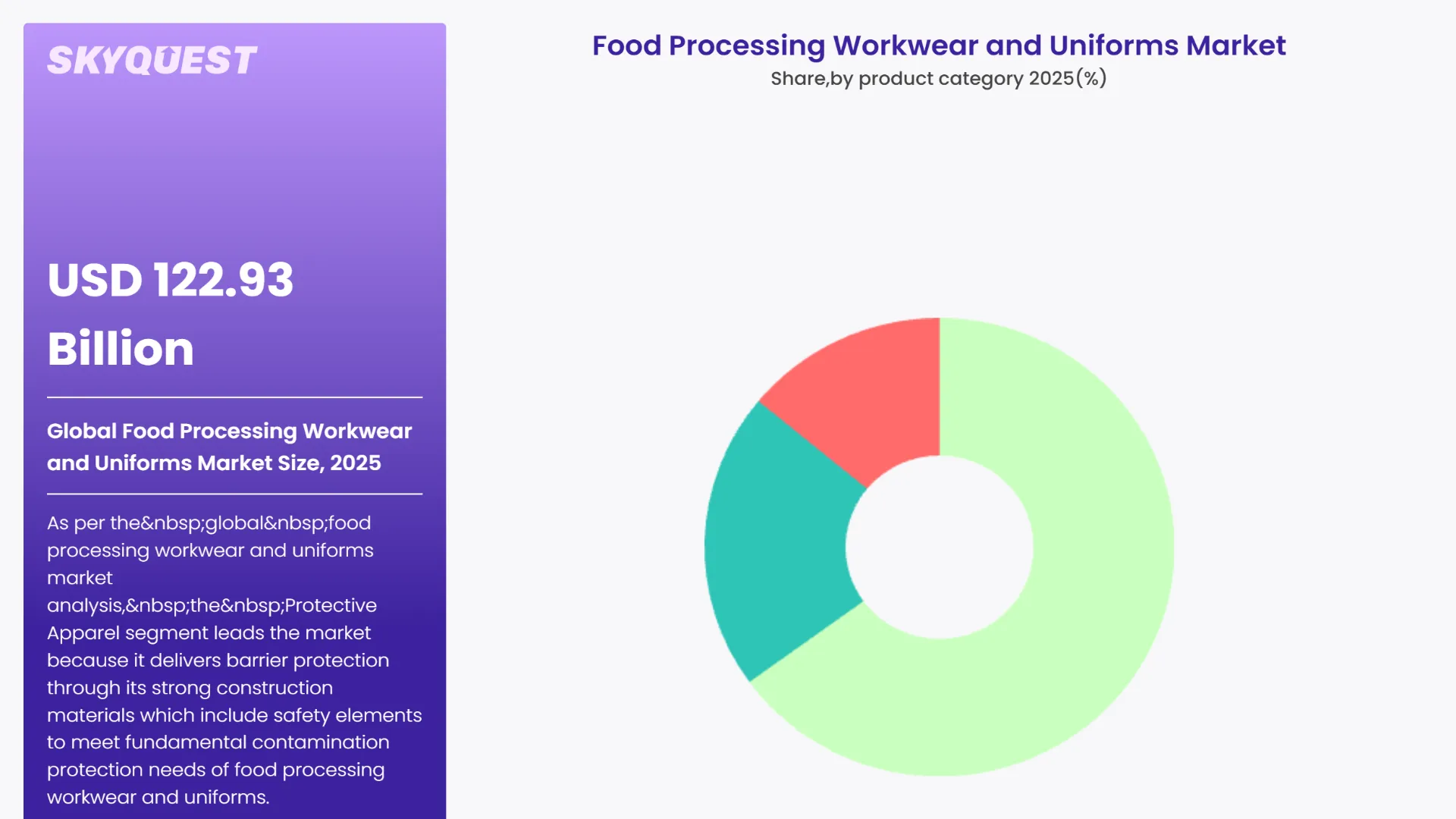
As per the global food processing workwear and uniforms market analysis, the Protective Apparel segment leads the market because it delivers barrier protection through its strong construction materials which include safety elements to meet fundamental contamination protection needs of food processing workwear and uniforms. Buyers prefer protective clothing which prevents cross contamination while meeting their need for routine cleaning access, which drives their choice for sturdy protective designs. Companies acquire proven protective equipment because it meets their hygiene standards and reduces their need to manage potential risks, which leads manufacturers to increase their production capacity and distribution networks for these products.
However, the Hygiene Wear sector is growing quickly because more people want single-use products that they can easily clean, which manufacturers design through their new lightweight disposable fabric innovations, and which processing sites now use to control contamination of their products. The market creates new business opportunities for suppliers who provide solutions which can scale up their operations through continual restocking of essential hygiene products that help customers meet their daily safety requirements.
According to the global food processing workwear and uniforms market forecast, The Antimicrobial & Liquid Repellent segment dominates the market because its material characteristics stop bacteria from growing and shut down liquid flow which causes contamination through foodborne pathogens, thus protecting product safety and making it easier to clean all areas of food processing. The demand for cleaning products exists because regulatory bodies enforce sanitary surface requirements, while buyers choose materials which can improve their garment lifespan, which leads suppliers to focus on developing durable repellent treatments and antimicrobial finishes.
Whereas the breathable or lightweight synthetic blends category is anticipated to achieve the largest food processing workwear and uniforms market share. This is due to the need for breathable fabrics and the need for fabrics that enable multiple washing processes without losing their quality. The combination of hydrophobic breathable knits with advanced performance coatings together with ergonomic comfort, which is getting more attention, opens up new markets through premium fabric products which enable additional revenue streams.
To get detailed segments analysis, Request a Free Sample Report
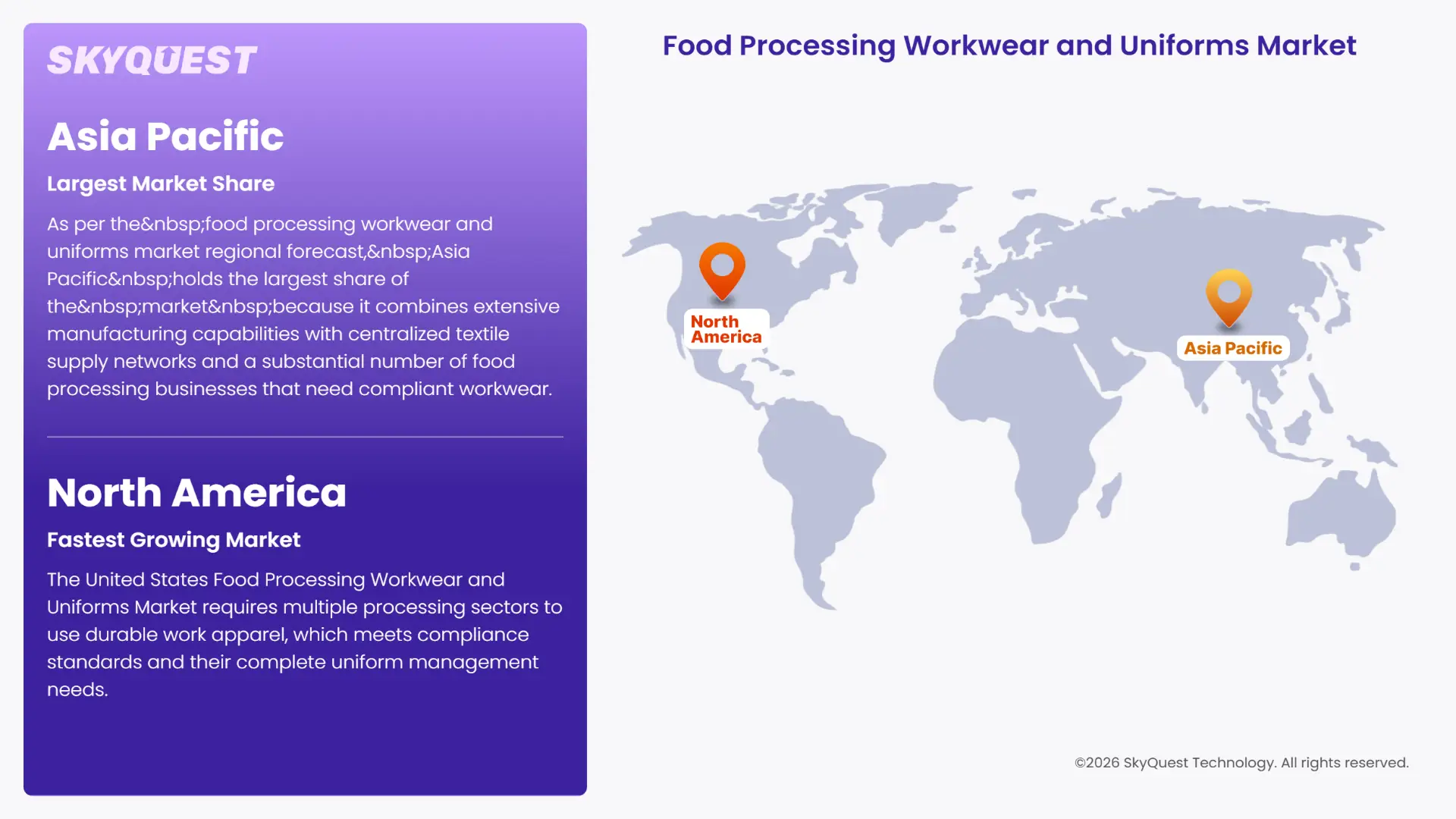
As per the food processing workwear and uniforms market regional forecast, Asia Pacific holds the largest share of the market because it combines extensive manufacturing capabilities with centralized textile supply networks and a substantial number of food processing businesses that need compliant workwear. The food production industry maintains continuous demand for specialized clothing because major economies industrialize their food production operations, which also enables suppliers to quickly create new materials for sanitary and contamination control purposes. The local manufacturing sector creates competitive advantages through its partnerships with food processing companies, which enable production customization and scalable manufacturing and streamlined product distribution. The implementation of automated systems together with smart textile technology has created new product distinctions, while strong export activity enables design standards and technology to spread to multiple markets. The region becomes a worldwide center for innovative development and mass production because food safety requirements and workforce safety regulations create increasing demand for certified work apparel that provides superior performance.
The Japanese Food Processing Workwear and Uniforms sector requires suppliers to meet high hygiene standards through precise manufacturing while using advanced textiles that fulfill strict contamination control regulations. Companies provide design solutions that support ergonomic comfort through their development of long-lasting materials which include fabric treatments that facilitate cleaning. The partnership between textile engineers and food processors leads to research developments, which create performance workwear solutions needed by specialized industries that include seafood and processed food production.
The South Korean Food Processing Workwear and Uniforms Market penetration enhances through advanced textile technology adoption together with fabric producer and processing enterprise partnerships and contamination prevention practices. Companies supply fabrics which comply with workplace hygiene requirements through their use of breathable antimicrobial materials that can be washed easily. Companies develop products which provide ergonomic design specifically for various processing work environments. The local manufacturing sector provides businesses with fast product modifications through their supply chain system, which meets both domestic and international export requirements.
The North American food processing workwear and uniforms market experiences rapid growth because of three factors, which include workplace safety regulations, equipment modernization in processing plants and a comprehensive services ecosystem that provides uniform supply and rental and washing services. The food processing sector requires suppliers to develop new technical garments which provide contamination control and comfort and durability advantages. The demand for standardized compliant work apparel and disposal management solutions has increased because of processor consolidation and advanced procurement methods. The heightened interest in sustainable resource acquisition methods together with circular resource management solutions drives product innovation and vendor market differentiation. The uniform program development process becomes more efficient through the close collaboration between manufacturing, distribution, and service partners, which enables market growth and the wider adoption of advanced workwear solutions.
The United States Food Processing Workwear and Uniforms Market requires multiple processing sectors to use durable work apparel, which meets compliance standards and their complete uniform management needs. Companies supply high throughput facilities with technical textiles and pathogen resistant finishes, and ergonomic designs. They provide rental and laundering services to help customers manage their garment lifecycle process. The buyer needs integrated procurement which includes supplier transparency to sustain environmental credentials to drive both innovation and the creation of strong business partnerships throughout distributed manufacturing operations.
The Canadian Food Processing Workwear and Uniforms Market enables processors to operate under different weather conditions by providing work apparel that meets their requirements for comfort and durability and hygiene standards. Companies deliver regional processors with flexible solutions, which include easy care fabrics. Remote operations depend on rental and laundering networks, while procurement practices give priority to suppliers who provide dependable service along with traceable status and environmentally friendly credentials. The partnership between local manufacturers and food companies enables businesses to better react to customer needs through their ability to develop custom products.
European Union member states improve their market position in food processing workwear and uniforms through their joint dedication to three main areas which include regulatory development, sustainable practices and technical progress that boosts minimum standards for all member countries. Research into antimicrobial finishes and durable low impact fibers and recyclable garment systems benefits from support by industrial and textile clusters, while procurement frameworks give preferential treatment to suppliers who can show their products' origins and stewardship of product life cycles. Manufacturers and launderers, and food processors establish common hygiene standards and uniform requirements through their international cooperation. Market leaders maintain their position through protective performance and environmental responsibility while advanced testing facilities and certification systems enable the widespread distribution of superior workwear. Regional supplier networks and service models enable all processing operations to implement solutions that match their business size from artisanal to industrial processing.
The German food processing workwear and uniforms market growth results from engineering-based production processes which demand exceptional performance and safety equipment. Textile manufacturers collaborate with testing centers to create protective clothing systems which combine protective elements with washing-resistant fabric systems. Buyers demand compliance and traceability and lifecycle value, so suppliers must deliver certified garments and service packages. Suppliers create new products because they have access to industrial resources and high-level technical knowledge.
The United Kingdom food processing workwear and uniforms market provides multiple service delivery systems through its existing rental and laundering systems which maintain hygiene standards for various food processing activities. Supply companies develop customized solutions through their fast delivery and program management systems to serve both small batch and growing processing companies. Innovative development includes both sustainable materials and intelligent textile systems. The network of distributors and launderers and food companies work together to build community production networks while providing backup support for their systems.
The French food processing workwear and uniforms market meets both hygienic standards and design requirements to serve European food production operations. Companies provide functional fabrics through their refined materials to create products that meet both protection and design requirements. Procurement decisions get shaped by companies who want to use sustainable materials and buy from local suppliers while service providers create custom washing and rental services. The manufacturing and food industry teams work together to create custom products through their mutual support of product development.
To know more about the market opportunities by region and country, click here to
Buy The Complete Report
Rising Food Safety Standards
Food processing facilities must now use certified workwear which meets their specific requirements to protect against contaminants while maintaining hygiene standards. Organizations require organizations to use controlled garments which must go through multiple wash cycles and display compliance elements to support their acquisition of specialized uniforms. The market enables suppliers to develop tailored solutions for odor management and moisture control and equipment sanitization, which leads to both product replacement and market growth. Organizations assign important status to compliant apparel because safety frameworks need traceability and standardization, which results in organizations increasing their purchasing budgets, thus driving market prosperity.
Demand for Hygienic Fabrics
Food producers currently seek antimicrobial fabrics which also resist fluids and allow for simple cleaning, leading apparel manufacturers to develop new products especially for food production environments. The use of improved materials leads to lower contamination risks, which match the cleaning procedures of operations, thus driving facilities to switch from standard garments to specialized items. Higher-value products result from manufacturers' investments in fabric research and sourcing and certification, which strengthen supplier relationships with customers. The distinctive features of these materials lead to increased purchasing activity, which leads organizations to adopt specialized workwear solutions more widely throughout their industry.
High Compliance and Certification Costs
The specialized food safety certification process requires both food processing facilities and suppliers to handle costly administrative operations, which becomes a barrier that prevents them from using customized work apparel solutions. Certified clothing system costs force smaller operators to skip spending on non-essential expenses, which leads to lower demand for high-margin clothing items. Suppliers must pay extra expenses for testing and documentation and process changes, which results in them having to choose between decreasing product variety or increasing product prices. The market contraction results from these factors which stop buyers from entering the market and slow down product adoption and block new suppliers who want to sell compliant uniform systems.
Fragmented Supplier Pricing Pressure
The food processing workwear market faces severe price competition because multiple suppliers fight for business, which makes it hard for companies to invest in critical product development and lasting material investment and certification operations. The lowest-cost option which buyers choose leads suppliers to lower their product quality while reducing their additional services, which decreases overall market accessibility. The process of commodities becoming standardized prevents suppliers from meeting specific market demands, which leads to reduced product differentiation, thus stopping the market from advanced development into higher-priced products.
Request Free Customization of this report to help us to meet your business objectives.
The global food processing workwear and uniforms market experiences competitive changes because companies combine their operations while they enforce requirements that all suppliers must have hygiene certified products and because antimicrobial fabric technologies and environmentally friendly fabric technologies enter the market at an accelerated pace. Large suppliers pursue acquisitions of niche ecofriendly providers, rental firms form digital inventory and locker partnerships, and textile innovators commercialize antiviral polymers such as HeiQ Viroblock to create product differentiation and procurement value.
Sustainable Material Adoption: The food processing workwear sector is adopting recycled and bio-based fabrics because brands want to demonstrate their commitment to sustainability through all their business activities. The manufacturer and supplier base select materials that meet their needs for long-lasting products which resist stains and maintain compliance with hygiene regulations while protecting the environment from harm. The development process focuses on two main objectives which involve creating washable finishes that do not contain harmful chemicals and developing products which extend their lifespan through repair options. The current shift enables organizations to implement circular programs which include take back and refurbish and resale operations and it establishes corporate responsibility standards and product value propositions which buyers and operational and procurement teams regard as essential.
Digital Traceability and Hygiene: The demand for real-time monitoring of laundering and hygiene compliance has led to increased adoption of RFID and QR and sensor-enabled garments by processors. The system supports traceability by enabling operations to manage garment rotation and lifecycle monitoring and contamination risk assessment with comprehensive audit documentation and regulatory requirements, followed by the system's ability to support those functions. Vendors are collaborating with technology partners to implement washable tags and cloud systems which streamline inventory control and equipment maintenance planning. The current trend results in enhanced operational productivity which minimizes errors during uniform management and improves food safety standards for both customers and regulatory agencies.
SkyQuest’s ABIRAW (Advanced Business Intelligence, Research & Analysis Wing) is our Business Information Services team that Collects, Collates, Correlates, and Analyses the Data collected by means ofPrimary Exploratory Research backed by robust Secondary Desk research.
As per SkyQuest analysis, the demand for specialized garments which prevent contamination and enable traceability has increased because of both regulatory requirements and food safety concerns, while the textile industry has developed antimicrobial finishes through RFID traceability and creation of hygienic fabrics and through innovations which enable sustainable textile production. The market experiences restricted growth because high compliance and certification expenses create obstacles which suppliers and smaller processors must overcome. Asia Pacific holds the top market position because of its extensive manufacturing capacity, complete textile supply chain operations, and vast processing industry. The Protective Apparel segment leads the market because its products offer essential contamination control solutions which follow safety standards and emergency safety regulations.
| Report Metric | Details |
|---|---|
| Market size value in 2024 | USD 115.0 Billion |
| Market size value in 2033 | USD 209.65 Billion |
| Growth Rate | 6.9% |
| Base year | 2024 |
| Forecast period | 2026-2033 |
| Forecast Unit (Value) | USD Billion |
| Segments covered |
|
| Regions covered | North America (US, Canada), Europe (Germany, France, United Kingdom, Italy, Spain, Rest of Europe), Asia Pacific (China, India, Japan, Rest of Asia-Pacific), Latin America (Brazil, Rest of Latin America), Middle East & Africa (South Africa, GCC Countries, Rest of MEA) |
| Companies covered |
|
| Customization scope | Free report customization with purchase. Customization includes:-
|
To get a free trial access to our platform which is a one stop solution for all your data requirements for quicker decision making. This platform allows you to compare markets, competitors who are prominent in the market, and mega trends that are influencing the dynamics in the market. Also, get access to detailed SkyQuest exclusive matrix.
Table Of Content
Executive Summary
Market overview
Parent Market Analysis
Market overview
Market size
KEY MARKET INSIGHTS
COVID IMPACT
MARKET DYNAMICS & OUTLOOK
Market Size by Region
KEY COMPANY PROFILES
Methodology
For the Food Processing Workwear and Uniforms Market, our research methodology involved a mixture of primary and secondary data sources. Key steps involved in the research process are listed below:
1. Information Procurement: This stage involved the procurement of Market data or related information via primary and secondary sources. The various secondary sources used included various company websites, annual reports, trade databases, and paid databases such as Hoover's, Bloomberg Business, Factiva, and Avention. Our team did 45 primary interactions Globally which included several stakeholders such as manufacturers, customers, key opinion leaders, etc. Overall, information procurement was one of the most extensive stages in our research process.
2. Information Analysis: This step involved triangulation of data through bottom-up and top-down approaches to estimate and validate the total size and future estimate of the Food Processing Workwear and Uniforms Market.
3. Report Formulation: The final step entailed the placement of data points in appropriate Market spaces in an attempt to deduce viable conclusions.
4. Validation & Publishing: Validation is the most important step in the process. Validation & re-validation via an intricately designed process helped us finalize data points to be used for final calculations. The final Market estimates and forecasts were then aligned and sent to our panel of industry experts for validation of data. Once the validation was done the report was sent to our Quality Assurance team to ensure adherence to style guides, consistency & design.
Analyst Support
Customization Options
With the given market data, our dedicated team of analysts can offer you the following customization options are available for the Food Processing Workwear and Uniforms Market:
Product Analysis: Product matrix, which offers a detailed comparison of the product portfolio of companies.
Regional Analysis: Further analysis of the Food Processing Workwear and Uniforms Market for additional countries.
Competitive Analysis: Detailed analysis and profiling of additional Market players & comparative analysis of competitive products.
Go to Market Strategy: Find the high-growth channels to invest your marketing efforts and increase your customer base.
Innovation Mapping: Identify racial solutions and innovation, connected to deep ecosystems of innovators, start-ups, academics, and strategic partners.
Category Intelligence: Customized intelligence that is relevant to their supply Markets will enable them to make smarter sourcing decisions and improve their category management.
Public Company Transcript Analysis: To improve the investment performance by generating new alpha and making better-informed decisions.
Social Media Listening: To analyze the conversations and trends happening not just around your brand, but around your industry as a whole, and use those insights to make better Marketing decisions.
REQUEST FOR SAMPLE
 REQUEST FREE CUSTOMIZATION
Global Food Processing Workwear And Uniforms Market size was valued at USD 115.0 Billion in 2024 and is poised to grow from USD 122.93 Billion in 2025 to USD 209.65 Billion by 2033, growing at a CAGR of 6.9% during the forecast period (2026-2033).
The competitive landscape in the global food processing workwear and uniforms market is driven by consolidation, procurement mandates for hygiene certified suppliers, and rapid rollout of antimicrobial and sustainable fabric technologies. Large suppliers pursue acquisitions of niche ecofriendly providers, rental firms form digital inventory and locker partnerships, and textile innovators commercialize antiviral polymers such as HeiQ Viroblock to create product differentiation and procurement value. 'VF Corporation', 'Carhartt', 'Cintas', 'Aramark', 'UniFirst', 'Engelbert Strauss', 'Dickies', 'Workwear Group', 'Johnson’s Apparelmaster', 'Alsco', 'Berne Apparel', 'Walls Outdoor', 'Superior Group', 'Kapton', 'Fristads', 'Snickers Workwear', 'Blaklader', 'Portwest', 'Red Kap', 'Cherokee Uniforms'
Stricter food safety regulations compel processors to adopt certified, purpose-built workwear that minimizes contamination risk and supports hygienic operations. Requirement for controlled garments, frequent laundering protocols, and visible compliance features encourages procurement of specialized uniforms, fueling demand. Suppliers respond with tailored offerings addressing odor control, moisture resistance, and ease of sanitation, which increases replacement cycles and market turnover. As safety frameworks emphasize traceability and standardization, organizations prioritize compliant apparel investments, thereby expanding procurement budgets and stimulating sustained market growth and expansion.
Sustainable Material Adoption: The food processing workwear sector is embracing recycled and bio-based fabrics as brands seek visible sustainability across operations. Suppliers and manufacturers prioritize materials that deliver durability, stain resistance, and hygiene compatibility while reducing environmental impact. Development focuses on wash-stable finishes without harmful chemistries and on designs that support extended service life and repairability. This shift enables circular initiatives such as take-back, refurbish and resale programs, strengthens corporate responsibility claims, and creates differentiated product propositions valued by buyers, operations, procurement stakeholders.
Asia Pacific Dominate the Global Food Processing Workwear and Uniforms Market.
Hygiene Wear currently represents the largest segment due to its critical role in maintaining food safety standards, minimizing contamination risks, and ensuring regulatory compliance in processing environments.
IoT-enabled uniforms equipped with RFID tags and sensors improve garment traceability, track laundering histories, monitor usage, and help food processors maintain compliance with hygiene and safety regulations.
Manufacturers increasingly focus on antimicrobial and liquid-repellent fabrics, high-visibility materials, and breathable lightweight synthetic blends that enhance worker safety, comfort, and hygiene performance.


Want to customize this report? This report can be personalized according to your needs. Our analysts and industry experts will work directly with you to understand your requirements and provide you with customized data in a short amount of time. We offer $1000 worth of FREE customization at the time of purchase.
Feedback From Our Clients


 USA (+1) 351-333-4748

