Food Processing Blades Market
Report ID: SQMIG20D2585
Report ID: SQMIG20D2585
[email protected]
USA +1 351-333-4748
Report ID:
SQMIG20D2585 |
Region:
Global |
Published Date: May, 2026
Pages:
157
|Tables:
242
|Figures:
81


Global Food Processing Blades Market size was valued at USD 1.6 Billion in 2024 and is poised to grow from USD 1.64 Billion in 2025 to USD 2.03 Billion by 2033, growing at a CAGR of 2.7% during the forecast period (2026-2033).
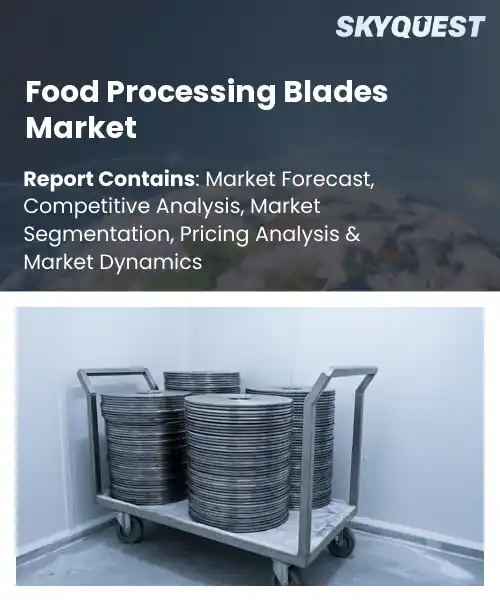
The demand for food processing blades mainly comes from an increasing demand for processed, safe, and easy-to-consume food products across the world, forcing manufacturers to upgrade their machinery and use particular blades. The market is significant due to the impact of blade shape and grade on yield, product quality, and contamination. The market consists of design, manufacturing, and after-market distribution of blades for slicing, dicing, shredding, and grinding used in meat, seafood, bakery, and produce operations. Examples of serrated meat slicers and rotary vegetable knives are some of the cases where the industry moved from manually forged blades to CNC blades, specialty coatings, and disposables through time, pointing to a trend towards automation and hygiene. Automation and regulations are two of the main factors affecting global growth.These have led to an increase in the demand for blades that are capable of handling high-speed line operations while reducing the risk of contamination. Blades makers provide single-use blades and anti-corrosion alloy blades in order to avoid recalls and make profits from the after-market since the factories are being forced by regulations to remove the risk of cross-contamination. Similar to that, there is also the promotion of blade coatings to reduce ownership cost and extend service life.
How is AI Improving Precision and Safety in the Food Processing Blades Market?
Through the combined effort of computer vision, sensor technology, and machine learning technologies to control cutting and maintain the blade status, artificial intelligence (AI) enhances accuracy and safety in the food processing blade industry. Feed rate and angle control to achieve uniform slicing, real-time monitoring to identify any product variation and burrs, and predictive maintenance to identify any wear on the blades are some of the key features of this technology. The use of smart cutting machines for meat, fruits, vegetables, and ready-to-eat meals is becoming increasingly common among companies because of the demands of the market. Slicing with the help of computer vision, which results in minimal waste production, and automatic safety interlock systems that stop equipment when there is an anomaly are two practical applications.
Market snapshot - (2026-2033)
Global Market Size
USD 1.6 Billion
Largest Segment
Circular Blades
Fastest Growth
Specialty Blades
Growth Rate
2.7% CAGR
To get more insights on this market click here to Request a Free Sample Report
Global food processing blades market is segmented by product type, material type, function/application, end-use food category, blade design, processing equipment type, mode of operation, distribution channel and region. Based on product type, the market is segmented into Straight Blades, Circular Blades, Curved Blades, Rotary Blades and Specialty Blades. Based on material type, the market is segmented into Stainless Steel, High Carbon Steel, Carbide, Ceramic and Others. Based on function/application, the market is segmented into Cutting & Portioning, Slicing, Dicing, Grinding, Peeling & Skinning, Chopping & Mincing and Others. Based on end-use food category, the market is segmented into Meat & Poultry Processing, Seafood Processing, Fruit & Vegetable Processing, Bakery & Confectionery Processing, Dairy Processing, Frozen & Convenience Food Processing and Others. Based on blade design, the market is segmented into Serrated Blades, Smooth Edge Blades, Single-Edge Blades, Double-Edge Blades and Customized Blades. Based on processing equipment type, the market is segmented into Slicers, Grinders, Dicers, Mixers & Blenders, Peeling Machines, Portioning Equipment and Others. Based on mode of operation, the market is segmented into Manual Processing Equipment, Semi-Automatic Processing Equipment and Fully Automatic Processing Equipment. Based on distribution channel, the market is segmented into OEMs and Aftermarket/Replacement Sales. Based on region, the market is segmented into North America, Europe, Asia Pacific, Latin America and Middle East & Africa.
The stainless steel category enjoys leadership in the market owing to its rust-proof properties and sanitizable surface finish that satisfy immediate food safety and sanitary needs and promote wide adoption among processors. There are several cutting uses made possible because of the availability of various blade forms compatible with the material, while its robustness and ease of sterilization prevent any complicated maintenance processes and downtimes. As an easily recyclable metal that follows standard manufacturing procedures, stainless steel is the choice of OEMs and aftermarket manufacturers when searching for durable blades.
However, in contrast to the above-mentioned trend, processors' need for improved edge life and performance that reduces regrinding cycles and downtimes in abrasive processes makes Carbide the fastest-growing category in the market. New technologies of composite brazing and micro-grain formation boost the adoption rate of carbides in frozen and bone cutting, creating new opportunities for aftermarket sales and high-end blade purchases for specialized manufacturers.
The semi-automatic processing equipment subsegment accounts for the major market share due to the combination of economic efficiency and productivity possible for a broad spectrum of processors, thus enabling continuous production without the burden of capital expenses inherent in full automation. The compatibility of this type of processing equipment with existing production lines and the ability to accommodate various types of blades reduce maintenance expenses and the obstacles involved in retrofits. The approach to the implementation of such processing equipment takes into consideration the constraints regarding personnel and financing.
As companies continue trying to improve efficiency, traceability, and process repeatability, which in turn require high-quality, durable blades, the fastest growing subsegment will be represented by fully automated processing equipment. The blade design is made more complex through integration with sensors and predictive maintenance, which spurs advancements in blade coating and shape designs. It also results in accelerated capital expenditure cycles, offering new opportunities for blade producers and aftermarket service providers.
To get detailed segments analysis, Request a Free Sample Report
The presence of deep manufacturing capabilities, high demand from large food processing centers, and the existence of strong precision engineering are some of the reasons why the region dominates in the field. A coordinated supply chain involving food processors, tool manufacturers, and material suppliers helps the companies in the region through fast iterations of their blade designs and coatings. Although technological breakthroughs in material science have been driven by partnerships and research institutions in the industry, local manufacturers have focused on effective yet efficient manufacturing processes. The competitive advantage of the region is also fueled by automation and specialized blades for different products. High replacement and aftermarket demands continue to be generated due to the proximity of the region to major food exporters and the rising consumption of processed foods.
The Japanese market for food-processing blades is based on precision manufacturing techniques, focus on high-quality materials, and tight tolerance requirements. Durability, hygiene, and compatibility with automated food processing systems are the most important features desired by domestic OEM customers. Though strict cleaning requirements stimulate technological development in coating technologies and finishing operations, close collaboration between tool manufacturers and food processors leads to special geometries of blades for delicate and costly items. Reliability, good customer service, and continuous product refinement are important features of the market.
South Korea's food processing blades market is dominated by agile suppliers who adapt quickly to changes in processing techniques and consumer demands. The demand for blades that can be used in various food items and are adaptable and robust has grown because of the focus on small-scale automation in urban food processing. This is aided by the ability to customize solutions in the form of seafood, meat, and prepared food processors through regional metalwork and coating techniques.
An amalgamation of high-quality food processing infrastructure, concerns regarding food safety, and automation and customization are propelling growth in North America. Processing companies require blades that give consistent yields without any interruption in production, all the while meeting the highest standards of hygiene and traceability. Companies that have developed blades that meet the standards for durability and cleanability will find an outlet in a market that pits local blade producers against international vendors in terms of technological prowess, materials research, and service networks. Diversity in terms of blade shape and sharpening techniques will be required to accommodate the increasingly diverse range of products found in the realm of convenience and specialty foods.
Very high standards related to equipment integration, safety of the operators, and sanitation are characteristic of the US market of food processing blades. Besides considering efficiency and availability to be top priorities, customers are very concerned about certification, easy-to-clean materials, and other factors that reduce the probability of contamination. Technical support, engineering solutions, and quick response times are appreciated in this market. Various blade types and specifications are needed to accommodate the different types of food products processed, ranging from mass production of proteins to artisanal manufacturing.
The Canadian market for food processing blades is affected by the close association with exports and emphasis on food safety compliance. Processing plants place great importance on blades that are able to integrate with automated systems both centrally located and in distant areas while being capable of performing consistently across various seasonal products. Maintaining operational continuity requires strong relationships with suppliers and fast service in the after-market. The purchase of blade systems that are durable and easily repaired is also driven by environmental concerns.
Europe is enhancing blade performance and accuracy through engineering innovation, strict standards, and sustainability. Materials optimization, coating technology, and ergonomic design minimize contamination risks and ease maintenance needs. Although unique regional cuisine demands customized solutions from specialist producers, effective industrial relationships ensure fast dissemination of information regarding hygiene and design. Circular design and repairability lead to increased longevity and aftermarket services. All of these aspects increase competition and create a market focused on accuracy and reliability when coupled with export-related skills and methodologies for testing.
The Food Processing Blades Market in Germany is largely based on a passion for precise engineering as well as a strong tradition of innovation. Manysuppliers are also making investments into developing robustly built products, which can be integrated into complicated automated processes and complywith the tightest level of hygiene standards. In addition, most suppliers are working with their machine manufacturing counterparts to create customizedblade solutions that are particularly applicable for high volume processing. When it comes time to purchase food processing blades, the key factorsinfluencing their purchase are reliability, maintainability, and efficient supply chain logistics.
The UK Food Processing Blades Market focuses on flexibility and rapid product development, while complying with strict food safety standards; with localsuppliers providing a combination of custom engineering designs and responsive service to both artisan and larger-scale food processors. Design considerations include ease of cleaning, operator safety, and compatibility with modular processing lines; aftermarket support and retrofit solutions are criticalfor supporting a range of production environments.
The French Food Processing Blades Market has a well-established link between its heritage and specialty producers. As a result, there is a significant amount of demand for food processing blades which can give the user the precision, and delicacy of handling, that they require. The manufacturers of food processing blades are catering to businesses that require quality preservation, control of food texture, and presentation, as well as meeting high standards for food hygiene. The market highly values custom made or manufactured blades, collaboration with technical experts on a personal basis, and service capabilitiesthat enable both artisan and large scale processors to operate effectively.
To know more about the market opportunities by region and country, click here to
Buy The Complete Report
Increasing Demand for Processed Foods
As consumers continue to desire goods that are convenient, with longer lives on the shelf, manufacturers began investing in cutting/slicing technologies which provide greater consistency and productivity. With greater complexity/variety of products being manufactured and a movement towards automation,there has been an increase in the demand for durable/hygienic cutting surfaces designed for a specific texture of food products. These factors haveprompted cutting tool manufacturers to create specialized alloys/coatings to lower the risk of contamination and maintenance requirements. Enhancing thequality, safety, and efficiency of food processing operations by purchasing contemporary food processing blades will reinforce the need for modern food processing blades across all food categories.
Technological Advancements in Blade Materials
Metallurgy and surface finish advancements provide the ability of blades to sustain a sharp edge longer, not wear down or rust easily, thus making newmaterials more appealing because they will reduce downtime and sanitation needs. Precision manufacturing methods provide improved accuracy in bladeedge geometry so they can be used for more types of foods, leading to better yield and reduced food loss during production. Suppliers answer with customized solutions and service models focusing on reliability and hygienic issues. These areas ascend as one because of advancements in material science and precision manufacturing so that an increasing number of food processing blade manufacturers are investing in higher quality products.
High Initial Capital Requirements
Huge up-front outlay for precision grinding machinery, specialised coating systems and sanitary manufacturing facilities, inhibits small processors from upgrading blades and using outsourced suppliers, restricting growth of suppliers to lower-cost processors. Due to large capital outlays by customersdelaying average customer investment pay-back periods, customers are more cautious about frequently replacing blades and adopting advanced blade technologies. Therefore, growth of blade demand may develop unevenly with more concentrated growth from well-financed processor companies while developing at a slower rate in regions where financing or technical assistance is less accessible, thus limiting overall advances in blade marketdevelopment.
Regulatory and Food Safety Standards
Food contact material regulation is complicated by the need to design, test, and document compliance with different standards across regions, whichinhibits suppliers from entering markets with new blade designs and increases production costs for blade manufacturers and processors due to the administrative burden of meeting regulatory requirements. As a result, smaller suppliers may face obstacles related to the administrative loads and costsassociated with obtaining certifications, resulting in decreased diversity of products available and slower rates of innovation compared to larger suppliers. Therefore, regulatory compliance acts as a bottleneck to market growth and slows the rate of adoption of new products.
Request Free Customization of this report to help us to meet your business objectives.
Through alliances among manufacturers of weighing, AI labeling, slicing, and robotics equipment, there is an increase in integration through partnerships. Thecutting edge of new technology introduced by robotics and automation will redefine how buyers purchase blades by moving away from separate hardware and service contracts to bundled solutions.
Automation Driven Efficiency: Automated slicing, cutting and sorting systems are changing the priorities of blade design to include integration, consistency and ease of maintenance. Blade manufacturers and processors are requesting blades designed for servo-driven platforms with quick-change mechanisms for faster changeovers and less downtime which will result in greater uniformity of finished product quality over time. This trend increasescollaboration between suppliers, resulting in more standardized interfaces and preventive maintenance programs, and encourages R&D to create cutting solutions that provide maximum cutting performance and strength for continued use, increasing throughput and reducing downtime without relying on manual adjustments.
Eco-Friendly Blade Materials: Increased focus on sustainable products is creating an increased demand for blades and blade coatings that focus on being recyclable, reduced negative impact on the environment during production, and are compatible with recycling streams for food contact materials. Suppliers are investigating the use of alternative alloys, bio-based coatings, and lifecycle-aware manufacturing processes in order to reduce waste and provide manufacturers with support for their sustainability claims. This transformation will lead to greater transparency in sourcing materials and program take-back at the end of the life cycle as well as encourage innovations for surface treatments that promote hygiene and performance, enabling processors to align both operational efficiency with the environmental commitments of their companies.
SkyQuest’s ABIRAW (Advanced Business Intelligence, Research & Analysis Wing) is our Business Information Services team that Collects, Collates, Correlates, and Analyses the Data collected by means of Primary Exploratory Research backed by robust Secondary Desk research.
As per SkyQuest analysis, growth in the global food processing blade industry is driven by consumer demand for convenient, processed, easy-to-use foods, aswell as advancements in technology related to blade materials and coating manufacturing processes that increase the lifespan of blades and produce cleanerblade surfaces. High initial capital investment requirements for precision blades and coatings limit the adoption of precision equipment by smaller processors, which contributes to slow market growth. The Asia Pacific region has the largest market share due to its abundant manufacturing capability, verticallyintegrated supply chain systems, and high rate of replacement activity. Due to its high resistance to corrosion and ability to be cleaned easily, stainless steel isstill the preferred material for manufacturing blades. Because of advances in automation and artificial intelligence-driven technology that provide increasedprecision in processing operations, manufacturers are expected to seek to replace old blades with premium, long-lasting blades along with new aftermarket service options.
| Report Metric | Details |
|---|---|
| Market size value in 2024 | USD 1.6 Billion |
| Market size value in 2033 | USD 2.03 Billion |
| Growth Rate | 2.7% |
| Base year | 2024 |
| Forecast period | (2026-2033) |
| Forecast Unit (Value) | USD Billion |
| Segments covered |
|
| Regions covered | North America (US, Canada), Europe (Germany, France, United Kingdom, Italy, Spain, Rest of Europe), Asia Pacific (China, India, Japan, Rest of Asia-Pacific), Latin America (Brazil, Rest of Latin America), Middle East & Africa (South Africa, GCC Countries, Rest of MEA) |
| Companies covered |
|
| Customization scope | Free report customization with purchase. Customization includes:-
|
To get a free trial access to our platform which is a one stop solution for all your data requirements for quicker decision making. This platform allows you to compare markets, competitors who are prominent in the market, and mega trends that are influencing the dynamics in the market. Also, get access to detailed SkyQuest exclusive matrix.
Table Of Content
Executive Summary
Market overview
Parent Market Analysis
Market overview
Market size
KEY MARKET INSIGHTS
COVID IMPACT
MARKET DYNAMICS & OUTLOOK
Market Size by Region
KEY COMPANY PROFILES
Methodology
For the Food Processing Blades Market, our research methodology involved a mixture of primary and secondary data sources. Key steps involved in the research process are listed below:
1. Information Procurement: This stage involved the procurement of Market data or related information via primary and secondary sources. The various secondary sources used included various company websites, annual reports, trade databases, and paid databases such as Hoover's, Bloomberg Business, Factiva, and Avention. Our team did 45 primary interactions Globally which included several stakeholders such as manufacturers, customers, key opinion leaders, etc. Overall, information procurement was one of the most extensive stages in our research process.
2. Information Analysis: This step involved triangulation of data through bottom-up and top-down approaches to estimate and validate the total size and future estimate of the Food Processing Blades Market.
3. Report Formulation: The final step entailed the placement of data points in appropriate Market spaces in an attempt to deduce viable conclusions.
4. Validation & Publishing: Validation is the most important step in the process. Validation & re-validation via an intricately designed process helped us finalize data points to be used for final calculations. The final Market estimates and forecasts were then aligned and sent to our panel of industry experts for validation of data. Once the validation was done the report was sent to our Quality Assurance team to ensure adherence to style guides, consistency & design.
Analyst Support
Customization Options
With the given market data, our dedicated team of analysts can offer you the following customization options are available for the Food Processing Blades Market:
Product Analysis: Product matrix, which offers a detailed comparison of the product portfolio of companies.
Regional Analysis: Further analysis of the Food Processing Blades Market for additional countries.
Competitive Analysis: Detailed analysis and profiling of additional Market players & comparative analysis of competitive products.
Go to Market Strategy: Find the high-growth channels to invest your marketing efforts and increase your customer base.
Innovation Mapping: Identify racial solutions and innovation, connected to deep ecosystems of innovators, start-ups, academics, and strategic partners.
Category Intelligence: Customized intelligence that is relevant to their supply Markets will enable them to make smarter sourcing decisions and improve their category management.
Public Company Transcript Analysis: To improve the investment performance by generating new alpha and making better-informed decisions.
Social Media Listening: To analyze the conversations and trends happening not just around your brand, but around your industry as a whole, and use those insights to make better Marketing decisions.
REQUEST FOR SAMPLE
 REQUEST FREE CUSTOMIZATION
Global Food Processing Blades Market size was valued at USD 1.6 Billion in 2024 and is poised to grow from USD 1.64 Billion in 2025 to USD 2.03 Billion by 2033, growing at a CAGR of 2.7% during the forecast period (2026-2033).
The competitive landscape is defined by consolidation, targeted partnerships, and product innovation that directly shape blade demand and OEM strategy. Recent M&A activity has consolidated precision knife capacity, strategic alliances link weighing and AI labeling with slicing equipment to improve integration, and robotics and automation entrants are introducing new cutting form factors that shift buyer procurement toward bundled hardware and service contracts. 'JBT Marel Corporation', 'GEA Group AG', 'Bühler Group', 'Urschel Laboratories, Inc.', 'FAM STUMABO', 'FORTIFI Food Processing Solutions', 'Mepaco Group', 'Lutz Blades', 'Talsabell S.A.', 'York Saw & Knife Co., Inc.', 'Kadant Inc.', 'Mitsubishi Materials Corporation', 'Fernite of Sheffield Ltd.', 'Hyde Industrial Blade Solutions', 'Dienes Werke GmbH & Co. KG', 'TGW Global', 'Hamilton Knife Co.', 'International Knife & Saw, Inc.', 'DICK GmbH & Co. KG', 'Saturn Machine Knives Ltd.'
Rising consumer preference for convenience and longer shelf life drives manufacturers to invest in advanced cutting and slicing technologies that improve consistency and throughput. As producers expand product assortments and adopt automated lines, demand for durable, hygienic blades tailored to specific food textures increases. This encourages blade makers to develop specialized alloys and coatings that reduce contamination risk and maintenance needs. The resulting emphasis on quality, safety, and operational efficiency reinforces procurement of modern food processing blades across processing segments.
Automation Driven Efficiency: Adoption of automated slicing, cutting, and sorting systems is reshaping blade design priorities toward integration, consistency, and ease of maintenance. Manufacturers and processors demand blades compatible with servo-driven platforms and quick-change mechanisms, reducing downtime and enabling predictable product quality across shifts. This trend elevates supplier collaboration on standardized interfaces and preventive maintenance programs, while compelling R&D to balance cutting performance with robustness for continuous operation, improving throughput and operational predictability without relying solely on manual adjustments.
Why does Asia Pacific Dominate the Global Food Processing Blades Market? |@12


Want to customize this report? This report can be personalized according to your needs. Our analysts and industry experts will work directly with you to understand your requirements and provide you with customized data in a short amount of time. We offer $1000 worth of FREE customization at the time of purchase.
Feedback From Our Clients


 USA (+1) 351-333-4748

