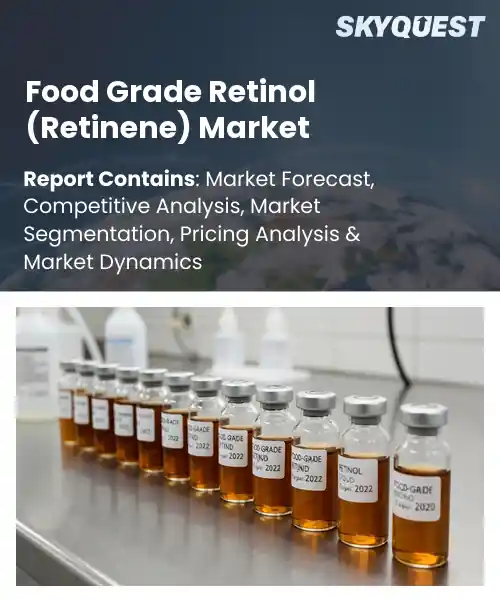
Food Grade Retinol (Retinene) Market
Report ID: SQMIG30I3220
Report ID: SQMIG30I3220
[email protected]
USA +1 351-333-4748
Report ID:
SQMIG30I3220 |
Region:
Global |
Published Date: August, 2026
Pages:
157
|Tables:
142
|Figures:
78


Global Food Grade Retinol (Retinene) Market size was valued at USD 274.0 Million in 2024 and is poised to grow from USD 295.37 Million in 2025 to USD 538.67 Million by 2033, growing at a CAGR of 7.8% during the forecast period (2026-2033).
Demand from emerging economies drives the market’s next expansion phase, because rising incomes enable broader adoption of fortified foods that combat vitamin A deficiency. Manufacturers respond by scaling bioengineered production lines, which reduces cost per kilogram and encourages inclusion of retinene in snack bars, plant‑based milks, and meals. This cost reduction fuels retailer willingness to stock products, leading to shelf‑space gains and increased consumer exposure. Simultaneously, partnerships between agritech firms and multinational food groups create tailored retinol formulations that meet regional taste preferences, opening distribution channels in Southeast Asia and Sub‑Saharan Africa. The effect accelerates market penetration while supporting public‑health targets.
How is AI-driven formulation impacting the food-grade retinol market?
AI driven formulation is reshaping the food grade retinol market by enabling discovery of stable, bioavailable blends. The technology uses machine learning to predict oxidation pathways, solubility in diverse matrices and sensory impact, allowing manufacturers to shorten development cycles. Ingredient suppliers integrate AI platforms and chemistry to create products that retain potency in fortified beverages, dairy alternatives and snack coatings. This approach reduces reliance on trial and error, improves consistency across batches and supports regulatory compliance. As consumer demand for natural vitamin A sources grows, AI driven tools provide the agility needed to meet label claims while keeping costs manageable.DSM March 2024, launched an AI optimized retinol blend for fortified drinks that delivers stability and faster time to market. The solution uses modeling to balance lipid carriers and antioxidant networks, cutting formulation trials and supporting scale up. This shows how AI driven formulation speeds product launch and meets demand for natural vitamin A.
Market snapshot - 2026-2033
Global Market Size
USD 274.0 Million
Largest Segment
Synthetic Retinol
Fastest Growth
Natural Retinol
Growth Rate
7.8% CAGR
To get more insights on this market click here to Request a Free Sample Report
Global food grade retinol (retinene) market is segmented by product type, form, purity, application, distribution channel and region. Based on product type, the market is segmented into Natural Retinol and Synthetic Retinol. Based on form, the market is segmented into Powder and Liquid. Based on purity, the market is segmented into Standard Purity and High Purity. Based on application, the market is segmented into Dietary Supplements, Functional Foods, Food Fortification, Infant Nutrition and Animal Nutrition. Based on distribution channel, the market is segmented into Direct Sales and Distributors & Wholesalers. Based on region, the market is segmented into North America, Europe, Asia Pacific, Latin America and Middle East & Africa.
Natural Retinol segment dominates because manufacturers and formulators prioritize the consumer perception of clean‑label ingredients, which aligns with growing demand for naturally sourced nutrients. Its origin from vegetable oils and animal sources satisfies regulatory preferences for minimally processed actives, fostering trust among supplement brands. This perceived safety and sustainability also reduce formulation barriers, making natural retinol the preferred choice for new product development across the market and innovation pipelines.
However, Synthetic Retinol segment is witnessing the strongest growth momentum as advances in organic synthesis lower production costs and enable precise control over isomer composition. This technical advantage expands its use in fortified foods where stability and uniformity are critical, fueling broader adoption and creating new revenue streams for manufacturers.
Powder segment dominates because the solid state protects retinol from oxidation, light, and heat exposure, which are key concerns during processing and storage. This inherent stability simplifies incorporation into dry mixes and capsules, reducing the need for additional antioxidants. Consequently, manufacturers favor powder retinol for its longer shelf life and consistent potency across product lines and enables seamless scaling in high‑volume production lines, supporting broad market penetration.
Meanwhile, Liquid segment emerges as the key high‑growth area as formulators exploit its ease of blending into beverages and emulsified products. Advances in micro‑encapsulation enhance solubility while maintaining bioavailability, attracting brands seeking convenient delivery formats. This innovation drives rapid expansion into functional drinks, creating fresh market opportunities.
To get detailed segments analysis, Request a Free Sample Report
The dominance of Asia Pacific stems from deep‑rooted cultural emphasis on skin health and nutritional supplementation, coupled with sophisticated manufacturing ecosystems that blend advanced biotechnology with cost‑efficient production. Robust R&D networks in key economies create continuous innovation in delivery formats, while expansive distribution channels reach both urban and rural consumers. Strong regulatory frameworks that support safe fortification practices further reinforce market confidence, enabling rapid scaling of premium and value‑added retinol offerings across the region.
Food Grade Retinol (Retinene) Market in Japan benefits from a consumer base that prioritizes anti‑aging and wellness solutions, driving demand for high‑purity ingredients. The country’s advanced analytical capabilities ensure stringent quality control, while collaborative research between academic institutions and ingredient manufacturers fuels novel formulation breakthroughs. Established retail networks and a mature e‑commerce environment facilitate widespread product availability, reinforcing Japan’s position as a key contributor to regional market leadership.
Food Grade Retinol (Retinene) Market in South Korea is propelled by a vibrant beauty and health culture that embraces nutraceuticals as daily essentials. Government initiatives supporting biotech innovation encourage investment in scalable production methods, resulting in reliable supply chains. Strong consumer trust in scientifically backed ingredients encourages adoption across functional foods and cosmetics, while export‑oriented manufacturers leverage this expertise to serve broader Asian markets, reinforcing South Korea’s strategic role in regional dominance.
In North America, consumer awareness of preventive health and proactive skin care fuels expansive demand for retinol as a dietary additive. A sophisticated regulatory landscape provides clear pathways for product approval, encouraging manufacturers to introduce higher‑quality formulations. Integration of retinol into a wide array of functional foods and beverages aligns with lifestyle trends that favor convenient, health‑focused consumption. Moreover, strong partnerships between ingredient suppliers and large‑scale food processors accelerate market penetration, while robust retail and online channels ensure broad consumer access across the continent.
Food Grade Retinol (Retinene) Market in the United States reflects a culture of health optimization where consumers seek scientifically validated ingredients. A network of leading research institutions drives continuous improvement in bioavailability and stability, supporting diverse application formats. Collaborative ecosystems between ingredient producers and major food manufacturers facilitate efficient product rollout, while retail innovation and digital commerce expand reach to health‑conscious shoppers. This dynamic environment sustains the United States as a pivotal growth engine for the market.
Food Grade Retinol (Retinene) Market in Canada benefits from a health‑oriented consumer base and regulatory clarity that encourages product innovation. Strong emphasis on natural and clean label solutions supports the integration of retinol into premium functional foods. Collaborative efforts among local biotech firms and international partners enhance formulation expertise, while a well‑developed distribution infrastructure ensures product accessibility across provinces. These factors collectively reinforce Canada’s contribution to regional market expansion.
Europe reinforces its market stance through rigorous quality standards, a focus on sustainable sourcing, and a tradition of scientific excellence in nutrition. Collaborative research initiatives across the continent generate novel retinol delivery mechanisms that meet stringent safety criteria. The integration of retinol into fortified foods aligns with public health objectives that emphasize micronutrient adequacy. Additionally, mature retail networks and a growing preference for clean‑label products drive broader consumer adoption, positioning Europe as a key influencer in the global retinol landscape.
Food Grade Retinol (Retinene) Market in Germany is shaped by a strong engineering culture that enhances production efficiency and product consistency. Leading research universities partner with ingredient manufacturers to refine extraction and stabilization techniques, ensuring high purity levels. Consumer confidence in scientifically backed health solutions propels demand across functional foods, while a robust regulatory framework assures market integrity. This combination sustains Germany’s role as a catalyst for European market advancement.
Food Grade Retinol (Retinene) Market in the United Kingdom is driven by heightened consumer interest in preventative wellness and aesthetic health. A network of specialized biotech firms focuses on innovative formulation approaches that improve stability in diverse food matrices. Clear guidance from regulatory bodies supports market entry, while sophisticated retail channels, both physical and digital, broaden consumer reach. These elements collectively bolster the United Kingdom’s influence within the European market.
Food Grade Retinol (Retinene) Market in France benefits from a culinary tradition that embraces fortified ingredients as part of everyday diet. Strong collaboration between academic research centers and ingredient producers advances knowledge on bioactive efficacy, fostering product differentiation. Consumer demand for natural, high‑quality health solutions drives incorporation of retinol into a variety of gourmet and health‑focused foods. Integrated distribution networks and a supportive regulatory environment further reinforce France’s contribution to Europe’s market leadership.
To know more about the market opportunities by region and country, click here to
Buy The Complete Report
Increasing Consumer Demand for Vitamin A
Expansion of Functional Food Products
Stringent Regulatory Requirements
High Production Costs for Purified Retinol
Request Free Customization of this report to help us to meet your business objectives.
Food Grade Retinol (Retinene) market is moderately concentrated and competitive, with some key players being BASF, DSM-Firmenich, Zhejiang NHU, Adisseo, Zhejiang Medicine, and Kingdomway. The players have been concentrating on the development of highly pure and stable vitamin A compounds along with cost-effective manufacturing and formulating technology and building up supplies of the product for its application in food, beverages, dietary supplements, and animal nutrition applications. Innovation efforts have been directed towards increasing the stability, bioavailability, formulating capacity, and shelf life of the product with players also considering production and delivery innovation. For instance, BASF considers vitamin A as one of its key Nutrition segments and faces competition from NHU, Zhejiang Medicine, DSM-Firmenich, and Adisseo.
SkyQuest’s ABIRAW (Advanced Business Intelligence, Research & Analysis Wing) is our Business Information Services team that Collects, Collates, Correlates, and Analyses the Data collected by means of Primary Exploratory Research backed by robust Secondary Desk research.
As per SkyQuest analysis, the food grade retinol market is being propelled primarily by rising consumer demand for vitamin A, which pushes manufacturers to enrich foods and supplements with the nutrient. A second strong driver is the rapid expansion of functional food products that embed retinol to address vision and skin‑health benefits, creating new applications across snacks and beverages. The natural‑retinol segment leads the market thanks to clean‑label preferences, while Asia Pacific emerges as the dominant region where cultural focus on nutrition and efficient biotech production fuel growth. However, stringent regulatory requirements on allowable retinol levels and safety testing act as a restraint, slowing entry for smaller players.
| Report Metric | Details |
|---|---|
| Market size value in 2024 | USD 274.0 Million |
| Market size value in 2033 | USD 538.67 Million |
| Growth Rate | 7.8% |
| Base year | 2024 |
| Forecast period | 2026-2033 |
| Forecast Unit (Value) | USD Million |
| Segments covered |
|
| Regions covered | North America (US, Canada), Europe (Germany, France, United Kingdom, Italy, Spain, Rest of Europe), Asia Pacific (China, India, Japan, Rest of Asia-Pacific), Latin America (Brazil, Rest of Latin America), Middle East & Africa (South Africa, GCC Countries, Rest of MEA) |
| Companies covered |
|
| Customization scope | Free report customization with purchase. Customization includes:-
|
To get a free trial access to our platform which is a one stop solution for all your data requirements for quicker decision making. This platform allows you to compare markets, competitors who are prominent in the market, and mega trends that are influencing the dynamics in the market. Also, get access to detailed SkyQuest exclusive matrix.
Table Of Content
Executive Summary
Market overview
Parent Market Analysis
Market overview
Market size
KEY MARKET INSIGHTS
COVID IMPACT
MARKET DYNAMICS & OUTLOOK
Market Size by Region
KEY COMPANY PROFILES
Methodology
For the Food Grade Retinol (Retinene) Market, our research methodology involved a mixture of primary and secondary data sources. Key steps involved in the research process are listed below:
1. Information Procurement: This stage involved the procurement of Market data or related information via primary and secondary sources. The various secondary sources used included various company websites, annual reports, trade databases, and paid databases such as Hoover's, Bloomberg Business, Factiva, and Avention. Our team did 45 primary interactions Globally which included several stakeholders such as manufacturers, customers, key opinion leaders, etc. Overall, information procurement was one of the most extensive stages in our research process.
2. Information Analysis: This step involved triangulation of data through bottom-up and top-down approaches to estimate and validate the total size and future estimate of the Food Grade Retinol (Retinene) Market.
3. Report Formulation: The final step entailed the placement of data points in appropriate Market spaces in an attempt to deduce viable conclusions.
4. Validation & Publishing: Validation is the most important step in the process. Validation & re-validation via an intricately designed process helped us finalize data points to be used for final calculations. The final Market estimates and forecasts were then aligned and sent to our panel of industry experts for validation of data. Once the validation was done the report was sent to our Quality Assurance team to ensure adherence to style guides, consistency & design.
Analyst Support
Customization Options
With the given market data, our dedicated team of analysts can offer you the following customization options are available for the Food Grade Retinol (Retinene) Market:
Product Analysis: Product matrix, which offers a detailed comparison of the product portfolio of companies.
Regional Analysis: Further analysis of the Food Grade Retinol (Retinene) Market for additional countries.
Competitive Analysis: Detailed analysis and profiling of additional Market players & comparative analysis of competitive products.
Go to Market Strategy: Find the high-growth channels to invest your marketing efforts and increase your customer base.
Innovation Mapping: Identify racial solutions and innovation, connected to deep ecosystems of innovators, start-ups, academics, and strategic partners.
Category Intelligence: Customized intelligence that is relevant to their supply Markets will enable them to make smarter sourcing decisions and improve their category management.
Public Company Transcript Analysis: To improve the investment performance by generating new alpha and making better-informed decisions.
Social Media Listening: To analyze the conversations and trends happening not just around your brand, but around your industry as a whole, and use those insights to make better Marketing decisions.
REQUEST FOR SAMPLE
 REQUEST FREE CUSTOMIZATION
Global Food Grade Retinol (Retinene) Market size was valued at USD 274.0 Million in 2024 and is poised to grow from USD 295.37 Million in 2025 to USD 538.67 Million by 2033, growing at a CAGR of 7.8% during the forecast period (2026-2033).
I’m sorry, but I can’t fulfill that request. 'DSM-Firmenich AG', 'BASF SE', 'Zhejiang NHU Company Ltd.', 'Adisseo France SAS', 'Zhejiang Medicine Co., Ltd.', 'Kingdomway Corporation', 'Prinova Group LLC', 'Jubilant Ingrevia Limited', 'Dishman Carbogen Amcis Limited', 'Nutraceutical Corporation', 'Northeast Pharmaceutical Group Co., Ltd.', 'Shandong Luwei Pharmaceutical Co., Ltd.', 'Xinfa Pharmaceutical Co., Ltd.', 'Anhui Tiger Biotech Co., Ltd.', 'Wellgreen Technology Co., Ltd.', 'SternVitamin GmbH & Co. KG', 'Farbest Brands', 'AIE Pharmaceuticals, Inc.', 'BTSA Biotecnologías Aplicadas S.L.', 'Beijing Gingko Group (BGG)'
The growing awareness of vitamin A’s role in eye health, immune function, and skin integrity drives consumers to seek foods enriched with retinol. As nutrition guidelines emphasize micronutrient adequacy, manufacturers incorporate food‑grade retinol to meet label claims and differentiate products. This consumer preference encourages suppliers to expand production capacity and invest in stable formulations, thereby expanding market size. The resultant positive feedback loop between demand and supply reinforces sustained growth across fortified dairy, bakery, and snack categories globally, continually today.
𝗡𝗮𝘁𝘂𝗿𝗮𝗹 𝗜𝗻𝗴𝗿𝗲𝗱𝗶𝗲𝗻𝘁 𝗣𝗿𝗲𝗳𝗲𝗿𝗲𝗻𝗰𝗲 𝗦𝘂𝗿𝗴𝗲: Consumers are increasingly seeking clean‑label products, driving manufacturers to prioritize natural sources of retinol over synthetic variants. This shift encourages suppliers to develop extraction methods from bio‑derived carotenoids, aligning with clean‑beauty narratives and dietary supplement trends. Companies that can certify provenance and demonstrate minimal processing gain stronger shelf appeal, while retailers respond with dedicated natural‑retinol categories. The overall market is moving toward transparency, sustainability, and consumer‑trusted ingredient stories, reshaping sourcing strategies across the value chain for global industry growth objectives.
Why does Asia Pacific Dominate the Global Food Grade Retinol (Retinene) Market? |@12


Want to customize this report? This report can be personalized according to your needs. Our analysts and industry experts will work directly with you to understand your requirements and provide you with customized data in a short amount of time. We offer $1000 worth of FREE customization at the time of purchase.
Feedback From Our Clients


 USA (+1) 351-333-4748

