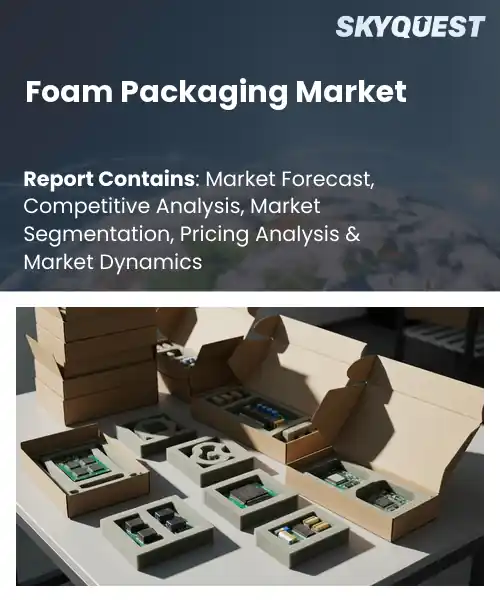
Foam Packaging Market
Report ID: SQMIG15H2246
Report ID: SQMIG15H2246
[email protected]
USA +1 351-333-4748
Report ID:
SQMIG15H2246 |
Region:
Global |
Published Date: July, 2026
Pages:
157
|Tables:
125
|Figures:
77


Global Foam Packaging Market size was valued at USD 17.05 Billion in 2024 and is poised to grow from USD 18.17 Billion in 2025 to USD 30.2 Billion by 2033, growing at a CAGR of 6.56% during the forecast period (2026-2033).
Foam packaging, predominantly crafted from expanded polystyrene, polyethylene and polyurethane, serves as a lightweight cushioning medium that shields products during transit and storage. Its relevance stems from the exponential growth of e‑commerce, where fragile goods demand cost‑effective protection, and from stringent retailer standards that penalise damaged inventory. Historically, the market emerged in the 1960s for appliance insulation, later expanding into food safety with molded trays for perishables. Over the past decade, rising online sales in North America and Asia have accelerated demand, illustrated by Amazon’s adoption of UPS‑compatible foam inserts that reduce breakage rates by up to fifteen percent significantly. Environmental regulation now drives the next wave of expansion, because manufacturers are compelled to replace single‑use plastics with recyclable or bio‑based foams, prompting investment in sustainable formulations. This shift fuels demand from automotive firms that seek lightweight shock‑absorbers to meet fuel‑efficiency targets; for example, Tesla incorporates molded polyurethane panels in its battery packs, reducing weight while preserving thermal stability. Simultaneously, food distributors benefit from compostable foam trays that extend shelf life and meet retailer zero‑waste policies, creating a revenue stream for producers of plant‑derived polylactide foams. Consequently, the market’s growth trajectory aligns with pressure and consumer preference for greener packaging.
How is AI-driven automation enhancing efficiency and sustainability in the foam packaging market?
AI‑driven automation is reshaping foam packaging by streamlining design, production and quality control. Machine‑learning models analyze product dimensions and shipping requirements to generate optimized foam geometries, cutting excess material and lowering waste. Robotics equipped with vision systems handle cutting, molding and assembly with consistent precision, which speeds up throughput and reduces labor intensity. Real‑time monitoring links equipment performance to energy‑use dashboards, allowing operators to adjust parameters for lower consumption. These technologies also enable rapid prototyping, so manufacturers can respond quickly to customer needs while maintaining sustainable practices. The combined effect is a more efficient supply chain that delivers lighter, stronger packaging with a smaller environmental footprint.In June 2026, a major foam packaging firm launched an AI‑driven line‑cutting system, cutting material waste and energy use, thereby bolstering market efficiency and sustainability.
Market snapshot - (2026-2033)
Global Market Size
USD 17.05 Billion
Largest Segment
Polystyrene
Fastest Growth
Bio-Based Foams
Growth Rate
6.56% CAGR
To get more insights on this market click here to Request a Free Sample Report
Global foam packaging market is segmented by material type, type, product form, end-use industry and region. Based on material type, the market is segmented into Polyurethane, Polystyrene, Polyethylene, Polypropylene and Bio-Based Foams. Based on type, the market is segmented into Rigid Foam Packaging and Flexible Foam Packaging. Based on product form, the market is segmented into Molded Foam Components, Foam Sheets, Foam Rolls, Foam Blocks and Loose Fills. Based on end-use industry, the market is segmented into Food Packaging, Beverage Packaging, Consumer Electronics, Automotive Components, Pharmaceutical Products, Medical Devices, Industrial Machinery and Others. Based on region, the market is segmented into North America, Europe, Asia Pacific, Latin America and Middle East & Africa.
Polyurethane segment dominates because its versatility allows it to be formulated for a wide range of rigidity and density, meeting diverse protection needs while offering excellent shock absorption. Its ability to be molded into complex geometries reduces material waste, and its chemical resistance supports food safety and long term durability, driving broad adoption across multiple industries. Manufacturers also value its compatibility with recycling streams and its capacity for integrating flame retardants, which further enhances compliance with safety standards.
Meanwhile bio based foams segment emerges as the key high growth area in the foam packaging market because renewable feedstocks are attracting eco conscious brands, and advances in bio polyol chemistry are improving performance to rival petro chemical alternatives. This environmental momentum is prompting new product lines and creating opportunities for differentiation, accelerating market expansion.
Rigid foam packaging segment dominates because its high structural integrity provides superior load bearing and thermal insulation, crucial for safeguarding fragile items during transport. The ability to be precision molded creates custom cavities that minimize product movement, while its closed cell architecture prevents moisture ingress, satisfying stringent quality requirements across many sectors. Additionally its resistance to compression under varying temperature conditions extends shelf life for temperature sensitive goods, reinforcing its preference among logistics providers seeking reliable protection solutions.
However flexible foam packaging segment is witnessing the strongest growth momentum because its lightweight and conformable nature enables efficient packing of irregular shapes while reducing overall shipment weight. Innovations in recyclable elastomers and enhanced barrier coatings are addressing sustainability concerns, opening new applications in e commerce and apparel sectors, thereby propelling market expansion.
To get detailed segments analysis, Request a Free Sample Report
Asia Pacific leads the global foam packaging market because of its deep manufacturing ecosystems, extensive consumer electronics and automotive production, and rapid e‑commerce penetration. The region blends cost‑competitive material supply with advanced technology adoption, allowing producers to innovate lightweight and protective solutions. Strong logistical networks and proximity to key raw‑material exporters further reduce lead times. Moreover, growing environmental awareness drives investment in recyclable and bio‑based foams, positioning the region as a hub for sustainable packaging advancement. Regional trade agreements facilitate cross‑border supply chain integration, while government incentives encourage research into high‑performance polymers. Consumer demand for premium unboxing experiences fuels premium‑grade foam adoption across food, health, and luxury goods sectors, reinforcing the region’s competitive edge. The convergence of digital design tools with local manufacturing capabilities accelerates product‑to‑market cycles, ensuring Asia Pacific remains at the forefront of foam packaging innovation.
Japan Foam Packaging Market
Foam Packaging Market in Japan benefits from a mature manufacturing base and a culture of precision engineering. Local producers prioritize high‑performance insulation and shock‑absorbent solutions for electronics, automotive, and medical devices. Strong collaboration between material suppliers and end‑users drives continuous refinement of foam density and recyclability. Consumer preference for premium packaging drives demand for aesthetically refined foam inserts, while regulatory frameworks encourage the shift toward reusable and recyclable foam formats.
South Korea Foam Packaging Market
Foam Packaging Market in South Korea is propelled by a dynamic consumer electronics sector and a fast‑growing logistics network. Companies focus on lightweight, high‑strength foams that protect high‑value devices during rapid delivery cycles. Close ties between research institutes and manufacturers foster innovation in biodegradable and flame‑retardant foam formulations. Environmental stewardship initiatives and government support for green materials further incentivize the adoption of sustainable foam solutions across packaging applications global markets.
The rapid expansion of the foam packaging market in North America stems from a confluence of consumer expectations, supply‑chain efficiency demands, and regulatory momentum toward sustainable materials. Retailers and e‑commerce platforms require protective yet lightweight solutions to preserve product integrity during extensive shipping distances. Advanced manufacturing technologies enable producers to tailor foam properties, aligning with the growing preference for recyclable and bio‑based options. Government policies encouraging reduced landfill waste and corporate sustainability pledges further reinforce investment in eco‑friendly foam alternatives. Additionally, the prevalence of high‑value goods such as electronics, pharmaceuticals, and specialty foods amplifies the need for customized protective packaging, cementing foam role as an indispensable component of the North American packaging ecosystem. Industry collaborations between material innovators and major logistics providers accelerate the rollout of next‑generation foam solutions, while consumer awareness campaigns highlight the environmental benefits of reduced material usage, further propelling market momentum.
United States Foam Packaging Market
Foam Packaging Market in the United States is shaped by a consumer base and a distribution network. Demand for protective packaging is driven by e‑commerce volumes and an emphasis on product safety across sectors such as technology, food, and pharmaceuticals. Innovation hubs focus on developing recyclable foam formulations that meet environmental standards. Collaboration between retailers and packaging firms accelerates adoption of foam solutions that balance cost efficiency with sustainability objectives.
Canada Foam Packaging Market
Foam Packaging Market in Canada reflects a focus on sustainability and resilience in logistics. Manufacturers tailor foam insulation and cushioning solutions to protect goods throughout shipping routes and temperature fluctuations. Cooperation between packaging suppliers and the agricultural and aerospace sectors drives the creation of lightweight foams that meet safety and environmental criteria. Government incentives for circular‑economy practices encourage the shift toward recyclable foam products in consumer and industrial packaging streams.
The European foam packaging market is strengthening its position through a synergistic blend of regulatory leadership, technological innovation, and a commitment to circular economy principles. Stricter waste‑reduction directives compel manufacturers to develop recyclable and bio‑based foam solutions, fostering a wave of material‑science breakthroughs. Collaborative research hubs across the continent accelerate the commercialization of high‑performance foams that offer superior thermal insulation and shock protection while minimizing environmental impact. Major consumer goods brands prioritize sustainable packaging, driving demand for lightweight, reusable foam components. Additionally, sophisticated logistics networks and a tradition of precision engineering enable rapid customization, ensuring that European suppliers can meet the nuanced requirements of sectors such as automotive, pharmaceuticals, and luxury goods, thereby reinforcing Europe competitive advantage in the global arena.
Germany Foam Packaging Market
Foam Packaging Market in Germany is driven by an industrial base and an emphasis on engineering excellence. Companies develop advanced foam products that provide protection for automotive components, machinery, and electronics. Close collaboration with research institutes accelerates the adoption of renewable raw materials and energy‑efficient manufacturing processes. Environmental regulations promote the use of recyclable foams, while firms leverage German precision reputation to secure market share in packaging international supply chains.
United Kingdom Foam Packaging Market
Foam Packaging Market in the United Kingdom reflects a consumer market and an emphasis on sustainability. Packaging firms prioritize lightweight, recyclable foam designs that meet environmental standards while ensuring product protection for sectors such as pharmaceuticals, food, and electronics. Collaboration with university research centres drives innovation in bio‑based foam chemistries and recycling processes. The presence of retailers accelerates rapid adoption of eco‑friendly foam solutions across domestic and global export channels.
France Foam Packaging Market
Foam Packaging Market in France benefits from a heritage of material science and an environmental agenda. Manufacturers develop versatile foam solutions that balance high performance with biodegradability for use in goods, food preservation, and automotive interiors. Close ties between industry clusters and research institutes enable prototyping of innovative foam formulations. Government support for circular‑economy initiatives further incentivizes the transition toward recyclable and bio‑derived foam products across the sustainable packaging landscape.
To know more about the market opportunities by region and country, click here to
Buy The Complete Report
Increasing Demand for Sustainable Packaging
Growth Of E‑Commerce Logistics Requirements
High Cost of Advanced Materials
Regulatory Variability Across Regions
Request Free Customization of this report to help us to meet your business objectives.
Intense rivalry drives firms to secure series‑A capital for lightweight foam innovations and geographic expansion. Cruz Foam’s $18 million Series A in October 2022 funded high‑performance automotive cushioning and a Midwest production line. Sustainable‑packaging startup Sway, founded in 2020, raised CHF 13 million Series A in April 2025 with Amcor Ventures, accelerating bio‑based foam solutions for cosmetics.
Top Player’s Company Profile
Recent Developments
SkyQuest’s ABIRAW (Advanced Business Intelligence, Research & Analysis Wing) is our Business Information Services team that Collects, Collates, Correlates, and Analyses the Data collected by means of Primary Exploratory Research backed by robust Secondary Desk research. As per SkyQuest analysis the global foam packaging market is being propelled primarily by the surge in demand for sustainable packaging as brands seek lightweight recyclable foams that lower material use and transport emissions, while a second important driver is the rapid expansion of e‑commerce logistics which pushes manufacturers to offer high‑performance space‑saving cushioning solutions. The market is led by the Asia Pacific region where strong manufacturing ecosystems and intense e‑commerce growth fuel adoption, and within the market the polyurethane material segment holds the largest share because of its versatility in rigidity, density and recyclability. However, the high cost of advanced foam formulations acts as a restraint, limiting broader uptake among price‑sensitive customers.
| Report Metric | Details |
|---|---|
| Market size value in 2024 | USD 17.05 Billion |
| Market size value in 2033 | USD 30.2 Billion |
| Growth Rate | 6.56% |
| Base year | 2024 |
| Forecast period | (2026-2033) |
| Forecast Unit (Value) | USD Billion |
| Segments covered |
|
| Regions covered | North America (US, Canada), Europe (Germany, France, United Kingdom, Italy, Spain, Rest of Europe), Asia Pacific (China, India, Japan, Rest of Asia-Pacific), Latin America (Brazil, Rest of Latin America), Middle East & Africa (South Africa, GCC Countries, Rest of MEA) |
| Companies covered |
|
| Customization scope | Free report customization with purchase. Customization includes:-
|
To get a free trial access to our platform which is a one stop solution for all your data requirements for quicker decision making. This platform allows you to compare markets, competitors who are prominent in the market, and mega trends that are influencing the dynamics in the market. Also, get access to detailed SkyQuest exclusive matrix.
Table Of Content
Executive Summary
Market overview
Parent Market Analysis
Market overview
Market size
KEY MARKET INSIGHTS
COVID IMPACT
MARKET DYNAMICS & OUTLOOK
Market Size by Region
KEY COMPANY PROFILES
Methodology
For the Foam Packaging Market, our research methodology involved a mixture of primary and secondary data sources. Key steps involved in the research process are listed below:
1. Information Procurement: This stage involved the procurement of Market data or related information via primary and secondary sources. The various secondary sources used included various company websites, annual reports, trade databases, and paid databases such as Hoover's, Bloomberg Business, Factiva, and Avention. Our team did 45 primary interactions Globally which included several stakeholders such as manufacturers, customers, key opinion leaders, etc. Overall, information procurement was one of the most extensive stages in our research process.
2. Information Analysis: This step involved triangulation of data through bottom-up and top-down approaches to estimate and validate the total size and future estimate of the Foam Packaging Market.
3. Report Formulation: The final step entailed the placement of data points in appropriate Market spaces in an attempt to deduce viable conclusions.
4. Validation & Publishing: Validation is the most important step in the process. Validation & re-validation via an intricately designed process helped us finalize data points to be used for final calculations. The final Market estimates and forecasts were then aligned and sent to our panel of industry experts for validation of data. Once the validation was done the report was sent to our Quality Assurance team to ensure adherence to style guides, consistency & design.
Analyst Support
Customization Options
With the given market data, our dedicated team of analysts can offer you the following customization options are available for the Foam Packaging Market:
Product Analysis: Product matrix, which offers a detailed comparison of the product portfolio of companies.
Regional Analysis: Further analysis of the Foam Packaging Market for additional countries.
Competitive Analysis: Detailed analysis and profiling of additional Market players & comparative analysis of competitive products.
Go to Market Strategy: Find the high-growth channels to invest your marketing efforts and increase your customer base.
Innovation Mapping: Identify racial solutions and innovation, connected to deep ecosystems of innovators, start-ups, academics, and strategic partners.
Category Intelligence: Customized intelligence that is relevant to their supply Markets will enable them to make smarter sourcing decisions and improve their category management.
Public Company Transcript Analysis: To improve the investment performance by generating new alpha and making better-informed decisions.
Social Media Listening: To analyze the conversations and trends happening not just around your brand, but around your industry as a whole, and use those insights to make better Marketing decisions.
REQUEST FOR SAMPLE
 REQUEST FREE CUSTOMIZATION


Want to customize this report? This report can be personalized according to your needs. Our analysts and industry experts will work directly with you to understand your requirements and provide you with customized data in a short amount of time. We offer $1000 worth of FREE customization at the time of purchase.
Feedback From Our Clients


 USA (+1) 351-333-4748

