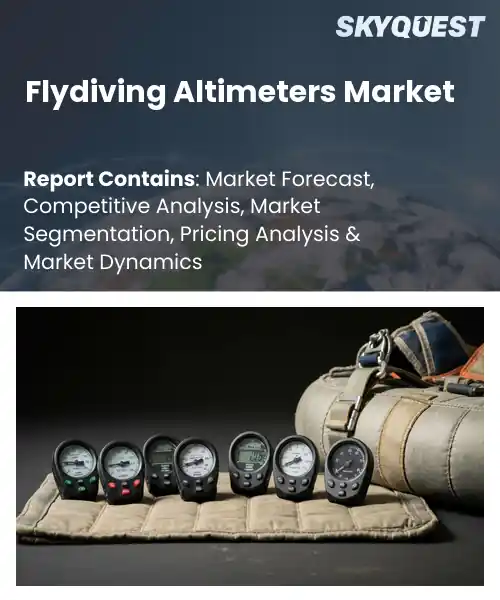
Flydiving Altimeters Market
Report ID: SQMIG20A2806
Report ID: SQMIG20A2806
[email protected]
USA +1 351-333-4748
Report ID:
SQMIG20A2806 |
Region:
Global |
Published Date: July, 2026
Pages:
157
|Tables:
143
|Figures:
78


Global Flydiving Altimeters Market size was valued at USD 198.6 Million in 2024 and is poised to grow from USD 211.91 Million in 2025 to USD 356.01 Million by 2033, growing at a CAGR of 6.7% during the forecast period (2026-2033).
Flydiving altimeters, compact devices that electronically record descent speed and altitude for sky‑divers, have become a cornerstone of safety and performance measurement in the sport. The market emerged in the early 2000s when digital sensor technology replaced mechanical barometers, enabling real‑time data transmission to helmets and smartphones. This shift mattered because accurate altitude feedback reduces the risk of premature chute deployment, a leading cause of accidents. Over the past decade, adoption surged as high‑profile competitions such as the Red Bull Stratos project showcased the technology’s reliability, prompting manufacturers to launch cost‑effective models for recreational jumpers and expanded the market globally rapidly.
The principal growth catalyst now lies in integration of Bluetooth and cloud analytics, which transforms raw altitude logs into actionable performance insights for athletes and coaches. As competition teams adopt data‑driven training, they purchase multi‑sensor altimeters capable of syncing with mobile apps, generating heat maps of descent profiles that pinpoint inefficiencies. This cause‑effect chain drives manufacturers to invest in software ecosystems, thereby creating subscription revenue streams and encouraging frequent hardware upgrades. Real‑world examples include the United States Parachute Association recommending digital altimeters for certified instructors, and European free‑fly leagues mandating telemetry for safety audits, both fueling market expansion in 2024.
How is AI Improving Safety And Accuracy In The Flydiving Altimeter Market?
AI is reshaping flydiving altimeters by embedding predictive algorithms that continuously calibrate pressure readings against environmental variables. Sensors now learn from each jump, correcting drift before it affects the display and alerting the jumper when thresholds are approached. This intelligence reduces reliance on manual checks and creates a seamless safety net that adapts to weather changes and equipment wear. The market, valued in the tens of millions, is seeing operators adopt these smart devices to meet rising expectations for precision. As more skydiving schools prioritize data driven safety, AI powered altimeters become a core component of training and competition.
Market snapshot - (2026-2033)
Global Market Size
USD 198.6 Million
Largest Segment
Visual Altimeters
Fastest Growth
Digital Altimeters
Growth Rate
6.7% CAGR
To get more insights on this market click here to Request a Free Sample Report
Global flydiving altimeters market is segmented by product type, display type, application, end user, distribution channel and region. Based on product type, the market is segmented into Visual Altimeters, Audible Altimeters and Digital Altimeters. Based on display type, the market is segmented into Analog and Digital. Based on application, the market is segmented into Recreational Skydiving, Military Parachuting and Training. Based on end user, the market is segmented into Individual Skydivers, Skydiving Schools and Military Organizations. Based on distribution channel, the market is segmented into Online Retail, Specialty Stores and Direct Sales. Based on region, the market is segmented into North America, Europe, Asia Pacific, Latin America and Middle East & Africa.
Visual Altimeters segment dominates because skydivers value glance free altitude cues that enhance safety and confidence during freefall. Their straightforward dial design eliminates reliance on batteries, making them trusted for harsh outdoor conditions. This reliability aligns with the core demand of both recreational enthusiasts and seasoned jumpers, reinforcing purchase preference toward devices that provide clear, unambiguous readings without electronic failure risk. Consequently, manufacturers prioritize production and innovation of visual models to meet this market need.
Meanwhile, Audible Altimeters are witnessing the strongest growth momentum because manufacturers integrate lightweight speakers and vibration alerts that complement visual cues, attracting parachutists seeking redundant safety layers. Emerging training programs emphasize multi sensory feedback, driving adoption among schools and hobbyists. This expanding use case fuels rapid product development and creates fresh market entry points.
Military Parachuting segment dominates because defense agencies demand rigorous altitude verification and redundancy, prioritizing altimeters that meet strict operational protocols. The necessity for precision under combat conditions compels procurement of robust devices, fostering close collaboration with manufacturers for customized solutions. This focus on reliability and mission critical performance steers market priorities, encouraging investment in hardened hardware and comprehensive testing regimes that set industry benchmarks. As a result, the application’s requirements shape overall product development trajectories.
On the other hand, Recreational Skydiving emerges as the key high growth area because rising participation drives demand for affordable, user friendly altimeters with enhanced visual and audible alerts. Innovations in lightweight materials and Bluetooth connectivity appeal to hobbyists, expanding the market base and spurring rapid product cycles that amplify future expansion opportunities.
To get detailed segments analysis, Request a Free Sample Report
North America benefits from a mature ecosystem of adventure sports enthusiasts, extensive training infrastructure, and strong safety regulations that drive demand for reliable altitude measurement devices. Robust research and development capabilities within leading aerospace and sensor firms foster continuous innovation, ensuring products meet the rigorous performance expectations of professional skydivers and recreational flyers. Close collaboration between manufacturers, certifying bodies, and skydiving clubs creates a feedback loop that accelerates product refinement. Additionally, a culture that embraces extreme sports, coupled with high disposable income among participants, fuels sustained market activity and positions North America as a benchmark for technology adoption and best‑practice standards worldwide.
Flydiving Altimeters Market in the United States thrives on a vibrant community of skydiving schools and competitive events that demand precision instruments. The presence of leading technology firms accelerates the introduction of advanced features, while comprehensive training programs underscore the importance of accurate altitude data for safety. Strong partnerships between equipment manufacturers and regulatory agencies ensure that device standards remain rigorous, reinforcing confidence among pilots and operators. This synergy supports a dynamic environment where innovation and user feedback continuously shape product evolution.
Flydiving Altimeters Market in Canada is bolstered by a growing network of drop zones and a national emphasis on outdoor recreation safety. Collaborative research initiatives between academic institutions and manufacturers drive enhancements in sensor accuracy and durability for cold‑climate conditions. Regulatory frameworks promote stringent testing, fostering trust among operators who rely on precise altitude readings. The market benefits from a supportive community that values cutting‑edge technology, encouraging early adoption of new product generations and reinforcing Canada’s reputation as a progressive participant in the industry.
Europe’s expansion is propelled by a convergence of regulatory harmonization, a strong tradition of parachuting sports, and intensive cross‑border collaboration among manufacturers and clubs. Unified safety standards across member states simplify market entry, encouraging manufacturers to introduce sophisticated devices tailored to diverse flying environments. Investment in research hubs located in key countries fuels technological breakthroughs, especially in miniaturization and data integration. Furthermore, a rising appetite for adventure tourism and a vibrant competitive scene generate consistent demand, while eco‑conscious design trends align with broader sustainability goals, positioning Europe as a leading innovator and market driver.
Flydiving Altimeters Market in Germany is anchored by a dense concentration of engineering expertise and a historic passion for precision sports. Close ties between technical universities and equipment producers accelerate the development of high‑performance sensors. Stringent certification processes ensure that devices meet exacting safety criteria, fostering confidence among clubs and professional pilots. The country’s active skydiving community regularly adopts cutting‑edge technology, reinforcing Germany’s status as a dominant force in the European landscape.
Flydiving Altimeters Market in the United Kingdom experiences rapid growth fueled by a vibrant adventure sport culture and a proactive regulatory environment. Collaborative forums between manufacturers and skydiving associations facilitate swift feedback loops that shape product enhancements. The nation’s emphasis on innovation, particularly in digital integration and real‑time telemetry, attracts early adopters across training schools and competitive circuits. This dynamic ecosystem accelerates market momentum, establishing the United Kingdom as a leading growth engine within Europe.
Flydiving Altimeters Market in France is emerging as a focal point for niche sport enthusiasts and pioneering manufacturers. Strong governmental support for sports safety initiatives encourages the integration of advanced altitude monitoring solutions. Partnerships with regional aerospace clusters nurture the development of lightweight, user‑friendly devices tailored to recreational use. Growing participation in skydiving events across the country enhances visibility, positioning France as an emerging contributor to the broader European market trajectory.
Asia Pacific advances its role through a blend of expanding adventure tourism, heightened safety awareness, and strategic investment in sensor technology research. Nations within the region are establishing dedicated skydiving facilities that prioritize modern instrumentation, encouraging manufacturers to localize production and adapt designs to varied climatic conditions. Collaborative initiatives between academic institutions and industry players stimulate innovations in durability and connectivity, while regional regulatory bodies progressively align standards with international best practices. This coordinated effort enhances market accessibility and cultivates a growing base of skilled operators, reinforcing Asia Pacific’s emerging influence on the global stage.
Flydiving Altimeters Market in Japan benefits from a disciplined approach to safety and a robust aerospace supply chain. Close cooperation between universities specializing in precision engineering and equipment makers drives continual improvements in sensor reliability. The market is attentive to compact form factors and high‑resolution data display, reflecting the preferences of a technical user community. Integration with emerging digital platforms further enhances operational insight, positioning Japan as a forward‑looking participant in the regional ecosystem.
Flydiving Altimeters Market in South Korea is propelled by rapid adoption of high‑technology solutions and an enthusiastic base of extreme‑sport practitioners. Strong governmental emphasis on sports safety standards encourages manufacturers to embed advanced features such as real‑time altitude alerts. Collaborative research hubs focus on enhancing sensor resilience for diverse weather conditions, aligning product development with the needs of local drop zones. This proactive environment supports South Korea’s growing reputation as an innovative contributor to the Asia Pacific market.
To know more about the market opportunities by region and country, click here to
Buy The Complete Report
Increasing Adoption of Digital Altimeters
Growth Fueled by Regulatory Encouragement
High Cost of Advanced Sensors
Limited Global Training Infrastructure
Request Free Customization of this report to help us to meet your business objectives.
The competitive landscape is shaped by rapid product cycles and tech‑driven differentiation, with manufacturers launching visually integrated altimeters and leveraging data‑fusion algorithms to enhance jump safety; recent M&A activity includes larger adventure‑sport firms acquiring niche sensor developers, while strategic partnerships between GPS providers and skydiving gear brands accelerate feature rollouts and market reach.
SkyQuest’s ABIRAW (Advanced Business Intelligence, Research & Analysis Wing) is our Business Information Services team that Collects, Collates, Correlates, and Analyses the Data collected by means of Primary Exploratory Research backed by robust Secondary Desk research.
As per SkyQuest analysis, the global flydiving altimeters market is projected to driven primarily by the increasing adoption of digital altimeters that offer real‑time data and reduce human error. A second strong driver is regulatory encouragement that pushes operators to replace legacy devices with certified units. The market’s dominant region remains North America where a mature skydiving ecosystem fuels demand, while visual altimeters lead the segment landscape because users value simple, battery‑free readouts. However, high cost of advanced sensors restrains wider uptake, especially among hobbyists and smaller schools, tempering the pace of overall expansion significantly.
| Report Metric | Details |
|---|---|
| Market size value in 2024 | USD 198.6 Million |
| Market size value in 2033 | USD 356.01 Million |
| Growth Rate | 6.7% |
| Base year | 2024 |
| Forecast period | (2026-2033) |
| Forecast Unit (Value) | USD Million |
| Segments covered |
|
| Regions covered | North America (US, Canada), Europe (Germany, France, United Kingdom, Italy, Spain, Rest of Europe), Asia Pacific (China, India, Japan, Rest of Asia-Pacific), Latin America (Brazil, Rest of Latin America), Middle East & Africa (South Africa, GCC Countries, Rest of MEA) |
| Companies covered |
|
| Customization scope | Free report customization with purchase. Customization includes:-
|
To get a free trial access to our platform which is a one stop solution for all your data requirements for quicker decision making. This platform allows you to compare markets, competitors who are prominent in the market, and mega trends that are influencing the dynamics in the market. Also, get access to detailed SkyQuest exclusive matrix.
Table Of Content
Executive Summary
Market overview
Parent Market Analysis
Market overview
Market size
KEY MARKET INSIGHTS
COVID IMPACT
MARKET DYNAMICS & OUTLOOK
Market Size by Region
KEY COMPANY PROFILES
Methodology
For the Flydiving Altimeters Market, our research methodology involved a mixture of primary and secondary data sources. Key steps involved in the research process are listed below:
1. Information Procurement: This stage involved the procurement of Market data or related information via primary and secondary sources. The various secondary sources used included various company websites, annual reports, trade databases, and paid databases such as Hoover's, Bloomberg Business, Factiva, and Avention. Our team did 45 primary interactions Globally which included several stakeholders such as manufacturers, customers, key opinion leaders, etc. Overall, information procurement was one of the most extensive stages in our research process.
2. Information Analysis: This step involved triangulation of data through bottom-up and top-down approaches to estimate and validate the total size and future estimate of the Flydiving Altimeters Market.
3. Report Formulation: The final step entailed the placement of data points in appropriate Market spaces in an attempt to deduce viable conclusions.
4. Validation & Publishing: Validation is the most important step in the process. Validation & re-validation via an intricately designed process helped us finalize data points to be used for final calculations. The final Market estimates and forecasts were then aligned and sent to our panel of industry experts for validation of data. Once the validation was done the report was sent to our Quality Assurance team to ensure adherence to style guides, consistency & design.
Analyst Support
Customization Options
With the given market data, our dedicated team of analysts can offer you the following customization options are available for the Flydiving Altimeters Market:
Product Analysis: Product matrix, which offers a detailed comparison of the product portfolio of companies.
Regional Analysis: Further analysis of the Flydiving Altimeters Market for additional countries.
Competitive Analysis: Detailed analysis and profiling of additional Market players & comparative analysis of competitive products.
Go to Market Strategy: Find the high-growth channels to invest your marketing efforts and increase your customer base.
Innovation Mapping: Identify racial solutions and innovation, connected to deep ecosystems of innovators, start-ups, academics, and strategic partners.
Category Intelligence: Customized intelligence that is relevant to their supply Markets will enable them to make smarter sourcing decisions and improve their category management.
Public Company Transcript Analysis: To improve the investment performance by generating new alpha and making better-informed decisions.
Social Media Listening: To analyze the conversations and trends happening not just around your brand, but around your industry as a whole, and use those insights to make better Marketing decisions.
REQUEST FOR SAMPLE
 REQUEST FREE CUSTOMIZATION
Global Flydiving Altimeters Market size was valued at USD 198.6 Million in 2024 and is poised to grow from USD 211.91 Million in 2025 to USD 356.01 Million by 2033, growing at a CAGR of 6.7% during the forecast period (2026-2033).
The competitive landscape is shaped by rapid product cycles and tech‑driven differentiation, with manufacturers launching visually integrated altimeters and leveraging data‑fusion algorithms to enhance jump safety; recent M&A activity includes larger adventure‑sport firms acquiring niche sensor developers, while strategic partnerships between GPS providers and skydiving gear brands accelerate feature rollouts and market reach. 'Larsen & Brusgaard ApS', 'Alti-2 Europe Ltd.', 'AON2 Ltd.', 'SunPath Products, Inc.', 'S.S.K. Industries, Inc.', 'Airtec GmbH & Co. KG', 'AAD nv/sa', 'Vigil AAD Belgium', 'MarS a.s.', 'FXC Corporation', 'JYRO Pty Ltd.', 'Performance Designs, Inc.', 'United Parachute Technologies, LLC', 'Aerodyne Research, LLC', 'Skydive Designs Pty Ltd.', 'Parasport Italia S.r.l.', 'Sunrise Manufacturing International Inc.', 'Skydive Dubai LLC', 'Vertical Suits s.r.o.', 'Intrudair S.L.'
The shift toward digital altimeters is driven by their enhanced reliability, ease of integration with existing flight systems, and ability to provide real‑time data without manual adjustments. Operators value the reduction in human error and the streamlined maintenance processes that digital solutions offer. Consequently, training programs can focus more on tactical decision making rather than instrument handling, which improves overall safety standards. This confidence in technology motivates both recreational and professional skydiving communities to upgrade equipment, thereby expanding market demand.
Integrated Telemetry Solutions: The market is witnessing rapid convergence of fly‑diving altimeters with real‑time telemetry platforms, enabling athletes and coaches to access instantaneous performance metrics via wireless links. This integration reduces reliance on manual data logging, enhances safety through immediate altitude alerts, and supports advanced analytics for training optimization. Manufacturers are embedding Bluetooth and LoRa modules directly into altimeter housings, fostering seamless connectivity with smart devices and cloud‑based dashboards, thereby creating a more immersive and data‑driven user experience for competitive edge and longevity.
Why does North America Dominate the Global Flydiving Altimeters Market? |@12


Want to customize this report? This report can be personalized according to your needs. Our analysts and industry experts will work directly with you to understand your requirements and provide you with customized data in a short amount of time. We offer $1000 worth of FREE customization at the time of purchase.
Feedback From Our Clients


 USA (+1) 351-333-4748

