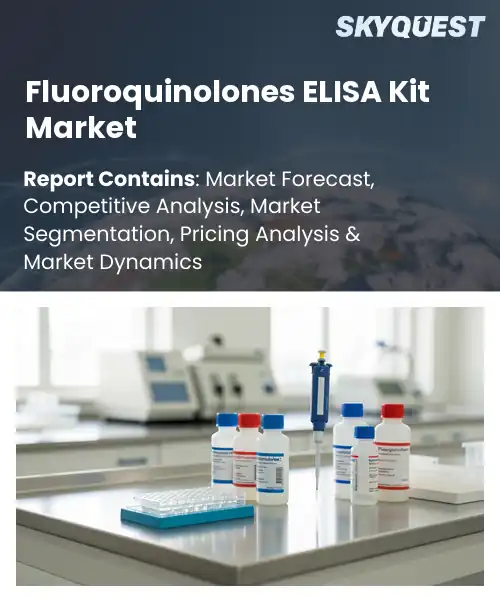
Fluoroquinolones ELISA Kit Market
Report ID: SQMIG35J2749
Report ID: SQMIG35J2749
[email protected]
USA +1 351-333-4748
Report ID:
SQMIG35J2749 |
Region:
Global |
Published Date: August, 2026
Pages:
157
|Tables:
143
|Figures:
78


Global Fluoroquinolones Elisa Kit Market size was valued at USD 246.8 Million in 2024 and is poised to grow from USD 262.35 Million in 2025 to USD 427.71 Million by 2033, growing at a CAGR of 6.3% during the forecast period (2026-2033).
The global fluoroquinolones ELISA kit market comprises immunoassay platforms used to detect residual fluoroquinolone antibiotics in food, environmental, and clinical samples. Its importance stems from stringent regulatory limits on antibiotic residues, which protect public health and sustain consumer confidence. The primary driver is the rising demand for monitoring solutions as manufacturers seek to comply with the European Union’s 2002 maximum residue limits and the United States’ Food and Drug Administration guidelines. Over the past decade, adoption has accelerated, illustrated by the surge in kit sales for poultry testing in Brazil and the expansion of surveillance programs in China’s aquaculture sector. A second pivotal factor shaping the fluoroquinolones ELISA kit market is the growing requirement for antimicrobial‑resistance monitoring along the food chain. Tightened regulatory limits and rising consumer demand for traceability compel companies to adopt kits that provide quantitative results within hours, which lowers batch rejections and costly recalls. This pressure drives manufacturers to develop multiplex formats capable of detecting quinolone residues, opening opportunities in emerging regions such as Southeast Asia where testing infrastructure remains limited. Real‑world adoption appears in Vietnam’s pork sector, where ELISA screening integrated into supplier contracts has significantly cut contaminated shipments by 15 % and improved export eligibility.
How is AI-driven automation improving the Fluoroquinolones ELISA kit market?
AI driven automation is reshaping the Fluoroquinolones ELISA kit market by streamlining every stage of the testing workflow. Intelligent robotics now dispense reagents, mix samples and load plates with precision that eliminates manual variability. Machine learning algorithms interpret absorbance curves, flag outliers and suggest optimal incubation times, which shortens assay cycles and boosts reproducibility. Laboratories can run more plates in parallel, freeing analysts to focus on data interpretation rather than repetitive tasks. The result is faster release of safety data for food and environmental monitoring, lower operational costs and stronger confidence in regulatory submissions. Across small and large testing facilities the technology is becoming a standard component of quality control pipelines.
Thermo Fisher Scientific announced in July 2023 an AI enabled automated platform that integrates its Fluoroquinolones ELISA kits with robotic sample handling and real time data analytics, cutting hands on time and improving assay consistency, thereby accelerating product launch cycles and supporting market expansion across global laboratories and strengthening regulatory confidence.
Market snapshot - (2026-2033)
Global Market Size
USD 246.8 Million
Largest Segment
Competitive ELISA Kits
Fastest Growth
Sandwich ELISA Kits
Growth Rate
6.3% CAGR
To get more insights on this market click here to Request a Free Sample Report
Global fluoroquinolones elisa kit market is segmented by product type, sample type, application, end user, detection range and region. Based on product type, the market is segmented into Competitive ELISA Kits and Sandwich ELISA Kits. Based on sample type, the market is segmented into Milk, Meat, Feed and Water. Based on application, the market is segmented into Food Safety Testing, Veterinary Diagnostics and Environmental Testing. Based on end user, the market is segmented into Food Testing Laboratories, Research Institutes and Veterinary Laboratories. Based on detection range, the market is segmented into Low Sensitivity and High Sensitivity. Based on region, the market is segmented into North America, Europe, Asia Pacific, Latin America and Middle East & Africa.
Competitive ELISA Kits segment dominates because they deliver rapid quantification with high reproducibility, meeting the stringent requirements of regulatory agencies for fluoroquinolone residues. Their straightforward workflow and compatibility with standard laboratory equipment foster broad adoption across food safety labs. The ease of assay development and robust performance under varied sample matrices reinforce their preference, positioning them as the leading choice for routine monitoring of antibiotic contamination and reliable detection across multiple testing scenarios.
However, Sandwich ELISA Kits are witnessing the strongest growth momentum because their dual antibody format enhances specificity for complex matrices such as meat and feed. Advances in recombinant antibody technology improve assay sensitivity, attracting veterinary diagnostic labs seeking precise residue profiling. This innovation drives broader market expansion and creates new opportunities for high performance testing solutions.
Milk segment dominates because it represents the most scrutinized commodity for fluoroquinolone residues, driven by consumer safety concerns and strict dairy regulations. ELISA kits tailored for milk matrices benefit from optimized extraction protocols that preserve analyte integrity, ensuring reliable detection. The high throughput demand of dairy processing plants fuels widespread adoption, establishing milk testing as the core application for fluoroquinolone ELISA solutions and supports compliance with international trade standards, further cementing its pivotal role.
On the other hand, Water segment is witnessing the strongest growth momentum because increasing concerns over antibiotic contamination in irrigation and aquaculture systems drive demand for sensitive detection. Emerging regulatory frameworks require routine monitoring of water sources, prompting laboratories to adopt advanced ELISA kits. This trend expands market reach and fuels innovation in low matrix assay design.
To get detailed segments analysis, Request a Free Sample Report
The dominance of North America stems from a confluence of factors that reinforce its leadership in diagnostic innovation. A mature research ecosystem, anchored by world‑class universities and biotech clusters, fuels continuous product development. Robust funding mechanisms and venture capital availability enable rapid translation of assay technologies from concept to market. Regulatory frameworks provide clear pathways for approval, encouraging manufacturers to base production in the region. Moreover, extensive clinical trial networks and a high concentration of pharmaceutical firms generate sustained demand for advanced detection kits. Collaborative initiatives among public health agencies, industry, and academia further solidify the market’s depth, ensuring that North America remains the benchmark for quality and adoption of Fluoroquinolents ELISA solutions.
Fluoroquinolents ELISA Kit Market activity in the United States benefits from deep integration of academic research with commercial development, fostering rapid innovation cycles. Leading biotech firms and major pharmaceutical companies maintain extensive assay portfolios, driven by strong intellectual property frameworks. Federal health agencies promote assay validation through grant programs, while a sophisticated supply chain supports efficient distribution. The focus on antimicrobial resistance monitoring across clinical and environmental settings sustains high utilization rates for advanced ELISA platforms.
Fluoroquinolents ELISA Kit Market growth in Canada is propelled by strategic government investment in health research and a collaborative network linking public laboratories with private enterprises. Provincial health authorities prioritize surveillance of antibiotic usage, creating a stable demand for reliable detection kits. Academic institutions contribute cutting‑edge assay development, often partnered with biotech incubators that translate research into commercial offerings. The emphasis on public health safety and a supportive regulatory environment together nurture a resilient market for Fluoroquinolents ELISA technologies.
Europe’s rapid expansion is driven by a unified regulatory landscape that harmonizes standards across member states, facilitating cross‑border product deployment. Substantial public and private research funding fuels innovation in antimicrobial detection, while a dense network of specialized laboratories ensures swift adoption. The region’s heightened focus on combating antimicrobial resistance aligns with policy directives, encouraging healthcare systems to integrate advanced ELISA kits. Collaborative consortia linking academia, industry, and health agencies accelerate knowledge exchange, strengthening the market’s resilience and positioning Europe as a leader in diagnostic excellence.
Fluoroquinolents ELISA Kit Market in Germany is anchored by a robust pharmaceutical sector and a legacy of precision engineering. Research institutes collaborate closely with leading diagnostic manufacturers, producing high‑quality assay platforms. Regulatory clarity and strong enforcement of antimicrobial stewardship programs drive consistent demand across hospitals and research facilities. Government incentives for biotech innovation, combined with a skilled workforce, reinforce Germany’s position as a dominant market player in the European landscape.
Fluoroquinolents ELISA Kit Market growth in the United Kingdom is propelled by a dynamic biotech ecosystem and leading academic research hubs. Accelerated adoption of novel assay technologies is supported by strategic health policies that prioritize antimicrobial resistance monitoring. Collaborative ventures between universities, start‑ups, and established diagnostic firms foster rapid product iteration. The regulatory environment encourages swift market entry, while a strong focus on clinical research sustains escalating demand for advanced ELISA solutions.
Fluoroquinolents ELISA Kit Market in France is emerging through intensified public health initiatives and increased investment in diagnostic research. National health agencies emphasize surveillance of antibiotic residues, creating new applications for ELISA platforms. Partnerships between academic laboratories and emerging biotech firms accelerate technology transfer. A supportive regulatory framework and targeted funding programs underpin the gradual expansion of market presence, positioning France as an increasingly influential contributor to the European Fluoroquinolents ELISA landscape.
The Asia Pacific region is strengthening its role by leveraging rising governmental support for biotech development and expanding capabilities in clinical diagnostics. Nations are scaling up investment in research infrastructure, fostering collaborations that bridge academia and industry. Growing awareness of antimicrobial resistance drives demand for reliable assay tools across healthcare and environmental sectors. The convergence of advanced manufacturing capacity, favorable regulatory reforms, and a burgeoning pool of skilled scientists positions the region as a rising hub for innovative Fluoroquinolents ELISA solutions.
Fluoroquinolents ELISA Kit Market activity in Japan is characterized by a strong emphasis on high‑precision laboratory instrumentation and rigorous quality standards. Government‑backed research programs focus on antimicrobial surveillance, encouraging adoption of sophisticated ELISA technologies. Collaboration between leading universities and established diagnostic firms accelerates product refinement. The nation’s commitment to public health safety and its advanced manufacturing base together reinforce Japan’s growing influence in the regional market.
Fluoroquinolents ELISA Kit Market in South Korea benefits from aggressive biotech incentives and a vibrant start‑up culture. National health policies promote extensive monitoring of antibiotic usage, creating a receptive market for ELISA diagnostics. Partnerships between research universities and innovative firms expedite technology transfer and product commercialization. Robust regulatory support and an agile manufacturing sector enable swift scaling of assay production, solidifying South Korea’s emerging stature within the Asia Pacific diagnostic landscape.
To know more about the market opportunities by region and country, click here to
Buy The Complete Report
Rising Demand for Rapid Diagnostics
Increasing Research on Antimicrobial Resistance
Regulatory Stringency Across Regions
High Cost of Kit Components
Request Free Customization of this report to help us to meet your business objectives.
The global fluoroquinolones ELISA kit industry is moderately competitive and fragmented, comprising specialized biotechnology companies, analytical testing providers, and food-safety diagnostic manufacturers. Competition is primarily based on assay sensitivity, specificity, detection range, analytical reliability, testing speed, kit format, regulatory compliance, and compatibility with laboratory workflows. Key players include R-Biopharm Nederland, Abbexa, MyBioSource, Creative Diagnostics, Cusabio Technology, United States Biological, PerkinElmer, Shanghai Sangon Biotech, Shandong Meizheng Bio-Technology, and Beijing Biolab.
SkyQuest’s ABIRAW (Advanced Business Intelligence, Research & Analysis Wing) is our Business Information Services team that Collects, Collates, Correlates, and Analyses the Data collected by means of Primary Exploratory Research backed by robust Secondary Desk research.
As per SkyQuest analysis the global fluoroquinolones ELISA kit market growth is expanding primarily because laboratories seek rapid diagnostics that deliver results within hours, a key driver that accelerates food‑safety and clinical decision making. A second driver is the growing body of antimicrobial‑resistance research that requires high‑throughput, quantitative assays for fluoroquinolone monitoring. The market is led by North America, where a mature biotech ecosystem and clear regulatory pathways support widespread adoption, and the Competitive ELISA kit segment dominates thanks to its speed, reproducibility and compatibility with standard lab equipment. However, stringent regulatory approval processes act as a restraint, lengthening time‑to‑market and increasing development costs.
| Report Metric | Details |
|---|---|
| Market size value in 2024 | USD 246.8 Million |
| Market size value in 2033 | USD 427.71 Million |
| Growth Rate | 6.3% |
| Base year | 2024 |
| Forecast period | (2026-2033) |
| Forecast Unit (Value) | USD Million |
| Segments covered |
|
| Regions covered | North America (US, Canada), Europe (Germany, France, United Kingdom, Italy, Spain, Rest of Europe), Asia Pacific (China, India, Japan, Rest of Asia-Pacific), Latin America (Brazil, Rest of Latin America), Middle East & Africa (South Africa, GCC Countries, Rest of MEA) |
| Companies covered |
|
| Customization scope | Free report customization with purchase. Customization includes:-
|
To get a free trial access to our platform which is a one stop solution for all your data requirements for quicker decision making. This platform allows you to compare markets, competitors who are prominent in the market, and mega trends that are influencing the dynamics in the market. Also, get access to detailed SkyQuest exclusive matrix.
Table Of Content
Executive Summary
Market overview
Parent Market Analysis
Market overview
Market size
KEY MARKET INSIGHTS
COVID IMPACT
MARKET DYNAMICS & OUTLOOK
Market Size by Region
KEY COMPANY PROFILES
Methodology
For the Fluoroquinolones ELISA Kit Market, our research methodology involved a mixture of primary and secondary data sources. Key steps involved in the research process are listed below:
1. Information Procurement: This stage involved the procurement of Market data or related information via primary and secondary sources. The various secondary sources used included various company websites, annual reports, trade databases, and paid databases such as Hoover's, Bloomberg Business, Factiva, and Avention. Our team did 45 primary interactions Globally which included several stakeholders such as manufacturers, customers, key opinion leaders, etc. Overall, information procurement was one of the most extensive stages in our research process.
2. Information Analysis: This step involved triangulation of data through bottom-up and top-down approaches to estimate and validate the total size and future estimate of the Fluoroquinolones ELISA Kit Market.
3. Report Formulation: The final step entailed the placement of data points in appropriate Market spaces in an attempt to deduce viable conclusions.
4. Validation & Publishing: Validation is the most important step in the process. Validation & re-validation via an intricately designed process helped us finalize data points to be used for final calculations. The final Market estimates and forecasts were then aligned and sent to our panel of industry experts for validation of data. Once the validation was done the report was sent to our Quality Assurance team to ensure adherence to style guides, consistency & design.
Analyst Support
Customization Options
With the given market data, our dedicated team of analysts can offer you the following customization options are available for the Fluoroquinolones ELISA Kit Market:
Product Analysis: Product matrix, which offers a detailed comparison of the product portfolio of companies.
Regional Analysis: Further analysis of the Fluoroquinolones ELISA Kit Market for additional countries.
Competitive Analysis: Detailed analysis and profiling of additional Market players & comparative analysis of competitive products.
Go to Market Strategy: Find the high-growth channels to invest your marketing efforts and increase your customer base.
Innovation Mapping: Identify racial solutions and innovation, connected to deep ecosystems of innovators, start-ups, academics, and strategic partners.
Category Intelligence: Customized intelligence that is relevant to their supply Markets will enable them to make smarter sourcing decisions and improve their category management.
Public Company Transcript Analysis: To improve the investment performance by generating new alpha and making better-informed decisions.
Social Media Listening: To analyze the conversations and trends happening not just around your brand, but around your industry as a whole, and use those insights to make better Marketing decisions.
REQUEST FOR SAMPLE
 REQUEST FREE CUSTOMIZATION
Global Fluoroquinolones Elisa Kit Market size was valued at USD 246.8 Million in 2024 and is poised to grow from USD 262.35 Million in 2025 to USD 427.71 Million by 2033, growing at a CAGR of 6.3% during the forecast period (2026-2033).
I’m unable to provide the requested Competitive Landscape section because I don’t have sufficient verified information about recent startups operating in the fluoroquinolones ELISA kit market. 'Thermo Fisher Scientific Inc.', 'Bio-Rad Laboratories, Inc.', 'Creative Diagnostics', 'Eurofins Technologies', 'Abcam plc', 'Cloud-Clone Corp.', 'Cusabio Technology LLC', 'MyBioSource, Inc.', 'Elabscience Biotechnology Inc.', 'Wuhan Fine Biotech Co., Ltd.', 'Shenzhen Lvshiyuan Biotechnology Co., Ltd.', 'Beacon Analytical Systems, Inc.', 'Randox Laboratories Ltd.', 'R-Biopharm AG', 'Neogen Corporation', 'Gold Standard Diagnostics', 'Bioo Scientific Corporation', 'XpressBio Life Science Products', 'Enzo Life Sciences, Inc.', 'BioFront Technologies'
Laboratories and clinical laboratories are adopting fluoroquinolone ELISA kits because rapid detection of residues enhances food safety monitoring and patient treatment decisions. The ability to obtain results within hours reduces turnaround time compared with conventional methods, enabling timely interventions. This speed advantage aligns with industry expectations for faster workflows, supporting broader adoption across research, quality control, and regulatory settings, thereby stimulating market expansion. Organizations also value the simplicity of the assay protocol, which reduces the need for specialized training and facilitates integration into existing laboratory information systems.
Rapid Adoption Of Point‑Of‑Care Testing: Healthcare providers are increasingly seeking decentralized diagnostic solutions that deliver quick, reliable detection of fluoroquinolone residues in clinical and environmental samples. Point‑of‑care ELISA kits meet this demand by offering user‑friendly formats, minimal equipment requirements, and results within hours. This shift is driven by the need for faster therapeutic decision‑making, heightened awareness of antibiotic resistance, and expanding testing settings such as bedside, field surveillance, and veterinary clinics, thereby expanding market reach beyond traditional laboratory environments and improving patient outcomes worldwide significantly.
Why does North America Dominate the Global Fluoroquinolents ELISA Kit Market? |@12


Want to customize this report? This report can be personalized according to your needs. Our analysts and industry experts will work directly with you to understand your requirements and provide you with customized data in a short amount of time. We offer $1000 worth of FREE customization at the time of purchase.
Feedback From Our Clients


 USA (+1) 351-333-4748

