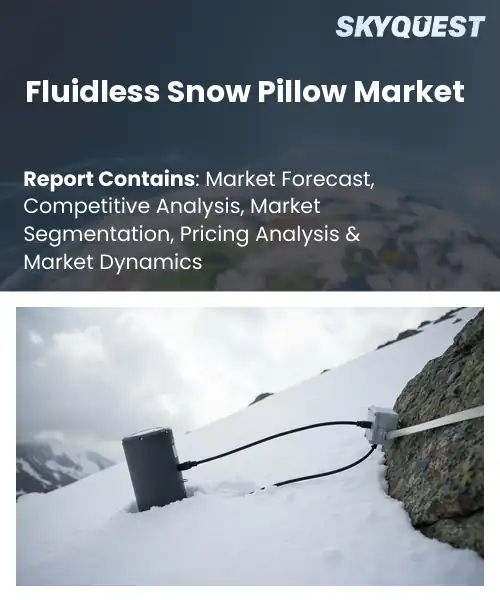
Fluidless Snow Pillow Market
Report ID: SQMIG25I2119
Report ID: SQMIG25I2119
[email protected]
USA +1 351-333-4748
Report ID:
SQMIG25I2119 |
Region:
Global |
Published Date: July, 2026
Pages:
157
|Tables:
143
|Figures:
78


Global Fluidless Snow Pillow Market size was valued at USD 178.4 Million in 2024 and is poised to grow from USD 189.28 Million in 2025 to USD 303.97 Million by 2033, growing at a CAGR of 6.1% during the forecast period (2026-2033).
The primary driver of the global fluidless snow pillow market is the rising demand for water‑conserving snow‑melt measurement in mountainous regions. Fluidless snow pillows are passive sensors that capture snowfall weight and convert it into water‑equivalent data without liquid‑filled tubes, eliminating leakage risks and calibration drift. This technology matters because accurate snowpack assessment underpins reservoir planning, hydro‑electric generation, and flood mitigation in water‑scarce basins. Historically, the market emerged in the early 2000s when Scandinavian hydropower operators replaced conventional gauges with robust polymer devices. Adoption then spread across the Rockies, the Alps, and parts of Central Asia, spurred by tighter water‑budget rules regional policy. Another pivotal factor shaping market expansion is the integration of Internet‑of‑Things platforms that transmit snow pillow readings to centralized water‑management hubs. When sensors relay data, operators can adjust reservoir releases, reducing downstream flooding while preserving summer water supplies. This feedback loop has prompted utilities in British Columbia to pair fluidless pillows with predictive analytics, cutting emergency release costs by roughly fifteen percent. Simultaneously, the low‑maintenance nature of the devices attracts projects in remote ski resorts, where staffing constraints make manual gauge checks impractical. Consequently, manufacturers are investing in rugged wireless modules and standardized protocols, creating a virtuous cycle of adoption and improved hydrological forecasting.
How is AI and IoT integration reshaping the Fluidless snow pillow market?
AI and IoT are turning fluidless snow pillows into smart sensing platforms. AI algorithms process weight data to estimate water equivalent and detect trends without human intervention. IoT connectivity streams measurements to cloud dashboards where operators can view conditions across remote basins. The integration reduces field visits, improves safety and allows predictive modeling of melt events. Sensors now self calibrate using machine learning, extending lifespan and lowering maintenance. Data from multiple sites can be fused with satellite observations, giving watershed managers a holistic view. This shift is accelerating adoption as agencies seek more reliable, automated snowpack monitoring.Geonor announced a new fluidless snow pillow at the Western Snow Conference in April 2024, embedding AI driven analytics and IoT telemetry. The device transmits weight data instantly, enabling early melt forecasts and reducing manual checks, which strengthens market growth through greater efficiency.
Market snapshot - (2026-2033)
Global Market Size
USD 178.4 Million
Largest Segment
Standard Snow Pillows
Fastest Growth
Portable Snow Pillows
Growth Rate
6.1% CAGR
To get more insights on this market click here to Request a Free Sample Report
Global fluidless snow pillow market is segmented by product type, application, installation, end user, monitoring system and region. Based on product type, the market is segmented into Standard Snow Pillows, High-Altitude Snow Pillows and Portable Snow Pillows. Based on application, the market is segmented into Snowpack Monitoring, Hydrological Research, Water Resource Management and Flood Forecasting. Based on installation, the market is segmented into Permanent and Temporary. Based on end user, the market is segmented into Government Agencies, Research Institutes and Environmental Organizations. Based on monitoring system, the market is segmented into Manual Data Collection and Remote Telemetry. Based on region, the market is segmented into North America, Europe, Asia Pacific, Latin America and Middle East & Africa.
Standard Snow Pillows segment dominates because it offers proven reliability in harsh snow conditions while eliminating the need for liquid interfaces. Its simplicity fosters trust among field operators, leading to widespread adoption across diverse projects. The design’s compatibility with existing data loggers and low maintenance requirements further reinforce its appeal, making it the cornerstone of fluidless snow pillow deployments and its scalable architecture supports expansion into new research initiatives.
However, Portable Snow Pillows are witnessing the strongest growth momentum because they enable rapid field deployment in remote terrains without extensive infrastructure. Their lightweight construction attracts emerging projects focused on climate extremes, driving broader market reach. This agility fuels new opportunities and positions the segment as a catalyst for future expansion.
Remote Telemetry segment dominates because it provides continuous real‑time data streams, eliminating the need for frequent site visits. This capability enhances safety for technicians and allows immediate detection of snowpack anomalies, improving decision support for water managers. Integration with existing communication networks simplifies deployment, and the reduced labor intensity strengthens stakeholder confidence, cementing its leadership in fluidless snow pillow operations across varied climatic zones and project scales, reinforcing its central role.
Meanwhile, Manual Data Collection emerges as a high‑growth area because researchers require hands‑on measurements to validate automated outputs. This tactile approach aids calibration of new sensors and delivers nuanced insights for scientific studies. Increased academic funding for detailed snowpack analysis amplifies demand, driving rapid expansion and creating fresh collaborative opportunities in the market.
To get detailed segments analysis, Request a Free Sample Report
North America leads the fluidless snow pillow market due to a confluence of mature winter sports culture, sophisticated manufacturing ecosystems, and proactive regulatory frameworks that favor innovative safety equipment. The region benefits from a high concentration of ski resorts and training facilities, creating strong demand for reliable, maintenance‑free snow pillows. Established partnerships between equipment manufacturers and sport governing bodies accelerate product development and market penetration. Moreover, investment in research and development, supported by a robust intellectual property environment, drives continuous improvements in material performance and cost efficiency. Consumer awareness of injury prevention and liability considerations further reinforce adoption across both recreational and professional segments, cementing North America’s position at the forefront of the global market.
Fluidless Snow Pillow Market in the United States thrives on a deep network of ski resorts and a vibrant outdoor recreation community that prioritizes safety. Strong collaboration between manufacturers and industry associations fosters rapid integration of advanced designs into training programs. High consumer expectations for performance and durability drive manufacturers to emphasize premium materials, while the presence of leading research institutions ensures a pipeline of innovations that keep the market dynamic and competitive.
Fluidless Snow Pillow Market in Canada benefits from extensive winter terrain and a national emphasis on sports safety that encourages early adoption of cutting‑edge protective gear. Collaborative initiatives between provincial sport agencies and equipment producers promote standardized testing and certification, reinforcing confidence among users. The country’s commitment to sustainable manufacturing practices aligns with the eco‑friendly attributes of fluidless designs, supporting both market growth and alignment with broader environmental goals.
Europe’s rapid expansion of the fluidless snow pillow market is propelled by a strong regulatory emphasis on athlete safety, coupled with a cohesive market of technologically advanced manufacturers. The continent’s diverse winter sport destinations create a broad base of users seeking high‑performance, low‑maintenance solutions. Cross‑border collaboration within the European Union facilitates harmonized standards, allowing manufacturers to scale innovations efficiently. Growing consumer consciousness around injury prevention and the desire for environmentally sustainable products further amplify demand. Academic research hubs in key countries contribute cutting‑edge material science, while industry consortia accelerate knowledge sharing, reinforcing Europe’s position as a leader in market expansion.
Fluidless Snow Pillow Market in Germany stands as the regional anchor, driven by a well‑established engineering sector and rigorous safety standards. Close cooperation between leading manufacturers and sport federations accelerates product validation and adoption across alpine facilities. The German market’s preference for high‑quality, durable equipment encourages continuous refinement of fluidless technologies, while strong export capabilities extend influence to neighboring markets, solidifying its dominant status.
Fluidless Snow Pillow Market in the United Kingdom experiences the fastest growth, fueled by a surge in participation in snow sports and a proactive approach to injury mitigation. Government‑backed safety campaigns and evolving liability frameworks motivate ski centres to upgrade to fluidless solutions. Emerging collaborations between innovative start‑ups and established equipment providers foster rapid product rollout, while heightened media attention on athlete welfare further accelerates market uptake.
Fluidless Snow Pillow Market in France is emerging as a niche yet promising segment, supported by a growing network of mountain resorts and heightened awareness of safety benefits. Collaborative pilot projects between regional sports authorities and manufacturers are testing fluidless designs in real‑world conditions. The French market’s appreciation for sustainable, low‑maintenance products aligns with the inherent advantages of fluidless technology, laying the groundwork for broader adoption.
Asia Pacific is strengthening its position in the fluidless snow pillow market through a combination of expanding winter tourism infrastructure, increasing investment in advanced materials, and a cultural shift towards proactive injury prevention. Nations in the region are establishing dedicated research centers that focus on lightweight, resilient composites, enhancing product performance. Government incentives aimed at modernizing ski facilities encourage the integration of low‑maintenance safety solutions. Growing middle‑class participation in winter sports creates a sizable customer base eager for innovative protective gear. Collaborative ventures between local manufacturers and global technology partners accelerate knowledge transfer, positioning Asia Pacific as an emerging hub for both production and consumption of fluidless snow pillows.
Fluidless Snow Pillow Market in Japan benefits from a long‑standing winter sports tradition and a reputation for precision engineering. Close ties between manufacturers and ski resort operators facilitate swift adoption of fluidless solutions that meet stringent reliability expectations. Ongoing research at leading universities focuses on next‑generation polymers, reinforcing Japan’s role as a technology pioneer. Consumer demand for high‑performance, low‑maintenance equipment further fuels market momentum.
Fluidless Snow Pillow Market in South Korea is propelled by rapid development of artificial ski venues and a youthful demographic enthusiastic about extreme sports. Government programs supporting safety innovation provide resources for local producers to integrate fluidless designs into their product lines. Partnerships with multinational firms enable access to cutting‑edge material technologies, while public awareness campaigns highlight the benefits of injury‑free training, driving broader acceptance across recreational and competitive arenas.
To know more about the market opportunities by region and country, click here to
Buy The Complete Report
Increasing Adoption Of Eco‑Friendly Practices
Manufacturers are increasingly adopting fluidless snow pillow technology because it aligns with broader corporate sustainability goals, reducing water consumption and chemical usage while delivering comparable comfort. This alignment encourages brand differentiation and meets consumer expectations for environmentally responsible products, prompting retailers to allocate shelf space and marketing resources toward these solutions. Consequently, supply chain participants experience heightened collaboration, and the overall market environment becomes more receptive to innovative, low‑impact alternatives, fostering sustained demand growth and reinforcing confidence among end‑users globally.
Growing Interest In Sustainable Tourism
Travel operators and destination managers are leveraging fluidless snow pillow solutions to enhance their sustainability credentials, as responsible tourism increasingly influences visitor choices. By integrating these eco‑friendly accommodations, they demonstrate commitment to preserving natural resources and reducing environmental footprints, which resonates with environmentally conscious travelers. This positive perception encourages repeat visitation and word‑of‑mouth promotion, prompting additional hospitality providers to explore similar offerings. As a result, the market experiences organic expansion driven by tourism sector endorsement and heightened consumer demand for greener lodging experiences.
High Initial Investment Costs
Implementing fluidless snow pillow systems requires substantial capital outlay for specialized equipment, R&D, and staff training, which can deter smaller operators with limited financial flexibility. The perceived risk associated with allocating resources to unproven technology further amplifies hesitance, leading many organizations to postpone adoption until clearer return‑on‑investment evidence emerges. Consequently, market penetration proceeds at a measured pace, as budgetary constraints and risk‑aversion encourage reliance on conventional alternatives, thereby moderating overall growth momentum. This financial barrier also limits early market feedback that could accelerate product refinement.
Limited Awareness Among Stakeholders
Many hot‑shelf retailers, property managers, and end‑users remain unfamiliar with the benefits and operational requirements of fluidless snow pillow technology, creating a knowledge gap that hampers adoption. Without clear understanding of maintenance procedures, performance expectations, and ecological advantages, decision‑makers often default to traditional solutions perceived as lower risk. This informational deficit curtails demand generation efforts, restricts promotional activities, and slows the diffusion of innovation across market segments, ultimately constraining the overall expansion trajectory and emphasizes the need for targeted education campaigns by industry leaders.
Request Free Customization of this report to help us to meet your business objectives.
The fluidless snow pillow market is shaped by a few specialized firms competing on sensor accuracy and deployment simplicity. Geonor’s recent launch of an easy‑pack, low‑maintenance fluid‑less snow pillow illustrates tech innovation aimed at reducing field effort, while emerging collaborations with hydrological research institutes accelerate data integration, intensifying rivalry among niche players.
Top Player’s Company Profile
Recent Developments
SkyQuest’s ABIRAW (Advanced Business Intelligence, Research & Analysis Wing) is our Business Information Services team that Collects, Collates, Correlates, and Analyses the Data collected by means of Primary Exploratory Research backed by robust Secondary Desk research. As per SkyQuest analysis the global fluidless snow pillow market is projected to expand at a 6.1 % CAGR through 2033, driven primarily by the growing need for water‑conserving snow‑melt measurement in mountainous basins, while the integration of IoT and AI platforms provides a second boost by delivering real‑time, automated data streams. High initial investment costs act as a restraint, limiting early adoption among smaller operators. North America remains the dominant region thanks to its mature winter‑sports infrastructure and supportive regulatory framework, and the standard snow pillow segment leads the market because of its proven reliability and ease of deployment across both public and private initiatives, reinforcing its market leadership
| Report Metric | Details |
|---|---|
| Market size value in 2024 | USD 178.4 Million |
| Market size value in 2033 | USD 303.97 Million |
| Growth Rate | 6.1% |
| Base year | 2024 |
| Forecast period | (2026-2033) |
| Forecast Unit (Value) | USD Million |
| Segments covered |
|
| Regions covered | North America (US, Canada), Europe (Germany, France, United Kingdom, Italy, Spain, Rest of Europe), Asia Pacific (China, India, Japan, Rest of Asia-Pacific), Latin America (Brazil, Rest of Latin America), Middle East & Africa (South Africa, GCC Countries, Rest of MEA) |
| Companies covered |
|
| Customization scope | Free report customization with purchase. Customization includes:-
|
To get a free trial access to our platform which is a one stop solution for all your data requirements for quicker decision making. This platform allows you to compare markets, competitors who are prominent in the market, and mega trends that are influencing the dynamics in the market. Also, get access to detailed SkyQuest exclusive matrix.
Table Of Content
Executive Summary
Market overview
Parent Market Analysis
Market overview
Market size
KEY MARKET INSIGHTS
COVID IMPACT
MARKET DYNAMICS & OUTLOOK
Market Size by Region
KEY COMPANY PROFILES
Methodology
For the Fluidless Snow Pillow Market, our research methodology involved a mixture of primary and secondary data sources. Key steps involved in the research process are listed below:
1. Information Procurement: This stage involved the procurement of Market data or related information via primary and secondary sources. The various secondary sources used included various company websites, annual reports, trade databases, and paid databases such as Hoover's, Bloomberg Business, Factiva, and Avention. Our team did 45 primary interactions Globally which included several stakeholders such as manufacturers, customers, key opinion leaders, etc. Overall, information procurement was one of the most extensive stages in our research process.
2. Information Analysis: This step involved triangulation of data through bottom-up and top-down approaches to estimate and validate the total size and future estimate of the Fluidless Snow Pillow Market.
3. Report Formulation: The final step entailed the placement of data points in appropriate Market spaces in an attempt to deduce viable conclusions.
4. Validation & Publishing: Validation is the most important step in the process. Validation & re-validation via an intricately designed process helped us finalize data points to be used for final calculations. The final Market estimates and forecasts were then aligned and sent to our panel of industry experts for validation of data. Once the validation was done the report was sent to our Quality Assurance team to ensure adherence to style guides, consistency & design.
Analyst Support
Customization Options
With the given market data, our dedicated team of analysts can offer you the following customization options are available for the Fluidless Snow Pillow Market:
Product Analysis: Product matrix, which offers a detailed comparison of the product portfolio of companies.
Regional Analysis: Further analysis of the Fluidless Snow Pillow Market for additional countries.
Competitive Analysis: Detailed analysis and profiling of additional Market players & comparative analysis of competitive products.
Go to Market Strategy: Find the high-growth channels to invest your marketing efforts and increase your customer base.
Innovation Mapping: Identify racial solutions and innovation, connected to deep ecosystems of innovators, start-ups, academics, and strategic partners.
Category Intelligence: Customized intelligence that is relevant to their supply Markets will enable them to make smarter sourcing decisions and improve their category management.
Public Company Transcript Analysis: To improve the investment performance by generating new alpha and making better-informed decisions.
Social Media Listening: To analyze the conversations and trends happening not just around your brand, but around your industry as a whole, and use those insights to make better Marketing decisions.
REQUEST FOR SAMPLE
 REQUEST FREE CUSTOMIZATION


Want to customize this report? This report can be personalized according to your needs. Our analysts and industry experts will work directly with you to understand your requirements and provide you with customized data in a short amount of time. We offer $1000 worth of FREE customization at the time of purchase.
Feedback From Our Clients


 USA (+1) 351-333-4748

