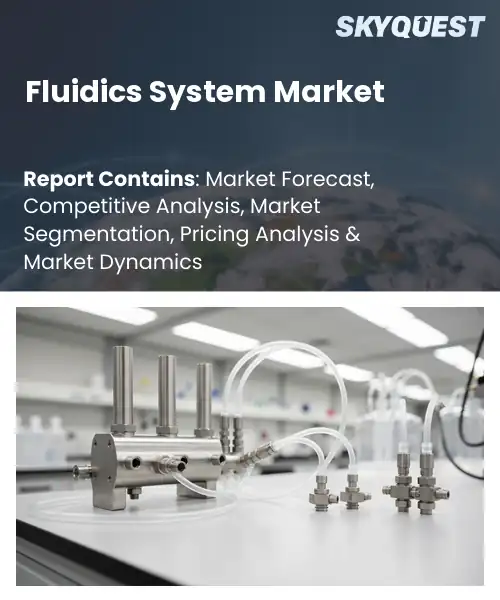
Fluidics System Market
Report ID: SQMIG20I2751
Report ID: SQMIG20I2751
[email protected]
USA +1 351-333-4748
Report ID:
SQMIG20I2751 |
Region:
Global |
Published Date: March, 2026
Pages:
157
|Tables:
89
|Figures:
76


Global Fluidics System Market size was valued at USD 3.7 Billion in 2024 and is poised to grow from USD 3.96 Billion in 2025 to USD 6.8 Billion by 2033, growing at a CAGR of 7.0% during the forecast period (2026-2033).
The fluidics system industry includes products that are used to move liquids in various applications such as medicine, chemicals, and manufacturing. The primary impetus for the expansion of fluidics systems is the convergence of miniaturization and automation. The significance of the market is that efficiently handling fluids improves the speed of diagnosing and the use of resources and improves manufacturing productivity, which leads to reduced costs and better results. The evolution of fluidics systems has followed a path from a simple valve and tube to the integration of many devices onto one chip (lab on a chip) and the development of automated dispensing robots.
Examples of these advancements can be seen in the use of microfluidics in point-of-care diagnostics and in the precision of the inkjet machines used for cleaning semiconductors. Both technologies have been driven by the demand for fluid handling solutions to be faster, smaller, and more reliable, with increasing levels of integration across multiple industries.
Based on these advances in technology, the global fluidics market is continuing to expand due to the increased demand for greater throughput in the pharmaceutical, biotech and semiconductor industries through the implementation of automation to the process of moving liquids. Automated fluid handling reduces cycle time, eliminates risk of contamination, and allows for scaling of production. As the pharmaceutical industry scales up biologics manufacturing, the use of microfluidic reactors and precision dispensing devices will improve the consistency of reagent handling, leading to increased yields and shorter time to market. Likewise, the implementation of advanced pneumatic and electrokinetic controls in wafer cleaning and chemical delivery will improve the uniformity of the process and reduce the number of defects and producing costs per unit.
How is AI-enabled Automation Improving Throughput In The Fluidics System Market?
Automation enabled by Artificial Intelligence (AI) in fluidics systems connects real-time measurement to automated decision making using classical flow control. Core functions within this technology include adaptive flow control; predictive maintenance; automated sampling, and orchestration between multiple devices. Currently, automated systems demonstrate the integration of scheduling software and data analytics, which results in reduced human intervention and less variability from run to run. The integration of these capabilities meets market demand for increased productivity and reproducibility in the life sciences laboratory and biomanufacturing sectors.
Suppliers are combining robotics, intelligent fluidics, and cloud or edge analytics to decrease cycle time while increasing the reproducibility and scalability of workflows. The Stratyx 250 is an example that demonstrates how AI-based optimization and remote operation reduce chances of error and simplify experiment setup. This type of automation decreases the time required for conducting experiments and increases the appeal of fluidics workflows by providing efficiency and scalability benefits to the market.
Market snapshot - (2026-2033)
Global Market Size
USD 3.7 Billion
Largest Segment
Sensors
Fastest Growth
Actuators
Growth Rate
7.0% CAGR
To get more insights on this market click here to Request a Free Sample Report
Global fluidics system market is segmented into component type, product type, application area and region. Based on component type, the market is segmented into sensors and actuators. Based on product type, the market is segmented into microfluidics and nanofluidics. Based on application area, the market is segmented into healthcare, industrial, life sciences and chemicals. Based on region, the market is segmented into North America, Europe, Asia Pacific, Latin America and Middle East & Africa.
As per the fluidics system market outlook, the sensors segment leads the market due to their capability to give accurate and instantaneous information regarding the measurement and management of fluids throughout almost every application where fluid management is involved. As such, high-performance sensors will enable closed-loop control of flow, concentration, and pressure, minimizing variances between expected performance and actual performance, resulting in improved diagnostic, processing, and experimental results. The advent of improved miniaturization techniques, material science, as well as the increased use of electronic integration, has placed sensors at the core of the system design/engineering process. Thereby driving adoption through the facilitation of automated, data-optimized, and interoperable with laboratory and industrial control systems as well as assistance towards meeting regulatory requirements.
As per the fluidics system market analysis, the actuators segment is also witnessing significant growth, particularly as the most rapidly growing segment in the market, because of their ability to provide accurate mechanical control in micro/nanoscale applications. The introduction of new MEMS-based pumps, valves, and electrostatic/magnetic actuation technology is increasing application development opportunities as well as creating more complicated workflow possibilities. Thus, contributing to increased throughput and additional opportunities for integration of systems to enhance their capability and facilitate commercial adoption.
As per the fluidics system market forecast, microfluidics is the largest segment because of already established fabrication methods/platforms being used within diagnostics/drug discovery/analytical processes, which allows for widespread implementation of microfluidic integration across multiple disciplines. The compact design leads to reduced reagent usage and enhanced automation opportunities for research lab and medical device developer markets. Manufacturers of microfluidic devices have been able to build an established supply chain for microfluidic products, which supports continued improvement/modification of microfluidic products, creating an ecosystem for development of other similar products.
In contrast, nanofluidics has been experiencing tremendous growth because developing new fabrication techniques and advances in designing/creating new surface chemistry will allow for the ability to conduct single molecule analyses with much greater sensitivity. These two advancements will lead to many new applications for conducting high-resolution sensing, separating materials from each other, or developing new synthetic biology products. With these new capabilities, additional innovation dollars being invested in developing similar types of products, providing large commercial opportunities for companies that use technology to develop products.
To get detailed segments analysis, Request a Free Sample Report
As per fluidics system regional outlook, North America is the leader due to its unique combination of the depth of research and development, highly consolidated original equipment manufacturer (OEM) base, and established clinical and industrial user communities that have adopted new fluidics technologies. The advanced health care and biotechnology sectors provide the ongoing demand for diagnostics, drug delivery and bioprocessing solutions, while established regulatory pathways and established after-sales service networks minimize time to market.
The fluidics systems market in the U.S. is supported by a high concentration of OEMs, research institutions and clinical networks that accelerate product development and market entry. Strong venture and corporate financing, well-established regulatory pathways, and sophisticated hospital procurement processes help speed up the commercialization process.
As per fluidics system regional forecast, Canada is driven by the collaborative culture of specialized research hospitals, public health institutions, and manufacturing partners that support product development and clinical validation. Government-funded research programs and clinical consortia allow for translational work while strong relationships with export markets encourage partnerships with global OEMs. A highly skilled scientific workforce, along with targeted procurement by health authorities, promote the adoption of precision fluidic platforms for both diagnostic and research applications.
The rapid growth of Europe can be attributed to a dense network of medtech clusters, solid contract manufacturing capabilities, and a harmonized regulatory regime that enables companies to sell their products internationally across Europe. Hospitals and laboratories throughout Europe have established clinical testing environments that allow manufacturers to have their products validated through a rigorous clinical validation process before being sold to early adopter customers. Collaborative research initiatives exist between universities and companies to assist companies scale their products up quickly through the use of academically developed technologies and university-based research. With an emphasis on precision diagnostics and business models with integrated care, there will continue to be a high demand for advanced fluidics systems and solutions.
In Germany, the fluidics system market is driven by precision engineering capabilities, a large industrial supply chain, and many OEMs who drive both product innovation and product quality. Working closely with universities and university-affiliated research institutions enables German engineering advances to be quickly incorporated into scalable fluidics systems. Additionally, the robust export market for German manufactures and an equally strong manufacturing services industry make it easy for companies to export their products internationally while also meeting strict regulatory compliance, as well as being able to meet the demands of the marketplace globally.
Fluidics system in the United Kingdom benefit from an established and active innovation ecosystem consisting of universities, incubators, and networks for conducting clinical research to expedite market entry. The public healthcare procurement process and translational research initiatives provide early input into products as they are developed, allowing for an iterative product development process. Additionally, there is also a very high level of investor interest, as well as numerous acceleration programs designed to take promising fluidic technologies from the lab to the clinic. Similarly, partnerships between companies and industry partners help increase manufacturing capability and improve access to European markets for fluidic systems.
The fluidics system market in France is currently maturing because of targeted public-private initiatives, biotechnology cluster development, and government investment to support the commercialization of medical technology. Clinical research hospitals and incubators are acting as conduits for clinical validation and user testing, while partnerships with contract manufacturing organizations are creating the necessary infrastructure to support scalable production. Furthermore, the French government has placed a strong emphasis on the development of diagnostic products, as well as sourcing funds to support the translation of fluidic systems from the laboratory to commercially viable products.
The Asia Pacific region is developing its position via a triple approach of increasing indigenous production capabilities, government-sponsored initiatives to promote new industries, and technological advancement in the convergence of electrical/electronic devices with microfluidic devices, and biotechnologies. Regional manufacturers are establishing investment of precision manufacturing capabilities and quality management programs which allow higher quality product families to be manufactured in larger quantities. Joint ventures involving regional manufacturers and global suppliers are also promoting the development of new technologies through better access to knowledge and by providing better localized customization of global technologies for customers in regional markets.
As per fluidics system industry analysis, Japan market is being driven by a culture of precision manufacturing, high technology automation and robotics/integration with fluidics technologies. Long established global fluidics OEMs and specialized component suppliers have created partnerships with research organizations to improve reliability and reproducibility in their respective devices. Furthermore, the existing restrictiveness of quality assurance, etc. will promote additional adoption of fluidics devices and improve consistency of user experience of fluidics systems in clinical and industrial applications. A well-established supplier base for fluidics OEMs will help facilitate economies of scale for fluidics OEMs globally.
The South Korea fluidics system market has benefited from a convergence of the electronics, semiconductor precision and biotechnology industries resulting in the rapid development of the compact fluidic system. Rapid prototyping using agile startups and contract manufacturers and targeted industrial policy and public funded R&D programs have fostered the commercialization of new fluidics technologies.
To know more about the market opportunities by region and country, click here to
Buy The Complete Report
Increasing Demand for Lab Automation
As laboratories increasingly adopt laboratory automation, demand for advanced solids-based systems continues to rise due to their ability to elevate throughput, enhance reproducibility, and decrease the variability associated with manual practices when using complicated workflows. By using solid-based automated fluid handling platforms, laboratories can conduct complex assays with reliability and can also integrate these processes with a variety of downstream analytical instrumentation, resulting in increased investment in reliable solid-based systems. As organizations continue to make efficient, consistent processes the emphasis for their research and/or diagnostic operations, the fluidics system market trend towards increased use of solid-based automated fluid handling systems is expected to gain momentum as organizations attempt to standardize processes.
Growth In Biopharmaceutical Research
Expansion of biopharmaceutical research as well as the expanding use of personalized medicines is generating increased demand from researchers for accurate, flexible solid-based fluid handling systems that can accommodate the increasingly complex biological workflows being used. The use of solid-based fluid-handling systems provides researchers with the ability to create controlled micro-environments for single-cell analyses, facilitate the performance of high sensitivity assays, and reproducibly handle reagents through accurate dispensing and integration capability. As the biologic development pipeline continues to diversify and the period required for the completion of drug development continues to decrease, laboratories and contract research organizations will focus on solid systems technologies.
High System Complexity and Integration
The advanced complexity of fluidics systems and the challenge of integrating them into current laboratory infrastructure slow down the adoption of advanced fluidics systems since customers have to overcome a very steep learning curve. This also requires significant validation to ensure proper operation of the advanced fluidics system before it can be deployed in production. Most organizations require highly skilled personnel to operate and maintain advanced and complex fluidics systems; not only does this require time to train and develop skilled personnel. But more importantly, the time it takes to qualify fluidics systems for regulated environments can significantly slow down their ability to deploy the systems quickly.
Limited Standardization and Interoperability
The lack of standardization and interoperability across different fluidics vendors and fluidics platforms inhibits the ability of the fluidics systems market to achieve greater scalability in its market by forcing end users to develop a unique integration and validation effort. Multiple proprietary interfaces and various communication protocols among the many different suppliers of fluidics systems increase the costs and complexity to combine fluidics systems from multiple suppliers. These factors increase the risk perception to the buying customer, lengthen the time to implement fluidics systems, and discourage the broader adoption of fluidics systems in multi-supplier environments and, therefore, constrain the overall fluidics system market growth.
Request Free Customization of this report to help us to meet your business objectives.
The competitive nature of the global fluidics system industry involves a few key things developing platforms that are differentiated from each other; forming partnerships with strategic companies that are also creating new products, and acquiring companies that can accelerate our business growth. Some recent examples of these companies include venture-backed companies such as Atrandi Biosciences that raised significant money in a Series A round to scale their droplet microfluidics platform; Andson Biotech, an academic spinout by the founders of UCL Biochemical Engineering, has commercialized microfluidic sample preparation tools with support from an accelerator.
SkyQuest’s ABIRAW (Advanced Business Intelligence, Research & Analysis Wing) is our Business Information Services team that Collects, Collates, Correlates, and Analyses the Data collected by means of Primary Exploratory Research backed by robust Secondary Desk research.
As per SkyQuest analysis, one key driver is the rising demand for automation-enabled throughput improvements in biopharma and semiconductor manufacturing. A second driver is the expansion of biopharmaceutical research, which fuels demand for precise, scalable fluid handling and accelerates the adoption of microfluidic and nanofluidic platforms. However, a major restraint is the high system complexity and integration burden, which slows deployment. North America remains the dominant region in the market. The sensor segment leads due to its critical role in enabling high-performance sensing for closed-loop control and advanced analytics. This combination creates opportunities for modular architectures, aftermarket services and software-driven optimization that improve uptime and lower total cost of ownership, strengthening supplier differentiation and customer value. The market is moderately consolidated, with leading multinational players accounting for a significant portion of the global fluidics system market share, while a wide base of regional and specialized manufacturers contributes to the remaining share.
| Report Metric | Details |
|---|---|
| Market size value in 2024 | USD 3.7 Billion |
| Market size value in 2033 | USD 6.8 Billion |
| Growth Rate | 7.0% |
| Base year | 2024 |
| Forecast period | (2026-2033) |
| Forecast Unit (Value) | USD Billion |
| Segments covered |
|
| Regions covered | North America (US, Canada), Europe (Germany, France, United Kingdom, Italy, Spain, Rest of Europe), Asia Pacific (China, India, Japan, Rest of Asia-Pacific), Latin America (Brazil, Rest of Latin America), Middle East & Africa (South Africa, GCC Countries, Rest of MEA) |
| Companies covered |
|
| Customization scope | Free report customization with purchase. Customization includes:-
|
To get a free trial access to our platform which is a one stop solution for all your data requirements for quicker decision making. This platform allows you to compare markets, competitors who are prominent in the market, and mega trends that are influencing the dynamics in the market. Also, get access to detailed SkyQuest exclusive matrix.
Table Of Content
Executive Summary
Market overview
Parent Market Analysis
Market overview
Market size
KEY MARKET INSIGHTS
COVID IMPACT
MARKET DYNAMICS & OUTLOOK
Market Size by Region
KEY COMPANY PROFILES
Methodology
For the Fluidics System Market, our research methodology involved a mixture of primary and secondary data sources. Key steps involved in the research process are listed below:
1. Information Procurement: This stage involved the procurement of Market data or related information via primary and secondary sources. The various secondary sources used included various company websites, annual reports, trade databases, and paid databases such as Hoover's, Bloomberg Business, Factiva, and Avention. Our team did 45 primary interactions Globally which included several stakeholders such as manufacturers, customers, key opinion leaders, etc. Overall, information procurement was one of the most extensive stages in our research process.
2. Information Analysis: This step involved triangulation of data through bottom-up and top-down approaches to estimate and validate the total size and future estimate of the Fluidics System Market.
3. Report Formulation: The final step entailed the placement of data points in appropriate Market spaces in an attempt to deduce viable conclusions.
4. Validation & Publishing: Validation is the most important step in the process. Validation & re-validation via an intricately designed process helped us finalize data points to be used for final calculations. The final Market estimates and forecasts were then aligned and sent to our panel of industry experts for validation of data. Once the validation was done the report was sent to our Quality Assurance team to ensure adherence to style guides, consistency & design.
Analyst Support
Customization Options
With the given market data, our dedicated team of analysts can offer you the following customization options are available for the Fluidics System Market:
Product Analysis: Product matrix, which offers a detailed comparison of the product portfolio of companies.
Regional Analysis: Further analysis of the Fluidics System Market for additional countries.
Competitive Analysis: Detailed analysis and profiling of additional Market players & comparative analysis of competitive products.
Go to Market Strategy: Find the high-growth channels to invest your marketing efforts and increase your customer base.
Innovation Mapping: Identify racial solutions and innovation, connected to deep ecosystems of innovators, start-ups, academics, and strategic partners.
Category Intelligence: Customized intelligence that is relevant to their supply Markets will enable them to make smarter sourcing decisions and improve their category management.
Public Company Transcript Analysis: To improve the investment performance by generating new alpha and making better-informed decisions.
Social Media Listening: To analyze the conversations and trends happening not just around your brand, but around your industry as a whole, and use those insights to make better Marketing decisions.
REQUEST FOR SAMPLE
 REQUEST FREE CUSTOMIZATION
Global Fluidics System Market size was valued at USD 3.7 Billion in 2024 and is poised to grow from USD 3.96 Billion in 2025 to USD 6.8 Billion by 2033, growing at a CAGR of 7.0% during the forecast period (2026-2033).
Competitive dynamics in the global fluidics systems market center on platform differentiation, strategic partnerships and targeted acquisitions that accelerate scale and channel access; notable recent moves include venture-backed scale-ups such as Atrandi Biosciences raising a major Series A to expand its droplet microfluidics platform, academic spinouts like Andson Biotech commercializing microfluidic sample-prep tools with accelerator support, and Infini Fluidics advancing SBIR-funded process integration for LNP manufacturing. 'Waters Corporation', 'Agilent Technologies', 'PerkinElmer', 'Thermo Fisher Scientific', 'Brooks Automation', 'Festo AG', 'Microfluidics International Corporation', 'Labcyte Inc.', 'Elveflow', 'Dolomite Microfluidics', 'Schneider Electric', 'Gilmont Instruments', 'Tecan Group', 'Sartorius AG', 'Biovision Inc.', 'Headwall Photonics', 'Applikon Biotechnology', 'Eppendorf AG', 'TTP Group', 'Sartorius Stedim Biotech'
The rising adoption of laboratory automation drives demand for advanced fluidics systems by enabling higher throughput, improved reproducibility, and reduced manual variability in complex workflows. Automated fluid handling platforms allow laboratories to run sophisticated assays reliably and integrate seamlessly with downstream analytical instruments, which encourages investment in robust fluidics solutions. As research and diagnostic processes prioritize efficiency and consistency, organizations increasingly select automated fluidics to standardize protocols, accelerate development timelines, and support scalable operations, thereby contributing directly to market expansion and supplier interest in innovation.
Sustainable Circular Design: Suppliers and end users are prioritizing materials selection, recyclable components, and efficient pump and valve designs to reduce lifecycle environmental impact. Emphasis on clean manufacturing, extended serviceability, and product reclamation is driving adoption of reusable cartridges and standardized remanufacturing processes. This shift fosters partnerships across supply chains to ensure traceability and regulatory alignment, enhancing brand resilience and customer preference while opening aftermarket service revenue opportunities through circular business models that balance performance with environmental stewardship and measurable operational benefits too.
As per fluidics system regional outlook, North America is the leader due to its unique combination of the depth of research and development, highly consolidated original equipment manufacturer (OEM) base, and established clinical and industrial user communities that have adopted new fluidics technologies.


Want to customize this report? This report can be personalized according to your needs. Our analysts and industry experts will work directly with you to understand your requirements and provide you with customized data in a short amount of time. We offer $1000 worth of FREE customization at the time of purchase.
Feedback From Our Clients


 USA (+1) 351-333-4748

