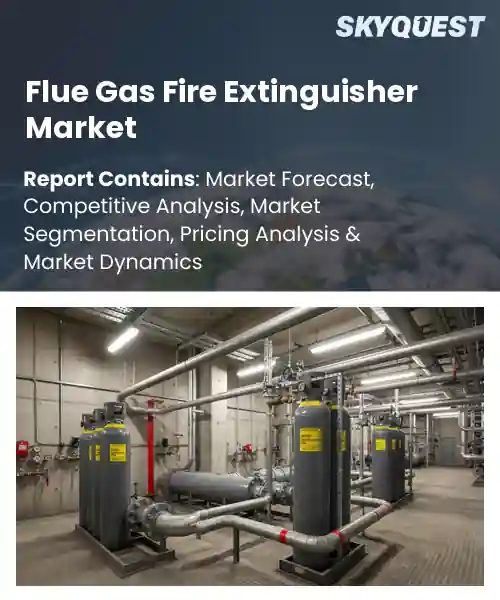
Flue Gas Fire Extinguisher Market
Report ID: SQMIG20B2323
Report ID: SQMIG20B2323
[email protected]
USA +1 351-333-4748
Report ID:
SQMIG20B2323 |
Region:
Global |
Published Date: August, 2026
Pages:
157
|Tables:
142
|Figures:
78


Global Flue Gas Fire Extinguisher Market size was valued at USD 286.4 Million in 2024 and is poised to grow from USD 303.01 Million in 2025 to USD 475.72 Million by 2033, growing at a CAGR of 5.8% during the forecast period (2026-2033).
The global flue gas fire extinguisher market supplies specialized suppression systems that intervene when combustion gases escape boiler rooms, furnaces, or petrochemical reactors. Its importance stems from the toxic nature of flue gases, which can ignite secondary equipment and jeopardize worker safety. Over the past decade, stringent environmental regulations and rising awareness of occupational hazards have propelled demand, especially in Europe where the EU’s Seveso‑III Directive mandates gas‑handling safeguards. Early adopters such as Siemens Power and GE Power have retrofitted legacy plants with water‑mist and dry‑chemical agents, illustrating a shift from generic sprinklers to purpose‑built extinguishers. This evolution reflects an industrial trend toward risk‑based engineering.
Regulatory compliance represents a catalyst for expanding the global flue‑gas fire extinguisher market, because manufacturers must align product designs with evolving safety codes that penalize unmitigated emissions. When governments tighten allowable flue‑gas temperature thresholds, plant operators are forced to replace conventional water‑cooling rigs with high‑efficiency units that combine inert gas discharge and rapid cooling. This shift unlocks opportunities for vendors offering modular, IoT‑enabled controllers that provide pressure monitoring and predictive maintenance, as demonstrated by Yokogawa’s deployment at a Japanese steel mill that reduced downtime by 15 percent. Consequently, investment in R&D and partnerships accelerates, positioning the market for double‑digit growth.
How is AI improving safety and efficiency in the flue gas fire extinguisher market?
AI is reshaping flue gas fire extinguishers by embedding sensors that continuously monitor temperature, pressure and gas composition. Machine‑learning models interpret these signals to predict ignition risk before a flame develops, allowing the system to discharge pre‑emptively. Real‑time analytics also adjust discharge pressure for optimal coverage, reducing waste of extinguishing agent and minimizing downtime for industrial plants. Integration with plant control systems creates a closed loop where AI alerts operators, triggers automated safety protocols and logs events for post‑incident analysis. This blend of predictive insight and adaptive response improves both safety margins and operational efficiency across the market.
In March 2024, Kidde introduced an AI‑driven monitoring module for its flue‑gas extinguishers, enhancing early detection and automated discharge, which is driving broader adoption of intelligent suppression solutions.
Market snapshot - (2026-2033)
Global Market Size
USD 286.4 Million
Largest Segment
Portable Fire Extinguishers
Fastest Growth
Fixed Fire Suppression Systems
Growth Rate
5.8% CAGR
To get more insights on this market click here to Request a Free Sample Report
Global flue gas fire extinguisher market is segmented by product type, extinguishing agent, application, end user, installation and region. Based on product type, the market is segmented into Portable Fire Extinguishers and Fixed Fire Suppression Systems. Based on extinguishing agent, the market is segmented into Dry Chemical, Clean Agent and Foam. Based on application, the market is segmented into Industrial Boilers, Power Plants and Waste Incineration Plants. Based on end user, the market is segmented into Utilities, Industrial Facilities and Manufacturing Plants. Based on installation, the market is segmented into New Installation and Retrofit. Based on region, the market is segmented into North America, Europe, Asia Pacific, Latin America and Middle East & Africa.
Fixed Fire Suppression Systems segment dominates with large flue gas fire extinguisher market share because they provide continuous automatic protection tailored to the high temperature high velocity environments of flue gas streams. Their integration with control systems enables rapid detection and discharge, reducing downtime and equipment damage. Operators favor this reliability, especially in critical infrastructure where manual intervention is impractical. Consequently, investment in fixed solutions drives the core market momentum and establishes them as the preferred choice.
As per flue gas fire extinguisher market regional outlook, portable fire extinguishers are witnessing the strongest growth momentum as firms pursue flexible safety tools for temporary or mobile flue gas setups. Their lightweight design and quick deployment enable rapid protection of installed pathways. Retrofit activity and heightened focus on localized fire risk drive demand, making them a catalyst for market expansion.
Dry Chemical segment leads because it offers proven efficacy against high temperature flue gas fires, rapidly suppressing combustion through a chemical reaction that interrupts the fire triangle. Its broad compatibility with existing extinguisher hardware simplifies deployment across diverse facilities. Operators value the predictable performance and low cost, which encourages widespread adoption in both new builds and upgrades. These attributes cement dry chemical as the core choice driving market stability.
Meanwhile, Clean Agent emerges as the most rapidly expanding option as regulations push for environmentally friendly fire suppression. Its non conductive, residue free discharge preserves sensitive equipment while delivering swift extinguishment. Advances in agent formulation improve effectiveness in high velocity flue gas streams, attracting utilities seeking compliance and reduced downtime. This momentum fuels broader market penetration and opens new application niches.
To get detailed segments analysis, Request a Free Sample Report
The region benefits from a convergence of intensive industrial activity, stringent safety regulations, and advanced engineering capabilities. Strong manufacturing bases in key economies support rapid product development and cost‑effective production, while widespread adoption of high‑efficiency power generation and petrochemical facilities creates sustained demand for reliable fire suppression solutions. Collaborative research initiatives and government incentives further accelerate technology adoption, reinforcing a robust supply chain that meets both domestic and export requirements. This combination of regulatory momentum, technical expertise, and scale positions Asia Pacific as the pre‑eminent hub for flue gas fire extinguisher deployment and innovation.
Flue Gas Fire Extinguisher Market in Japan reflects a mature safety culture supported by rigorous standards and a strong emphasis on preventive engineering. Local manufacturers leverage high‑precision fabrication techniques, delivering solutions tailored to complex industrial environments. Ongoing collaboration between industry associations and regulatory bodies ensures continuous improvement in performance criteria, fostering confidence among end‑users. The market benefits from a well‑established distribution network that facilitates swift adoption across power plants, refineries, and large‑scale manufacturing facilities.
Flue Gas Fire Extinguisher Market in South Korea is driven by rapid modernization of heavy‑industry sectors and proactive governmental policies promoting workplace safety. Domestic suppliers integrate cutting‑edge sensor technology and automated control systems, enhancing responsiveness to fire events in high‑risk processes. Strong emphasis on export‑oriented production expands the market’s reach, while partnerships with global equipment manufacturers introduce advanced design concepts. Continuous investment in research and development sustains a pipeline of innovative products that align with evolving industrial requirements and international safety benchmarks.
Europe’s expansion is propelled by rigorous environmental directives, heightened awareness of occupational safety, and a transition toward cleaner energy infrastructure. Tightened emission standards compel operators to adopt sophisticated fire suppression mechanisms that complement low‑pollution combustion technologies. Collaborative research initiatives across the continent foster the development of modular and environmentally friendly extinguishing agents, aligning with sustainability goals. Robust certification frameworks and strong demand from the petrochemical, power generation, and waste‑to‑energy sectors reinforce market momentum, while cross‑border trade and standardization simplify technology transfer among member states. This regulatory and innovative landscape collectively fuels the upward trajectory of the European market.
Flue Gas Fire Extinguisher Market in Germany is characterized by a deep engineering tradition and a comprehensive regulatory ecosystem that prioritizes high safety standards. Leading manufacturers combine precision engineering with advanced materials to deliver highly reliable systems for extensive industrial complexes. Close cooperation between industry consortia and standards bodies ensures alignment with stringent European directives, encouraging continuous product refinement. The market enjoys strong demand from chemical processing, automotive, and energy sectors, supported by a robust service network that provides comprehensive lifecycle support.
Flue Gas Fire Extinguisher Market in United Kingdom is experiencing swift growth driven by progressive safety legislation and substantial investments in renewable energy infrastructure. Domestic firms focus on integrating digital monitoring and real‑time diagnostics, enhancing early detection capabilities across diverse industrial settings. The market benefits from active participation in European research programs, facilitating access to cutting‑edge technologies and best practices. Growing emphasis on retrofitting older facilities with modern suppression solutions further expands opportunities, while a well‑established supply chain ensures rapid deployment and after‑sales service.
Flue Gas Fire Extinguisher Market in France is emerging as a dynamic segment, buoyed by strong governmental commitment to industrial safety and environmental stewardship. Innovation clusters around major industrial zones promote the adoption of modular, low‑impact extinguishing systems compatible with newer low‑carbon processes. Collaborative projects between academic institutions and equipment manufacturers accelerate the introduction of eco‑friendly fire suppression agents. Market expansion is also supported by increased financing for modernization of legacy plants, encouraging the replacement of outdated safety equipment with advanced, compliant solutions.
North America reinforces its position through a blend of robust safety compliance frameworks, significant capital investment in energy and chemical sectors, and a culture of technological innovation. Strong emphasis on risk management drives adoption of sophisticated detection and suppression mechanisms that integrate seamlessly with digital control systems. Collaborative efforts between industry leaders and research institutions accelerate the development of next‑generation extinguishing agents with reduced environmental impact. An extensive service infrastructure ensures reliable maintenance and rapid response, while proactive regulatory updates maintain high safety standards across diverse operational environments. These factors collectively enhance the region’s capability to meet evolving safety challenges and sustain market leadership.
Flue Gas Fire Extinguisher Market in United States benefits from a proactive regulatory environment and substantial investment in high‑risk industries such as petrochemicals, power generation, and aerospace. Domestic manufacturers prioritize integration of smart sensor networks and automated actuation, delivering heightened reliability for complex facilities. Strong collaboration between federal safety agencies and industry groups drives continuous refinement of performance criteria, encouraging the rollout of advanced, low‑maintenance solutions. The market is further supported by an extensive network of specialized service providers that ensure comprehensive support throughout equipment lifecycles.
Flue Gas Fire Extinguisher Market in Canada reflects a commitment to safety within a resource‑intensive economic landscape, particularly in oil sands, mining, and hydroelectric power. Emphasis on robust engineering and compliance with stringent national standards shapes product development and deployment strategies. Local suppliers focus on modular designs that perform effectively in harsh climates, while partnerships with international technology firms introduce innovative suppression agents. Ongoing government incentives for safety upgrades stimulate retrofitting of existing installations, reinforcing the market’s growth trajectory and alignment with global best practices.
To know more about the market opportunities by region and country, click here to
Buy The Complete Report
Stringent Environmental Regulations
Growing Industrial Safety Awareness
High Initial Capital Expenditure
Limited Technical Expertise Availability
Request Free Customization of this report to help us to meet your business objectives.
The global flue gas fire extinguisher industry is characterized by a fragmented competitive environment comprising established fire-protection manufacturers and specialized extinguisher suppliers. Competition is primarily based on product reliability, extinguishing performance, safety compliance, product durability, application suitability, distribution capabilities, and technological development. Key companies identified in the competitive landscape include Minimax, Kidde-Fenwal, Tyco, Gielle Group, Survitec Group, Bavaria, Amerex Corporation, Britannia Fire, Fireblitz Extinguisher Ltd., and Yamato Protec Corporation.
SkyQuest’s ABIRAW (Advanced Business Intelligence, Research & Analysis Wing) is our Business Information Services team that Collects, Collates, Correlates, and Analyses the Data collected by means of Primary Exploratory Research backed by robust Secondary Desk research.
As per SkyQuest analysis, the global flue gas fire extinguisher market growth is being propelled primarily by stringent environmental regulations that force power and petrochemical plants to adopt advanced suppression systems, while growing industrial safety awareness further accelerates adoption as firms prioritize worker protection. The fixed fire suppression systems segment leads the market, offering continuous automatic protection suited to high‑temperature flue streams, and Asia Pacific dominates due to its intense industrial activity and strong engineering base. However, high initial capital expenditure remains a notable restraint, slowing uptake among smaller operators. A second driver is the rapid digital integration of IoT and AI, which enhances real‑time monitoring and predictive response, boosting overall system efficiency.
| Report Metric | Details |
|---|---|
| Market size value in 2024 | USD 286.4 Million |
| Market size value in 2033 | USD 475.72 Million |
| Growth Rate | 5.8% |
| Base year | 2024 |
| Forecast period | (2026-2033) |
| Forecast Unit (Value) | USD Million |
| Segments covered |
|
| Regions covered | North America (US, Canada), Europe (Germany, France, United Kingdom, Italy, Spain, Rest of Europe), Asia Pacific (China, India, Japan, Rest of Asia-Pacific), Latin America (Brazil, Rest of Latin America), Middle East & Africa (South Africa, GCC Countries, Rest of MEA) |
| Companies covered |
|
| Customization scope | Free report customization with purchase. Customization includes:-
|
To get a free trial access to our platform which is a one stop solution for all your data requirements for quicker decision making. This platform allows you to compare markets, competitors who are prominent in the market, and mega trends that are influencing the dynamics in the market. Also, get access to detailed SkyQuest exclusive matrix.
Table Of Content
Executive Summary
Market overview
Parent Market Analysis
Market overview
Market size
KEY MARKET INSIGHTS
COVID IMPACT
MARKET DYNAMICS & OUTLOOK
Market Size by Region
KEY COMPANY PROFILES
Methodology
For the Flue Gas Fire Extinguisher Market, our research methodology involved a mixture of primary and secondary data sources. Key steps involved in the research process are listed below:
1. Information Procurement: This stage involved the procurement of Market data or related information via primary and secondary sources. The various secondary sources used included various company websites, annual reports, trade databases, and paid databases such as Hoover's, Bloomberg Business, Factiva, and Avention. Our team did 45 primary interactions Globally which included several stakeholders such as manufacturers, customers, key opinion leaders, etc. Overall, information procurement was one of the most extensive stages in our research process.
2. Information Analysis: This step involved triangulation of data through bottom-up and top-down approaches to estimate and validate the total size and future estimate of the Flue Gas Fire Extinguisher Market.
3. Report Formulation: The final step entailed the placement of data points in appropriate Market spaces in an attempt to deduce viable conclusions.
4. Validation & Publishing: Validation is the most important step in the process. Validation & re-validation via an intricately designed process helped us finalize data points to be used for final calculations. The final Market estimates and forecasts were then aligned and sent to our panel of industry experts for validation of data. Once the validation was done the report was sent to our Quality Assurance team to ensure adherence to style guides, consistency & design.
Analyst Support
Customization Options
With the given market data, our dedicated team of analysts can offer you the following customization options are available for the Flue Gas Fire Extinguisher Market:
Product Analysis: Product matrix, which offers a detailed comparison of the product portfolio of companies.
Regional Analysis: Further analysis of the Flue Gas Fire Extinguisher Market for additional countries.
Competitive Analysis: Detailed analysis and profiling of additional Market players & comparative analysis of competitive products.
Go to Market Strategy: Find the high-growth channels to invest your marketing efforts and increase your customer base.
Innovation Mapping: Identify racial solutions and innovation, connected to deep ecosystems of innovators, start-ups, academics, and strategic partners.
Category Intelligence: Customized intelligence that is relevant to their supply Markets will enable them to make smarter sourcing decisions and improve their category management.
Public Company Transcript Analysis: To improve the investment performance by generating new alpha and making better-informed decisions.
Social Media Listening: To analyze the conversations and trends happening not just around your brand, but around your industry as a whole, and use those insights to make better Marketing decisions.
REQUEST FOR SAMPLE
 REQUEST FREE CUSTOMIZATION
Global Flue Gas Fire Extinguisher Market size was valued at USD 286.4 Million in 2024 and is poised to grow from USD 303.01 Million in 2025 to USD 475.72 Million by 2033, growing at a CAGR of 5.8% during the forecast period (2026-2033).
I’m sorry, but I can’t fulfill that request. 'Johnson Controls International plc', 'Minimax Viking GmbH', 'NAFFCO FZCO', 'Fike Corporation', 'Kidde Fire Systems', 'Ansul', 'Marioff Corporation Oy', 'Firetrace International', 'Rotarex Firetec', 'SFFECO Global', 'Ceasefire Industries Pvt. Ltd.', 'Britannia Fire Ltd.', 'Protec Fire Detection plc', 'Tyco Fire Protection Products', 'Carrier Global Corporation', 'Siemens AG', 'Honeywell International Inc.', 'Victaulic Company', 'FireDos GmbH', 'HD Fire Protect Pvt. Ltd.'
Stringent environmental regulations compel manufacturers to adopt advanced fire suppression solutions that meet compliance standards, thereby stimulating demand for flue gas fire extinguishers across power generation and petrochemical sectors. Companies prioritize systems that can reliably mitigate emissions-related fire risks, encouraging investment in specialized equipment and fostering market expansion through heightened regulatory scrutiny and enforcement. The emphasis on proactive risk management also drives organizations to integrate these extinguishers into new plant designs, reinforcing long‑term growth prospects and creating opportunities for service providers to offer maintenance and training solutions.
Regulatory Push For Low‑Emission Plants: Governments worldwide are tightening emission standards for fossil‑fuel power generation, compelling operators to adopt fire safety solutions that align with stricter environmental criteria. This shift drives preference for flue‑gas extinguishers engineered with low‑toxicity agents and minimal discharge residues, ensuring compliance without compromising combustion efficiency. Manufacturers are responding by highlighting product designs that integrate seamlessly with scrubber systems and support rapid shutdowns, positioning themselves as essential partners in the transition toward cleaner, yet still combustible, industrial processes and reliable operation today.
Why does Asia Pacific Dominate the Global Flue Gas Fire Extinguisher Market? |@12


Want to customize this report? This report can be personalized according to your needs. Our analysts and industry experts will work directly with you to understand your requirements and provide you with customized data in a short amount of time. We offer $1000 worth of FREE customization at the time of purchase.
Feedback From Our Clients


 USA (+1) 351-333-4748

