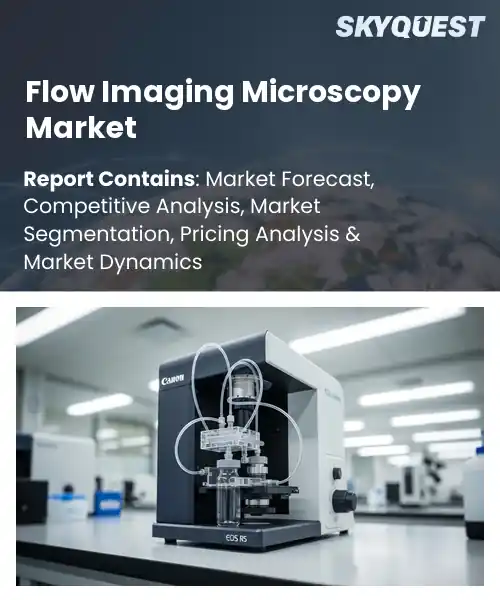
Flow Imaging Microscopy Market
Report ID: SQMIG35A3196
Report ID: SQMIG35A3196
[email protected]
USA +1 351-333-4748
Report ID:
SQMIG35A3196 |
Region:
Global |
Published Date: February, 2026
Pages:
177
|Tables:
94
|Figures:
67


Global Flow Imaging Microscopy Market size was valued at USD 44.8 Million in 2024 and is poised to grow from USD 47.98 Million in 2025 to USD 83.06 Million by 2033, growing at a CAGR of 7.1% during the forecast period (2026-2033).
Growing investments in biopharmaceutical research, increasing focus on biologics safety, stringent regulatory requirements, technological advancements in imaging systems, and expanding applications beyond pharmaceuticals are driving adoption of flow imaging microscopy.
Growing emphasis on biologics, vaccines, and injectable drug safety coupled with stricter quality assurance requirements is expected to primarily drive flow imaging microscopy market growth. Increasing adoption in pharmaceutical R&D, quality control laboratories, and CROs is boosting demand for detailed morphological particle analysis. Expansion of environmental monitoring, food safety testing, and materials science applications is further supporting adoption. Integration of advanced software, automation, and AI-driven analytics is enhancing usability and data accuracy, making flow imaging microscopy more attractive for high-throughput and complex analytical workflows. Rising demand for precise particle characterization in drug development and quality control is creating new business scope in the long run.
On the contrary, high capital and maintenance costs of advanced systems, complexity of data interpretation, shortage of skilled professionals, and competition from alternative particle analysis techniques are slated to impede flow imaging microscopy market penetration through 2033 and beyond.
How are Data Analytics and AI Augmenting Flow Imaging Microscopy Demand?
A major trend in the flow imaging microscopy market is the integration of artificial intelligence (AI) and advanced data analytics capabilities into imaging platforms. Modern FIM systems increasingly incorporate machine learning algorithms to automate particle classification, improve morphological analysis accuracy, and reduce user dependency on manual interpretation. AI-driven analytics enhances reproducibility, identifies subtle patterns, and accelerates data processing across high-throughput workflows. This trend responds to demand for more actionable insights and supports complex applications in biological development, quality control, and materials characterization. As software advances, the value of intelligent imaging solutions continues to grow, strengthening adoption across research and industrial labs.
Market snapshot - 2026-2033
Global Market Size
USD 45.09 Million
Largest Segment
Liquid Sample
Fastest Growth
Large Molecule
Growth Rate
7.9% CAGR
To get more insights on this market click here to Request a Free Sample Report
Global Flow Imaging Microscopy Market is segmented by Product Type, End User, Application, Technology, Sales Channel and region. Based on Product Type, the market is segmented into Standalone Systems and Integrated Systems. Based on End User, the market is segmented into Pharmaceuticals, Research Institutions and Biotechnology. Based on Application, the market is segmented into Cell Analysis, Particle Sizing and Quality Control. Based on Technology, the market is segmented into Image Analysis and Optical Techniques. Based on Sales Channel, the market is segmented into Direct Sales, Distributors and Online Sales. Based on region, the market is segmented into North America, Europe, Asia Pacific, Latin America and Middle East & Africa.
The dynamic image analysis segment is estimated to lead the global flow imaging microscopy market revenue generation over the coming years. High demand for this technique in pharmaceutical and biopharmaceutical applications is expected to bolster its high share going forward. Strong dynamic image analysis adoption across biologics development, injectable drugs, and environmental monitoring use cases is also bolstering the dominance of this technology.
On the other hand, the demand for combination systems is forecasted to increase at an impressive pace as per this flow imaging microscopy industry analysis. Increasing preference for all-in-one solutions in research, quality control, and regulatory testing environments is predicted to create new opportunities for companies focused on this segment.
The liquid sample segment is estimated to account for a major chunk of the global flow imaging microscopy market share in the future. Flow-based imaging enables high-throughput evaluation of particle size, shape, and concentration directly in liquid matrices, supporting quality control and regulatory compliance. Widespread use in formulation development, stability testing, and contamination monitoring ensures liquid samples remain in the most analyzed and dominant segment.
Meanwhile, the use of large molecule samples is slated to rise at a robust CAGR through 2033. Rising biologics pipelines, stringent regulatory scrutiny, and increased outsourcing of advanced analytical testing are accelerating adoption of flow imaging microscopy for large molecule characterization.
To get detailed segments analysis, Request a Free Sample Report
Early adoption of advanced analytical technologies and presence of established biopharmaceutical and biotechnology ecosystems help this region maintain its dominant stance. Rising investments in life sciences R&D, presence of top instrument manufacturers, and well-funded academic institutions are expected to boost flow imaging microscopy demand in North America. The presence of an advanced laboratory infrastructure in the region is also sustaining its dominance going forward.
The presence of leading pharmaceutical and biotechnology companies backed by robust R&D spending allows the country to lead flow imaging microscopy adoption in North America. Regulatory expectations from the U.S. Food and Drug Administration (FDA) are also boosting the demand for advanced flow imaging microscopy solutions in the United States. Integration of flow imaging microscopy and other analytical tools with AI is also expected to create new revenue generation potential for market players through 2033 and beyond.
Increase in demand for environmental monitoring and food safety testing are driving flow imaging microscopy adoption across Canada. Public-private collaborations and government innovation programs support R&D investments, creating new business scope for flow imaging microscopy companies. Use of flow imaging microscopy services to assess water quality and microplastic contamination in ecosystems is also rising in the country as emphasis on environmental conservation rises.
Increasing research investments and expanding pharmaceutical manufacturing are making Asia Pacific a highly rewarding region for flow imaging microscopy companies. Efforts of industries in countries such as China, India, Japan, and South Korea to meet global standards are prompting high demand for advanced analytics solutions. Growing number of CROs, outsourcing of drug development, and government backing for life sciences R&D are also expected to boost the demand for flow imaging microscopy services over the coming years.
Japan is influencing flow imaging microscopy demand across pharmaceutical, biotechnology, and advanced materials research sectors. The government’s “Society 5.0” initiative fosters adoption of digital technologies, AI, and automation in scientific instrumentation. Regulatory emphasis on rigorous particle analysis for formulation performance and safety in pharmaceutical and cosmetics industries is also creating a new business scope going forward.
High demand for precision analysis and innovation in biotechnology, pharmaceutical, and electronics sectors is shaping flow imaging microscopy adoption in the country. Government initiatives supporting the digital transformation are boosting demand for automated flow imaging microscopy tools in South Korea. Demand for flow imaging microscopy service from cosmetic and environmental testing applications is also expected to rise over the coming years. AI integration with flow imaging microscopy solutions is a popular trend in the country.
Robust regulatory emphasis on pharmaceutical quality and safety is forecasted to primarily shape flow imaging microscopy demand in this region. Rising investments in life sciences innovation, advanced academic research ecosystem, and widespread biologics development are ensuring steady demand for flow imaging microscopy services across all European countries in the long run. The presence of a mature laboratory infrastructure is estimated to make this a slower expanding market compared to Asia Pacific and North America.
High academic research activity and growing use of flow imaging microscopy in the pharmaceutical industry is slated to drive market development in the country. High demand for environmental monitoring and expanding materials science research in the country is also expected to create a new business scope. Universities and biotech firms in the United Kingdom are actively investing in advanced imaging tools for particle characterization in drug discovery and quality control processes.
Demand for flow imaging microscopy in France is slated to be backed by quality assurance disciplines and rising interest in biotechnology innovation. Government initiatives that support digital transformation and scientific innovation are also prompting investments in advanced flow imaging microscopy services. Collaborative research projects involving universities and industry players from around the world are also creating new opportunities.
Presence of robust pharmaceutical, biotechnology, and industrial research sectors are augmenting the adoption of flow imaging microscopy solutions in Germany. The country’s commitment to automation, precision engineering, and principles encourages integration of advanced imaging with automated workflows. Surge in demand for environmental monitoring strong presence of analytical instrument manufacturers are also making the country a hub for innovation in Europe.
To know more about the market opportunities by region and country, click here to
Buy The Complete Report
Stringent Regulatory and Quality Standards
Growing Industry–Academia Collaborations
Dearth of Skilled Professionals
Complexity of Data Interpretation
Request Free Customization of this report to help us to meet your business objectives.
Launching new and advanced flow imaging microscopy tools at affordable prices could help flow imaging microscopy companies expand their business scope in the future. Integration of smart technologies can also help flow imaging microscopy companies overcome their current challenges and stay competitive. Expansion of flow imaging microscopy application across new industry verticals is slated to be a key opportunity as per this flow imaging microscopy market analysis.
SkyQuest’s ABIRAW (Advanced Business Intelligence, Research & Analysis Wing) is our Business Information Services team that Collects, Collates, Correlates, and Analyses the Data collected by means of Primary Exploratory Research backed by robust Secondary Desk research.
As per SkyQuest analysis, rising investments in biopharmaceutical research and increasing need for detailed particle characterization in biologics and injectable drugs are anticipated to drive the demand for flow imaging microscopy going forward. However, high system costs, complexity of data interpretation, and competition from alternative particle analysis techniques are slated to slow down the adoption of flow imaging microscopy in the future. North America is slated to spearhead the demand for flow imaging microscopy owing to strong pharmaceutical R&D activity and the presence of advanced laboratory infrastructure. Integration of artificial intelligence, automation, and expansion into environmental and food testing applications are anticipated to be key trends driving the flow imaging microscopy sector through 2033.
| Report Metric | Details |
|---|---|
| Market size value in 2024 | USD 44.8 Million |
| Market size value in 2033 | USD 83.06 Million |
| Growth Rate | 7.1% |
| Base year | 2024 |
| Forecast period | 2026-2033 |
| Forecast Unit (Value) | USD Million |
| Segments covered |
|
| Regions covered | North America (US, Canada), Europe (Germany, France, United Kingdom, Italy, Spain, Rest of Europe), Asia Pacific (China, India, Japan, Rest of Asia-Pacific), Latin America (Brazil, Rest of Latin America), Middle East & Africa (South Africa, GCC Countries, Rest of MEA) |
| Companies covered |
|
| Customization scope | Free report customization with purchase. Customization includes:-
|
To get a free trial access to our platform which is a one stop solution for all your data requirements for quicker decision making. This platform allows you to compare markets, competitors who are prominent in the market, and mega trends that are influencing the dynamics in the market. Also, get access to detailed SkyQuest exclusive matrix.
Table Of Content
Executive Summary
Market overview
Parent Market Analysis
Market overview
Market size
KEY MARKET INSIGHTS
COVID IMPACT
MARKET DYNAMICS & OUTLOOK
Market Size by Region
KEY COMPANY PROFILES
Methodology
For the Flow Imaging Microscopy Market, our research methodology involved a mixture of primary and secondary data sources. Key steps involved in the research process are listed below:
1. Information Procurement: This stage involved the procurement of Market data or related information via primary and secondary sources. The various secondary sources used included various company websites, annual reports, trade databases, and paid databases such as Hoover's, Bloomberg Business, Factiva, and Avention. Our team did 45 primary interactions Globally which included several stakeholders such as manufacturers, customers, key opinion leaders, etc. Overall, information procurement was one of the most extensive stages in our research process.
2. Information Analysis: This step involved triangulation of data through bottom-up and top-down approaches to estimate and validate the total size and future estimate of the Flow Imaging Microscopy Market.
3. Report Formulation: The final step entailed the placement of data points in appropriate Market spaces in an attempt to deduce viable conclusions.
4. Validation & Publishing: Validation is the most important step in the process. Validation & re-validation via an intricately designed process helped us finalize data points to be used for final calculations. The final Market estimates and forecasts were then aligned and sent to our panel of industry experts for validation of data. Once the validation was done the report was sent to our Quality Assurance team to ensure adherence to style guides, consistency & design.
Analyst Support
Customization Options
With the given market data, our dedicated team of analysts can offer you the following customization options are available for the Flow Imaging Microscopy Market:
Product Analysis: Product matrix, which offers a detailed comparison of the product portfolio of companies.
Regional Analysis: Further analysis of the Flow Imaging Microscopy Market for additional countries.
Competitive Analysis: Detailed analysis and profiling of additional Market players & comparative analysis of competitive products.
Go to Market Strategy: Find the high-growth channels to invest your marketing efforts and increase your customer base.
Innovation Mapping: Identify racial solutions and innovation, connected to deep ecosystems of innovators, start-ups, academics, and strategic partners.
Category Intelligence: Customized intelligence that is relevant to their supply Markets will enable them to make smarter sourcing decisions and improve their category management.
Public Company Transcript Analysis: To improve the investment performance by generating new alpha and making better-informed decisions.
Social Media Listening: To analyze the conversations and trends happening not just around your brand, but around your industry as a whole, and use those insights to make better Marketing decisions.
REQUEST FOR SAMPLE
 REQUEST FREE CUSTOMIZATION
Global Flow Imaging Microscopy Market size was valued at USD 45.09 Million in 2025 and is poised to grow from USD 48.67 Million in 2026 to USD 82.86 Million by 2033, growing at a CAGR of 7.9% during the forecast period (2026-2033).
Launching new and advanced flow imaging microscopy tools at affordable prices could help flow imaging microscopy companies expand their business scope in the future. Integration of smart technologies can also help flow imaging microscopy companies overcome their current challenges and stay competitive. Expansion of flow imaging microscopy application across new industry verticals is slated to be a key opportunity as per this flow imaging microscopy market analysis. 'Bettersize Instruments', 'Bio-Techne', 'Anton Paar', 'Yokogawa Electric Corporation', 'Microtrac MRB', 'Micromeritics Instrument Corporation', 'Fritsch', 'Haver & Boecker', 'Spectris', 'HORIBA', 'Barco NV'
The imposition of stringent regulatory standards emphasizing quality across different sectors is slated to expand the adoption of flow imaging microscopy solutions. Traditional particle analysis techniques often lack detailed morphological insights, making flow imaging microscopy a preferred solution for compliance testing. Increasing emphasis on particulate contamination minimization and ensuring detailed documentation of particle profiles are also projected to boost investments in flow imaging microscopy solutions and services.
Expansion into Non-Traditional Industries: Surge in adoption of flow imaging microscopy across food and beverage, environmental sciences, cosmetics, and materials research sectors is creating new business scope. Materials scientists use FIM to characterize advanced particles, suspensions, and nanomaterials. The food industry is utilizing flow imaging microscopy to analyze emulsions, contaminants, and particulate properties. This cross-industry expansion is emerging as a prominent flow imaging microscopy industry trend across the study period and beyond.
Why is North America at the Forefront of Flow Imaging Microscopy Adoption?


Want to customize this report? This report can be personalized according to your needs. Our analysts and industry experts will work directly with you to understand your requirements and provide you with customized data in a short amount of time. We offer $1000 worth of FREE customization at the time of purchase.
Feedback From Our Clients


 USA (+1) 351-333-4748

