Flow Battery Market
Report ID: SQMIG20E2133
Report ID: SQMIG20E2133
[email protected]
USA +1 351-333-4748
Report ID:
SQMIG20E2133 |
Region:
Global |
Published Date: July, 2025
Pages:
197
|Tables:
148
|Figures:
78


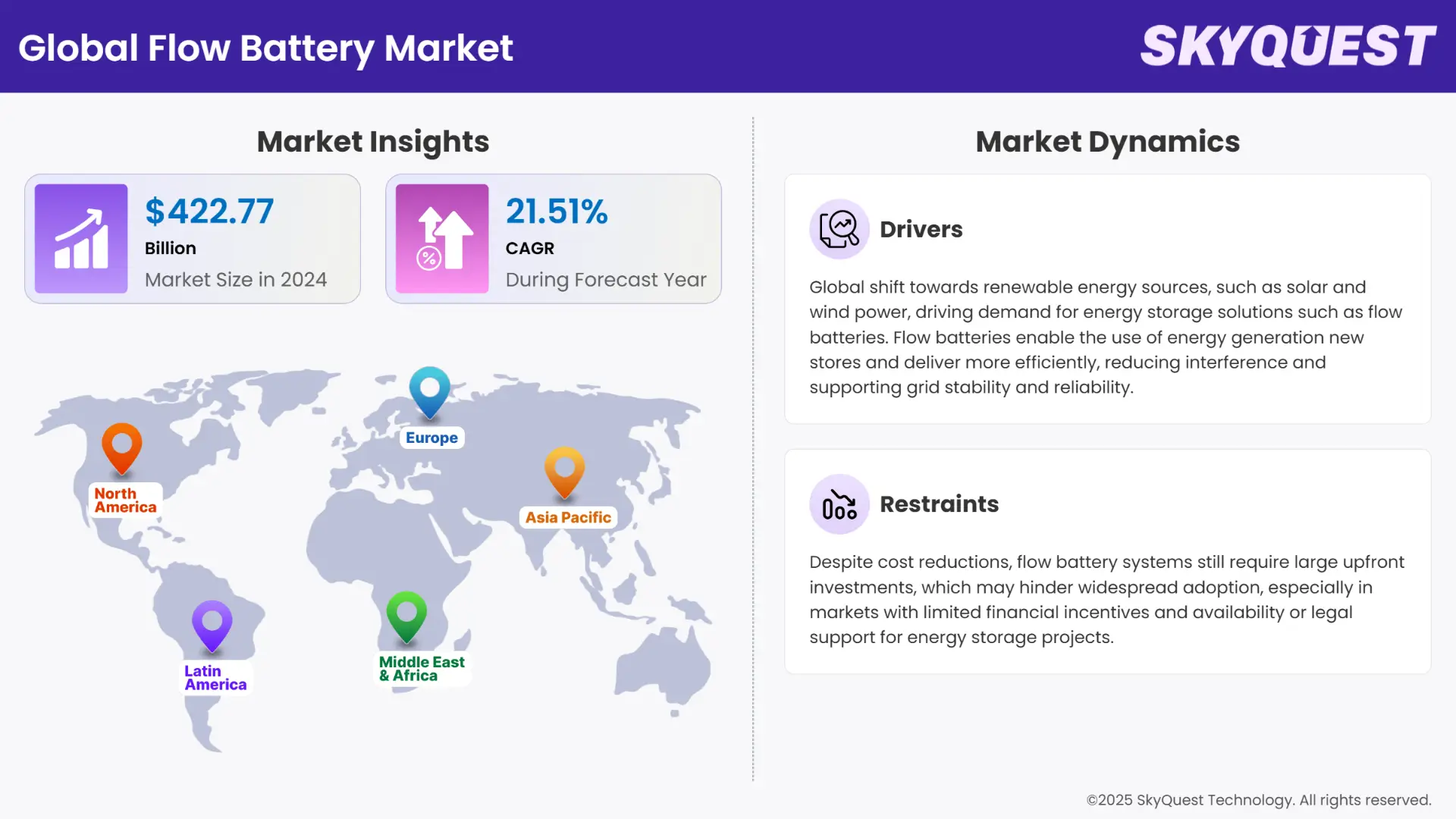
Global Flow Battery Market size was valued at USD 426.63 Million in 2024 and is poised to grow from USD 518.4 Million in 2025 to USD 2463.56 Million by 2033, growing at a CAGR of 21.51% during the forecast period (2026–2033).
Flow batteries are making inroads in the marketplace mainly due to a number of important key motivators. First, the global transition to renewable energy is accelerating particularly through solar and wind ventures that further increased demand for large scale (i.e., utility scale) long duration storage systems. Their design allows for a decoupling of a systems power and energy capacity, therefore, providing flexibility in smoothing intermittent generation and balancing supply and demand throughout the grid. Second, utilities and governments globally are investing heavily in grid modernization for energy resilience.
For example, the United States allocated more than $850 million in funding toward storage upgrades in 2023, with major growth occurring in Asia Pacific (47.7% of annual installations in 2023). Third, flow batteries provide long cycle life (up to 20,000 cycles), low degradation and a non-flammable electrolyte which improved safety and longevity in offering an advantage from using lithium-ion systems.
On the restraint side, there are very significant challenges. Leading the way is the high up-front capital cost; flow systems remain 25–30 % more costly per kWh than lithium-ion, and consequently the longer payback periods (~10 years) will deter many potential adopters. In addition, supply and chain constraints; for many flow systems, the reliance on vanadium can be an issue, considering 60–66% of production is concentrated in China and Russia, this concentration exposes the market to price volatility as well as geopolitical risk; for example, 2023 price increases due to disruptions in supply chain saw an increase in vatadiam electrolyte costs equal to ~17%. In addition, there are technical complexity issues; there are inefficiencies (i.e., lower energy density), auxiliary components (e.g. pumps, membranes) are complex problems within their own right.
With increased demand for clean, reliable energy, flow batteries are ready to step into the spotlight of grid-scale and renewables integration. However, if flow batteries are to see meaningful deployment three things must occur: scaling the costs down, diversifying the supply chain, and improving standards and energy density. While slowing down on the side addressment issues will be important in moving flow battery technology from a niche pilot to a widely used energy infrastructure.
AI is transforming the flow battery industry design, efficiency, and operational aspects through intelligent algorithms. Machine learning models are now being used to develop optimal electrolyte chemistries, optimize electrode geometries, and optimal stack configurations all at a cadence that is much faster than lab work. Furthermore, AI powered control systems and real-time analytics optimize charge-discharge cycles, create predictive maintenance schedules for long-term operation viability and greatly prolong life of installed systems and reduce whole-life costs.
In a recent development, Finland-based Capalo AI received a challenging milestone of raising a $4.1 million seed round in March 2025 to deploy AI powered "virtual power plants". Capalo’s platform uses renewable generation and demand forecasting to schedule flow battery operations to maximize revenue for their clients while ensuring grid stability. This is all highly impressive as it demonstrates how AI is evolving flow batteries from a static source of energy storage into a dynamic participant in a grid, advancing value and potentially deployment opportunities.
To get more insights on this market click here to Request a Free Sample Report
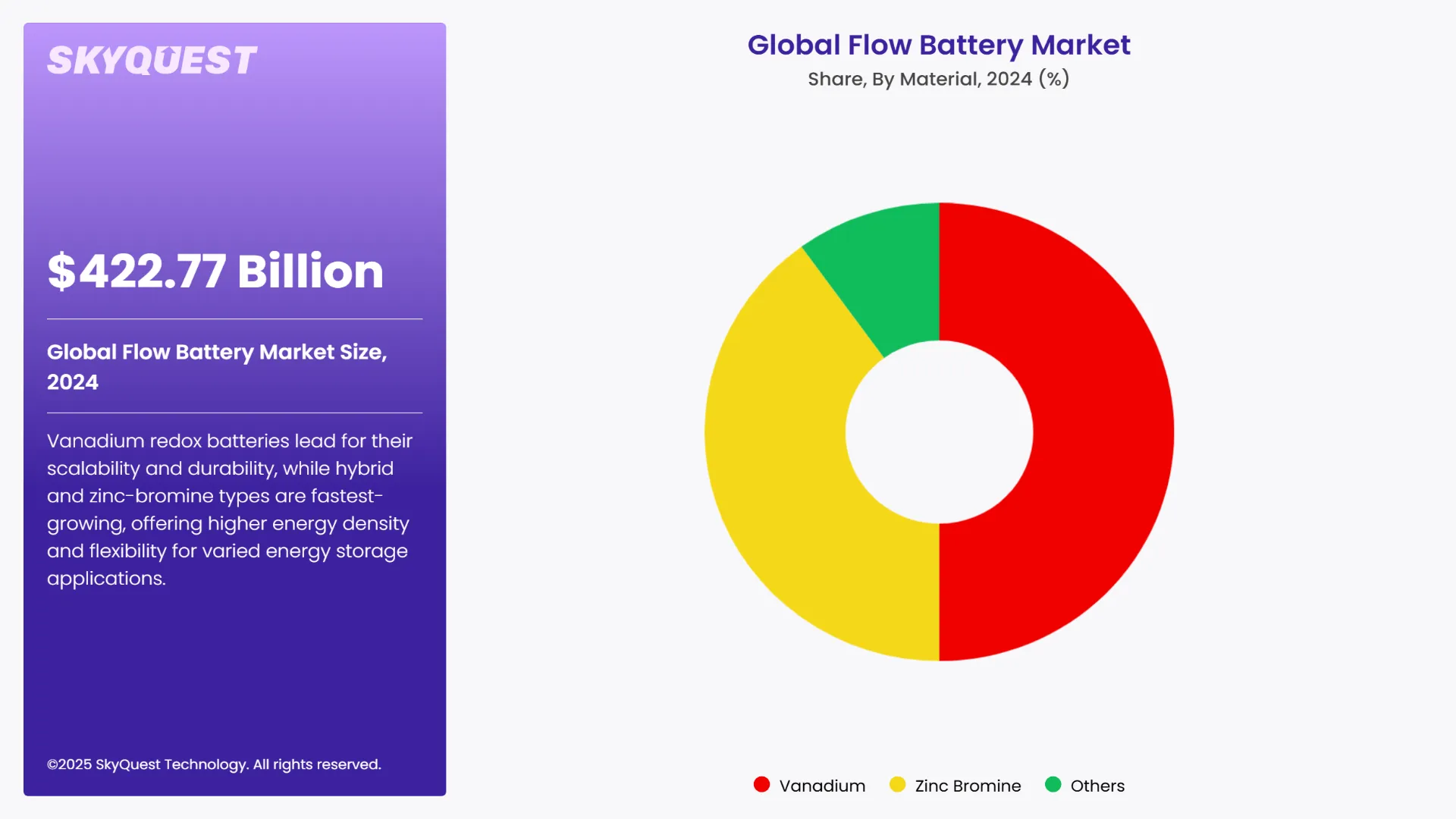
Global Flow Battery Market is segmented by Battery Type, Material, Ownership, Storage, Application and region. Based on Battery Type, the market is segmented into Redox and Hybrid. Based on Material, the market is segmented into Vanadium, Zinc Bromine and Others. Based on Ownership, the market is segmented into Customer owned, Third-party owned and Utility owned. Based on Storage, the market is segmented into Small-scale and Large-scale. Based on Application, the market is segmented into Utilities, Commercial & Industrial, EV Charging Stations and Other Applications. Based on region, the market is segmented into North America, Europe, Asia Pacific, Latin America and Middle East & Africa.
Redox-flow batteries, such as vanadium redox-flow batteries (VRFBs), offer scalable energy storage solutions suitable for a wide range of applications, from residential and commercial energy storage to grid-scale deployment. The construction allows flexible power expansion to meet evolving energy storage needs. The RFB is known for its long cycle life and durability, making it ideal for applications that require frequent charge and discharge cycles over long periods of time.
Hybrid is the fastest growing segment in the market. Flow batteries combine the advantages of different chemicals such as zinc-bromine, vanadium, and organic electrolytes for improved performance and energy levels. Using the complementary properties of many electrolytes, hybrid flow batteries provide improved performance, energy density and energy storage. Hybrid flow batteries offer great flexibility and practicality in meeting a variety of energy storage needs in many industries and applications. Their ability to generate robust energy density, operating capacity and cycle life based on specific application data makes them ideally suited for both stationary and mobile energy storage applications.
Vanadium redox flow battery is predicted to dominate the global market over the forecast period. This is attributed to the growth in demand for vanadium redox go with the flow batteries (VRFB), specifically within the mini-grid, off-grid, and utility markets. Several groups round the arena are concerned in hastily commercializing vanadium redox drift batteries, to cater to the growing demand.
Zinc bromine flow battery is the fastest segment in the market. The zinc bromine flow battery segment plays an important role in the flow battery market, offering unique advantages and services compared to other types of flow batteries. Zinc bromine is known for relatively high energy as compared to other flow battery brands. This makes them ideally suited for applications that require long-term energy storage, such as grid-level energy storage for renewable energy integration, load switching and energy storage.
To get detailed segments analysis, Request a Free Sample Report
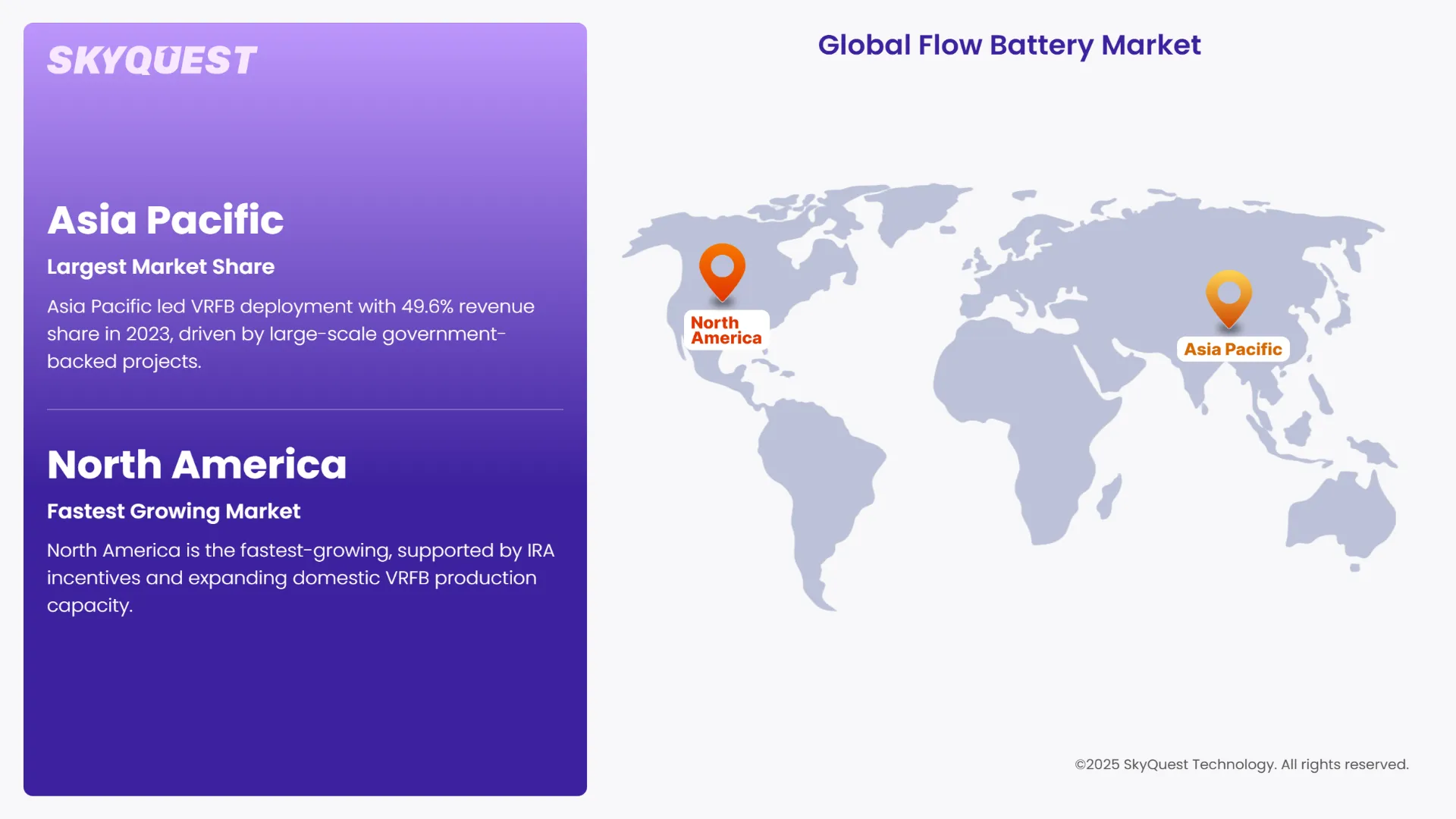
Asia Pacific leads in VRFB deployment with around 49.6% of global revenue share in 2023. Governmentbacked pilot projects are expanding everywhere—from China’s 100 MW/400 MWh Dalian installation under the 14th FiveYear Plan to Japan's Sumitomo Electric facility supporting wind and solar storage.
China Flow Battery Market
Rongke Power, backed by state utilities and controlling 68% of China’s vanadium production, leads APAC VRFB with 500 MWh+ deployments and the 175 MW/700 MWh Dalian plant. Guided by government renewables mandates, provincial pilots further anchor its dominance.
India Flow Battery Market
Delectrik Systems (with Rays Power Infra) won an NTPC tender to deploy a 3 MWh VRFB at the NETRA microgrid in Greater Noida, scheduled for H1 2025. This reflects India’s National Electricity Plan, projecting a need for 411 GWh stationary BESS by 2032—showing early government confidence in flow battery tech.
South Korea Flow Battery Market
H2, Inc. is expanding: its existing 330 MWh K1 VRFB plant will scale to 1.2 GWh capacity by 2026 with ~$16M bridge financing. Additionally, AVESS Energy is setting up a 500tonne vanadium electrolyte plant in Pohang in collaboration with local government highlighting strong public private alignment.
North America generated USD 118.8 million in VRFB revenues in 2023 and is projected to reach USD 429.3 million by 2030. U.S. authorities, via the Inflation Reduction Act’s 48C tax credit, now support vanadium electrolyte production spurring construction of domestic production plants in Michigan and Texas. A Largo/Stryten JV is also preparing to boost North American VRFB manufacturing.
U.S. Flow Battery Market
Largo Clean Energy and Stryten formed a JV to boost U.S. VRFB electrolyte production and domestic supply—leveraging IRA incentives and Maracás mine feedstock. Sumitomo Electric is investing US $7.6 million to scale and install VRFB systems (2 MW/8 MWh and microgrid) under U.S. clean-energy policies.
Canada Flow Battery Market
Electrochem Technologies in Quebec operates a commercial VRFB electrolyte plant (100–685 L/day), with plans to expand to 1,000 L/day—leveraging low-cost hydro power and skilled workforce.
Europe is actively deploying VRFBs under the EU Net‑Zero Industry Act. Germany has pledged €200 million in 2023 for VRFB component production, leading to a 62% surge in vanadium electrolyte orders in Q1 2024. The “Storage for Grid Stability” initiative targets 2 GW by 2030, demonstrated by grid‑scale pilots like the Schwarze Pumpe hybrid system.
Germany Flow Battery Market
VoltStorage received €30 M EIB-backed venture debt for commercial and agricultural VRFB/iron-salt systems, boosting R&D and market rollout. AMG is building a 6,000 m³ vanadium electrolyte plant in Nuremberg, enhancing domestic supply with government-backed capital.
France Flow Battery Market
Sivens stands at the forefront of France’s VRFB market, delivering modular, long-duration systems for industrial and utility use. Backed by EU NetZero Act co-funding, they deployed a 100 kW/300 kWh system in Grenoble in 2024, supported by French Ministry of Ecological Transition grants—boosting local green grid integration.
UK Flow Battery Market
Invinity leads in UK VRFBs, secured DESNZ grants (~£7–11 M) for 20–30 MWh projects in Southeast England colocated with solar, starting operations in 2026. Its modular VS3 units and government funding reflects strong public commitment to long-duration storage.
To know more about the market opportunities by region and country, click here to
Buy The Complete Report
Renewable Energy Integration:
Grid Modernization Programs:
Initial Capital Costs:
Technical Challenges:
Request Free Customization of this report to help us to meet your business objectives.
The market is characterized by new start-ups and collaboration between industry and research institutes to meet the need. Some of the leading players at the forefront in the global redox flow battery market include StorEn Technologies Inc., Avalon Battery Corporation, HydraRedox, Storion Energy, Vionx Energy, H2, Inc., Le System Co., Ltd., Sumitomo Electric Industries, Ltd., redT Energy Plc, and Dalian Rongke Power Co., Ltd.
China's historical 14th Five Year Plan has allocated funding for 5 GW of flow battery installations by 2025 , while the U.S. Inflation Reduction Act provides a 30% investment tax credit for energy storage, improving project costs and economics.
The Queensland Australia state government allocated ~US 15.4 M to regional iron flow battery and zinc projects, plus an additional A$3 M to growLewis electrolyte production, creating new domestic supply chains and jobs.
SkyQuest’s ABIRAW (Advanced Business Intelligence, Research & Analysis Wing) is our Business Information Services team that Collects, Collates, Correlates, and Analyses the Data collected using Primary Exploratory Research backed by robust Secondary Desk research.
The global flow battery market is driven by factors such as renewable energy integration, grid modernization efforts, and technological advancements. Key trends include the increasing adoption of vanadium redox flow batteries (VRFB) for energy storage applications in utility. Despite driving factors such as renewable energy integration and grid modernization, challenges related to high start-up costs and technological limitations restrain the market growth edge. In a competitive environment, there are established players and new start-ups focused on product development and strategic partnerships. North America and Asia Pacific provide opportunities for growth and innovation in the flow battery segment of the energy storage market, playing a key role in driving the market expansion.
| Report Metric | Details |
|---|---|
| Market size value in 2024 | USD 426.63 Million |
| Market size value in 2033 | USD 2463.56 Million |
| Growth Rate | 21.51% |
| Base year | 2024 |
| Forecast period | 2026-2033 |
| Forecast Unit (Value) | USD Million |
| Segments covered |
|
| Regions covered | North America (US, Canada), Europe (Germany, France, United Kingdom, Italy, Spain, Rest of Europe), Asia Pacific (China, India, Japan, Rest of Asia-Pacific), Latin America (Brazil, Rest of Latin America), Middle East & Africa (South Africa, GCC Countries, Rest of MEA) |
| Companies covered |
|
| Customization scope | Free report customization with purchase. Customization includes:-
|
To get a free trial access to our platform which is a one stop solution for all your data requirements for quicker decision making. This platform allows you to compare markets, competitors who are prominent in the market, and mega trends that are influencing the dynamics in the market. Also, get access to detailed SkyQuest exclusive matrix.
Table Of Content
Executive Summary
Market overview
Parent Market Analysis
Market overview
Market size
KEY MARKET INSIGHTS
COVID IMPACT
MARKET DYNAMICS & OUTLOOK
Market Size by Region
KEY COMPANY PROFILES
Methodology
For the Flow Battery Market, our research methodology involved a mixture of primary and secondary data sources. Key steps involved in the research process are listed below:
1. Information Procurement: This stage involved the procurement of Market data or related information via primary and secondary sources. The various secondary sources used included various company websites, annual reports, trade databases, and paid databases such as Hoover's, Bloomberg Business, Factiva, and Avention. Our team did 45 primary interactions Globally which included several stakeholders such as manufacturers, customers, key opinion leaders, etc. Overall, information procurement was one of the most extensive stages in our research process.
2. Information Analysis: This step involved triangulation of data through bottom-up and top-down approaches to estimate and validate the total size and future estimate of the Flow Battery Market.
3. Report Formulation: The final step entailed the placement of data points in appropriate Market spaces in an attempt to deduce viable conclusions.
4. Validation & Publishing: Validation is the most important step in the process. Validation & re-validation via an intricately designed process helped us finalize data points to be used for final calculations. The final Market estimates and forecasts were then aligned and sent to our panel of industry experts for validation of data. Once the validation was done the report was sent to our Quality Assurance team to ensure adherence to style guides, consistency & design.
Analyst Support
Customization Options
With the given market data, our dedicated team of analysts can offer you the following customization options are available for the Flow Battery Market:
Product Analysis: Product matrix, which offers a detailed comparison of the product portfolio of companies.
Regional Analysis: Further analysis of the Flow Battery Market for additional countries.
Competitive Analysis: Detailed analysis and profiling of additional Market players & comparative analysis of competitive products.
Go to Market Strategy: Find the high-growth channels to invest your marketing efforts and increase your customer base.
Innovation Mapping: Identify racial solutions and innovation, connected to deep ecosystems of innovators, start-ups, academics, and strategic partners.
Category Intelligence: Customized intelligence that is relevant to their supply Markets will enable them to make smarter sourcing decisions and improve their category management.
Public Company Transcript Analysis: To improve the investment performance by generating new alpha and making better-informed decisions.
Social Media Listening: To analyze the conversations and trends happening not just around your brand, but around your industry as a whole, and use those insights to make better Marketing decisions.
REQUEST FOR SAMPLE
 REQUEST FREE CUSTOMIZATION
Between 2025 and 2032, the flow battery market is forecast to grow by 21.8% CAGR, propelled by the integrations of renewable energy platforms and demand for long-duration energy storage in utility and industrial applications.
AI can enhance the efficiency of flow batteries by optimizing factors like electrolyte chemistry, geometry of electrodes, and stack design configurations to maximize energy density potentials of the technologies. Also, AI can provide predictive maintenance, interoperability platforms, and real-time charge-discharge, to generate less downtime, and reduce operational cost throughout overall lifetime of the battery.
The main materials of flow batteries are vanadium and zinc-bromine. The benefits of vanadium batteries are longer cycle life, tremendous safety for long-term storage applications, while zinc-bromine batteries have higher energy densities and are still preferred for grid-scale or long-duration energy storage application.
Flow batteries support EV charging stations and microgrids, by supporting stable long-duration storage potential for continuous energy supply for use in these types of applications. Latent DC charging supports these processes while easily managing expected load shifts and allow for us to balance supply-demand in decentralized energy systems by decoupling the power and energy capacity.
Flow batteries are an ideal energy storage solution for long-duration storage, as they have a very high cycle life (up to 20,000 cycles), are non-flammable due to the liquid electrolyte, and have truly scalable energy capacity to enable grid stability and work with intermittent renewable sources, like wind and solar.
Flow batteries carry a much higher safety rating, due to being able to use non-flammable electrolytes and possess a considerably longer life span, but they also incur a 25-30% higher cost ($/kWh) than lithium-ion batteries — resulting in a longer payback period and a certain rate of adoption.
Utilities (for grid support) and EV charging stations are the fastest growing sectors driven for either modernization of electrical grids or supporting renewable generation. Specifically, flow batteries are able to support integration of solar and wind generation into the grid. Hybrid flow batteries have also started to grow rapidly since they provide a better performance while allowing for longer operational lifetimes.
Hybrid flow batteries are a combination of multiple electrolyte chemistries which provide improved performance, energy density, and cycle life. Hybrid flow batteries can be used in numerous applications ranging from stationary grid systems to AEM polymer batteries for mobile storage systems as they integrate into emerging complex energy landscapes.
The National Electricity Plan promotes the need for 411 GWh of stationary storage by 2032, which created a favorable environment for early flow battery use. For example, Delectrik recently began work on an NTPC-backed 3 MWh VRFB project to be used in an NETRA microgrid to be deployed in Greater Noida.
AI-based models are able to substantially decrease the amount of time to develop formulas of optimal electrolyte by rapidly analyzing data sets that are far larger than any typical lab study. The overall goal is to have better battery properties, lower costs and increase the commercialization of flow batteries so they can be practically utilized.
AI-managed virtual power plants used by companies such as Mixed Energy, utilize distributed energy resources including flow batteries and can charge and discharge them according to the optimization protocols briefed earlier.


Want to customize this report? This report can be personalized according to your needs. Our analysts and industry experts will work directly with you to understand your requirements and provide you with customized data in a short amount of time. We offer $1000 worth of FREE customization at the time of purchase.
Feedback From Our Clients


 USA (+1) 351-333-4748

