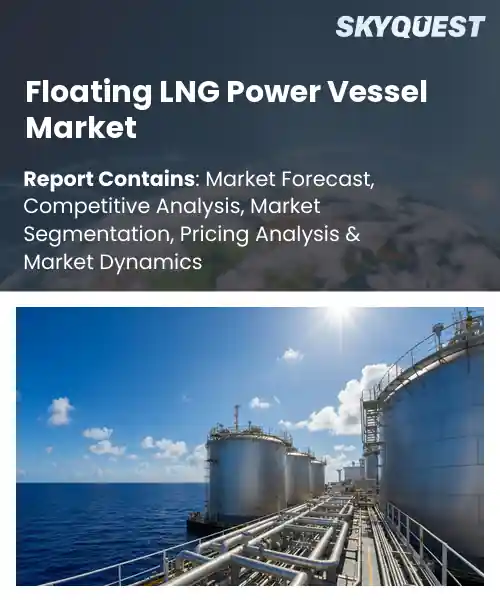
Floating LNG Power Vessel Market
Report ID: SQMIG10B2149
Report ID: SQMIG10B2149
[email protected]
USA +1 351-333-4748
Report ID:
SQMIG10B2149 |
Region:
Global |
Published Date: February, 2026
Pages:
192
|Tables:
88
|Figures:
69


Global Floating LNG Power Vessel Market size was valued at USD 791.2 Million in 2024 and is poised to grow from USD 819.68 Million in 2025 to USD 1087.74 Million by 2033, growing at a CAGR of 3.6% during the forecast period (2026-2033).
The global floating LNG power vessel market growth is driven by global initiatives to decarbonize as well as harsher environmental legislation. Besides, the increasing urgency for electricity compels a country to look for lower-carbon energy sources; that phenomenon is developing within offshore projects and new lands, as opposed to fossil fuels, which yield LNG-powered vessels that allow for distributions with much less CO₂, sulfur oxide, and particle emissions, as well as enhanced freedoms and flexibility in movement.
Floating LNG-powered vessels offer a very attractive and feasible solution toward building a sustainable and scalable energy infrastructure. Among these, speedy deployment potential that can serve otherwise isolated coastal or off-grid areas makes such an alternative electricity source attractive. Importantly, floating LNG vessels also combine well with a country's climate goals.
Moreover, offshore solutions ideally fuel the impetus for growth of the floating LNG power vessel industry. For those involving deep waters and distant seas, they provide scalable, reliable power. Hence, they eliminate the requirement to build comprehensive, costly investments in onshore infrastructure, which enhances the safe, speedy, and economic deployment of energy solutions. It best favors least developed regions, isolated coastal communities, and offshore oil and gas sites directly without significant land pipelines. This promotes the electrification of even the mostly relatively harsh seas and creates flexibility in the supply chain. Yet, equally, one of the most significant aspects of spurring the market is appropriate for offshore applications, which in turn supports global energy transition schemes.
Why Is Automation Becoming Essential in Modern Clinical Laboratories?
The global floating LNG power vessel market outlook is reconstructed on the basis of digitalization and remote monitoring enhancements. These enhancements enable the diagnosis of remote problem status, predictive maintenance abilities, and real-time performance recording. The IoT sensors, AI-based analytics, and digital twin technologies are all executing this action. From shore-controlled centers, operators nowadays can monitor critical equipment, optimize fuel consumption, and mitigate unplanned equipment downtimes.
Research on the cooperation between MOL and DSME is now afoot. The firms are jointly developing a smartship solution for FSRU operation, which comprises remote monitoring and digital twin technologies. The intention is to enhance the efficiency and safety of every offshore LNG power plant. This would probably enhance operational excellence and diminish expenditures.
Market snapshot - 2026-2033
Global Market Size
USD 1,043.83 Million
Largest Segment
Power Barge
Fastest Growth
Power Ship
Growth Rate
4.21% CAGR
To get more insights on this market click here to Request a Free Sample Report
Global Floating LNG Power Vessel Market is segmented by Vessel Type, Power Generation Type, Power Generation System, Power Output, End Use, Power Distribution System and region. Based on Vessel Type, the market is segmented into Floating Power Unit, Floating Storage Unit and Floating Storage Regasification Unit. Based on Power Generation Type, the market is segmented into Power Barge and Power Ship. Based on Power Generation System, the market is segmented into Gas Turbine & IC Engine and Steam Turbine & Generator. Based on Power Output, the market is segmented into Small Scale, Medium Scale and Large Scale. Based on End Use, the market is segmented into Power Generation, Desalination and Gas Processing. Based on Power Distribution System, the market is segmented into Transformer and Switchboard. Based on region, the market is segmented into North America, Europe, Asia Pacific, Latin America and Middle East & Africa.
As per the 2025 floating LNG power vessel market analysis, the power barge category constituted almost 56.76% of share. Their utility for areas affected by power deficits or lacking onshore infrastructure has contributed toward their attractiveness. The civil engineering requirements for these vessels are less demanding, with advantages including ease of transportation, anchoring, and grid connection.
With a CAGR of 4.66%, the power ship segment is expected to grow during the projection period. One crucial growth driver is the ability of power ships to connect to existing electrical grids, thus helping energy peak demands and limiting chances of blackout. Power ships represent a fast-growing industry because of their increased scalability and flexibility, especially in demanding operational circumstances.
As per the 2025 floating LNG power vessel market forecast, the power generation system had the biggest share of the market. Its main task was to convert LNG into stable electrical power offshore and in remote coastal areas. This category includes combined-cycle generators and high-efficiency gas turbines all designed to comply with grid requirements. Wison's floating LNG power plants further dominate this market by deploying power generation modules to supply electricity to remote and island networks.
On the other hand, the auxiliary systems segment is expected to have the highest floating LNG power vessel market share. Navy vessels are presently incorporating advanced support systems—automation, emission control, cooling, safety, and others, so they can become more efficient and respect regulations. The integration of such cutting-edge auxiliary systems positively affects the performance and dependability of floating LNG power boats. Therefore, this is expected to encourage further growth and investments in this subsegment during the forecast period.
To get detailed segments analysis, Request a Free Sample Report
As per the floating LNG power vessel market regional forecast, with almost 44% of the market is dominated by Asia-Pacific as it drives rapid coastal electrification and industrial development along with the increasing energy demands in China, India, and Southeast Asia. This increases the contact for flexible ships operating on LNG fuel because of the enormous savings realized from expensive onshore power plants for supplemental generation. Stimulus further includes a fast and flexible installation and transfer between islands or offshore systems. More investment for LNG import capacity and grid assistance through floating solutions will improve reliability and meet peak load requirements.
China is the main country in Asia-Pacific with considerable conversion into cleaner fuel sources and major construction of LNG infrastructure because of the high coastal energy demand. This high demand for LNG has improved the resilience of the grid across its port and industrial areas while providing flexible offshore power solutions. Thus, by supporting floating LNG developments, China's commitment continues to progress in moving away from coal and diversifying energy sources to achieve national clean energy goals with the floating power system.
Japan's energy policy emphasizes LNG-based solutions, including floating LNG vessels for coastal and island systems, to partly alleviate insufficient domestic fuel supplies and ensure stable electricity provision. Floating LNG power vessels will boost system flexibility and security due to the country's heavy electricity consumption and environmental commitments. Investments in advanced maritime LNG projects and port electrification initiatives would deteriorate emissions and enhance grid reliability thereby securing Japan's place as a significant regional player in floating LNG power applications.
Floating LNG power vessels account for 12% of the total market in North America, with the United States showing the highest activity in this respect. The strong LNG infrastructure in the region and the need for a robust grid, particularly in coastal areas of the region, make a compelling case for flexible LNG power options in managing peak and emergency demands. Utilities, as they re-tool their energy portfolios, now consider floating with LNG tankers for strengthening energy security, backup power, and compliance with environmental norms.
Unlike many other nations, the United States by virtue of its extensive networks for LNG and drive for grid reliability, particularly in view of rapidly rising energy requirements along the coast, leads in North America in floating LNG power vessels. Utility companies are investigating floating LNG power tankers as an alternative means of supplementing generation during peak and outage periods. Modern maritime power systems will be integrated with environmental requirements to deliver cleaner, more flexible power sources while supporting grid transition strategies beyond traditional land-based plants.
The increasing infrastructure of LNG and the growing need to provide flexible and cleaner generation sources adapted to remote, coastal, and industrial demands constitute the primary drivers for enhanced activity in the floating LNG power vessel industry within Canada. The investments made towards emphasizing LNG and other renewable fuels in this country toward the environment objectives encourage using offshore power vessels that can help augment grid capacity where limitations exist as a land-based option. These solutions will thus be used in balancing power demands while pollution and infrastructure limitations are reduced.
Europe has a very important market share in the floating LNG power vessel industry because of its need for coastal grid stabilization due to an expanded LNG infrastructure and energy security diversification. Floating power solutions are being evaluated in several countries to manage supply unpredictability and aging assets. Vessel design and integration will continue to be pressed by stringent environmental requirements, along with demand in the market for more versatile solutions, using LNG to help transition from high-carbon generation and increasingly strengthen electrical resilience throughout the Mediterranean and northern coastal stretches.
The floating LNG power vessel market is quickly growing in the country because of developed LNG infrastructure in the UK and efforts towards energy diversification. The floating power solutions will reduce dependence on variable renewables whilst complementing power supply flexibility in their quest for cleaner energy. UK utilities and marine partners explore offshore LNG-based power generation boost to national energy security as well as carbon reduction goals. This would support grid stability and disaster preparedness.
As part of its wider energy transition ambitions, which explicitly point to LNG being a cleaner alternative to dirtier fossil fuels, France is investigating the floating LNG power vessel market. These provide flexible, LNG-powered marine solutions to the offshore and coastal regions of the country. These are especially useful in the absence of conventional power infrastructure because they assist local power grids. To keep floating LNG in the public eye, France's continuous commitments for emission cuts and energy security would also include rigorous thrusts in public energy advocacy. The systems support renewable energy sources to generate reliable electricity within strategic locations.
Germany is actively active in the industry of floating LNG power vessels driven by the need for diversifying energy imports and at the same time reinforcing the resilience of its power system. A planned development is that of an LNG terminal in Wilhelmshaven, which will serve as a testimony underlining the country's emphasis with respect to adaptable LNG infrastructure. Floating power vessels within the broader context of the LNG environment are still uncommon but are quickly gaining popularity. Maritime power solutions can be expected to provide chances in the long term in line with Germany's emphasis on energy security and decreasing dependency on pipeline gas.
To know more about the market opportunities by region and country, click here to
Buy The Complete Report
Growing Global Energy Demand and Electrification Needs
Environmental Regulations and Cleaner Fuel Policies
High Initial and Operational Costs
Competing Renewable Energy Sources
Request Free Customization of this report to help us to meet your business objectives.
Th global floating LNG power vessel market is of moderate competition, being driven by major ship builders, energy companies, and offshore engineering companies, all of which are enthused by venture and innovation. Most industry players employ advanced design capabilities, strategic partnerships, and technological integration to win contracts across the globe. The key competitive advantage is derived from the fact that the systems are integrated for storage, regasification, and power generation, and also have digital/remote operations capabilities, all coupled to maximize performance. Growing regional alliances with fleet builds increasingly add value toward capturing market share and effectively responding to demand for flexible and sustainable means of offshore electricity generation.
SkyQuest’s ABIRAW (Advanced Business Intelligence, Research & Analysis Wing) is our Business Information Services team that Collects, Collates, Correlates, and Analyses the Data collected by means of Primary Exploratory Research backed by robust Secondary Desk research.
As per SkyQuest analysis, the global floating LNG power vessel market will witness moderate growth, which is likely to continue. The growth is being driven by the increasing global demand for electricity and energy security, combined with the differences in environmental performance that LNG provides as compared to conventional fossil fuels. With technological advancements especially in digitalization and modular power solutions, vessel efficiency, operational safety, and overall performance during their entire life cycle can be enhanced. However, this industry is faced with challenges such as high capital costs and competition from renewable sources. Mitsui O.S.K. Lines, MODEC, Karpowership, Wison Group, Wärtsilä, and Siemens are among the key market players currently in control of market evolution via strategic partnerships, fleet expansions, and integrated power generation solutions for both offshore and coastal energy demands. Hence, as the energy sector continues to change, floating LNG power vessels will remain pertinent to flexible, cleaner offshore power generation.
| Report Metric | Details |
|---|---|
| Market size value in 2024 | USD 791.2 Million |
| Market size value in 2033 | USD 1087.74 Million |
| Growth Rate | 3.6% |
| Base year | 2024 |
| Forecast period | 2026-2033 |
| Forecast Unit (Value) | USD Million |
| Segments covered |
|
| Regions covered | North America (US, Canada), Europe (Germany, France, United Kingdom, Italy, Spain, Rest of Europe), Asia Pacific (China, India, Japan, Rest of Asia-Pacific), Latin America (Brazil, Rest of Latin America), Middle East & Africa (South Africa, GCC Countries, Rest of MEA) |
| Companies covered |
|
| Customization scope | Free report customization with purchase. Customization includes:-
|
To get a free trial access to our platform which is a one stop solution for all your data requirements for quicker decision making. This platform allows you to compare markets, competitors who are prominent in the market, and mega trends that are influencing the dynamics in the market. Also, get access to detailed SkyQuest exclusive matrix.
Table Of Content
Executive Summary
Market overview
Parent Market Analysis
Market overview
Market size
KEY MARKET INSIGHTS
COVID IMPACT
MARKET DYNAMICS & OUTLOOK
Market Size by Region
KEY COMPANY PROFILES
Methodology
For the Floating LNG Power Vessel Market, our research methodology involved a mixture of primary and secondary data sources. Key steps involved in the research process are listed below:
1. Information Procurement: This stage involved the procurement of Market data or related information via primary and secondary sources. The various secondary sources used included various company websites, annual reports, trade databases, and paid databases such as Hoover's, Bloomberg Business, Factiva, and Avention. Our team did 45 primary interactions Globally which included several stakeholders such as manufacturers, customers, key opinion leaders, etc. Overall, information procurement was one of the most extensive stages in our research process.
2. Information Analysis: This step involved triangulation of data through bottom-up and top-down approaches to estimate and validate the total size and future estimate of the Floating LNG Power Vessel Market.
3. Report Formulation: The final step entailed the placement of data points in appropriate Market spaces in an attempt to deduce viable conclusions.
4. Validation & Publishing: Validation is the most important step in the process. Validation & re-validation via an intricately designed process helped us finalize data points to be used for final calculations. The final Market estimates and forecasts were then aligned and sent to our panel of industry experts for validation of data. Once the validation was done the report was sent to our Quality Assurance team to ensure adherence to style guides, consistency & design.
Analyst Support
Customization Options
With the given market data, our dedicated team of analysts can offer you the following customization options are available for the Floating LNG Power Vessel Market:
Product Analysis: Product matrix, which offers a detailed comparison of the product portfolio of companies.
Regional Analysis: Further analysis of the Floating LNG Power Vessel Market for additional countries.
Competitive Analysis: Detailed analysis and profiling of additional Market players & comparative analysis of competitive products.
Go to Market Strategy: Find the high-growth channels to invest your marketing efforts and increase your customer base.
Innovation Mapping: Identify racial solutions and innovation, connected to deep ecosystems of innovators, start-ups, academics, and strategic partners.
Category Intelligence: Customized intelligence that is relevant to their supply Markets will enable them to make smarter sourcing decisions and improve their category management.
Public Company Transcript Analysis: To improve the investment performance by generating new alpha and making better-informed decisions.
Social Media Listening: To analyze the conversations and trends happening not just around your brand, but around your industry as a whole, and use those insights to make better Marketing decisions.
REQUEST FOR SAMPLE
 REQUEST FREE CUSTOMIZATION
Global Floating LNG Power Vessel Market size was valued at USD 1,043.83 Million in 2025 and is poised to grow from USD 1,087.78 Million in 2026 to USD 1,451.79 Million by 2033, growing at a CAGR of 4.21% during the forecast period (2026-2033).
Th global floating LNG power vessel market is of moderate competition, being driven by major ship builders, energy companies, and offshore engineering companies, all of which are enthused by venture and innovation. Most industry players employ advanced design capabilities, strategic partnerships, and technological integration to win contracts across the globe. The key competitive advantage is derived from the fact that the systems are integrated for storage, regasification, and power generation, and also have digital/remote operations capabilities, all coupled to maximize performance. Growing regional alliances with fleet builds increasingly add value toward capturing market share and effectively responding to demand for flexible and sustainable means of offshore electricity generation. 'Excelerate Energy', 'Samsung Heavy Industries (SHI)', 'BPCL', 'MODEC, Inc.', 'Karpowership (Karadeniz Holding)', 'Wison Group New Energies', 'Chiyoda Corporation', 'Kawasaki Heavy Industries', 'Wärtsilä Corporation', 'Siemens AG', 'General Electric (GE Power)', 'Hyundai Heavy Industries', 'MAN Energy Solutions'
Floating LNG power vessels are heavily driven by electricity requirement growth in developing countries and distant coastal regions. These floating vessels are an attractive alternative for speedy as well as flexible power generation in places where onshore infrastructure is limited or too expensive, thus making LNG-based floating solutions popular. Their ability to provide scalable and cleaner sources of energy justifies electrification initiatives especially in Asia-Pacific, which will continue to experience a strong demand for reliable power such as industrial and urban growth.
Digitization and Remote Surveillance: Remote monitoring, digital twins, AI-driven analytics, and all these digital technologies suddenly find themselves increasingly integrated into the floating LNG power vessels for operational efficiency and reliability enhancement. Monitoring real-time performance and predictive maintenance allows safe and cost-effective offshore operations, increased uptime, and reduced unplanned downtime. These digital innovations will soon be standard differentiators of market offerings and will further enhance lifecycle performance.
How Is Asia‑Pacific Meeting Peak Power Needs with Floating LNG Vessels?


Want to customize this report? This report can be personalized according to your needs. Our analysts and industry experts will work directly with you to understand your requirements and provide you with customized data in a short amount of time. We offer $1000 worth of FREE customization at the time of purchase.
Feedback From Our Clients


 USA (+1) 351-333-4748

