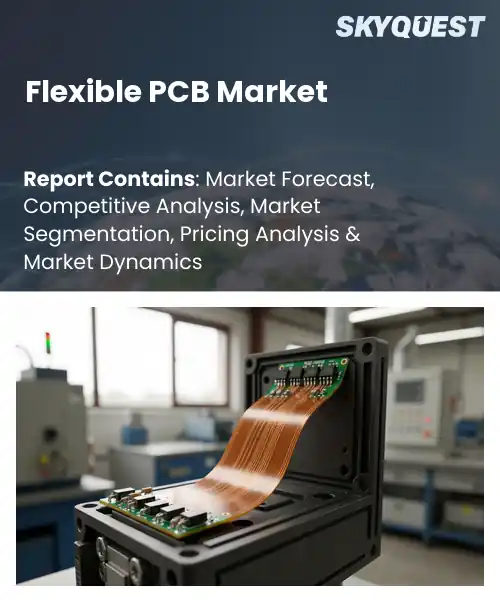
Flexible PCB Market
Report ID: SQMIG45K2271
Report ID: SQMIG45K2271
[email protected]
USA +1 351-333-4748
Report ID:
SQMIG45K2271 |
Region:
Global |
Published Date: May, 2026
Pages:
157
|Tables:
184
|Figures:
79


Global Flexible Pcb Market size was valued at USD 23.9 Billion in 2024 and is poised to grow from USD 27.05 Billion in 2025 to USD 72.95 Billion by 2033, growing at a CAGR of 13.2% during the forecast period (2026-2033).
The flexible printed circuit board market is centered on thin, bendable substrates that interconnect electronic components, enabling compact, lightweight designs in consumer electronics, medical devices, automotive systems and industrial sensors. Its primary driver is miniaturization coupled with demand for reliable, high-density interconnects, which has accelerated as smartphones and wearables required more complex layouts inside smaller volumes.
Historically the market evolved from simple single-sided flexes for early aerospace and military applications into multilayer flex and rigid-flex solutions adopted by mainstream manufacturers; suppliers improved materials and fabrication techniques, lowering cost and expanding use cases such as foldable phones and implantable medical leads.Building on the miniaturization trend described above, advancements in materials science represent a pivotal factor driving market growth because flexible substrates that tolerate higher temperatures and finer traces enable denser, more reliable circuits. As manufacturers adopt polyimide and liquid crystal polymer formulations, fabrication yields improve and assembly costs decline, which causes wider adoption in automotive ADAS modules and compact medical diagnostics where vibration resilience and sterilization compatibility matter.
How is IoT driving demand for flexible PCBs in wearable devices?
Flexible printed circuit boards are thin, bendable interconnects that let sensors, radios and power elements sit close to the body while conforming to complex shapes. As IoT expands, wearable devices demand always on connectivity, continuous sensing and smaller form factors. That drives designers to choose flexible PCBs for compact routing, integrated antennas and reliable connections in repeated bending.
The current market sees more medical patches, smart garments and compact smartwatches using polyimide and rigid flex approaches. Manufacturers and EMS partners are adapting processes for higher yields and tighter tolerances so wearables feel comfortable and perform reliably in real world use.Panasonic March 2026, announced a new MEGTRON multilayer circuit board materials production line, which strengthens PCB material supply and capability and indirectly supports flexible PCB makers. Better materials and capacity help IoT driven wearables add more sensors and wireless functions while staying thin and reliable.
Market snapshot - (2026-2033)
Global Market Size
USD 23.9 Billion
Largest Segment
Single-Sided Flexible PCB
Fastest Growth
Rigid-Flex PCB
Growth Rate
13.2% CAGR
To get more insights on this market click here to Request a Free Sample Report
Global flexible pcb market is segmented by type, material type, application, component type, end user, manufacturing process and region. Based on type, the market is segmented into Single-Sided Flexible PCB, Double-Sided Flexible PCB, Multilayer Flexible PCB, Rigid-Flex PCB and Others. Based on material type, the market is segmented into Polyimide, Polyester, Polyethylene Naphthalate (PEN) and Others. Based on application, the market is segmented into Consumer Electronics, Automotive Electronics, Healthcare Devices, Aerospace & Defense, Industrial Electronics, Telecommunications and Others. Based on component type, the market is segmented into Display Circuits, Battery Circuits, Sensor Circuits, Lighting Circuits and Others. Based on end user, the market is segmented into Consumer Electronics Industry, Automotive Industry, Healthcare Industry, Aerospace & Defense Industry, Industrial Manufacturing and Others. Based on manufacturing process, the market is segmented into Additive Process, Subtractive Process, Semi-Additive Process and Others. Based on region, the market is segmented into North America, Europe, Asia Pacific, Latin America and Middle East & Africa.
Rigid-Flex PCB segment dominates because rigid-flex constructions marry rigid board stability with flexible circuit conformability, enabling dense functional integration within tight form factors. This consolidation reduces connector dependence and interconnection failure points, simplifies assembly and enclosure design, and supports repeated bending cycles, which drives adoption in products demanding reliability and compactness while streamlining manufacturing flows and supplier selection for high-performance systems.
However, Multilayer Flexible PCB is witnessing the strongest growth momentum as designers pursue greater circuit density and more complex routing within minimal footprints. Advanced multilayer builds enhance signal integrity and power distribution for multifunctional devices, prompting investment in fabrication technologies and materials innovation that broadens application scope in next-generation consumer and industrial electronics and catalyzes new supplier capabilities.
Polyimide segment dominates because polyimide films provide superior thermal stability, dimensional consistency, and chemical resistance essential for high-reliability flexible circuits. Those intrinsic properties permit finer conductor geometries and stable dielectric behavior under thermal cycling, supporting advanced surface finishes and adhesive systems. Consequently, designers and manufacturers favor polyimide where long-term electrical performance and serviceability determine product qualification and influence procurement choices.
On the other hand, Polyethylene Naphthalate (PEN) is emerging as the key high-growth area due to its attractive cost-performance balance and improved dimensional stability compared with traditional polyester. Rising demand from flexible displays, sensors, and mid-tier consumer devices that need moderate thermal tolerance is driving material substitution, encouraging process adaptations and supplier investment that expand flexible PCB use cases and marketplace opportunities.
To get detailed segments analysis, Request a Free Sample Report
Asia Pacific dominance in the flexible PCB market stems from a deep integration of advanced manufacturing capabilities, dense electronics supply chains, and strong demand from consumer electronics and automotive segments. Established industrial clusters provide material suppliers, contract manufacturers, and design houses in close proximity to major original equipment manufacturers, enabling rapid product iterations and scale. High levels of private investment and focused research and development support sophisticated flexible circuit technologies for compact and high reliability applications. Skilled workforce and long standing expertise in precision fabrication contribute to superior yield and quality for complex multilayer and high flex designs. Regional collaboration between clusters and equipment suppliers creates an innovation ecosystem that accelerates adoption across multiple end use sectors. Competitive manufacturing costs further strengthen regional competitiveness and attract global sourcing.
Flexible PCB Market in Japan is characterized by specialization in high precision and density interconnect solutions for advanced consumer electronics, automotive electronics, and industrial instrumentation. Strong collaboration between equipment makers and materials specialists enables development of thermally robust and fine pitch flex designs. Emphasis on quality, reliability, and innovation supports niche, value applications. Domestic design houses and contract manufacturers prioritize process control and partnerships with global original equipment manufacturers globally.
Flexible PCB Market in South Korea benefits from close integration with advanced display and semiconductor ecosystems, supporting high density interconnect solutions for compact mobile devices. Strong ties between original equipment manufacturers and precision fabricators accelerate design cycles. Emphasis on rapid prototyping, process optimization, and material innovation fosters specialized offerings for reliable flex applications. Domestic suppliers focus on vertical integration and collaborative development with global customers and advanced testing practices continue.
North America expansion in the flexible PCB market is propelled by demand from high value sectors such as aerospace, medical devices, automotive electrification, and advanced industrial systems. Emphasis on customization, certification, and stringent reliability standards creates opportunities for domestic suppliers and specialized design firms. Growth is supported by investments in advanced materials, testing capabilities, and precision fabrication that address high frequency and harsh environment requirements. A strategic focus on supply chain resilience and nearshore sourcing encourages partnerships between original equipment manufacturers and contract manufacturers. Collaboration with research institutions accelerates development of novel substrates and assembly techniques, while end user emphasis on rapid prototyping and short lead time production underpins market momentum. Robust collaboration between technology startups, established electronics firms, and defense primes fosters specialized production capabilities and accelerates certification pathways for mission critical applications.
Flexible PCB Market in United States is driven by demand from aerospace, defense, medical device, and industrial sectors that require certified, high reliability interconnect solutions. Strong domestic capabilities in materials innovation, precision assembly, and testing support complex multilayer and high frequency flex designs. Close collaboration between original equipment manufacturers, contract electronics providers, and research institutions accelerates qualification and adoption. Emphasis on supply chain resilience and nearshore sourcing encourages production services.
Flexible PCB Market in Canada benefits from an electronics base oriented to medical devices, telecommunications, and clean energy, driving demand for reliable flex solutions. Design houses and contract manufacturers emphasize customization, regulatory compliance, and durability for demanding environments. Collaboration with neighboring manufacturing hubs supports nearshore sourcing and supply chain coordination. Investments in advanced assembly and testing enhance domestic capability to serve niche, high reliability applications for leading international equipment manufacturers.
Europe is strengthening its role in the flexible PCB market through a combination of engineering excellence, targeted investment in advanced materials, and close alignment with automotive, industrial automation, and medical device value chains. Regional suppliers emphasize quality, compliance, and sustainability, adopting cleaner production methods and materials selection that resonate with original equipment manufacturer priorities. Strong collaboration between design houses, contract manufacturers, and academic research centers supports development of specialized flex solutions for harsh environments and mobility applications. Harmonized standards and procurement practices among major markets encourage supplier qualification and cross border partnerships, enabling European firms to compete on reliability, traceability, and environmental performance rather than on low cost alone. Investment in local testing infrastructure, modular manufacturing lines, and materials recycling initiatives further enhances competitiveness and supports end user demands for sustainable, certified components.
Flexible PCB Market in Germany is anchored by strong ties to automotive and industrial automation sectors that demand robust, high reliability interconnect solutions. Emphasis on precision manufacturing, rigorous certification, and process control supports complex multilayer and high flex designs. Engineering led design houses and experienced contract manufacturers prioritize traceability and long term quality. Investments in testing infrastructure and collaborative programs with technical universities foster innovation and solutions for mobility applications.
Flexible PCB Market in United Kingdom is shaped by strengths in medical device development, telecommunications equipment, and defense systems that value bespoke, high reliability interconnects. Design centric firms and rapid prototyping shops support agile development cycles and certification pathways. Contract manufacturers emphasize traceability, testing, and compliance with stringent regulatory requirements. Collaboration with research centers and specialist materials suppliers accelerates development of lightweight, flexible solutions tailored for compact and mission critical applications.
Flexible PCB Market in France benefits from strong aerospace and automotive supplier networks and a focus on high reliability and miniaturization. Design and engineering firms collaborate closely with contract fabricators to develop customized flex solutions for performance and environmental standards. Emphasis on materials research, sustainable production practices, and certification builds trust with original equipment manufacturers. Regional clusters support export oriented growth and enable rapid prototyping and qualification for specialized applications.
To know more about the market opportunities by region and country, click here to
Buy The Complete Report
Rising Consumer Electronics Demand
Automotive Electronics Integration
Complex Manufacturing Processes
Cost Volatility Of Materials
Request Free Customization of this report to help us to meet your business objectives.
The competitive landscape in the global flexible PCB market is defined by consolidation, OEM supply agreements and rapid process innovation as manufacturers compete on multilayer density and bend reliability; demand from EVs, foldable devices and 5G drives suppliers to scale high-density flex capabilities. Firms pursue acquisitions and supply contracts—Trackwise’s 2020 purchase of Stevenage Circuits and its multi year EV supply deal—and manufacturing innovation such as ESI’s CapStone laser processing to reduce via costs.
Top Player’s Company Profile
Recent Developments
SkyQuest’s ABIRAW (Advanced Business Intelligence, Research & Analysis Wing) is our Business Information Services team that Collects, Collates, Correlates, and Analyses the Data collected by means of Primary Exploratory Research backed by robust Secondary Desk research. As per SkyQuest analysis, the global flexible PCB market is propelled primarily by device miniaturization and rising demand for compact consumer and wearable electronics, while advancements in materials science further accelerate adoption by enabling higher temperature tolerance and finer traces. Complex manufacturing processes present a key restraint, requiring specialized equipment, skilled labor and tight quality controls that can slow scaling. Asia Pacific remains the dominating region due to integrated supply chains and manufacturing clusters, and rigid-flex PCBs are the dominating segment because they combine rigid stability with flexible conformability for dense, reliable assemblies. The market outlook is strong as innovation and scale reduce unit costs.
| Report Metric | Details |
|---|---|
| Market size value in 2024 | USD 23.9 Billion |
| Market size value in 2033 | USD 72.95 Billion |
| Growth Rate | 13.2% |
| Base year | 2024 |
| Forecast period | (2026-2033) |
| Forecast Unit (Value) | USD Billion |
| Segments covered |
|
| Regions covered | North America (US, Canada), Europe (Germany, France, United Kingdom, Italy, Spain, Rest of Europe), Asia Pacific (China, India, Japan, Rest of Asia-Pacific), Latin America (Brazil, Rest of Latin America), Middle East & Africa (South Africa, GCC Countries, Rest of MEA) |
| Companies covered |
|
| Customization scope | Free report customization with purchase. Customization includes:-
|
To get a free trial access to our platform which is a one stop solution for all your data requirements for quicker decision making. This platform allows you to compare markets, competitors who are prominent in the market, and mega trends that are influencing the dynamics in the market. Also, get access to detailed SkyQuest exclusive matrix.
Table Of Content
Executive Summary
Market overview
Parent Market Analysis
Market overview
Market size
KEY MARKET INSIGHTS
COVID IMPACT
MARKET DYNAMICS & OUTLOOK
Market Size by Region
KEY COMPANY PROFILES
Methodology
For the Flexible PCB Market, our research methodology involved a mixture of primary and secondary data sources. Key steps involved in the research process are listed below:
1. Information Procurement: This stage involved the procurement of Market data or related information via primary and secondary sources. The various secondary sources used included various company websites, annual reports, trade databases, and paid databases such as Hoover's, Bloomberg Business, Factiva, and Avention. Our team did 45 primary interactions Globally which included several stakeholders such as manufacturers, customers, key opinion leaders, etc. Overall, information procurement was one of the most extensive stages in our research process.
2. Information Analysis: This step involved triangulation of data through bottom-up and top-down approaches to estimate and validate the total size and future estimate of the Flexible PCB Market.
3. Report Formulation: The final step entailed the placement of data points in appropriate Market spaces in an attempt to deduce viable conclusions.
4. Validation & Publishing: Validation is the most important step in the process. Validation & re-validation via an intricately designed process helped us finalize data points to be used for final calculations. The final Market estimates and forecasts were then aligned and sent to our panel of industry experts for validation of data. Once the validation was done the report was sent to our Quality Assurance team to ensure adherence to style guides, consistency & design.
Analyst Support
Customization Options
With the given market data, our dedicated team of analysts can offer you the following customization options are available for the Flexible PCB Market:
Product Analysis: Product matrix, which offers a detailed comparison of the product portfolio of companies.
Regional Analysis: Further analysis of the Flexible PCB Market for additional countries.
Competitive Analysis: Detailed analysis and profiling of additional Market players & comparative analysis of competitive products.
Go to Market Strategy: Find the high-growth channels to invest your marketing efforts and increase your customer base.
Innovation Mapping: Identify racial solutions and innovation, connected to deep ecosystems of innovators, start-ups, academics, and strategic partners.
Category Intelligence: Customized intelligence that is relevant to their supply Markets will enable them to make smarter sourcing decisions and improve their category management.
Public Company Transcript Analysis: To improve the investment performance by generating new alpha and making better-informed decisions.
Social Media Listening: To analyze the conversations and trends happening not just around your brand, but around your industry as a whole, and use those insights to make better Marketing decisions.
REQUEST FOR SAMPLE
 REQUEST FREE CUSTOMIZATION
Global Flexible Pcb Market size was valued at USD 23.9 Billion in 2024 and is poised to grow from USD 27.05 Billion in 2025 to USD 72.95 Billion by 2033, growing at a CAGR of 13.2% during the forecast period (2026-2033).
The competitive landscape in the global flexible PCB market is defined by consolidation, OEM supply agreements and rapid process innovation as manufacturers compete on multilayer density and bend reliability; demand from EVs, foldable devices and 5G drives suppliers to scale high-density flex capabilities. Firms pursue acquisitions and supply contracts—Trackwise’s 2020 purchase of Stevenage Circuits and its multi year EV supply deal—and manufacturing innovation such as ESI’s CapStone laser processing to reduce via costs. 'Nippon Mektron, Ltd.', 'Zhen Ding Technology Holding Limited', 'Flex Ltd.', 'Sumitomo Electric Industries, Ltd.', 'TTM Technologies, Inc.', 'Unimicron Technology Corporation', 'Compeq Manufacturing Co., Ltd.', 'Interflex Co., Ltd.', 'Career Technology (Mfg.) Co., Ltd.', 'Shengyi Technology Co., Ltd.', 'Young Poong Electronics Co., Ltd.', 'AT&S Austria Technologie & Systemtechnik AG', 'Daeduck Electronics Co., Ltd.', 'Multek Corporation', 'Kinwong Electronic Co., Ltd.', 'Meiko Electronics Co., Ltd.', 'NCAB Group AB', 'MFLEX Ltd.', 'AKM Meadville Electronics (Xiamen) Co., Ltd.', 'Flexium Interconnect, Inc.'
The increasing global consumption of smartphones, wearables, tablets, and other portable devices is encouraging manufacturers to adopt flexible printed circuits because they provide space savings, improved reliability, and enhanced performance in compact assemblies. OEMs prioritize thin, lightweight interconnects to enable slim form factors and multifunctional designs, which in turn drives procurement of flexible PCBs across consumer markets. Design teams favor flex solutions to integrate sensors and antennas efficiently, resulting in stronger demand from supply chains and accelerating adoption across device categories.
Miniaturization Driving Design Flexibility: Demand for smaller, thinner electronic devices is pushing designers to leverage flexible PCB architectures to achieve higher component density and novel form factors. Manufacturers are prioritizing routing strategies, multi-layer stacking, and integrated flex-rigid solutions to support compact assemblies while preserving signal integrity and thermal management. This trend encourages collaboration between OEMs and PCB suppliers on customized layouts, iterative prototyping and design-for-manufacturability practices, enabling rapid product differentiation across wearables, mobile devices and increasingly constrained industrial and medical applications and IoT platforms.
Why does Asia Pacific Dominate the Global Flexible PCB Market? |@12


Want to customize this report? This report can be personalized according to your needs. Our analysts and industry experts will work directly with you to understand your requirements and provide you with customized data in a short amount of time. We offer $1000 worth of FREE customization at the time of purchase.
Feedback From Our Clients


 USA (+1) 351-333-4748

