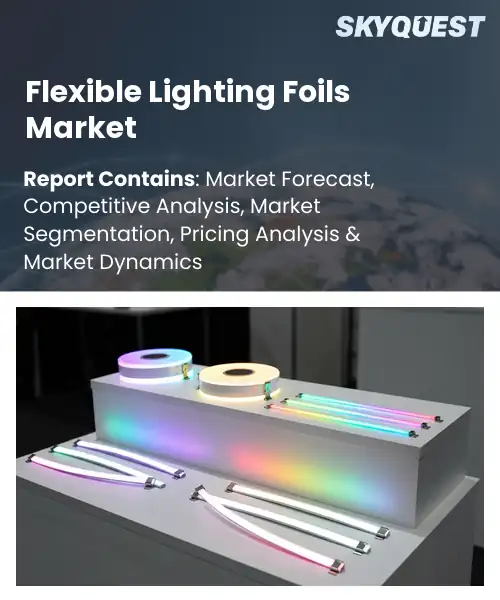
Flexible Lighting Foils Market
Report ID: SQMIG20D2533
Report ID: SQMIG20D2533
[email protected]
USA +1 351-333-4748
Report ID:
SQMIG20D2533 |
Region:
Global |
Published Date: February, 2026
Pages:
157
|Tables:
145
|Figures:
78


Global Flexible Lighting Foils Market size was valued at USD 1.3 Billion in 2024 and is poised to grow from USD 1.44 Billion in 2025 to USD 3.22 Billion by 2033, growing at a CAGR of 10.6% during the forecast period (2026-2033).
Growing demand for lightweight lighting solutions, rising adoption of flexible electronics, increasing use in automotive ambient lighting, advancements in printable lighting technologies, and emphasis on energy-efficient illumination are driving sales of flexible lighting foils.
Flexible lighting foil solutions enable manufacturers to implement flexible illumination systems which replace traditional lighting systems because they deliver lighter products and better energy performance and they support additional design and practical uses. The industry has progressed from using heavy fluorescent lighting systems together with unmovable LED light panels to using printed electroluminescent films and flexible OLED light sheets. The initial implementation of edge lighting in smartphones together with ambient lighting systems in automotive cabins has proven both its technical viability and its high demand. Growing demand for innovative lighting designs across consumer electronics, automotive interiors, and architectural applications, coupled with the need for compact and energy-efficient lighting systems, is expected to primarily drive flexible lighting foils market growth. As production yields improve, manufacturers are increasingly collaborating with automakers and electronics companies to develop advanced lighting systems for ambient cabin elements and edge-lit displays. At the same time, stricter energy efficiency regulations and corporate sustainability initiatives are encouraging the adoption of thin and power-efficient lighting technologies.
On the contrary, high production costs of advanced flexible lighting materials, durability and lifespan concerns under continuous operation, complex manufacturing processes, and limited large-scale commercialization are projected to hamper flexible lighting foils market penetration over the coming years.
Internet of Things (IoT) is adding smart capabilities to flexible lighting foils by introducing connectivity, sensing, and basic processing functions. This turns lighting from a passive element into an intelligent system. Real-world applications include laminated glass panels that adjust lighting ambience and vehicle interiors that change illumination based on driving conditions or user preferences. These solutions allow lighting to become more integrated with design while making systems easier to monitor and maintain.
In January 2026, Flexbright announced the commercialization of roll-to-roll IoT-enabled LED foil with built-in diagnostics and ambient sensors. This innovation helps enable faster deployment, remote maintenance, and smoother integration of flexible lighting foils into smart building and transportation systems.
Market snapshot - (2026-2033)
Global Market Size
USD 1.3 Billion
Largest Segment
LED Foils
Fastest Growth
OLED Foils
Growth Rate
10.6% CAGR
To get more insights on this market click here to Request a Free Sample Report
Global flexible lighting foils market is segmented by product type, material type, application, end user, distribution channel, and region. Based on by product type, the market is segmented into OLED Foils, LED foils, and electroluminescent foils. Based on material type, the market is segmented into polyester foils, polycarbonate foils, and specialty foils. Based on application, the market is segmented into architectural lighting, automotive lighting, advertising displays, and others. Based on end user, the market is segmented into commercial, residential, and industrial. Based on distribution channel, the market is segmented into online retail, offline retail, and direct sales. Based on region, the market is segmented into North America, Europe, Asia Pacific, Latin America, and Middle East & Africa.
The OLED foils segment is slated to lead the global flexible lighting foils market revenue generation in the long run. The combination of extreme thinness, surface emission, and high color fidelity enables seamless integration into curved and transparent surfaces, which helps cement the high share of this segment. Their low thermal output simplifies system design and reduces component needs, which in turn lowers integration complexity and enhances aesthetic and functional value across premium applications, leading buyers to prioritize OLED-based flexible lighting in high-design contexts.
However, LED foils are emerging as the most rapidly expanding segment as per this flexible lighting foils industry analysis. Advancements in flexible LED arrays, falling component costs, and broader use in high-brightness signage are creating new opportunities. The expansion of this sector creates opportunities for cost-sensitive markets which allow manufacturers to produce standardized products that drive market growth of energy-efficient flexible lighting products.
The automotive lighting segment is estimated to account for the largest global flexible lighting foils market share in the future. Growing adoption of compact, conformable illumination in vehicles that supports signature lighting, interior ambiance, and safety features while meeting stringent thermal and reliability requirements is bolstering the dominance of this segment. The use of flexible foils permits the design of curved aerodynamic surfaces which include integrated trims that maintain a streamlined appearance without requiring extra weighty installation components. The combination of OEM partnerships and specification-driven adoption processes establishes flexible lighting foils as essential components in automotive design cycles which generate continuous primary demand for original equipment programs.
Advertising displays experience their fastest growth period because companies want to use dynamic advertising formats that require flexible display shapes and high-intensity brightness. The combination of durability enhancements and modular installation systems enables faster adoption of flexible lighting foil technologies which generate new revenue opportunities and expand their commercial use in retail environments and promotional settings.
To get detailed segments analysis, Request a Free Sample Report
Concentrated manufacturing capability, integrated electronics supply chains, and early commercial adoption are factors that help Asia Pacific emerge as the dominant market for flexible lighting foils vendors. The region's strength in consumer electronics and automotive lighting and advanced display technologies makes it suitable for the rapid development of flexible lighting products. The development process is aided by the region's proximity to raw materials and component manufacturers, thus reducing lead times and keeping costs competitive. The established research institutions and corporate research and development facilities create new opportunities for innovation in product design and material science research. Collaborative ecosystems between manufacturers and OEMs accelerate product customization for diverse applications. The region serves as the main center for high volume production and technological development in flexible lighting foils through its industrial clusters and policy frameworks, which support export-oriented scaling operations.
Presence of robust precision manufacturing, advanced materials research, and close collaboration between electronics OEMs and component suppliers governs flexible lighting foils demand in the country. Emphasis on development of long-lasting foil products for high-end consumer electronics and industrial uses is high in Japan. Growing collaborations between research institutions and manufacturing partners also result in the creation of advanced and customized flexible lighting foils.
Expertise in display technology innovation, strong consumer electronics brands, and rapid commercialization are shaping flexible lighting foils adoption in South Korea. Collaborative efforts including material scientists and scale manufacturers are also boosting the sales of flexible lighting foils. Strategic supplier networks help businesses achieve cost effective expansion while they develop custom solutions for their clients. Sleek design, integrated circuitry, and energy efficient illumination are the top priorities of flexible lighting foils companies in the country.
High emphasis on sustainability and efforts to integrate intelligent lighting systems are forecasted to influence the sales of flexible lighting foils across Europe. Architectural, retail and transport applications often require buyer and specification preference for slim forms and customizable light sources, thus creating an environment that is conducive to the adoption of flexible foils. In addition, government incentives for modernization of energy-efficient building solutions, as well as the regulatory emphasis on those types of solutions, create an environment that supports the creation of thin, adaptable lighting panels that can be used for retrofitting existing buildings. Furthermore, the close partnerships between research centers and production facilities help to advance the maturity of materials, while also promoting standardization of specifications among markets, which encourages investor confidence and buyers' acceptance of new products.
Robust manufacturing expertise, industrial engineering, and integration with automotive and architectural supply chains are influencing the sales of flexible lighting foils in Germany. The partnership between lighting companies and materials testing facilities and system integration experts creates customized solutions for business and transportation sectors. Germany functions as a technical base which delivers high-quality production capabilities and advanced engineering expertise.
Robust design orientation and adoption in commercial spaces are shaping flexible lighting foils demand in the United Kingdom. Growing use of experiential lighting systems which work together with smart building control systems are creating new opportunities. The service ecosystem enables design specification and installation support for both retrofitting and custom projects in the long run.
Flexible lighting foil demand in France is governed by architecture, retail and cultural sectors that prize bespoke lighting. Designers and specifiers explore adaptable foils for creative installations, façades, and interior accents that blend aesthetics with efficiency. Local material innovators and specialist manufacturers collaborate with agencies to prototype tailored solutions for projects.
The high emphasis on innovation, manufacturing capabilities, and tight collaborations with smart building and automotive spaces have opened new avenues for flexible lighting foils companies in the region. By developing flexible form factors to accommodate new product categories for use in various consumer electronics, architectural, and mobility spaces, lightweight conformable lighting has now become a space of interest for these industries. The collaborative efforts between material scientists, systems integrators, and traditional manufacturers are also helping fast track innovation and commercialization of novel flexible lighting foils. Regional expertise in software-based lighting controls supports the overall value of connected solutions in North America, and joint pilot projects between industry stakeholders and end users provide real-world validation of performance across many different environments.
Presence of leading innovation ecosystems, electronics manufacturers, and strong integration with connected platforms are responsible for flexible lighting foils demand in the United States. Consumer electronics, automotive lighting, and commercial retrofit sectors are forecasted to lead business scope for flexible lighting foils companies. Collaboration between the startup industry, research centers, and system integrators speeds the product development and deployment processes. Emphasis is placed on the design of scalable product models for specification and installation, which aids in the product's market acceptance, while pilot projects are conducted for product validation in a variety of application environments.
High demand for energy efficiency, sustainable materials, and interaction between research centers and industry are significant aspects that impact flexible lighting foils innovation in Canada. Architectural and commercial developers are interested in flexible foil products that are used in building renovation and building new energy-efficient buildings with design. Pilot projects are used to demonstrate the results of testing flexible foils with end-user testing and to encourage the acceptance of products in various fields of application.
To know more about the market opportunities by region and country, click here to
Buy The Complete Report
Rising Demand for Energy Efficiency
Surge in energy-efficient solutions in commercial and consumer lighting applications leads to increased interest in flexible lighting foils. Minimal heat and thin designs of flexible lighting foils are also boosting their adoption. End users perceive dual value from manufacturers and specifiers who view them as efficiency tools that support new product designs, which leads to increased sales. Growing emphasis on sustainability and rising demand for energy efficiency ensures consistent flexible lighting foils market outlook through 2033.
Advances in Flexible Materials
Innovations in substrate technology and printable conductive inks have expanded the operational capabilities of flexible lighting foils. The new materials improve lighting distribution and material lifespan and simplify the process of designing lights for intricate shapes. The new material technologies enable designers to create innovative products while manufacturers can produce multiple product designs that attract architects and interior designers and product developers. Material performance establishes dependable standards which enhance buyer trust according to which custom projects and commercial enterprises choose to use new lighting technologies.
High Production and Installation Costs
The need for advanced manufacturing processes together with special equipment used to create thin lighting foils leads to increased production costs which make it difficult to compete with standard lighting products. The installation process requires special adhesives and handling methods and specific substrates which results in higher labor costs and integration expenses for both end users and contractors. Budget-conscious buyers will take longer to make their specifications because of the combined cost pressures which also restrict large-scale retrofit projects as decision makers choose established lower-cost options until manufacturing efficiencies and installation practices decrease total ownership costs.
Limited Standardization and Interoperability
The absence of widely accepted industry standards for interfaces, mounting methods, and control protocols complicates integration of flexible lighting foils into existing electrical and lighting control systems, creating hesitation among specifiers and facility managers. Stakeholders face extended procurement processes because they need to assess both product specifications and compatibility with existing systems and maintenance requirements. Until common standards emerge and manufacturers align connectivity and installation conventions, adoption may remain fragmented and slower, particularly in projects seeking predictable lifecycle performance.
Request Free Customization of this report to help us to meet your business objectives.
Competitive activity in the global flexible lighting foils market centres on partnerships, licensing, and roll to roll manufacturing scale ups as incumbents and specialised startups vie to supply ultrathin LED on foil and printed lighting. Strategic moves include ams OSRAM's LED on foil ALIYOS collaboration with LEONHARD KURZ and manufacturing spin offs pursuing automated R2R production to shorten time to market.
Flexible Design Enables New Forms: Flexible lighting foils enable designers to design lighting systems which can be applied to surfaces which have been shaped into various curves and contours and molded forms. Blending flexible lighting foils with textile products and furniture items and vehicle interior spaces is emerging as a popular flexible lighting foils industry trend. This results in increased collaboration between manufacturers and designers to help create easier deployment and integration procedures.
Sustainable Materials And Recycling: Sustainable materials and recycling activities are generating new demand patterns as consumer preferences evolve. Flexible foil producers invest in recyclable substrates and bio-based polymers and cleaner processes to make most of this flexible lighting foils market trend going forward. Designers select materials which provide both durable performance and light diffusion and end-of-life reclaimability, which leads to supply chain partnerships that develop take-back systems and circular design solutions.
SkyQuest’s ABIRAW (Advanced Business Intelligence, Research & Analysis Wing) is our Business Information Services team that Collects, Collates, Correlates, and Analyses the Data collected by means of Primary Exploratory Research backed by robust Secondary Desk research.
As per SkyQuest analysis, rising demand for flexible and energy-efficient lighting solutions and increasing adoption of advanced lighting in consumer electronics and automotive interiors are anticipated to drive the demand for flexible lighting foils going forward. However, high manufacturing costs and durability concerns associated with flexible lighting materials are slated to slow down the adoption of flexible lighting foils in the future. Asia Pacific is slated to spearhead the demand for flexible lighting foils owing to strong electronics manufacturing capacity and rapid growth in automotive production. Advancements in roll-to-roll printing technologies and development of flexible OLED and micro-LED lighting solutions are anticipated to be key trends driving the flexible lighting foils market through 2033 and beyond.
| Report Metric | Details |
|---|---|
| Market size value in 2024 | USD 1.3 Billion |
| Market size value in 2033 | USD 3.22 Billion |
| Growth Rate | 10.6% |
| Base year | 2024 |
| Forecast period | (2026-2033) |
| Forecast Unit (Value) | USD Billion |
| Segments covered |
|
| Regions covered | North America (US, Canada), Europe (Germany, France, United Kingdom, Italy, Spain, Rest of Europe), Asia Pacific (China, India, Japan, Rest of Asia-Pacific), Latin America (Brazil, Rest of Latin America), Middle East & Africa (South Africa, GCC Countries, Rest of MEA) |
| Companies covered |
|
| Customization scope | Free report customization with purchase. Customization includes:-
|
To get a free trial access to our platform which is a one stop solution for all your data requirements for quicker decision making. This platform allows you to compare markets, competitors who are prominent in the market, and mega trends that are influencing the dynamics in the market. Also, get access to detailed SkyQuest exclusive matrix.
Table Of Content
Executive Summary
Market overview
Parent Market Analysis
Market overview
Market size
KEY MARKET INSIGHTS
COVID IMPACT
MARKET DYNAMICS & OUTLOOK
Market Size by Region
KEY COMPANY PROFILES
Methodology
For the Flexible Lighting Foils Market, our research methodology involved a mixture of primary and secondary data sources. Key steps involved in the research process are listed below:
1. Information Procurement: This stage involved the procurement of Market data or related information via primary and secondary sources. The various secondary sources used included various company websites, annual reports, trade databases, and paid databases such as Hoover's, Bloomberg Business, Factiva, and Avention. Our team did 45 primary interactions Globally which included several stakeholders such as manufacturers, customers, key opinion leaders, etc. Overall, information procurement was one of the most extensive stages in our research process.
2. Information Analysis: This step involved triangulation of data through bottom-up and top-down approaches to estimate and validate the total size and future estimate of the Flexible Lighting Foils Market.
3. Report Formulation: The final step entailed the placement of data points in appropriate Market spaces in an attempt to deduce viable conclusions.
4. Validation & Publishing: Validation is the most important step in the process. Validation & re-validation via an intricately designed process helped us finalize data points to be used for final calculations. The final Market estimates and forecasts were then aligned and sent to our panel of industry experts for validation of data. Once the validation was done the report was sent to our Quality Assurance team to ensure adherence to style guides, consistency & design.
Analyst Support
Customization Options
With the given market data, our dedicated team of analysts can offer you the following customization options are available for the Flexible Lighting Foils Market:
Product Analysis: Product matrix, which offers a detailed comparison of the product portfolio of companies.
Regional Analysis: Further analysis of the Flexible Lighting Foils Market for additional countries.
Competitive Analysis: Detailed analysis and profiling of additional Market players & comparative analysis of competitive products.
Go to Market Strategy: Find the high-growth channels to invest your marketing efforts and increase your customer base.
Innovation Mapping: Identify racial solutions and innovation, connected to deep ecosystems of innovators, start-ups, academics, and strategic partners.
Category Intelligence: Customized intelligence that is relevant to their supply Markets will enable them to make smarter sourcing decisions and improve their category management.
Public Company Transcript Analysis: To improve the investment performance by generating new alpha and making better-informed decisions.
Social Media Listening: To analyze the conversations and trends happening not just around your brand, but around your industry as a whole, and use those insights to make better Marketing decisions.
REQUEST FOR SAMPLE
 REQUEST FREE CUSTOMIZATION
Global Flexible Lighting Foils Market size was valued at USD 1.3 Billion in 2024 and is poised to grow from USD 1.44 Billion in 2025 to USD 3.22 Billion by 2033, growing at a CAGR of 10.6% during the forecast period (2026-2033).
Competitive activity in the global flexible lighting foils market centres on partnerships, licensing, and roll to roll manufacturing scale ups as incumbents and specialised startups vie to supply ultrathin LED on foil and printed lighting. Strategic moves include ams OSRAM's LED on foil ALIYOS collaboration with LEONHARD KURZ and manufacturing spin offs pursuing automated R2R production to shorten time to market. '3M Company', 'DuPont', 'OLEDWorks', 'LG Display', 'FLEXtra', 'AMT Hitech', 'NEC Display Solutions', 'Universal Display Corporation', 'Philips Lighting', 'Osram', 'Samsung Display', 'Panasonic', 'Covestro', 'Avery Dennison', 'Toppan Printing', 'Toyobo', 'Vishay Intertechnology', 'Luminit', 'GE Lighting', 'Nitto Denko Corporation'
The growing prioritization of energy efficiency in commercial and consumer lighting encourages adoption of flexible lighting foils due to their low thermal output, thin profile, and adaptability to retrofit designs. Manufacturers and specifiers view these products as tools to meet efficiency goals while enabling new form factors, which increases procurement interest and procurement pathways. By offering designers and facility managers versatile options that integrate with existing systems, demand expands across applications where traditional luminaires could not deliver similar energy or spatial benefits.
Flexible Design Enables New Forms: Flexible lighting foils allow designers to integrate illumination into curved, contoured and molded surfaces, driving demand for unconventional product aesthetics and functional lighting. This adaptability supports convergence of lighting with textiles, furniture and vehicle interiors, enabling seamless ambient illumination and brand differentiation. Manufacturers and designers collaborate in development cycles to exploit form freedom, reduce component count and simplify assembly. The result is expanded application scope, new value propositions for end users and greater emphasis on material customization and supplier partnerships.
Concentrated manufacturing capability, integrated electronics supply chains, and early commercial adoption are factors that help Asia Pacific emerge as the dominant market for flexible lighting foils vendors.


Want to customize this report? This report can be personalized according to your needs. Our analysts and industry experts will work directly with you to understand your requirements and provide you with customized data in a short amount of time. We offer $1000 worth of FREE customization at the time of purchase.
Feedback From Our Clients


 USA (+1) 351-333-4748

