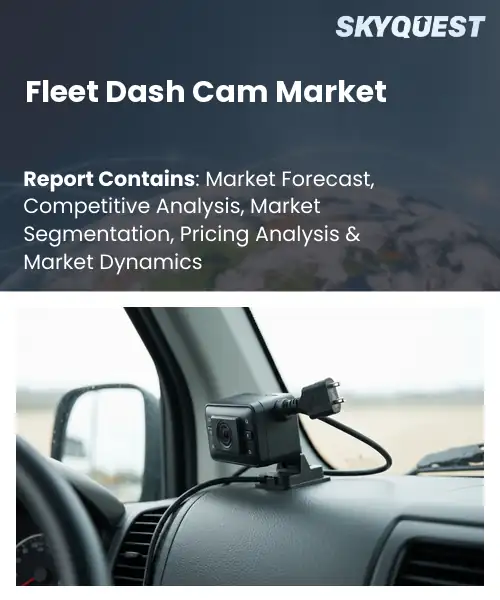
Fleet Dash Cam Market
Report ID: SQMIG25A2628
Report ID: SQMIG25A2628
[email protected]
USA +1 351-333-4748
Report ID:
SQMIG25A2628 |
Region:
Global |
Published Date: February, 2026
Pages:
157
|Tables:
116
|Figures:
77


Global Fleet Dash Cam Market size was valued at USD 4.45 Billion in 2024 and is poised to grow from USD 4.84 Billion in 2025 to USD 9.36 Billion by 2033, growing at a CAGR of 8.6% during the forecast period (2026-2033).
The global fleet dash cam market growth is growing rapidly as companies become aware of how valuable it is to create a safer work environment for employees by improving fleet safety, increasing the efficiency of operations, and managing risk more effectively. Fleet dash cameras are typically installed in commercial vehicles, where they continuously capture video evidence of driver behavior, road conditions, and events occurring inside the vehicle. With this information, fleet operators can reduce costs associated with accidents, hold drivers accountable for their actions, provide proof of events for insurance claims, and discourage unsafe driving behavior.
In addition to helping with fleet safety and risk management, there is also increasing pressure on companies to comply with regulations in the logistics and transportation sectors, which is driving up demand for dash cams that can deliver real-time monitoring, GPS tracking capabilities, and cloud storage. Technological advances, including high-definition video recording, AI-powered event detection, driver fatigue alerts, and wireless connectivity have contributed to the adoption of these products by fleets of all sizes. The integration of telematics and dash cam systems provides actionable data insights through analytics that help improve route optimization, reduce fuel consumption, and increase fleet utilization.
The global fleet dash cam market trends toward AI-powered smart dash cams with real-time driver monitoring, cloud connectivity, and telematics integration, as fleet operators increasingly adopt data-driven solutions to enhance safety, reduce liability, and improve operational efficiency.
North America accounts for the largest market share due to its strict safety regulations and high levels of early adoption among commercial fleets; however, Asia Pacific is expected to be the fastest growing region due to the development of logistics infrastructures in the region, the increase in e-commerce, and the development of government programs designed to improve road safety.
How is AI Improving Driver Safety in the Fleet Dash Cam Market?
The safety of fleet dash cameras is being transformed by artificial intelligence (AI) through the integration of video telematics, driver monitoring, and edge computing together into a method of creating proactive risk management.
The industry is gradually shifting toward preventive safety models to those geared towards prevention by providing solutions for reducing risk, as well as supporting safer operations. Many vendors now combine video evidence with vehicle data and processes so that fleet safety teams can prioritize their limited time in providing focused coaching to drivers rather than being distracted by unnecessary work. Some examples of these types of systems include alerts for phone use while driving. Multi-angled camera systems used to expand the driver's view to eliminate dangerous blind spots, and using AI filters to eliminate the occurrence of false positives.
Market snapshot - 2026-2033
Global Market Size
USD 3.8 Billion
Largest Segment
Smart Dash Cams
Fastest Growth
Smart Dash Cams
Growth Rate
3.1089% CAGR
To get more insights on this market click here to Request a Free Sample Report
Global fleet dash cam market is segmented into product type, vehicle type, features, end-user and region. Based on product type, the market is segmented into basic dash cams, smart dash cams, and dual-channel dash cams. Based on vehicle type, the market is segmented into commercial vehicles and passenger vehicles. Based on features, the market is segmented into GPS tracking, collision detection, and night vision. Based on end-user, the market is segmented into fleet operators, insurance companies and government agencies. Based on the region, the market is segmented into North America, Europe, Asia Pacific, Latin America, and Middle East & Africa.
As per fleet dash cam market forecast, the basic dash cams segment dominates the market because of their low price and the fact that more small and mid-size fleet owners have adopted them over the past few years than smart dash cams. basic dash cams are used to capture video images of a fleet’s drivers so that a fleet operator can monitor their drivers' driving behavior and use those images to document an accident. As the low price point is the main reason basic dash cams are popular with fleet owners, mostly in developing countries and in cost-sensitive markets, they are used to meet a fleet owner’s compliance and insurance documentation needs with little to no capital outlay on the part of the fleet owner.
As per fleet dash cam market outlook, the smart dash cams segment is the fastest growing one due to the increasing demand from fleet operators for additional safety features and more advanced data analysis capabilities. The smart dash cam’s integration of AI-based driver monitoring, real-time alerts, GPS tracking, cloud connectivity, telematics integration and event-triggered recording capabilities is being driven by fleet operators placing greater emphasis on predictive risk management, optimizing insurance and improving operational efficiency while transitioning to more connected and intelligent dash cam systems. Additionally, dual-channel dash cam systems are also continuing to grow at a steady pace, particularly in logistics and ride-hailing fleet markets as they provide video images capturing a view of both the front of the road as well as the inside of the cabin of the vehicle, creating a greater level of transparency and security.
The commercial vehicle segment dominates the market, as fleet dash cams are primarily deployed in trucks, buses, delivery vans, taxis, and other business-operated vehicles. Businesses that operate fleet vehicles prioritize the use of dash cams because they help reduce liability, improve driver performance, oversees fuel efficiency, and comply with safety regulations. The high mileage and the risk associated with having an accident while operating a commercial vehicle leads to the widespread adoption of the technology by businesses that operate commercial fleet vehicles, leading to a larger share of the total market by this segment.
As per fleet dash cam market analysis, the fastest-growing segment is passenger vehicle due to the rise in consumer awareness regarding road safety, an increase in incentives offered to insured drivers, and an increased concern regarding the risk of theft or disputes related to accidents. The growth of ride-sharing services and the increasing adoption rates of new technologies in vehicles connect directly to the demand for dash cams in personal use vehicles. Thus, while basic dash cams and commercial vehicles comprise most of the total market, for dash cams, respectively.
To get detailed segments analysis, Request a Free Sample Report
As per fleet dash cam market regional outlook, North America has the majority share of the market because of its well-established commercial vehicle ecosystem, advanced telematics integration, and high demand for risk management solutions. The widespread use of dash cameras among fleet operators, ride-hailing service companies, and municipal service providers has bolstered the viability and growth of established supply chain, through an ongoing emphasis on interoperability with fleet management platforms. Regulatory drivers towards safe driving practices along with the insurance industry’s desire to reduce loss assist both the speed of procurement and pilot projects as well as the availability of robust aftermarket channels for rapid deployment.
As per the fleet dash camera market regional forecast, United States is characterized by a mature supply of fleets together with strong demand for driver training and telematics integration. Fleets require real-time visibility, video analysis, and rigorous data management systems, which have led vendors to specialize.
The fleet dash camera market regional analysis in Canada is shaped by the presence of very large transportation corridors, a focus on fleet safety, and close vendor relationships with telematics providers. Fleet managers prefer to use systems that can operate in different types of environments and provide clear compliance reporting. Regional carriers and service providers value flexible installation options, as well as aftermarket support, driving adoption by non-users.
The fleet dash camera market revenue in Europe is expanding rapidly due to the increasing connections between the need for road safety regulations. The strong presence of cross-border logistics movements, a dense number of infrastructure support companies, and the creation of compliant-to-privacy data-handling technologies enable fleet operators to obtain actionable data from their operations to help them improve route operations and reduce their response time to accidents. With public and private-sector initiatives promoting safer driving practices and encouraging a pilot and large-scale roll-out of technology-based solutions, competitive vendor business strategies and local partnerships facilitate the facilitation of localized solutions and the acceptance of their use by various segments of the market. Vendor companies are moving to creative and flexible service models to support fleet operators as they increasingly need help to address the different regulatory and local compliance requirements in their operation.
Germany fleet dash cam industry features strong collaboration between OEMs, high engineering quality standards, and advanced telematics system integration for manufacturers with solid box hardware and accurate analytics. Fleet managers are interested in solutions that integrate with their vehicle systems and adhere to strict requirements for data protection of any kind. Vendor ecosystems consist of a mixture of traditional manufacturers and specialized software companies providing modular services.
The fleet dash cam industry outlook in the UK has seen a spike in adoption due to continued collaboration between insurers and numerous startups launching innovations with new models of easy-to-access procurement. Growing demand for incident-related analytics of driver behavior and evidence supporting incidents drives technology vendors to offer modern cloud-based platforms and modular hardware options. Urban road safety initiatives and increasing complexities in last-mile logistics are encouraging pilot programs and large deployments. Rapid iteration of products and customized service models for urban and regional fleets can be accomplished by working closely with agile local vendors and the associated funding ecosystem.
The France fleet dash cam market is evolving using systems in use by regional carriers, emphasis on driver safety education programs, and increasing vendor focus on privacy-compliant technologies. Fleet operators look for solutions that deliver on both their comprehensive analytics needs while delivering documentation needed to support their regulatory compliance obligations. Local integrators and service providers play a significant role in customizing and installing systems for their customers.
Asia Pacific is enhancing its fleet dash cam market position via the adoption of concentrated technology by large carriers, developing local vendor capability, and making strategic connectivity and analytics investment. Adoption of telematics in the region is well established, coupled with high smart phone use will ease the integration of dash cams with fleet management systems. Additionally, local manufacturers are designing hardware to meet regional operating conditions; while software companies are designing analytics to work within multi-lingual and multi-jurisdictional requirements.
The Japan fleet dash cam market continues to be driven by OEM strength, high expectations for engineering quality from the OEM, and integrating advanced telematics with the commercial fleet. Therefore, fleet operators place a high priority on dependability, low-light performance, and have powerful analytics to support driver coaching & incident reconstruction. To ensure seamless integration, vendors partner closely with vehicle manufacturers and fleet management systems.
The South Korean fleet dash cam market benefits from a robust electronics industry, advanced mobile connectivity solutions and high levels of integration with mobility programs. Therefore, high-resolution images, real-time connectivity, and timely firmware updates to assist in urban fleets operating efficiently. Local manufacturers leverage hardware manufacturing expertise with agile software development to provide analytic applications that support congested routes and distribution centers.
To know more about the market opportunities by region and country, click here to
Buy The Complete Report
Regulatory Insurance Incentives
Adoption of Advanced Video Analytics
High Upfront Equipment Costs
Concerns Surrounding Data Privacy
Request Free Customization of this report to help us to meet your business objectives.
Competitive landscape in the global fleet dash cam industry is made up of companies targeting M&A opportunities; embedded connectivity and differentiating themselves using AI driven technologies, M&A (mergers & acquisition) to gain data and/or services from a supplier when they complete a partnership with that supplier.
SkyQuest’s ABIRAW (Advanced Business Intelligence, Research & Analysis Wing) is our Business Information Services team that Collects, Collates, Correlates, and Analyses the Data collected by means of Primary Exploratory Research backed by robust Secondary Desk research.
As per SkyQuest analysis, demand for global fleet dash cams industry has surged in recent years due to their ability to mitigate risks by providing video evidence and data on driver behaviour to reduce insurance claims and to provide targeted coaching. Adoption acceleration has occurred because of both the increased availability of affordable high-speed connectivity and the emergence of artificial intelligence (AI) to deliver real-time alerts and actionable insights.
Nevertheless, the high initial purchase/installation costs associated with dash cams may continue to act as a barrier to widespread adoption for budget-conscious operators delaying deployment. North America currently has the largest fleet dash cams market share, due to its relatively advanced telematics ecosystems, widespread engagement by insurance companies and strong aftermarket channels.
Furthermore, dual-channel dash cams are dominant in the North American fleet dash cams market because they provide a combination of exterior and interior perspectives. Which increases the likelihood that confirmation will exist for incidents that occur involving a fleet vehicle, as well as maximize the potential operational value of a dual-channel fleet dash cam. The market is witnessing strong global fleet dash cam market growth driven by rising concerns over fleet safety, increasing regulatory compliance requirements, growing adoption of AI-enabled smart dash cams, and the expanding logistics and e-commerce sectors worldwide.
| Report Metric | Details |
|---|---|
| Market size value in 2024 | USD 4.45 Billion |
| Market size value in 2033 | USD 9.36 Billion |
| Growth Rate | 8.6% |
| Base year | 2024 |
| Forecast period | 2026-2033 |
| Forecast Unit (Value) | USD Billion |
| Segments covered |
|
| Regions covered | North America (US, Canada), Europe (Germany, France, United Kingdom, Italy, Spain, Rest of Europe), Asia Pacific (China, India, Japan, Rest of Asia-Pacific), Latin America (Brazil, Rest of Latin America), Middle East & Africa (South Africa, GCC Countries, Rest of MEA) |
| Companies covered |
|
| Customization scope | Free report customization with purchase. Customization includes:-
|
To get a free trial access to our platform which is a one stop solution for all your data requirements for quicker decision making. This platform allows you to compare markets, competitors who are prominent in the market, and mega trends that are influencing the dynamics in the market. Also, get access to detailed SkyQuest exclusive matrix.
Table Of Content
Executive Summary
Market overview
Parent Market Analysis
Market overview
Market size
KEY MARKET INSIGHTS
COVID IMPACT
MARKET DYNAMICS & OUTLOOK
Market Size by Region
KEY COMPANY PROFILES
Methodology
For the Fleet Dash Cam Market, our research methodology involved a mixture of primary and secondary data sources. Key steps involved in the research process are listed below:
1. Information Procurement: This stage involved the procurement of Market data or related information via primary and secondary sources. The various secondary sources used included various company websites, annual reports, trade databases, and paid databases such as Hoover's, Bloomberg Business, Factiva, and Avention. Our team did 45 primary interactions Globally which included several stakeholders such as manufacturers, customers, key opinion leaders, etc. Overall, information procurement was one of the most extensive stages in our research process.
2. Information Analysis: This step involved triangulation of data through bottom-up and top-down approaches to estimate and validate the total size and future estimate of the Fleet Dash Cam Market.
3. Report Formulation: The final step entailed the placement of data points in appropriate Market spaces in an attempt to deduce viable conclusions.
4. Validation & Publishing: Validation is the most important step in the process. Validation & re-validation via an intricately designed process helped us finalize data points to be used for final calculations. The final Market estimates and forecasts were then aligned and sent to our panel of industry experts for validation of data. Once the validation was done the report was sent to our Quality Assurance team to ensure adherence to style guides, consistency & design.
Analyst Support
Customization Options
With the given market data, our dedicated team of analysts can offer you the following customization options are available for the Fleet Dash Cam Market:
Product Analysis: Product matrix, which offers a detailed comparison of the product portfolio of companies.
Regional Analysis: Further analysis of the Fleet Dash Cam Market for additional countries.
Competitive Analysis: Detailed analysis and profiling of additional Market players & comparative analysis of competitive products.
Go to Market Strategy: Find the high-growth channels to invest your marketing efforts and increase your customer base.
Innovation Mapping: Identify racial solutions and innovation, connected to deep ecosystems of innovators, start-ups, academics, and strategic partners.
Category Intelligence: Customized intelligence that is relevant to their supply Markets will enable them to make smarter sourcing decisions and improve their category management.
Public Company Transcript Analysis: To improve the investment performance by generating new alpha and making better-informed decisions.
Social Media Listening: To analyze the conversations and trends happening not just around your brand, but around your industry as a whole, and use those insights to make better Marketing decisions.
REQUEST FOR SAMPLE
 REQUEST FREE CUSTOMIZATION
Global Fleet Dash Cam Market size was valued at USD 3.8 Billion in 2024 and is poised to grow from USD 3.92 Billion in 2025 to USD 5.01 Billion by 2033, growing at a CAGR of 3.1089% during the forecast period (2026-2033).
Competitive landscape in the global fleet dash cam market is defined by targeted M&A, embedded connectivity and AI driven differentiation, with incumbents and challengers pursuing acquisitions and partnerships to lock in data and services. Examples include Pittasoft BlackVue expanding into dedicated fleet services, asset sales and acquisitions around Owlcam, and vendor partnerships that bundle legal and cloud services for fleets. Important to add something please dont question anything there. 'Omnicomm', 'SmartDrive', 'Verizon Connect', 'Lytx', 'Nauto', 'Geotab', 'Teletrac Navman', 'Samsara', 'FleetComplete', 'CameraMatics', 'LoadMaster', 'Motive', 'Mobileye', 'INFINITUM', 'FleetCam', 'Rastrac', 'Transpoco', 'Vyncs', 'Azuga', 'Sumo Logic'
Fleet operators face increasing regulatory and insurer expectations for continuous monitoring and incident evidence, which encourages investment in dash cam systems. By improving driver accountability, enabling rapid incident verification, and reducing liability exposure through recorded footage, dash cams become an operational necessity rather than optional equipment. The visibility they provide supports safer driving behaviours and more efficient fleet management decision making, prompting procurement teams to prioritize installation and upgrades to meet compliance and risk mitigation objectives across diverse vehicle fleets.
As per fleet dash cam market regional outlook, North America has the majority share of the market because of its well-established commercial vehicle ecosystem, advanced telematics integration, and high demand for risk management solutions.


Want to customize this report? This report can be personalized according to your needs. Our analysts and industry experts will work directly with you to understand your requirements and provide you with customized data in a short amount of time. We offer $1000 worth of FREE customization at the time of purchase.
Feedback From Our Clients


 USA (+1) 351-333-4748

