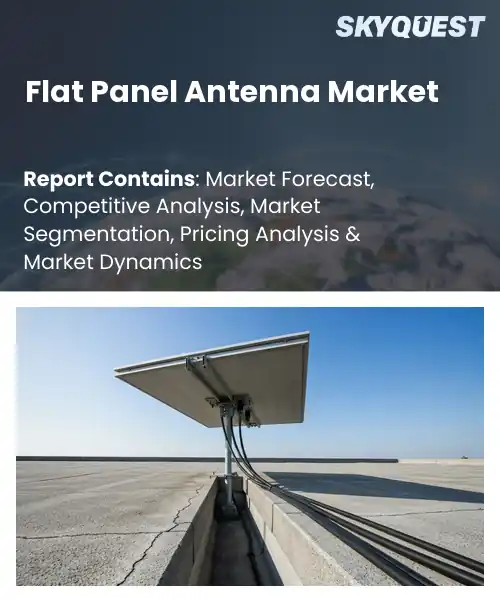
Flat Panel Antenna Market
Report ID: SQMIG45H2227
Report ID: SQMIG45H2227
[email protected]
USA +1 351-333-4748
Report ID:
SQMIG45H2227 |
Region:
Global |
Published Date: July, 2026
Pages:
157
|Tables:
94
|Figures:
76


Global Flat Panel Antenna Market size was valued at USD 3.72 Billion in 2024 and is poised to grow from USD 4.28 Billion in 2025 to USD 32.95 Billion by 2033, growing at a CAGR of 15.04% during the forecast period (2026-2033).
The global flat panel antenna market includes electronically steerable antennas for satellite, 5G and aerospace applications. It is important because compact, high-gain solutions are driving multi-band communications. The industry shifted from bulky parabolic reflectors in the 1990s to thin conformal arrays in the 2010s, driven by satellite broadband ventures such as OneWeb and SpaceX’s Starlink. When mobile operators started rolling out millimeter-wave 5G, there was a rush to have panels on towers and vehicles that weren’t obtrusive, so manufacturers began to adopt phased-array technology to reduce weight while maintaining performance. This trajectory exemplifies how the growth of data-throughput requirements has changed design philosophy and expanded market size.
The need for low-profile, electronically steered arrays for integration into automotive and defense platforms with limited space and stealth requirements is driving the flat-panel antenna market. And the adoption of connected-car radar and autonomous-vehicle communications creates a feedback loop with more vehicle connectivity increasing demand for compact panels that reduces unit cost through scale and drives their use in infotainment and V2X modules. The impact is demonstrated in the real world by Tesla’s over-the-air updates that use high-frequency links and the conformal panels used by the U.S. Navy on their unmanned surface vessels. Revenue drivers also include the upcoming 6G and satellite-internet rollouts, where operators are replacing legacy dishes with flat-panel solutions.
How is AI-driven Automation Influencing Design Efficiencies In The Flat Panel Antenna Market?
AI-driven automation revolutionizes flat panel antenna design by digitizing the entire workflow from electromagnetic simulation to mechanical layout. Generative algorithms search through thousands of geometry variations in an instant, enabling engineers to quickly converge on optimal shapes without having to iterate manually. Integrated AI models also predict thermal and structural performance, reducing the need for costly physical prototypes. The outcome is faster time-to-market, lighter structures and higher reliability, which are critical as LEO constellations require large-scale, low-cost antenna production. Industry teams now coordinate design, testing and manufacturing through a single data hub, turning what was once a siloed process into a seamless, iterative loop that scales with demand.
Market snapshot - (2026-2033)
Global Market Size
USD 3.72 Billion
Largest Segment
Electronically Steered Antennas
Fastest Growth
Electronically Steered Antennas
Growth Rate
15.04% CAGR
To get more insights on this market click here to Request a Free Sample Report
Global flat panel antenna market is segmented by type, frequency band, application and region. Based on type, the market is segmented into Electronically Steered Antennas and Mechanically Steered Antennas. Based on frequency band, the market is segmented into Ku Band, Ka Band, X Band and C Band. Based on application, the market is segmented into Automotive, Aviation, Defense and Government, Enterprise, Maritime, Telecom and Oil and Gas. Based on region, the market is segmented into North America, Europe, Asia Pacific, Latin America and Middle East & Africa.
The leading segment is electronically steered antennas because they can change the beam direction without moving parts very quickly and this fits very well with the flat panel form factor which needs to be low profile and high reliability. Their solid state architecture allows them to be integrated directly into digital control loops, reducing lag and maintenance needs. This convergence of technologies fosters broad adoption in industries that require fast reconfiguration, and the flat panel antenna industry is heading to higher performance standards and better connectivity for the future.
At the same time, the strongest growth momentum is seen for mechanically steered antennas as new lightweight actuation mechanisms enable traditional steering to be applied to larger flat panel surfaces. This combination of higher power handling and precise angular coverage capabilities meets increasing demand in markets requiring rugged wideband performance, creating new opportunities.
The Ka band segment is taking the lead due to the higher frequencies allowing for a much higher data throughput, well suited to the flat panel antenna need for compact high capacity links. The short wavelength of the band enables dense array integration and the ability for designers to embed more elements in a limited surface area. This technical advantage reduces aperture size while preserving link quality making Ka band the preferred choice for next generation high speed communication deployments within the flat panel antenna market .
On the other hand, Ku band is emerging as the key high growth area, as its moderate frequency offers balance between performance and hardware simplicity. The market is growing quickly as manufacturers are using mature component ecosystems to develop affordable flat panel designs, leading to wider use in satellite broadband and new connectivity projects.
To get detailed segments analysis, Request a Free Sample Report
Asia Pacific is a region that benefits from a combination of deep manufacturing expertise, relentless research and development investment and a rapidly expanding telecommunications ecosystem. Top technology companies in the region are working on cutting-edge designs for high-frequency communications, satellite connectivity and next-generation 5G deployments. Robust supply chains and cost effective production capabilities allow scale to be achieved without compromising on quality. Sustained demand across consumer, industrial and defence segments is being fuelled by government initiatives to promote advanced electronics and smart city projects. Cooperation ecosystems between universities, research institutes and industry accelerate the introduction of next generation antenna solutions, reinforcing the region’s leadership in both component innovation and volume production.
Japan Flat Panel Antenna Market is propelled by a deep-rooted history of precision engineering and a vast network of electronics manufacturers. The country’s push to build a high-performance communications infrastructure and advanced vehicle connectivity is driving demand for compact, high-gain antenna solutions. Strategic partnerships between research institutions and key suppliers spur technology transfer, while government support for next-generation networks maintain market momentum.
South Korea’s Flat Panel Antenna Market is driven by rapid adoption of advanced mobile and satellite services in the country. Major semiconductor and telecom companies open the door for miniaturized, high-efficiency antenna designs. The strong domestic demand for smart devices and strong export activities support the market. The collaborative R&D programs with global partners ensure the continuous innovation and competitive advantage.
North America experiences accelerated growth due to its deep investment in advanced communications infrastructure and a vibrant ecosystem of technology innovators. The region’s focus on high‑frequency applications, including broadband satellite services, autonomous vehicular connectivity, and defense communications, creates strong demand for lightweight, high‑performance antenna solutions. Strategic partnerships between leading network operators and component manufacturers accelerate product development cycles. Supportive regulatory frameworks and substantial research funding foster continuous innovation, while the presence of major aerospace and defense contractors adds a robust industrial demand base. Together, these factors position the region as a hotbed for rapid market expansion.
Flat Panel Antenna Market in the United States benefits from extensive deployment of next‑generation wireless networks and a prolific base of defense and aerospace programs. Leading technology firms and a dynamic startup community drive rapid prototyping and commercialization of high‑performance antenna arrays. Strong emphasis on research collaborations between universities and industry accelerates breakthroughs, while substantial investment in satellite broadband services fuels ongoing demand.
Flat Panel Antenna Market in Canada is shaped by a growing emphasis on northern connectivity and advanced communications for remote communities. The country’s focus on satellite‑based broadband and emerging autonomous transportation projects stimulates demand for compact, reliable antenna solutions. Collaborative initiatives between government research agencies and local manufacturers promote technology adoption, while a supportive policy environment encourages investment in modern communications infrastructure.
Europe is reinforcing its market position through a blend of high‑value manufacturing, strong standards‑setting bodies, and coordinated research programs that span multiple nations. The region’s emphasis on sustainable and energy‑efficient communications solutions drives innovation in low‑profile, high‑gain antenna designs suited for smart‑city deployments and advanced aerospace applications. Collaborative frameworks among leading industry clusters foster rapid technology transfer and cost‑effective scaling. Government incentives for advanced manufacturing and cross‑border R&D partnerships further enhance competitiveness, while stringent quality and safety standards reinforce the reputation of European products in global supply chains.
Flat Panel Antenna Market in Germany is underpinned by a robust industrial base and a focus on high‑precision manufacturing. The nation’s strong automotive and industrial automation sectors demand compact, reliable antenna solutions for connectivity and sensor integration. Collaborative research initiatives between engineering institutes and leading manufacturers accelerate innovation, while a regulatory environment that encourages technology adoption sustains market growth.
Flat Panel Antenna Market in the United Kingdom benefits from a thriving aerospace and defense ecosystem coupled with progressive telecommunications initiatives. Leading research universities work closely with industry partners to develop cutting‑edge antenna technologies, particularly for satellite communications and emerging 5G networks. Government support for innovation hubs and strategic investment in digital infrastructure further bolsters market development.
Flat Panel Antenna Market in France is driven by strong aerospace activities and a growing emphasis on smart‑city communications. The country’s leading engineering schools and research labs collaborate with manufacturers to create high‑performance antenna solutions for both civilian and defense applications. Incentives for research and development, along with a focus on sustainable connectivity, help cement France’s role in the evolving market.
To know more about the market opportunities by region and country, click here to
Buy The Complete Report
5G Rollout is Boosting Adoption
Emergence of Compact Satellite Dishes
High Production Cost is Limiting
Regulatory Compliance is Delaying Deployment
Request Free Customization of this report to help us to meet your business objectives.
The competitive landscape is shaped by intense rivalry among established antenna manufacturers and emerging chip‑focused innovators, driving accelerated product integration and cost reduction. Recent M&A activity, such as a major satellite‑service provider acquiring a flat‑panel antenna designer, and strategic partnerships between chipset developers and satellite operators, illustrate how firms are leveraging technology convergence to capture market share and meet the growing demand for compact, high‑gain solutions.
SkyQuest’s ABIRAW (Advanced Business Intelligence, Research & Analysis Wing) is our Business Information Services team that Collects, Collates, Correlates, and Analyses the Data collected by means of Primary Exploratory Research backed by robust Secondary Desk research.
As per SkyQuest analysis, the global flat panel antenna market is being propelled primarily by the 5G rollout, which demands low‑profile, high‑frequency panels for dense network deployments, while a second important catalyst is the rise of compact satellite dishes that enable broadband service in remote locations. However, high production costs and stringent regulatory compliance continue to curb wider adoption, especially in price‑sensitive segments. Asia Pacific remains the dominant region, due to its deep manufacturing base, strong R&D investment and rapid telecom expansion. Within the market, electronically steered antennas dominate, offering rapid beam steering without moving parts and fitting the flat‑panel form factor.
| Report Metric | Details |
|---|---|
| Market size value in 2024 | USD 3.72 Billion |
| Market size value in 2033 | USD 32.95 Billion |
| Growth Rate | 15.04% |
| Base year | 2024 |
| Forecast period | (2026-2033) |
| Forecast Unit (Value) | USD Billion |
| Segments covered |
|
| Regions covered | North America (US, Canada), Europe (Germany, France, United Kingdom, Italy, Spain, Rest of Europe), Asia Pacific (China, India, Japan, Rest of Asia-Pacific), Latin America (Brazil, Rest of Latin America), Middle East & Africa (South Africa, GCC Countries, Rest of MEA) |
| Companies covered |
|
| Customization scope | Free report customization with purchase. Customization includes:-
|
To get a free trial access to our platform which is a one stop solution for all your data requirements for quicker decision making. This platform allows you to compare markets, competitors who are prominent in the market, and mega trends that are influencing the dynamics in the market. Also, get access to detailed SkyQuest exclusive matrix.
Table Of Content
Executive Summary
Market overview
Parent Market Analysis
Market overview
Market size
KEY MARKET INSIGHTS
COVID IMPACT
MARKET DYNAMICS & OUTLOOK
Market Size by Region
KEY COMPANY PROFILES
Methodology
For the Flat Panel Antenna Market, our research methodology involved a mixture of primary and secondary data sources. Key steps involved in the research process are listed below:
1. Information Procurement: This stage involved the procurement of Market data or related information via primary and secondary sources. The various secondary sources used included various company websites, annual reports, trade databases, and paid databases such as Hoover's, Bloomberg Business, Factiva, and Avention. Our team did 45 primary interactions Globally which included several stakeholders such as manufacturers, customers, key opinion leaders, etc. Overall, information procurement was one of the most extensive stages in our research process.
2. Information Analysis: This step involved triangulation of data through bottom-up and top-down approaches to estimate and validate the total size and future estimate of the Flat Panel Antenna Market.
3. Report Formulation: The final step entailed the placement of data points in appropriate Market spaces in an attempt to deduce viable conclusions.
4. Validation & Publishing: Validation is the most important step in the process. Validation & re-validation via an intricately designed process helped us finalize data points to be used for final calculations. The final Market estimates and forecasts were then aligned and sent to our panel of industry experts for validation of data. Once the validation was done the report was sent to our Quality Assurance team to ensure adherence to style guides, consistency & design.
Analyst Support
Customization Options
With the given market data, our dedicated team of analysts can offer you the following customization options are available for the Flat Panel Antenna Market:
Product Analysis: Product matrix, which offers a detailed comparison of the product portfolio of companies.
Regional Analysis: Further analysis of the Flat Panel Antenna Market for additional countries.
Competitive Analysis: Detailed analysis and profiling of additional Market players & comparative analysis of competitive products.
Go to Market Strategy: Find the high-growth channels to invest your marketing efforts and increase your customer base.
Innovation Mapping: Identify racial solutions and innovation, connected to deep ecosystems of innovators, start-ups, academics, and strategic partners.
Category Intelligence: Customized intelligence that is relevant to their supply Markets will enable them to make smarter sourcing decisions and improve their category management.
Public Company Transcript Analysis: To improve the investment performance by generating new alpha and making better-informed decisions.
Social Media Listening: To analyze the conversations and trends happening not just around your brand, but around your industry as a whole, and use those insights to make better Marketing decisions.
REQUEST FOR SAMPLE
 REQUEST FREE CUSTOMIZATION
Global Flat Panel Antenna Market size was valued at USD 3.72 Billion in 2024 and is poised to grow from USD 4.28 Billion in 2025 to USD 32.95 Billion by 2033, growing at a CAGR of 15.04% during the forecast period (2026-2033).
The competitive landscape is shaped by intense rivalry among established antenna manufacturers and emerging chip‑focused innovators, driving accelerated product integration and cost reduction. Recent M&A activity, such as a major satellite‑service provider acquiring a flat‑panel antenna designer, and strategic partnerships between chipset developers and satellite operators, illustrate how firms are leveraging technology convergence to capture market share and meet the growing demand for compact, high‑gain solutions. 'Kymeta Corporation', 'ThinKom Solutions Inc', 'Hanwha Phasor Solutions', 'TTI Norte SL', 'Juniper Networks Inc', 'Ball Aerospace Corporation', 'RadioWaves Inc', 'SatPro Technologies Inc', 'NXT Communications Corp', 'ALCAN Systems GmbH', 'NetApp Inc', 'Citrix Systems Inc', 'Cobham Limited', 'Viasat Inc', 'Gilat Satellite Networks Ltd', 'Isotropic Systems Limited', 'AllGo Embedded Systems', 'C Com Satellite Systems Inc', 'Satixfy Communications Ltd', 'Anokiwave Inc'
The expansion of 5G networks is increasing demand for flat panel antennas because these devices can be seamlessly integrated into modern infrastructure, offering low‑profile design and high‑frequency performance. Manufacturers are able to leverage the compact form factor to meet aesthetic and space constraints in urban environments, while operators benefit from enhanced signal reliability. This synergy between network evolution and antenna capabilities drives broader adoption across telecommunications, smart cities, and IoT applications, thereby accelerating market growth and supports the transition to higher data throughput.
5G Rollout Accelerates Adoption: The global push for 5G connectivity is driving demand for compact, high‑gain flat panel antennas, as operators seek to densify networks and support massive‑MIMO deployments. Manufacturers are redesigning panel structures to meet tighter form‑factor constraints while maintaining broad bandwidth performance. This creates a surge in collaborations between antenna suppliers and telecom equipment makers, accelerating product cycles and enabling carrier‑grade solutions that can be integrated into small cells, indoor repeaters, and emerging edge devices across urban and suburban markets globally today.
Why does Asia Pacific Dominate the Global Flat Panel Antenna Market? |@12


Want to customize this report? This report can be personalized according to your needs. Our analysts and industry experts will work directly with you to understand your requirements and provide you with customized data in a short amount of time. We offer $1000 worth of FREE customization at the time of purchase.
Feedback From Our Clients


 USA (+1) 351-333-4748

