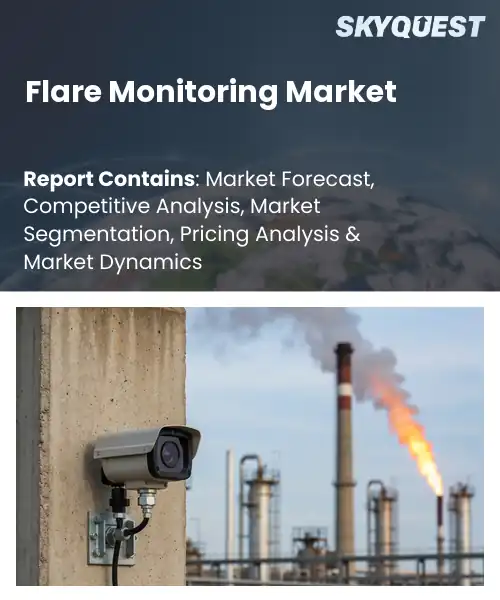
Flare Monitoring Market
Report ID: SQMIG20I2644
Report ID: SQMIG20I2644
[email protected]
USA +1 351-333-4748
Report ID:
SQMIG20I2644 |
Region:
Global |
Published Date: February, 2026
Pages:
157
|Tables:
176
|Figures:
79


Global Flare Monitoring Market size was valued at USD 1.28 Billion in 2024 and is poised to grow from USD 1.39 Billion in 2025 to USD 2.72 Billion by 2033, growing at a CAGR of 8.7% during the forecast period (2026-2033).
The main reason for the global flare monitoring market growth comes from stricter environmental rules and corporate net-zero goals because these requirements mandate operators to precisely measure and report their flaring emissions. Flare monitoring involves equipment and software and operational support which enables oil and gas facilities and refineries to measure their combustion efficiency and track their emissions of hydrocarbon gases. The industry adopted automated continuous monitoring systems after sensor technology reached better accuracy levels and analytical methods became more advanced and operational costs dropped. Satellite-based detection systems and infrared camera systems work together with stack-mounted flow meters to provide real-time alerts which help regulators and operators decrease emissions while enhancing gas recovery operations.
In addition, the global flare monitoring industry experiences its highest growth because advanced sensing technologies and analytics solutions enable organizations to achieve operational and financial advantages which drive their market uptake. When operators deploy integrated camera flow and satellite sensors coupled with AI-driven analytics they detect inefficient combustion and venting which leads to faster corrective actions that reduce methane emissions while recovering sellable gas. The effect creates better compliance results which generate actual financial returns for utilities and offshore platforms and midstream operators through both fuel sales and the prevention of penalties. Vendors expand their SaaS offering and service contract options to establish systems which enable them to generate ongoing recurring revenue.
How is AI Enhancing Predictive Capabilities in the Flare Monitoring Market?
The global flare monitoring market outlook changes by the use of AI to improve its predictive abilities by integrating continuous sensor data with advanced analytical techniques which predict combustion anomalies and plume initiation. The essential components involve visual and infrared camera systems which detect anomalies and ground-based data together with satellite data which creates unified information and model-based simulation methods which create virtual operational scenarios. The market has transitioned from using reactive logging systems to implementing proactive alert systems which help organizations determine their needed operational changes and upcoming maintenance tasks. Operators are requesting more emissions control solutions which provide compliance verification and operational resilience because of the increasing demand for these three outcomes. Smoke detection systems that operate at the edge and digital twin platforms which create process upset models to stop unwarranted flaring events serve as operational examples.
The edge AI platform from Afflu, which launched in February 2026, detects abnormal flare and smoke events while it creates audit ready timelines for all detected events. The system enables faster detection which allows for predictive actions that cut down the need for manual control while making reporting procedures easier. The system enables remote site monitoring expansion while it enables organizations to use AI for their flare management processes.
Market snapshot - (2026-2033)
Global Market Size
USD 1.8 Billion
Largest Segment
Hardware
Fastest Growth
Software
Growth Rate
8.2% CAGR
To get more insights on this market click here to Request a Free Sample Report
The global flare monitoring market is segmented based on component, mounting method, technology, application, industry vertical, deployment type, and region. By component, the market is categorized into hardware, software, and services. Based on mounting method, it is divided into in-process and remote monitoring systems. By technology, the market includes optical sensors, infrared sensors, acoustic sensors, thermal imaging, and remote sensing technologies. In terms of application, the market is segmented into flare gas recovery, emission monitoring, safety monitoring, data analytics, and regulatory compliance. Based on industry vertical, it covers oil & gas, petrochemical, waste management, mining, and metal & steel production industries. By deployment type, the market is classified into on-premises, cloud-based, and hybrid solutions. Regionally, the market is analyzed across North America, Europe, Asia Pacific, Latin America, and the Middle East & Africa.
As per the global flare monitoring market analysis, the industry needed hardware systems because flare stacks operated through physical sensors and infrared cameras and thermal imaging equipment plus their monitoring units. Oil and gas companies used infrared and optical sensor systems emissions monitoring because they needed to follow both emission control regulations and methane tracking requirements. Flare monitoring in both upstream and petrochemical operations generated its highest revenue from hardware sales because existing detection systems on site served as the primary detection method.
However, the software category is anticipated to have the highest flare monitoring market share because more people want real-time data analytics tools and AI-based pollution tracking systems and automated regulatory reporting solutions. The operating risks of their businesses and the protection of their environmental compliance needs lead more operators to implement predictive maintenance technologies with cloud-based monitoring dashboards.
According to the global flare monitoring market forecast, the market size of in-process system, which measure flare combustion efficiency together with emissions in real time at the source, achieved its highest level because these systems provided continuous monitoring capabilities. Major refineries and LNG processing facilities continued their implementation of in-stack sensor systems because they needed to meet strict environmental and safety regulatory standards. The highly precise systems find common usage in extensive oil and gas operations which require both safety and compliance with regulations.
Whereas the development of satellite monitoring systems together with remote sensing technology and drone inspection capabilities will drive the expansion of remote monitoring systems. Operators are establishing remote solutions for their flare sites which present hazardous conditions or difficult access challenges. Manual inspection requirements will decrease while maintenance costs will drop and safety of operations will increase.
To get detailed segments analysis, Request a Free Sample Report
As per the flare monitoring market regional forecast, North America achieves its dominance through its developed energy infrastructure and environmental laws which are strictly enforced and its widespread use of advanced technologies in various industrial sectors. The established oil and gas and petrochemical operations maintain their focus on compliance and transparency which generates ongoing demand for both advanced flare monitoring systems and their associated service agreements. The dense network of sensor manufacturers and systems integrators and analytics providers enables faster deployment of customized solutions while research and development capabilities and available funding enable both pilot testing and full commercial rollouts. The collaborative work between regulators and industry associations and operators establishes standardized operational methods and reporting standards which lead to increased usage of ongoing monitoring systems. The region provides extensive aftermarket and professional services which maintain system performance and use historical data to create operational improvements.
The United States flare monitoring sector benefits from its extensive energy resources which include diverse energy sources and its strong regulatory system and need for advanced monitoring solutions. The operators require advanced sensing technologies and data analytics and service contracts because they need to protect their legal obligations and their corporate reputation. The network of vendors and integrators and testing facilities enables companies to deploy their products quickly while the technology providers work together on pilot projects to create innovative solutions which develop new industry standards.
The Flare Monitoring Market in Canada develops through its need to monitor remote field sites which protect the environment and meet indigenous consultation requirements during project design. The operators of remote monitoring systems prefer ruggedized systems which can transmit data from distant locations without needing frequent maintenance because domestic engineering firms and academic institutions provide backing for these systems. The policy system which promotes service transparency and service trade between countries spurs the development of specialized installers and service providers while research projects develop reliable systems for cold weather operation.
The Asia Pacific market experiences rapid growth because industrialization progresses and environmental awareness increases and governments implement policies which support emissions monitoring. The expansion of petrochemical and refinery facilities in major industrial centers and the need to improve urban air quality are driving the demand for both inexpensive and advanced monitoring solutions. Manufacturers in the region now provide customized products which offer low prices and high technical performance while their global technology partners help them transfer knowledge and adjust to local operational requirements. Operators for monitoring purposes are increasingly adopting remote sensing and satellite-enabled services and integrated analytics as they search for solutions which allow them to monitor at a lower cost while expanding their monitoring capabilities.
The Flare Monitoring Market in Japan shows advanced industrial development through its strong emphasis on measuring instrument quality and its systems which link plant automation with control measurement technology. The research organizations and industrial operators in the field require high precision measurements and calibration and lifecycle support so vendors should provide them with certified measurement solutions. The industrial sector needs advanced analytics and dependable field monitoring equipment to implement flare monitoring as part of its emissions control programs which enables suppliers to create new technology solutions which become standard across industrial applications.
The Flare Monitoring Market in South Korea grows through its heavy industrial sector which operates multiple facilities and its electronics manufacturing base which drives companies to implement digital monitoring systems. The large conglomerates which operate in this market prefer to use integrated solutions which offer all three functions of sensing and communication and analysis whereas local system integrators modify international technologies to meet the specifications of Korean customers. The industrial safety culture together with the export-oriented supply chains enables manufacturers to create scalable products which development through programs which manufacturers and operators create.
Europe improves its competitive advantage through its strict regulatory procedures and its dedication to emissions reporting and its dynamic innovation system which connects businesses with research facilities and technology providers. Harmonized standards and cross border collaboration enable industrial clusters to adopt high technology sensing and analytics systems through shared operational frameworks. The retrofit programs and existing facility modernization initiatives create continuous demand for vendors who supply dependable certified products and service models. Companies within the region use their expertise in instrumentation and data management to build monitoring systems which help businesses achieve their sustainability goals while public and stakeholder pressure drives transparency and emission verification best practices in flare monitoring and emissions verification.
The Flare Monitoring Market in Germany provides advanced sensing technology development and reliable hardware manufacturing capabilities through its expert engineering team and its strong manufacturing operations. The industrial sector needs to develop systems which work together in complex plant environments by creating solutions which link to industrial automation and digitalization systems. System integrators who work locally with specialized vendors provide solutions which prioritize system reliability and easy maintenance together with their support for both retrofit projects and new system installations that meet national energy transition goals and environmental standards which apply to international trade.
The United Kingdom Flare Monitoring Market employs its offshore knowledge and existing regulatory framework for oil and gas operations to develop detailed monitoring and compliance requirements. Offshore installations require specialized service providers who deliver customized solutions which focus on safety and emission reduction. The innovation process in remote sensing and analytics development depends on the collaboration between operators and technology firms and research centers which create demand for adaptable monitoring platforms and term service models through their decommissioning and modernization programs.
The Flare Monitoring Market in France features strong regulatory controls which protect vital operations while its instrumentation industry develops highly precise instruments to meet regulatory standards. National research institutes work with the industry to develop advanced sensor technology and emissions verification methods, which petrochemical and refining facilities should adopt. The suppliers provide complete solutions which include field hardware and analytics and maintenance services, while environmental regulations and safety requirements drive the need for engineering-based retrofitting and installation work.
To know more about the market opportunities by region and country, click here to
Buy The Complete Report
Increasing Satellite Deployments
The ability to detect solar flares in near real time has expanded through the increased number of satellites and better coverage, which enables the creation of more extensive monitoring systems and constant data streams. Advanced flare monitoring instruments and data processing services and integration solutions create market growth through expanded observational footprint. Space weather forecasting organizations and satellite operators need reliable flare detection systems to safeguard their assets and maintain operation, which drives their need to acquire monitoring systems and leads to global investment in related technologies.
Advances In Data Analytics
Technological advancements which bring about better detection capabilities together with lower false alert rates enable the development of new market opportunities. The improved data analytics and machine learning algorithms and advanced modeling capabilities help scientists achieve better accuracy in their analysis of solar radiation data. The demand for integrated monitoring platforms and advanced software services in business grows because analytics capabilities progress from basic operational observation to full operational functionality.
High Implementation and Maintenance Costs
Advanced flare monitoring systems require high operational expenses which make it difficult for smaller operators and budget-restricted organizations to use these systems, which results in slower market growth. The high costs of sensor acquisition and platform integration and skilled personnel maintenance create barriers that prevent potential customers from buying products and that extend delays in purchase decisions. The financial barrier prohibits rapid deployment and monitoring investment, which causes some stakeholders to reduce their investments, resulting in decreased market penetration and slower adoption across various user groups.
Regulatory and Data Sharing Challenges
The global implementation of flare monitoring solutions faces two major challenges which include complex regulatory frameworks and restrictions on cross-border data sharing and the need to protect information privacy. The standardization process and data sharing permissions lead to decreased chances of establishing collaborative networks which provide integrated services because these two aspects create barriers for comprehensive service delivery. Providers and end users have difficulty interfacing operations because their needs for interoperability become more complex and their needs for compliance become more demanding. The potential for partnership development and multi-jurisdictional projects leads to market development delays which will prolong the time it takes to achieve widespread adoption.
Request Free Customization of this report to help us to meet your business objectives.
The global flare monitoring market is experiencing increased competition because companies need to implement specific business approaches which satisfy tighter measurement-based MRV standards and operators who require proof of compliant measurement results. Current initiatives involve companies establishing partnerships which integrate edge analytics into industrial systems while satellite systems from philanthropic and commercial sources provide independent verification, and vendors offer multispectral continuous monitoring solutions through products like SENSIA's Agni-RedLook system to achieve superior measurement performance and auditing capabilities.
CleanConnect.ai: The company started its operations in 2020 to develop AI-based visual automation solutions which enable automatic VOC and methane leak detection and flare monitoring and regulatory compliance throughout upstream and midstream petroleum activities. The company achieved its latest milestone by securing Series A funding from TCP ProveZero and Turnbridge partners which enabled them to start commercial deployment of Autonomous365 for automated Method 22 reporting while they established connections with emissions management partners to cut down manual inspection requirements and accelerate operator notification processes.
SkyQuest’s ABIRAW (Advanced Business Intelligence, Research & Analysis Wing) is our Business Information Services team that Collects, Collates, Correlates, and Analyses the Data collected by means of Primary Exploratory Research backed by robust Secondary Desk research.
As per SkyQuest analysis, the global flare monitoring market expands its growth through stringent environmental regulations and corporate net-zero commitments which require organizations to achieve precise detection and reporting. The current market adoption of AI-based predictive monitoring for recovery processes has become possible through advanced sensing and analytics technologies. The high expenses associated with implementation and maintenance serve as a major obstacle that especially affects smaller operators. The North American market maintains its leading position because of its established infrastructure and strict regulatory requirements and its comprehensive vendor ecosystem, while optical sensors dominate technology selection because they provide precise flare characterization together with low false alarm rates. Vendors are moving their business model toward cloud and SaaS solutions to establish ongoing revenue streams which enable them to expand their product deployments.
| Report Metric | Details |
|---|---|
| Market size value in 2024 | USD 1.8 Billion |
| Market size value in 2033 | USD 3.66 Billion |
| Growth Rate | 8.2% |
| Base year | 2024 |
| Forecast period | (2026-2033) |
| Forecast Unit (Value) | USD Billion |
| Segments covered |
|
| Regions covered | North America (US, Canada), Europe (Germany, France, United Kingdom, Italy, Spain, Rest of Europe), Asia Pacific (China, India, Japan, Rest of Asia-Pacific), Latin America (Brazil, Rest of Latin America), Middle East & Africa (South Africa, GCC Countries, Rest of MEA) |
| Companies covered |
|
| Customization scope | Free report customization with purchase. Customization includes:-
|
To get a free trial access to our platform which is a one stop solution for all your data requirements for quicker decision making. This platform allows you to compare markets, competitors who are prominent in the market, and mega trends that are influencing the dynamics in the market. Also, get access to detailed SkyQuest exclusive matrix.
Table Of Content
Executive Summary
Market overview
Parent Market Analysis
Market overview
Market size
KEY MARKET INSIGHTS
COVID IMPACT
MARKET DYNAMICS & OUTLOOK
Market Size by Region
KEY COMPANY PROFILES
Methodology
For the Flare Monitoring Market, our research methodology involved a mixture of primary and secondary data sources. Key steps involved in the research process are listed below:
1. Information Procurement: This stage involved the procurement of Market data or related information via primary and secondary sources. The various secondary sources used included various company websites, annual reports, trade databases, and paid databases such as Hoover's, Bloomberg Business, Factiva, and Avention. Our team did 45 primary interactions Globally which included several stakeholders such as manufacturers, customers, key opinion leaders, etc. Overall, information procurement was one of the most extensive stages in our research process.
2. Information Analysis: This step involved triangulation of data through bottom-up and top-down approaches to estimate and validate the total size and future estimate of the Flare Monitoring Market.
3. Report Formulation: The final step entailed the placement of data points in appropriate Market spaces in an attempt to deduce viable conclusions.
4. Validation & Publishing: Validation is the most important step in the process. Validation & re-validation via an intricately designed process helped us finalize data points to be used for final calculations. The final Market estimates and forecasts were then aligned and sent to our panel of industry experts for validation of data. Once the validation was done the report was sent to our Quality Assurance team to ensure adherence to style guides, consistency & design.
Analyst Support
Customization Options
With the given market data, our dedicated team of analysts can offer you the following customization options are available for the Flare Monitoring Market:
Product Analysis: Product matrix, which offers a detailed comparison of the product portfolio of companies.
Regional Analysis: Further analysis of the Flare Monitoring Market for additional countries.
Competitive Analysis: Detailed analysis and profiling of additional Market players & comparative analysis of competitive products.
Go to Market Strategy: Find the high-growth channels to invest your marketing efforts and increase your customer base.
Innovation Mapping: Identify racial solutions and innovation, connected to deep ecosystems of innovators, start-ups, academics, and strategic partners.
Category Intelligence: Customized intelligence that is relevant to their supply Markets will enable them to make smarter sourcing decisions and improve their category management.
Public Company Transcript Analysis: To improve the investment performance by generating new alpha and making better-informed decisions.
Social Media Listening: To analyze the conversations and trends happening not just around your brand, but around your industry as a whole, and use those insights to make better Marketing decisions.
REQUEST FOR SAMPLE
 REQUEST FREE CUSTOMIZATION
Global Flare Monitoring Market size was valued at USD 1.8 Billion in 2024 and is poised to grow from USD 1.95 Billion in 2025 to USD 3.66 Billion by 2033, growing at a CAGR of 8.2% during the forecast period (2026-2033).
Competitive pressure in the global flare monitoring market is being driven by tighter measurement based MRV requirements and operator demand for verifiable compliance data, forcing firms to pursue concrete strategies. Recent activity shows partnerships to embed edge analytics with industrial vendors, philanthropic and commercial satellite deployments for independent verification, and vendors commercializing multispectral continuous monitors such as SENSIA’s Agni-RedLook to win on measurement accuracy and auditability. 'Siemens Group', 'Honeywell', 'ABB', 'Emerson Electric Co.', 'Thermo Fisher Scientific', 'Flir Systems', 'MKS Instruments', 'Ametek Inc.', 'Zeeco Inc.', 'Lumasense Technologies Inc.', 'Endress+Hauser Ag', 'John Zink Company, LLC', 'Fluenta', 'Oleumtech Corporation', 'Galvanic Applied Sciences', 'Teledyne FLIR LLC', 'KROHNE', 'Advanced Energy', 'MSA Safety', 'Providence Photonics LLC'
Increasing numbers of satellites and improved coverage expand the capability to detect solar flares in near real time, enabling broader monitoring networks and more consistent data streams. This expanded observational footprint supports market growth by creating demand for advanced flare monitoring instruments, data processing services, and integration solutions. Organizations responsible for space weather forecasting and satellite operators increasingly require reliable flare detection to protect assets and maintain operations, driving procurement of monitoring systems and stimulating investments in related technologies worldwide.
As per the flare monitoring market regional forecast, North America achieves its dominance through its developed energy infrastructure and environmental laws which are strictly enforced and its widespread use of advanced technologies in various industrial sectors.


Want to customize this report? This report can be personalized according to your needs. Our analysts and industry experts will work directly with you to understand your requirements and provide you with customized data in a short amount of time. We offer $1000 worth of FREE customization at the time of purchase.
Feedback From Our Clients


 USA (+1) 351-333-4748

