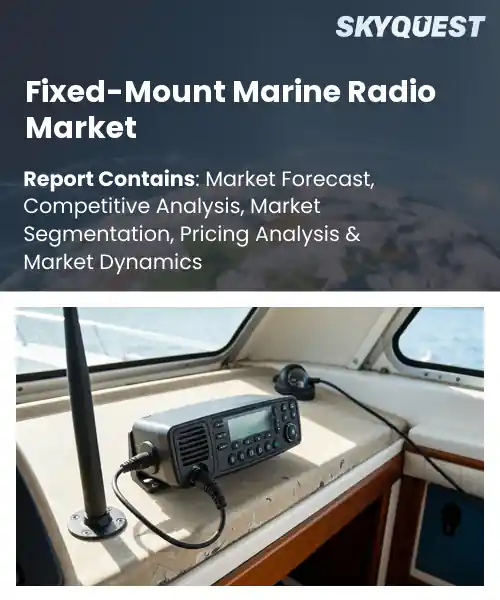
Fixed-Mount Marine Radio Market
Report ID: SQMIG45H2257
Report ID: SQMIG45H2257
[email protected]
USA +1 351-333-4748
Report ID:
SQMIG45H2257 |
Region:
Global |
Published Date: July, 2026
Pages:
157
|Tables:
115
|Figures:
77


Global Fixed-Mount Marine Radio Market size was valued at USD 1.74 Billion in 2024 and is poised to grow from USD 1.86 Billion in 2025 to USD 3.12 Billion by 2033, growing at a CAGR of 6.7% during the forecast period (2026-2033).
The global fixed‑mount marine radio market comprises rugged transceivers permanently installed on vessels to enable reliable voice communication, distress signaling, and navigation support. Its significance stems from stringent safety regulations such as SOLAS and the growing need for seamless coordination among commercial fleets, recreational yachts, and offshore platforms. Historically, the sector evolved from bulky analog units of the 1970s to digital consoles that integrate AIS and GPS data, driven by advances in semiconductor technology and decreasing component costs. For example, major shipbuilders now standardize VHF fixed‑mount units on new builds, reducing reliance on handheld devices and enhancing crew situational awareness. Regulatory harmonization across maritime jurisdictions constitutes the next pivotal catalyst, as authorities mandate continuous monitoring of VHF channels and automatic distress alerts, prompting operators to upgrade legacy equipment. This requirement fuels demand for radios equipped with DSC (Digital Selective Calling) and NMEA‑2000 compatibility, features that enable rapid incident reporting and seamless data exchange with bridge management systems. In practice, a North Sea offshore wind farm recently integrated fixed‑mount units with remote‑management software, cutting maintenance trips by 30 % and improving safety compliance. Consequently, manufacturers are channeling R&D into architectures and cloud‑based diagnostics, opening revenue streams through service contracts and aftermarket upgrades.
How is AI enhancing performance and reliability in the fixed‑mount marine radio market?
AI driven signal processing is sharpening voice clarity and reducing interference in fixed‑mount marine radios, allowing crews to communicate with confidence even in congested bands. Machine learning models analyze traffic patterns and automatically adjust channel selection, which improves uptime and cuts manual tuning. Predictive analytics monitor component health, flagging wear before failure and scheduling service during low‑usage periods. Integration with vessel navigation data lets radios prioritize critical alerts, enhancing safety while conserving power. These capabilities are reshaping the market as operators seek reliable, low‑maintenance solutions that adapt to changing maritime environments, driving broader adoption of smart radio platforms.In March 2024 Icom introduced an AI powered fixed‑mount marine radio that combines voice command with self‑diagnostic monitoring, demonstrating how intelligent features boost reliability and streamline operations, supporting market growth.
Market snapshot - (2026-2033)
Global Market Size
USD 1.74 Billion
Largest Segment
VHF
Fastest Growth
MF/HF
Growth Rate
6.7% CAGR
To get more insights on this market click here to Request a Free Sample Report
Global fixed-mount marine radio market is segmented by frequency type, power output, feature, end user and region. Based on frequency type, the market is segmented into VHF and MF/HF. Based on power output, the market is segmented into Up to 25 W and Above 25 W. Based on feature, the market is segmented into DSC Enabled, GPS Integrated and AIS Compatible. Based on end user, the market is segmented into Commercial Vessels, Recreational Boats and Defense. Based on region, the market is segmented into North America, Europe, Asia Pacific, Latin America and Middle East & Africa.
DSC enabled segment dominates because it directly addresses the critical safety and compliance requirements of maritime communication. By providing automatic distress signaling, it reduces response time during emergencies, which operators prioritize when selecting fixed mount marine radios. The reliability of digital selective calling builds trust among vessel owners, encouraging widespread specification in new builds and retrofits. Consequently, manufacturers focus development resources on DSC integration, reinforcing its market leadership.
However, AIS compatible segment is witnessing the strongest growth momentum as global traffic monitoring standards evolve. Integration of automatic identification system data enhances situational awareness, prompting ship owners to upgrade radios for better collision avoidance. This demand fuels component innovation and expands the addressable customer base, accelerating overall market expansion.
Above 25 W segment dominates because it satisfies the robust transmission demands of large commercial fleets operating in challenging sea conditions. Higher power ensures reliable long range communication, which is essential for coordinated navigation and convoy management. Vessel operators view this capability as a risk mitigation tool, prompting specification in new builds and mandatory upgrades. As a result, manufacturers allocate engineering focus to high output designs, reinforcing market prominence.
Meanwhile, Up to 25 W segment is emerging as a high growth area due to increasing adoption on recreational boats seeking affordable yet compliant communication solutions. Lower power models align with budget constraints while meeting safety regulations, encouraging retrofits. This trend broadens the user base and stimulates cost reductions, propelling market expansion.
To get detailed segments analysis, Request a Free Sample Report
North America benefits from a mature maritime infrastructure, extensive regulatory frameworks that prioritize safety, and a deep network of original equipment manufacturers. The United States and Canada combine high adoption of advanced communication standards with strong demand from commercial fishing, recreational boating, and offshore energy sectors. Robust research and development ecosystems foster continuous innovation in antenna design and signal processing, while well‑established distribution channels ensure rapid market penetration. Moreover, stringent compliance requirements drive operators to invest in reliable fixed‑mount solutions, reinforcing the region’s position as a global benchmark for performance and reliability.
Fixed-Mount Marine Radio Market in the United States is propelled by a large fleet of commercial vessels and a vibrant recreational boating community that values cutting‑edge communication tools. The regulatory emphasis on maritime safety encourages widespread retrofitting of vessels with compliant devices, while a strong presence of technology firms accelerates product development cycles. End‑users benefit from an extensive support network that simplifies installation and maintenance, reinforcing market confidence.
Fixed-Mount Marine Radio Market in Canada reflects the country’s extensive coastline and strong offshore resource activities that demand dependable communication links. Government standards for marine safety and environmental stewardship create a steady need for reliable fixed‑mount solutions. Collaborative efforts between local manufacturers and research institutions nurture innovation tailored to cold‑water operations, while a focused distribution framework ensures accessibility across remote maritime communities.
Europe’s expansion is fueled by rigorous safety directives, a high concentration of luxury yacht manufacturers, and progressive environmental policies that emphasize efficient navigation systems. Germany leads in engineering excellence, delivering precision‑crafted equipment that sets industry benchmarks. The United Kingdom exhibits brisk adoption driven by its vibrant leisure boating culture and strategic investment in maritime digitalisation. France contributes emerging demand through its expanding coastal tourism sector and renewed interest in modernising legacy fleets. Cross‑border harmonisation of standards and strong collaboration among European research hubs further accelerate technology diffusion and market growth.
Fixed‑Mount Marine Radio Market in Germany is anchored by a reputation for engineering precision and a robust industrial base that supplies high‑quality components. The nation’s emphasis on maritime safety standards encourages early adoption of advanced fixed‑mount devices across commercial and leisure vessels. Strong ties between manufacturers and technical universities foster continuous product refinement, ensuring that German offerings remain at the forefront of reliability and performance.
Fixed‑Mount Marine Radio Market in the United Kingdom is driven by an enthusiastic recreational boating community and a strategic focus on maritime digital transformation. Regulatory frameworks promote the integration of state‑of‑the‑art communication gear, while a thriving network of specialist installers accelerates market uptake. Collaborative initiatives between maritime authorities and technology providers support rapid rollout of next‑generation fixed‑mount solutions, positioning the United Kingdom as a fast‑moving hub for market expansion.
Fixed‑Mount Marine Radio Market in France is emerging as coastal tourism and maritime leisure activities gain momentum. National safety guidelines spur investment in modern communication equipment for both commercial and private vessels. Increased collaboration between French design firms and European research institutions nurtures innovative product features tailored to the Mediterranean and Atlantic operating environments, gradually expanding market presence.
Asia Pacific is advancing its role through rapid modernization of its maritime fleets, heightened emphasis on safety compliance, and increasing integration of digital navigation technologies. Japan leverages its legacy of precision electronics to deliver sophisticated fixed‑mount solutions that meet stringent operational demands. South Korea benefits from a dynamic shipbuilding sector that incorporates advanced communication systems as standard equipment, reinforcing the region’s competitiveness. Regional trade agreements and collaborative research initiatives further enhance technology transfer, supporting a cohesive ecosystem that drives adoption across commercial, recreational, and offshore segments.
Fixed‑Mount Marine Radio Market in Japan capitalises on a strong heritage of electronic innovation and a disciplined regulatory environment that prioritises vessel safety. Japanese manufacturers integrate cutting‑edge signal processing and robust hardware design, catering to both domestic and export markets. Close cooperation with maritime academies ensures that product development aligns with evolving operational requirements, fostering confidence among ship owners and operators.
Fixed‑Mount Marine Radio Market in South Korea is buoyed by a thriving shipbuilding industry that embeds advanced communication technology into new builds as a core feature. Governmental focus on maritime safety and digital connectivity encourages continuous upgrades of existing fleets. Partnerships between leading Korean electronics firms and marine research centres accelerate the introduction of resilient, high‑performance fixed‑mount devices, reinforcing the nation’s growing influence in the regional market.
To know more about the market opportunities by region and country, click here to
Buy The Complete Report
Increasing Maritime Safety Regulations
Growing Adoption Of Digital Communication
High Installation Cost Barriers
Limited Compatibility With Legacy Systems
Request Free Customization of this report to help us to meet your business objectives.
The competitive landscape of the global fixed‑mount marine radio market is shaped by established manufacturers such as Icom, Standard Horizon and Raymarine, which are pursuing strategic M&A to broaden product portfolios, forming distribution partnerships to increase market reach, and investing in digital VHF and AIS integration to deliver smarter, interoperable communication solutions. These moves intensify competition and accelerate technology adoption across commercial and recreational marine segments.
Top Player’s Company Profile
Recent Developments
SkyQuest’s ABIRAW (Advanced Business Intelligence, Research & Analysis Wing) is our Business Information Services team that Collects, Collates, Correlates, and Analyses the Data collected by means of Primary Exploratory Research backed by robust Secondary Desk research. As per SkyQuest analysis, the global fixed‑mount marine radio market is being propelled primarily by increasing maritime safety regulations that require vessels to equip reliable distress‑signaling radios, while a second powerful driver is the rapid adoption of digital communication standards such as DSC and AIS integration which boost operational efficiency and safety. The market’s growth is tempered by high installation cost barriers that discourage smaller operators from upgrading. North America remains the dominant region thanks to its mature maritime infrastructure and stringent compliance environment. Within the product landscape, DSC‑enabled radios dominate, reflecting the critical need for automatic distress alerts in both commercial and recreational fleets.
| Report Metric | Details |
|---|---|
| Market size value in 2024 | USD 1.74 Billion |
| Market size value in 2033 | USD 3.12 Billion |
| Growth Rate | 6.7% |
| Base year | 2024 |
| Forecast period | (2026-2033) |
| Forecast Unit (Value) | USD Billion |
| Segments covered |
|
| Regions covered | North America (US, Canada), Europe (Germany, France, United Kingdom, Italy, Spain, Rest of Europe), Asia Pacific (China, India, Japan, Rest of Asia-Pacific), Latin America (Brazil, Rest of Latin America), Middle East & Africa (South Africa, GCC Countries, Rest of MEA) |
| Companies covered |
|
| Customization scope | Free report customization with purchase. Customization includes:-
|
To get a free trial access to our platform which is a one stop solution for all your data requirements for quicker decision making. This platform allows you to compare markets, competitors who are prominent in the market, and mega trends that are influencing the dynamics in the market. Also, get access to detailed SkyQuest exclusive matrix.
Table Of Content
Executive Summary
Market overview
Parent Market Analysis
Market overview
Market size
KEY MARKET INSIGHTS
COVID IMPACT
MARKET DYNAMICS & OUTLOOK
Market Size by Region
KEY COMPANY PROFILES
Methodology
For the Fixed-Mount Marine Radio Market, our research methodology involved a mixture of primary and secondary data sources. Key steps involved in the research process are listed below:
1. Information Procurement: This stage involved the procurement of Market data or related information via primary and secondary sources. The various secondary sources used included various company websites, annual reports, trade databases, and paid databases such as Hoover's, Bloomberg Business, Factiva, and Avention. Our team did 45 primary interactions Globally which included several stakeholders such as manufacturers, customers, key opinion leaders, etc. Overall, information procurement was one of the most extensive stages in our research process.
2. Information Analysis: This step involved triangulation of data through bottom-up and top-down approaches to estimate and validate the total size and future estimate of the Fixed-Mount Marine Radio Market.
3. Report Formulation: The final step entailed the placement of data points in appropriate Market spaces in an attempt to deduce viable conclusions.
4. Validation & Publishing: Validation is the most important step in the process. Validation & re-validation via an intricately designed process helped us finalize data points to be used for final calculations. The final Market estimates and forecasts were then aligned and sent to our panel of industry experts for validation of data. Once the validation was done the report was sent to our Quality Assurance team to ensure adherence to style guides, consistency & design.
Analyst Support
Customization Options
With the given market data, our dedicated team of analysts can offer you the following customization options are available for the Fixed-Mount Marine Radio Market:
Product Analysis: Product matrix, which offers a detailed comparison of the product portfolio of companies.
Regional Analysis: Further analysis of the Fixed-Mount Marine Radio Market for additional countries.
Competitive Analysis: Detailed analysis and profiling of additional Market players & comparative analysis of competitive products.
Go to Market Strategy: Find the high-growth channels to invest your marketing efforts and increase your customer base.
Innovation Mapping: Identify racial solutions and innovation, connected to deep ecosystems of innovators, start-ups, academics, and strategic partners.
Category Intelligence: Customized intelligence that is relevant to their supply Markets will enable them to make smarter sourcing decisions and improve their category management.
Public Company Transcript Analysis: To improve the investment performance by generating new alpha and making better-informed decisions.
Social Media Listening: To analyze the conversations and trends happening not just around your brand, but around your industry as a whole, and use those insights to make better Marketing decisions.
REQUEST FOR SAMPLE
 REQUEST FREE CUSTOMIZATION


Want to customize this report? This report can be personalized according to your needs. Our analysts and industry experts will work directly with you to understand your requirements and provide you with customized data in a short amount of time. We offer $1000 worth of FREE customization at the time of purchase.
Feedback From Our Clients


 USA (+1) 351-333-4748

