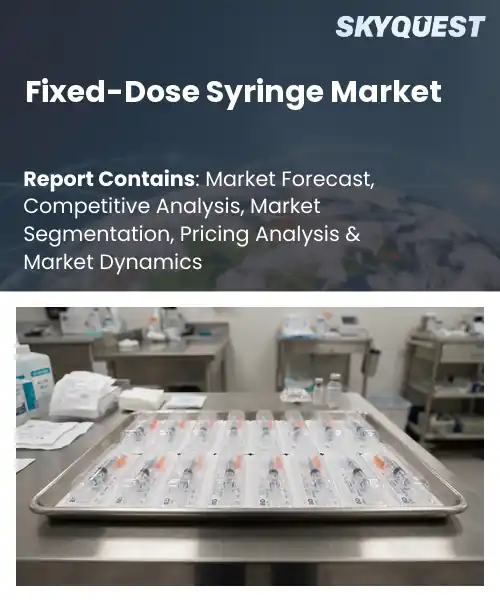
Fixed-Dose Syringe Market
Report ID: SQMIG35A4617
Report ID: SQMIG35A4617
[email protected]
USA +1 351-333-4748
Report ID:
SQMIG35A4617 |
Region:
Global |
Published Date: November, 2026
Pages:
157
|Tables:
118
|Figures:
77


Global Fixed-Dose Syringe Market size was valued at USD 6.4 Billion in 2024 and is poised to grow from USD 6.84 Billion in 2025 to USD 11.57 Billion by 2033, growing at a CAGR of 6.8% during the forecast period (2026-2033).
The global fixed‑dose syringe market comprises pre‑filled devices that integrate a sterile syringe with a precisely measured drug dose, allowing a single‑step injection. Its importance stems from reduced dosing errors, accelerated vaccine campaigns, and diminished medical waste benefits that proved vital during recent pandemics. Though initially confined to high‑value biologics in the early 2000s, the market broadened when regulators such as the FDA and EMA created streamlined pathways for combination products. The 2010 launch of a pre‑filled epinephrine auto‑injector for anaphylaxis illustrated how patient‑focused design spurred uptake in emergency care, prompting manufacturers to adopt flexible platforms for diverse therapeutics across indications. Building on this foundation, the principal growth engine for the global fixed‑dose syringe market is the expansion of immunization programs spurred by public‑health goals and new infectious threats. Government funding for mass vaccination lifts demand for ready‑to‑use syringes, prompting manufacturers to scale production, lower costs, and strengthen supply chains. A notable example is a partnership that supplied ten million COVID‑19 booster doses in pre‑filled syringes, cutting administration time by 40 % and reducing cold‑chain loss. This efficiency and use in oncology biologics and hormone therapies creates demand for advanced glass‑bolt‑lock designs that cut breakage and enable automated filling, accelerating market penetration.
How are AI and IoT technologies reshaping the fixed-dose syringe market?
AI-driven predictive analytics are enabling manufacturers to anticipate demand spikes and adjust production schedules for fixed‑dose syringes, reducing waste and inventory costs. IoT sensors embedded in manufacturing equipment provide real‑time data on temperature, pressure and fill accuracy, allowing immediate corrective actions that improve sterility and dosage precision. Together these technologies create a closed‑loop system where data from the production line informs supply‑chain decisions and quality‑control protocols, making the overall process more agile and reliable. The result is faster time‑to‑market for new therapies and greater confidence among healthcare providers that each syringe meets stringent safety standards.Becton Dickinson announced a smart‑connected syringe platform in June 2024, integrating AI‑based fill‑volume monitoring with IoT telemetry, which streamlines batch verification and reduces manual checks, boosting efficiency across the fixed‑dose syringe supply chain.
Market snapshot - (2026-2033)
Global Market Size
USD 6.4 Billion
Largest Segment
Prefilled Syringes
Fastest Growth
Fixed-Volume Disposable Syringes
Growth Rate
6.8% CAGR
To get more insights on this market click here to Request a Free Sample Report
Global fixed-dose syringe market is segmented by product type, material, application, end user and region. Based on product type, the market is segmented into Prefilled Syringes, Fixed-Volume Disposable Syringes and Other Fixed-Dose Syringes. Based on material, the market is segmented into Glass and Plastic. Based on application, the market is segmented into Vaccines, Biologics, Insulin & Diabetes Care and Other Therapeutic Applications. Based on end user, the market is segmented into Hospitals & Clinics, Ambulatory Surgical Centers, Home Healthcare and Pharmaceutical & Biotechnology Companies. Based on region, the market is segmented into North America, Europe, Asia Pacific, Latin America and Middle East & Africa.
Prefilled syringes segment dominates because they combine sterility, precise dosing, and ease of administration, meeting the heightened demand for ready‑to‑use delivery devices across diverse therapeutic areas. Manufacturers benefit from streamlined supply chains and reduced preparation errors, while healthcare providers appreciate the time‑saving workflow that enhances patient safety. This convergence of regulatory encouragement for single‑use devices and the push for patient‑centric care reinforces their central role in market expansion.
Meanwhile, fixed‑volume disposable syringes emerge as the most rapidly expanding category, driven by increasing adoption in emerging biologic therapies that require exact volume delivery without re‑constitution. Their low cost and compatibility with automated filling lines accelerate production scalability, positioning them as a catalyst for broader market penetration.
Plastic segment dominates because it offers lightweight construction, impact resistance, and cost efficiency, aligning with manufacturers’ need to deliver high‑volume products while maintaining patient comfort. Advances in polymer technology provide barrier properties that protect sensitive biologics, and regulatory pathways favor single‑use plastic devices for infection control. These benefits drive widespread preference across therapeutic applications, cementing plastic as the material of choice in market growth.
On the other hand, glass emerges as the fastest growing material category, propelled by its superior inertness and transparency that support high‑potency biologic and vaccine formulations. Emerging thin‑wall glass designs reduce weight while preserving strength, and heightened focus on cold‑chain stability encourages its adoption, creating new opportunities for premium market segments and innovation pipelines.
To get detailed segments analysis, Request a Free Sample Report
North America leads the Fixed-Dose Syringe market due to a mature healthcare infrastructure, strong regulatory alignment, and extensive investment in advanced manufacturing capabilities. The region benefits from a high concentration of multinational pharmaceutical firms that prioritize prefilled delivery technologies for improved patient safety and adherence. Robust reimbursement frameworks encourage adoption in hospital and outpatient settings, while a skilled workforce supports continuous innovation in device design and materials. Collaborative ecosystems linking device manufacturers, drug developers, and clinical institutions drive rapid product development cycles. Moreover, the presence of leading research institutions and a culture of early technology uptake further consolidates the region’s dominant position. This ecosystem also encourages continuous improvement in training programs for healthcare professionals, ensuring optimal use of prefilled technologies.
Fixed-Dose Syringe Market in the United States thrives on a convergence of advanced clinical research networks and a strong emphasis on precision medicine. Leading pharmaceutical innovators collaborate closely with device engineers to embed prefilled solutions into therapeutic pipelines. Regulatory pathways that reward safety and usability accelerate market entry, while healthcare providers prioritize streamlined administration to enhance treatment outcomes. This ecosystem sustains a continual flow of novel product introductions in the market.
Fixed-Dose Syringe Market in Canada is shaped by a proactive health authority framework that encourages early adoption of safety-enhancing devices. Collaborative initiatives between provincial health systems and multinational manufacturers foster localized testing and validation of prefilled technologies. Emphasis on cost-effective delivery aligns with public health objectives, driving integration across acute and community care settings. The supportive policy environment cultivates a steady pipeline of innovative syringe solutions for national health improvement.
Europe experiences rapid expansion of the Fixed-Dose Syringe market driven by a confluence of regulatory harmonization, strong emphasis on patient safety, and widespread commitment to sustainable healthcare delivery. Cross‑border regulatory frameworks facilitate streamlined approval processes, encouraging manufacturers to launch prefilled solutions across multiple markets simultaneously. National health systems prioritize reduction of medication errors, making prefilled devices an attractive option for hospitals and outpatient clinics. Additionally, a growing focus on environmental stewardship prompts adoption of recyclable and low‑waste syringe designs. Collaborative research programs among academic institutions, biotech firms, and device specialists accelerate innovation in drug‑device compatibility. Market participants also benefit from public‑private partnerships that support clinical validation and reimbursement pathways, reinforcing confidence among clinicians and patients alike. This ecosystem also encourages continuous improvement in training programs for healthcare professionals, ensuring optimal use of prefilled technologies.
Fixed-Dose Syringe Market in Germany benefits from a strong industrial base and a quality certification system that underpins confidence in prefilled delivery devices. Close collaboration between pharmaceutical giants and precision engineering firms results in reliable syringe solutions tailored to therapeutic regimens. Government incentives for health integration encourage adoption of devices that track usage and ensure compliance. The national focus on reducing medication errors aligns closely with the attributes of fixed-dose technology.
Fixed-Dose Syringe Market in the United Kingdom accelerates through government health initiatives and a biotech ecosystem that embraces innovative delivery formats. Reimbursement pathways reward clinical benefits of prefilled syringes, prompting uptake in both hospital and community care. Collaborative networks linking academic research centers with device manufacturers foster agile development cycles and clinical validation. Patient advocacy groups also play a pivotal role in promoting acceptance of fixed-dose solutions across therapeutic areas.
Fixed-Dose Syringe Market in France is emerging as healthcare providers seek streamlined administration to improve patient experience. National health policies emphasize reduction of drug handling errors, creating a receptive environment for prefilled technologies. Partnerships between regional pharmaceutical clusters and device innovators facilitate localized testing and adaptation to market needs. Growing awareness among clinicians about the safety and efficiency of fixed-dose delivery supports incremental adoption across chronic disease management programs.
Asia Pacific strengthens its position in the Fixed-Dose Syringe market by leveraging rapid healthcare modernization, increasing focus on patient-centric care, and expanding manufacturing capabilities across key economies. Government initiatives that prioritize safe injection practices and support domestic production of advanced medical devices encourage local companies to invest in prefilled technology platforms. The region's large and diverse patient populations create demand for convenient, low‑volume dosing solutions, especially in chronic and immunization programs. Collaborative ventures between multinational pharmaceutical firms and emerging Asian device manufacturers accelerate technology transfer and foster customized design for regional therapeutic needs. Additionally, growing awareness of environmental impact drives interest in recyclable and low‑waste syringe formats, aligning market growth with sustainability objectives. These dynamics position the region as a leading hub for innovative prefilled delivery solutions that can be scaled globally.
Fixed-Dose Syringe Market in Japan advances through a regulatory framework that emphasizes precision and safety, encouraging adoption of prefilled delivery devices across hospital networks. Collaboration between leading pharmaceutical companies and engineering firms results in sophisticated syringe designs tailored to the country’s high standards for drug stability. Government support for digital health integration promotes smart syringes that enable monitoring of administration. The cultural emphasis on meticulous medical practice further drives acceptance of fixed-dose technologies.
Fixed-Dose Syringe Market in South Korea benefits from a fast‑adopting healthcare system and strong government incentives that prioritize modern injection technologies. Close ties between biotech startups and established medical device manufacturers foster rapid prototyping and scalable production of prefilled syringes. Emphasis on patient convenience in both chronic disease management and vaccination programs drives clinician preference for ready‑to‑use solutions. Environmental policies encouraging reduced medical waste further motivate the shift toward recyclable fixed‑dose delivery platforms.
To know more about the market opportunities by region and country, click here to
Buy The Complete Report
Increasing Adoption of Safe Injection
Regulatory Incentives Encouraging Prefilled Solutions
Higher Production Costs Limit Adoption
Limited Shelf Life Reduces Flexibility
Request Free Customization of this report to help us to meet your business objectives.
The global fixed‑dose syringe market is shaped by intense competition among established manufacturers and emerging innovators, with recent M&A activity such as Company A’s acquisition of a specialty injector line and strategic partnerships like Company B joining forces with a leading biologics firm to co‑develop pre‑filled devices. Technology innovation drives differentiation, exemplified by the rollout of smart syringes with integrated dose‑tracking sensors and the adoption of advanced glass‑coating processes to improve drug stability, intensifying rivalry and prompting firms to accelerate product pipelines.
Top Player’s Company Profile
Recent Developments
SkyQuest’s ABIRAW (Advanced Business Intelligence, Research & Analysis Wing) is our Business Information Services team that Collects, Collates, Correlates, and Analyses the Data collected by means of Primary Exploratory Research backed by robust Secondary Desk research. As per SkyQuest analysis, the global fixed‑dose syringe market is being propelled primarily by the rising adoption of safe injection practices, which reduces needlestick injuries and boosts workflow efficiency in hospitals and clinics. A second strong catalyst is the growing regulatory incentives that streamline approval pathways and encourage manufacturers to launch prefilled devices faster. The market is led by North America, where mature healthcare infrastructure and strong reimbursement frameworks support rapid uptake. Prefilled syringes dominate the product mix thanks to their sterility and ease of use. However, higher production costs for aseptic filling and integrated devices act as a restraint, limiting penetration in cost‑sensitive regions.
| Report Metric | Details |
|---|---|
| Market size value in 2024 | USD 6.4 Billion |
| Market size value in 2033 | USD 11.57 Billion |
| Growth Rate | 6.8% |
| Base year | 2024 |
| Forecast period | (2026-2033) |
| Forecast Unit (Value) | USD Billion |
| Segments covered |
|
| Regions covered | North America (US, Canada), Europe (Germany, France, United Kingdom, Italy, Spain, Rest of Europe), Asia Pacific (China, India, Japan, Rest of Asia-Pacific), Latin America (Brazil, Rest of Latin America), Middle East & Africa (South Africa, GCC Countries, Rest of MEA) |
| Companies covered |
|
| Customization scope | Free report customization with purchase. Customization includes:-
|
To get a free trial access to our platform which is a one stop solution for all your data requirements for quicker decision making. This platform allows you to compare markets, competitors who are prominent in the market, and mega trends that are influencing the dynamics in the market. Also, get access to detailed SkyQuest exclusive matrix.
Table Of Content
Executive Summary
Market overview
Parent Market Analysis
Market overview
Market size
KEY MARKET INSIGHTS
COVID IMPACT
MARKET DYNAMICS & OUTLOOK
Market Size by Region
KEY COMPANY PROFILES
Methodology
For the Fixed-Dose Syringe Market, our research methodology involved a mixture of primary and secondary data sources. Key steps involved in the research process are listed below:
1. Information Procurement: This stage involved the procurement of Market data or related information via primary and secondary sources. The various secondary sources used included various company websites, annual reports, trade databases, and paid databases such as Hoover's, Bloomberg Business, Factiva, and Avention. Our team did 45 primary interactions Globally which included several stakeholders such as manufacturers, customers, key opinion leaders, etc. Overall, information procurement was one of the most extensive stages in our research process.
2. Information Analysis: This step involved triangulation of data through bottom-up and top-down approaches to estimate and validate the total size and future estimate of the Fixed-Dose Syringe Market.
3. Report Formulation: The final step entailed the placement of data points in appropriate Market spaces in an attempt to deduce viable conclusions.
4. Validation & Publishing: Validation is the most important step in the process. Validation & re-validation via an intricately designed process helped us finalize data points to be used for final calculations. The final Market estimates and forecasts were then aligned and sent to our panel of industry experts for validation of data. Once the validation was done the report was sent to our Quality Assurance team to ensure adherence to style guides, consistency & design.
Analyst Support
Customization Options
With the given market data, our dedicated team of analysts can offer you the following customization options are available for the Fixed-Dose Syringe Market:
Product Analysis: Product matrix, which offers a detailed comparison of the product portfolio of companies.
Regional Analysis: Further analysis of the Fixed-Dose Syringe Market for additional countries.
Competitive Analysis: Detailed analysis and profiling of additional Market players & comparative analysis of competitive products.
Go to Market Strategy: Find the high-growth channels to invest your marketing efforts and increase your customer base.
Innovation Mapping: Identify racial solutions and innovation, connected to deep ecosystems of innovators, start-ups, academics, and strategic partners.
Category Intelligence: Customized intelligence that is relevant to their supply Markets will enable them to make smarter sourcing decisions and improve their category management.
Public Company Transcript Analysis: To improve the investment performance by generating new alpha and making better-informed decisions.
Social Media Listening: To analyze the conversations and trends happening not just around your brand, but around your industry as a whole, and use those insights to make better Marketing decisions.
REQUEST FOR SAMPLE
 REQUEST FREE CUSTOMIZATION


Want to customize this report? This report can be personalized according to your needs. Our analysts and industry experts will work directly with you to understand your requirements and provide you with customized data in a short amount of time. We offer $1000 worth of FREE customization at the time of purchase.
Feedback From Our Clients


 USA (+1) 351-333-4748

