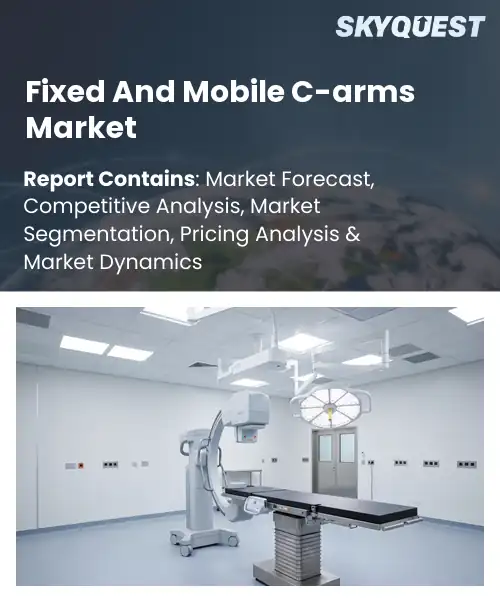
Fixed And Mobile C-arms Market
Report ID: SQMIG35A3982
Report ID: SQMIG35A3982
[email protected]
USA +1 351-333-4748
Report ID:
SQMIG35A3982 |
Region:
Global |
Published Date: May, 2026
Pages:
157
|Tables:
173
|Figures:
79


Global Fixed And Mobile C-Arms Market size was valued at USD 3.6 Billion in 2024 and is poised to grow from USD 3.81 Billion in 2025 to USD 6.03 Billion by 2033, growing at a CAGR of 5.9% during the forecast period (2026-2033).
The primary driver of the fixed and mobile c-arms market is the sustained shift toward minimally invasive procedures that increases demand for real-time, high-resolution fluoroscopic imaging in operating rooms. This market includes floor-mounted and mobile C-shaped X-ray systems that visualize anatomy during surgeries and pain interventions, and it matters because better intraoperative imaging lowers complication rates, shortens hospital stays and enables procedures that were once impossible. Over decades the industry progressed from bulky analog machines to compact digital flat-panel devices, with major manufacturers bringing portable systems into orthopedics, vascular therapy and outpatient clinics and labs across emerging and developed markets.
Building on technological progress outlined above, the primary market lever is innovation in imaging hardware and software that expands clinical utility and lowers adoption friction. Improvements in flat-panel detectors, dose-reduction algorithms and integrated navigation increase image clarity and safety, which persuades clinicians to rely on intraoperative fluoroscopy and prompts hospitals and ambulatory centers to purchase fixed and mobile units. Consequently orthopedic teams complete more complex fracture repairs in one operation, interventional cardiology gains precision for stent placement, and pain clinics raise success rates for injections, generating steady demand that creates openings for manufacturers, service providers and rental offerings and partnerships.
How is AI improving operational efficiency in the fixed and mobile C-arm market?
AI is helping to enhance operational efficiency in the fixed and mobile C-arm market by improving image quality, reducing manual steps and smoothing clinical workflows. Key features include AI-powered image denoising, motion correction and automated positioning and augmented guidance that minimize set-up and repeat imaging. Vendors are quickly integrating intelligent reconstruction and workflow assistants for use of systems in a variety of operating room environments on the market today. These tools allow care teams to concentrate on the procedure, not on imaging adjustments, and promote wider use of C-arms in minimally invasive and hybrid suites.
GE HealthCare announced Allia Moveo, an AI powered reconstruction and guidance for clearer images during surgery and quicker positioning. February 2026. The system reduces case complexity and simplifies workflow steps to enable higher throughput and help drive demand for AI-enabled fixed and mobile C-arm solutions.
Market snapshot - (2026-2033)
Global Market Size
USD 3.6 Billion
Largest Segment
Mobile C-Arms
Fastest Growth
Fixed C-Arms
Growth Rate
5.9% CAGR
To get more insights on this market click here to Request a Free Sample Report
Global fixed and mobile c-arms market is segmented by product type, technology, application, mobility type, end user, detector type and region. Based on product type, the market is segmented into Fixed C-Arms and Mobile C-Arms. Based on technology, the market is segmented into Flat Panel Detector C-Arms, Image Intensifier C-Arms, 2D C-Arms and 3D C-Arms. Based on application, the market is segmented into Orthopedic Surgery, Cardiovascular Procedures, Neurosurgery, Gastroenterology, Pain Management and Others. Based on mobility type, the market is segmented into Full-Size Mobile C-Arms and Mini C-Arms. Based on end user, the market is segmented into Hospitals, Ambulatory Surgical Centers, Specialty Clinics and Diagnostic Imaging Centers. Based on detector type, the market is segmented into Flat Panel Detectors and Image Intensifiers. Based on region, the market is segmented into North America, Europe, Asia Pacific, Latin America and Middle East & Africa.
The Flat Panel Detector C-Arms segment holds the lion’s share of the market due to higher resolution images of advanced detector technology and digital workflow integration catering to clinician demands for complex interventional procedures. They are compatible with iterative reconstruction, lower dose protocols and seamlessly connect to PACS, which drives their hospital procurement and procedural preference. This dominance is driven by clinical demand for high-quality intraoperative imaging, vendor investments in software improvements, and the push for efficient, multidisciplinary imaging platforms that reduce procedure time and improve outcomes.
However, Image Intensifier C-Arms are the fastest growing technology area due to lower acquisition costs, established clinical familiarity and broad compatibility with legacy interventional suites. Their appeal and refurbishment market for resource constrained providers accelerate adoption and enable increased access to fluoroscopic procedures and open growth pathways through equipment upgrades and service based business models.
Full-Size Mobile C-Arms has the highest revenue contribution to the market due to its combination of imaging power, maneuverability and full feature sets that cater the needs of large operating theaters and complex interventional suites. The large generator capacity and the advanced imaging modes provide a broad array of procedures, which is why the institution prefers a multi-purpose platform. Procurement decisions are influenced by the vendor’s emphasis on reliability, service contracts and surgical workflow integration, helping to establish a leadership position in high acuity clinical environments.
Mini C-Arms, however, are witnessing the highest growth momentum due to the demand for compact, point of care imaging solutions in outpatient and ambulatory settings. It is easy to use, low operating cost and portable, so it is rapidly accepted by orthopedic clinics and fracture management. The need for minimally invasive procedures and reduced procedure cycles is giving rise to niche devices and service models.
To get detailed segments analysis, Request a Free Sample Report
North America continues to be the leader in the global Fixed And Mobile C-arms market, owing to a confluence of advanced clinical infrastructure, established medical imaging expertise and a concentrated presence of leading device manufacturers. The region is focused on image guided interventions and minimally invasive procedures that is boosting consistent demand for high performance c-arm systems. Strong procurement processes, well developed distribution and service networks and supportive reimbursement environments are fueling the adoption of both fixed and mobile solutions. Strong relationships between industry and academic medical centers and collaborative research ecosystems speed product development and clinical validation. Robust post-sale support, training programs and access to capital equipment financing further minimize adoption barriers and enable healthcare institutions to deploy advanced imaging capabilities across care settings.
The C-arms market in the U.S. is driven by concentrated demand across diverse care settings, strong hospital networks and the early clinical uptake of image-guided procedures. The strong manufacturer presence and service agreements, and high expectations of system performance favor advanced fixed installations and versatile mobile units. The decisions around capital investment are informed by collaborations and training in clinical research. Competitive vendor ecosystems drive ongoing product refinement and customized solutions for procedural specialties.
Canada Fixed And Mobile C-arms Market. After sales service is a key differentiator in procurement decisions where performance is balanced with support and training. Teaching hospitals and regional centres drive demand for fixed systems. Local facilities’ needs are supported by mobile units. We work with manufacturers to create customized solutions that maintain equipment uptime and integrate it into clinical care pathways.
The Fixed And Mobile C-arms market in Europe is witnessing a considerable growth owing to the upgrade of procedural suites by healthcare systems and focus on minimally invasive procedures. Strong clinical demand in cardiology, orthopedics and vascular specialties coupled with investments in hybrid operating rooms and upgraded imaging infrastructure. New fixed and mobile configurations are more readily adopted when there are harmonized regulatory frameworks, more collaboration between manufacturers and healthcare providers, and active clinical validation pathways. Procurement strategies emphasizing total cost of ownership, service support and lifecycle partnerships foster the deployment of versatile systems across hospitals. Also, dedicated training programs and regional centers of excellence are speeding up clinical acceptance and the competitive vendor landscape is promoting tailored solutions that meet the needs of hospitals of different sizes and with diverse procedural mixes across the continent. This focus on patient throughput and care efficiency is further boosting market momentum.
Germany’s Fixed And Mobile C-arms Market is characterised by a robust clinical infrastructure, a healthy local manufacturing base and engineering expertise. Hospitals with advanced procedural suites prefer fixed installations and performance mobile systems to support complex interventions. Rigorous clinical validation, full-service ecosystems, and national maintenance agreements determine procurement decisions. Device manufacturers partner with academic centers to develop iterative product enhancements tailored to specialty workflows.
Drivers for UK Fixed And Mobile C-arms Market are modernization of procedural suites and a dynamic mix of public and private providers looking for operational efficiency. The adoption of both fixed and mobile solutions is driven by a focus on digital integration, lean procurement mechanisms and scalable service models. Demand is focused on specialist clinics and tertiary centers, but customized financing and training programs are increasingly being used to broaden access across hospital networks and outpatient sites.
France Fixed and Mobile C-arms Market is emerging with modernization initiatives, increasing interest in minimally invasive procedures and selective investment in imaging equipment. Public hospitals and private clinics are seeking solutions based on clinical versatility, lifecycle support and cost efficiency, and they prefer flexible mobile systems in addition to fixed installations in bigger centres. Focused training programs and strengthened relationships between manufacturers and research sites are increasing confidence and expanding deployment across regional care networks.
Asia Pacific is strengthening its position in Fixed And Mobile C-arms market through mix of technological advancement, localized manufacturing and focused clinical adoption. Major markets are enhancing procedural capabilities in hospitals and specialty centers, which is fueling demand for fixed, high-performance imaging suites as well as flexible mobile units that can be adapted to different care settings. The transfer of technology and service models that are appropriate to local clinical workflows is driven by the close collaboration of local vendors and multinational companies. Provider confidence is built through clinician training, equipment reliability and tailored aftermarket support focus. Policy initiatives that simplify approvals, and provide incentives to upgrade procedural infrastructure, along with cost-competitive production and scale, allow for wider deployment and greater availability throughout the region. The progress of clinical research and local product customization is encouraging faster integration into daily practice.
Japan’s Fixed And Mobile C-arms Market is fueled by a keen emphasis on accuracy, reliability and integration with advanced surgical platforms. Hospitals and specialty centres are interested in systems with consistent imaging quality and interoperability with procedural technologies. Homegrown manufacturers compete on engineering excellence and bespoke service offerings, academic partnerships drive clinical adoption A strong focus on maintenance and training keeps systems operational and clinicians confident in their use across all care settings.
South Korea Fixed And Mobile C-arms Market clinical adoption of advanced imaging and strong domestic manufacturing base, integration with digital procedural workflows. Leading hospitals and specialty centres looking for systems that provide the imaging quality and operational flexibility of fixed suites or mobile units are driving demand. Local vendor and firm partnerships assist in product adaptation and service networks. Training and maintenance assist in maintaining clinical confidence.
To know more about the market opportunities by region and country, click here to
Buy The Complete Report
Rising Demand For Minimally Invasive Procedures
Technological Advancements In Imaging Systems
High Capital Expenditure For Equipment
Regulatory and Reimbursement Complexity
Request Free Customization of this report to help us to meet your business objectives.
The global fixed and mobile C-arm market is heating up with competition as vendors pursue strategic M&A, product launches and OEM partnerships to protect OR share and address demand for low-dose, intraoperative 3D and faster workflows. On the M&A side, Siemens Healthineers acquired Corindus, and Philips launched the Zenition mobile C-arm platform. On the product clearance side, Siemens’ Cios Flow was also a standout.
SkyQuest’s ABIRAW (Advanced Business Intelligence, Research & Analysis Wing) is our Business Information Services team that Collects, Collates, Correlates and Analyses the Data collected through Primary Exploratory Research backed by robust Secondary Desk research.
The global fixed and mobile C-arm market is primarily driven by the persistent demand for minimally invasive procedures, which is further supported by rapid technological advancements such as AI-enabled reconstruction, flat-panel detectors and dose-reduction software which increase clinical utility reveals SkyQuest’s Analysis. High capital expenditure and ongoing maintenance costs temper growth, while purchases by smaller providers are limited. North America dominates the market due to the presence of advanced clinical infrastructure and strong presence of manufacturers in the region. Flat panel detector C-arms dominate the market due to better image quality and digital workflow integration. Together, these forces favor the deployment of versatile, software-rich systems across hospitals and ambulatory centers, creating opportunities for service, rental and hybrid operating room solutions.
| Report Metric | Details |
|---|---|
| Market size value in 2024 | USD 3.6 Billion |
| Market size value in 2033 | USD 6.03 Billion |
| Growth Rate | 5.9% |
| Base year | 2024 |
| Forecast period | (2026-2033) |
| Forecast Unit (Value) | USD Billion |
| Segments covered |
|
| Regions covered | North America (US, Canada), Europe (Germany, France, United Kingdom, Italy, Spain, Rest of Europe), Asia Pacific (China, India, Japan, Rest of Asia-Pacific), Latin America (Brazil, Rest of Latin America), Middle East & Africa (South Africa, GCC Countries, Rest of MEA) |
| Companies covered |
|
| Customization scope | Free report customization with purchase. Customization includes:-
|
To get a free trial access to our platform which is a one stop solution for all your data requirements for quicker decision making. This platform allows you to compare markets, competitors who are prominent in the market, and mega trends that are influencing the dynamics in the market. Also, get access to detailed SkyQuest exclusive matrix.
Table Of Content
Executive Summary
Market overview
Parent Market Analysis
Market overview
Market size
KEY MARKET INSIGHTS
COVID IMPACT
MARKET DYNAMICS & OUTLOOK
Market Size by Region
KEY COMPANY PROFILES
Methodology
For the Fixed And Mobile C-arms Market, our research methodology involved a mixture of primary and secondary data sources. Key steps involved in the research process are listed below:
1. Information Procurement: This stage involved the procurement of Market data or related information via primary and secondary sources. The various secondary sources used included various company websites, annual reports, trade databases, and paid databases such as Hoover's, Bloomberg Business, Factiva, and Avention. Our team did 45 primary interactions Globally which included several stakeholders such as manufacturers, customers, key opinion leaders, etc. Overall, information procurement was one of the most extensive stages in our research process.
2. Information Analysis: This step involved triangulation of data through bottom-up and top-down approaches to estimate and validate the total size and future estimate of the Fixed And Mobile C-arms Market.
3. Report Formulation: The final step entailed the placement of data points in appropriate Market spaces in an attempt to deduce viable conclusions.
4. Validation & Publishing: Validation is the most important step in the process. Validation & re-validation via an intricately designed process helped us finalize data points to be used for final calculations. The final Market estimates and forecasts were then aligned and sent to our panel of industry experts for validation of data. Once the validation was done the report was sent to our Quality Assurance team to ensure adherence to style guides, consistency & design.
Analyst Support
Customization Options
With the given market data, our dedicated team of analysts can offer you the following customization options are available for the Fixed And Mobile C-arms Market:
Product Analysis: Product matrix, which offers a detailed comparison of the product portfolio of companies.
Regional Analysis: Further analysis of the Fixed And Mobile C-arms Market for additional countries.
Competitive Analysis: Detailed analysis and profiling of additional Market players & comparative analysis of competitive products.
Go to Market Strategy: Find the high-growth channels to invest your marketing efforts and increase your customer base.
Innovation Mapping: Identify racial solutions and innovation, connected to deep ecosystems of innovators, start-ups, academics, and strategic partners.
Category Intelligence: Customized intelligence that is relevant to their supply Markets will enable them to make smarter sourcing decisions and improve their category management.
Public Company Transcript Analysis: To improve the investment performance by generating new alpha and making better-informed decisions.
Social Media Listening: To analyze the conversations and trends happening not just around your brand, but around your industry as a whole, and use those insights to make better Marketing decisions.
REQUEST FOR SAMPLE
 REQUEST FREE CUSTOMIZATION
Global Fixed And Mobile C-Arms Market size was valued at USD 3.6 Billion in 2024 and is poised to grow from USD 3.81 Billion in 2025 to USD 6.03 Billion by 2033, growing at a CAGR of 5.9% during the forecast period (2026-2033).
Competition in the global fixed and mobile C-arm market is intensifying as vendors pursue strategic M&A, product launches, and OEM partnerships to protect OR share and address demand for low-dose, intraoperative 3D and faster workflows. Notable industry moves include Siemens Healthineers acquisition of Corindus, Philips rollout of the Zenition mobile C-arm platform, and product clearances such as Siemens Cios Flow. 'GE HealthCare', 'Siemens Healthineers', 'Philips', 'Canon Medical Systems', 'Shimadzu Corporation', 'Ziehm Imaging', 'FUJIFILM Holdings', 'Hologic', 'Carestream Health', 'Genoray', 'MS Westfalia', 'Eurocolumbus', 'Allengers Medical Systems', 'Perlove Medical', 'Angell Technology', 'BMI Biomedical International', 'Comermy', 'Ecotron', 'Villa Sistemi Medicali', 'Canon Inc.'
Healthcare providers increasingly prefer minimally invasive procedures that rely on real time imaging, prompting greater adoption of both fixed and mobile C arms systems. Clinicians value enhanced visualization and precision during interventions, which improves procedural efficiency and patient recovery experiences, motivating hospitals and outpatient centers to procure advanced imaging equipment. The versatility of C arms across surgical specialties and their role in reducing procedure related complications supports capital investment decisions and service line expansion, thereby driving steady demand for modern fixed and mobile imaging solutions.
Ai Driven Imaging And Workflow: Artificial intelligence is increasingly embedded into C arm imaging and software, enabling enhanced image clarity, context aware procedure guidance, and intelligent workflow orchestration that streamline OR throughput. Vendors are adopting AI tools for real time noise reduction, anatomical recognition, and automated report generation, improving clinical confidence and interventional efficiency. This trend supports tighter integration with hospital imaging systems and remote collaboration capabilities while shifting procurement emphasis toward software capabilities, ongoing upgrades, and lifecycle services and remote diagnostics over hardware alone.
Why does North America Dominate the Global Fixed And Mobile C-arms Market? |@12


Want to customize this report? This report can be personalized according to your needs. Our analysts and industry experts will work directly with you to understand your requirements and provide you with customized data in a short amount of time. We offer $1000 worth of FREE customization at the time of purchase.
Feedback From Our Clients


 USA (+1) 351-333-4748

