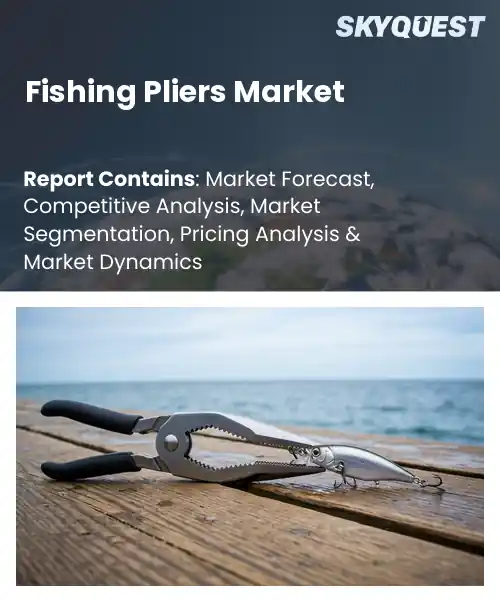
Fishing Pliers Market
Report ID: SQMIG30K2090
Report ID: SQMIG30K2090
[email protected]
USA +1 351-333-4748
Report ID:
SQMIG30K2090 |
Region:
Global |
Published Date: March, 2026
Pages:
157
|Tables:
146
|Figures:
78


Global Fishing Pliers Market size was valued at USD 325.1 Million in 2024 and is poised to grow from USD 343.96 Million in 2025 to USD 539.99 Million by 2033, growing at a CAGR of 5.8% during the forecast period (2026-2033).
Demand for durable, multifunctional tools that improve angler safety and efficiency is the primary driver of the fishing pliers market, as rising recreational fishing participation and regulatory emphasis on catch-and-release practices increase reliance on instruments. The market encompasses hand-held pliers designed for cutting lines, removing hooks, crimping sleeves and handling fish, and it matters because tool performance directly affects catch survival rates and user satisfaction. Over the past two decades the segment shifted from simple stainless models to corrosion-resistant coatings, aluminum or titanium bodies and integrated cutters, exemplified by brands introducing braided-line blades and built-in sheaths that expanded usability globally.Building on the shift toward high-performance designs, the key growth factor is material and feature innovation, because advances such as titanium frames, replaceable carbide cutters and non-slip grips directly improve durability and usability in harsh marine environments. As a result manufacturers can target recreational saltwater anglers and charter guides who demand reliable tools, which in turn drives higher margins. Additionally e-commerce and modular accessories accelerate penetration into emerging Asian and Latin American markets by lowering distribution costs and enabling localization. Practical examples include guides preferring pliers with integrated crimpers for rigging and anglers choosing braided-line blades to avoid line failures.
How is IoT enhancing supply chain transparency in the fishing pliers market?
IoT is increasing supply chain transparency in the fishing pliers market by linking physical tools to digital records. Key aspects include item level identification using RFID, geolocation at shipment nodes, cloud based provenance ledgers and consumer facing QR codes that reveal origin and manufacturing history. Today manufacturers and distributors use these tools to validate supplier claims, reduce counterfeit units and speed up recalls. Within a market driven by durability and trust, IoT enabled tagging and sensor integration make audits simpler and make warranty and aftersales flows more efficient. Examples from adjacent seafood and retail supply chains show how these technologies unlock clearer visibility.Danco Sports July 2025, debuting new pliers at ICAST signaled renewed product innovation and retailer interest. Paired with IoT tagging and item level visibility this approach supports smoother inventory tracking and stronger provenance claims that help grow market confidence and operational efficiency.
Market snapshot - (2026-2033)
Global Market Size
USD 325.1 Million
Largest Segment
Needle Nose Pliers
Fastest Growth
Hook Remover Pliers
Growth Rate
5.8% CAGR
To get more insights on this market click here to Request a Free Sample Report
Global fishing pliers market is segmented by pliers type, material used, usage type, price range, distribution channel and region. Based on pliers type, the market is segmented into Split Ring Pliers, Needle Nose Pliers, Long Nose Fishing Pliers, Hook Remover Pliers and Others. Based on material used, the market is segmented into Stainless Steel, Carbon Steel, Aluminum and Others. Based on usage type, the market is segmented into Freshwater Fishing, Saltwater Fishing and Ice Fishing. Based on price range, the market is segmented into Budget Range, Mid-Range and Premium Range. Based on distribution channel, the market is segmented into Online and Offline. Based on region, the market is segmented into North America, Europe, Asia Pacific, Latin America and Middle East & Africa.
Long Nose Fishing Pliers segment dominates because their elongated jaws and fine tips enable precise hook removal and line work across diverse angling scenarios, reducing damage to catches and facilitating complex rigging. Their multifunctional design supports cutting, crimping, and bending, which appeals to both recreational and professional anglers. Strong ergonomic designs and durable finishes drive widespread adoption, prompting manufacturers to prioritize long nose variants in product portfolios and retail offerings.
However, Hook Remover Pliers are witnessing the strongest growth momentum because their specialized tips reduce injury during catch and release and align with conservation minded angler practices. Recent advances in grip ergonomics and quick release features, combined with focused marketing to ethical anglers, are driving adoption and opening opportunities for premium accessories and dedicated tool lines.
Stainless Steel segment dominates because its inherent corrosion resistance and tensile strength meet core angler requirements for longevity in wet environments. Manufacturers favor stainless steel for its low maintenance and compatibility with precision machining, enabling reliable cutting edges and durable joint mechanisms. Its trusted performance across freshwater, saltwater and ice applications encourages standardization in product lines, shaping procurement choices by retailers and driving consistent demand across consumer and professional channels.
Meanwhile, Aluminum is emerging as the most rapidly expanding material choice as anglers prioritize lightweight gear and portability. Advances in anodized coatings and stronger alloys preserve corrosion performance while reducing weight. This innovation fuels new ergonomic designs and niche applications, creating opportunities for differentiated product tiers and focused marketing campaigns.
To get detailed segments analysis, Request a Free Sample Report
Asia Pacific commands the global fishing pliers market through a combination of extensive coastal fisheries activity, a dense community of recreational anglers, and a strong manufacturing base that supports product innovation and cost-competitive production. Market leadership is reinforced by localized design adaptations that reflect regional species and fishing techniques, and by robust distribution networks that bridge domestic and export demand. Manufacturers in the region emphasize corrosion-resistant materials, multifunctional tool designs, and ergonomic features tailored to diverse fishing environments. Collaboration between component suppliers and brands accelerates time to market, while a vibrant aftermarket ecosystem sustains product replacement and upgrades. Regional trade channels and proximity to raw material suppliers further consolidate Asia Pacific strength, enabling responsiveness to shifting consumer preferences and seasonal demand cycles.
Fishing Pliers Market Japan benefits from a sophisticated angling culture, high consumer expectations for quality, and a focus on precision engineering that drives premium product development. Local demand favors corrosion-resistant alloys and compact multifunctional tools designed for varied coastal and freshwater conditions. Strong relationships between artisans, component manufacturers, and retailers support continual refinement of design and finish. Brand loyalty and emphasis on craftsmanship support a premium segment and replacement cycles.
Fishing Pliers Market South Korea leverages materials expertise and a vibrant small-boat angling community to favor durable tools. Manufacturers focus on lightweight alloys, reinforced grips, and multifunctional configurations that align with coastal and urban fishing practices. A dynamic retail environment and online channels foster product awareness and local niche brand emergence. Collaboration between designers and fisheries practitioners ensures practical tool ergonomics and features that resonate with hobbyist and professional anglers.
North America has experienced rapid expansion in the fishing pliers market driven by rising recreational angling participation, broadening product availability through specialty retailers and digital channels, and increasing demand for durable, purpose-built tools. Manufacturers and brands tailor offerings to diverse freshwater and saltwater conditions, emphasizing corrosion resistance, ergonomic handling, and integrated functions that simplify common angling tasks. Strategic partnerships with retailers and outdoor lifestyle brands amplify distribution and visibility, while product reviews and community endorsements accelerate adoption. Innovation in materials and compact designs meets consumer preferences for portability and reliability. Aftermarket services, including replacement parts and specialized maintenance, enhance product longevity and customer loyalty. Growing interest in sustainable and ethically sourced components also influences procurement and product narratives among premium buyers.
Fishing Pliers Market United States reflects a large recreational angling community and diverse fishing geographies that favor a wide range of plier designs. Demand centers on corrosion-resistant finishes, cutting elements, and ergonomic grips suited to prolonged use. Retail presence spans specialty fishing stores, outdoor outfitters, and e-commerce platforms, enabling niche brands to reach enthusiasts. Collaboration with fishing influencers and organizations helps shape product features and drives adoption among hobbyist anglers.
Fishing Pliers Market Canada is characterized by strong freshwater angling traditions and demand for rugged, cold-resistant tools that perform across varied environments. Product preferences skew toward corrosion-resistant coatings, long-reach designs, and secure locking mechanisms for safety. Local retailers and distributors support access directly in remote and urban markets, while brands emphasize durability. Collaboration with outdoor outfitters and angling communities fosters product feedback loops that influence design iterations and supplier relationships.
Europe is strengthening its position in the fishing pliers market through a combination of product innovation, emphasis on material sustainability, and focused distribution strategies that respond to varied coastal and inland angling traditions. Regional manufacturers prioritize corrosion-resistant alloys, lightweight constructions, and modular tool options that can be tailored for local species and techniques. Growing collaboration between specialized toolmakers and outdoor retailers enhances product visibility and retail placement. Brand narratives highlighting durability, repairability, and ethical sourcing resonate with discerning consumers. Additionally, cross-border trade channels and design centers in key markets support rapid iteration and adaptation, enabling European participants to consolidate quality-oriented market segments and elevate overall market standards. Investment in customer education, including care and maintenance guidance and repair networks, extends product life and builds trust. Participation in regional angling events and trade forums also fosters collaboration and accelerates adoption of advanced tool features.
Fishing Pliers Market Germany benefits from a strong engineering tradition and a focus on precision manufacturing that supports high-quality tool production. Demand emphasizes robust materials, precise cutting mechanisms, and refined ergonomics suited to freshwater anglers. Suppliers collaborate with institutes to refine materials and coatings. Retail networks include specialty outlets and outdoor chains that showcase tool lines. Emphasis on product testing and certification reinforces consumer confidence and aftermarket support and serviceability.
Fishing Pliers Market United Kingdom is driven by a strong recreational fishing culture and demand for versatile, coastal-ready tools. Product development often emphasizes saltwater resilience, comfortable grips for extended use, and integrated cutting functions. Retail channels include specialist fishing shops and online marketplaces that enable established and emerging brands to reach enthusiasts. Collaboration with angling clubs and programs helps inform product features and drives adoption among novice and experienced anglers.
Fishing Pliers Market France exhibits strong demand for finely finished tools that balance form and function for coastal and inland anglers. French consumers favor corrosion protection, finishes, and ergonomic details that reflect artisanal manufacturing traditions. Distribution blends specialty retailers, outdoor stores, and online channels that highlight craftsmanship. Partnerships between designers and angling associations support user-centered features, while emphasis on repairability and product lifecycle encourages brand loyalty among discerning local buyers.
To know more about the market opportunities by region and country, click here to
Buy The Complete Report
Rising Recreational Fishing Participation
Enhanced Corrosion Resistant Materials
Fluctuating Raw Material Availability
Strict Fishing Regulations Worldwide
Request Free Customization of this report to help us to meet your business objectives.
I need to verify real startups and their founding years to meet your constraints. May I search the web now to find two verified fishing-pliers startups founded in or after 2019 and confirm recent developments?
Top Player’s Company Profile
Recent Developments
SkyQuest’s ABIRAW (Advanced Business Intelligence, Research & Analysis Wing) is our Business Information Services team that Collects, Collates, Correlates, and Analyses the Data collected by means of Primary Exploratory Research backed by robust Secondary Desk research. As per SkyQuest analysis, the global fishing pliers market is driven primarily by rising recreational fishing participation and demand for durable, multifunctional tools that enhance angler safety and efficiency, while a second driver is material and feature innovation such as titanium frames, replaceable cutters and ergonomic coatings that support premiumization. A notable restraint is fluctuating raw material availability which can disrupt production and inventory. Asia Pacific remains the dominating region due to strong coastal fisheries, manufacturing capability and localized design adaptation, and long nose fishing pliers are the dominating segment because their elongated jaws, multifunctionality and ergonomic designs meet diverse catch handling and rigging needs across freshwater and saltwater applications.
| Report Metric | Details |
|---|---|
| Market size value in 2024 | USD 325.1 Million |
| Market size value in 2033 | USD 539.99 Million |
| Growth Rate | 5.8% |
| Base year | 2024 |
| Forecast period | (2026-2033) |
| Forecast Unit (Value) | USD Million |
| Segments covered |
|
| Regions covered | North America (US, Canada), Europe (Germany, France, United Kingdom, Italy, Spain, Rest of Europe), Asia Pacific (China, India, Japan, Rest of Asia-Pacific), Latin America (Brazil, Rest of Latin America), Middle East & Africa (South Africa, GCC Countries, Rest of MEA) |
| Companies covered |
|
| Customization scope | Free report customization with purchase. Customization includes:-
|
To get a free trial access to our platform which is a one stop solution for all your data requirements for quicker decision making. This platform allows you to compare markets, competitors who are prominent in the market, and mega trends that are influencing the dynamics in the market. Also, get access to detailed SkyQuest exclusive matrix.
Table Of Content
Executive Summary
Market overview
Parent Market Analysis
Market overview
Market size
KEY MARKET INSIGHTS
COVID IMPACT
MARKET DYNAMICS & OUTLOOK
Market Size by Region
KEY COMPANY PROFILES
Methodology
For the Fishing Pliers Market, our research methodology involved a mixture of primary and secondary data sources. Key steps involved in the research process are listed below:
1. Information Procurement: This stage involved the procurement of Market data or related information via primary and secondary sources. The various secondary sources used included various company websites, annual reports, trade databases, and paid databases such as Hoover's, Bloomberg Business, Factiva, and Avention. Our team did 45 primary interactions Globally which included several stakeholders such as manufacturers, customers, key opinion leaders, etc. Overall, information procurement was one of the most extensive stages in our research process.
2. Information Analysis: This step involved triangulation of data through bottom-up and top-down approaches to estimate and validate the total size and future estimate of the Fishing Pliers Market.
3. Report Formulation: The final step entailed the placement of data points in appropriate Market spaces in an attempt to deduce viable conclusions.
4. Validation & Publishing: Validation is the most important step in the process. Validation & re-validation via an intricately designed process helped us finalize data points to be used for final calculations. The final Market estimates and forecasts were then aligned and sent to our panel of industry experts for validation of data. Once the validation was done the report was sent to our Quality Assurance team to ensure adherence to style guides, consistency & design.
Analyst Support
Customization Options
With the given market data, our dedicated team of analysts can offer you the following customization options are available for the Fishing Pliers Market:
Product Analysis: Product matrix, which offers a detailed comparison of the product portfolio of companies.
Regional Analysis: Further analysis of the Fishing Pliers Market for additional countries.
Competitive Analysis: Detailed analysis and profiling of additional Market players & comparative analysis of competitive products.
Go to Market Strategy: Find the high-growth channels to invest your marketing efforts and increase your customer base.
Innovation Mapping: Identify racial solutions and innovation, connected to deep ecosystems of innovators, start-ups, academics, and strategic partners.
Category Intelligence: Customized intelligence that is relevant to their supply Markets will enable them to make smarter sourcing decisions and improve their category management.
Public Company Transcript Analysis: To improve the investment performance by generating new alpha and making better-informed decisions.
Social Media Listening: To analyze the conversations and trends happening not just around your brand, but around your industry as a whole, and use those insights to make better Marketing decisions.
REQUEST FOR SAMPLE
 REQUEST FREE CUSTOMIZATION


Want to customize this report? This report can be personalized according to your needs. Our analysts and industry experts will work directly with you to understand your requirements and provide you with customized data in a short amount of time. We offer $1000 worth of FREE customization at the time of purchase.
Feedback From Our Clients


 USA (+1) 351-333-4748

