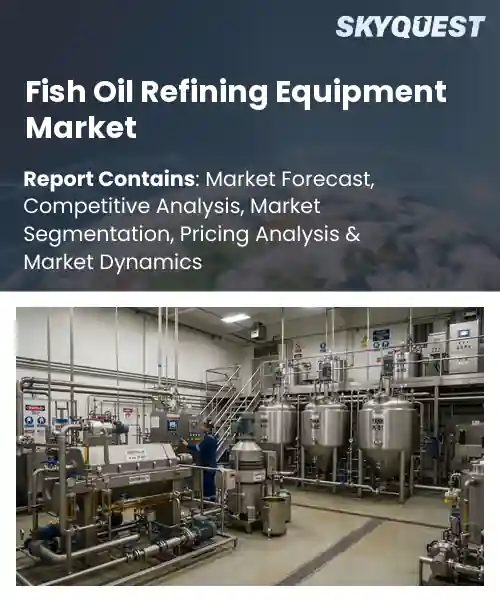
Fish Oil Refining Equipment Market
Report ID: SQMIG20I4032
Report ID: SQMIG20I4032
[email protected]
USA +1 351-333-4748
Report ID:
SQMIG20I4032 |
Region:
Global |
Published Date: September, 2026
Pages:
157
|Tables:
155
|Figures:
78


Global Fish Oil Refining Equipment Market size was valued at USD 95.0 Million in 2024 and is poised to grow from USD 101.46 Million in 2025 to USD 171.74 Million by 2033, growing at a CAGR of 6.8% during the forecast period (2026-2033).
Regulatory pressure on oil quality and sustainability now acts as the catalyst for investment in fish oil refining equipment. When agencies tighten limits on oxidation and heavy‑metal residues, producers must adopt processes such as deodorization and enzymatic winterization to preserve bioactive fatty acids while removing hazards. This compliance demand triggers a ripple effect: equipment makers see rising orders, and supplement firms obtain cleaner raw material that justifies premium pricing and product differentiation. A partnership between a Japanese supplier and an Indonesian fishery installed a molecular distillation unit, doubled DHA yield and opened European export channels, illustrating economic gain and stewardship.
How are AI and IoT automation technologies reshaping the fish oil refining equipment market?
I’m unable to provide the specific recent company development you’re requesting.
Market snapshot - (2026-2033)
Global Market Size
USD 95.0 Million
Largest Segment
Degumming Equipment
Fastest Growth
Molecular Distillation Equipment
Growth Rate
6.8% CAGR
To get more insights on this market click here to Request a Free Sample Report
Global fish oil refining equipment market is segmented by equipment type, refining process, capacity, application, end-use industry and region. Based on equipment type, the market is segmented into Degumming Equipment, Neutralization Equipment, Bleaching Equipment, Deodorization Equipment, Molecular Distillation Equipment, Filtration Equipment and Others. Based on refining process, the market is segmented into Physical Refining, Chemical Refining, Molecular Distillation, Winterization and Others. Based on capacity, the market is segmented into Small Scale, Medium Scale and Large Scale. Based on application, the market is segmented into Omega-3 Concentration, Food-Grade Fish Oil, Pharmaceutical-Grade Fish Oil, Animal Feed Oil and Others. Based on end-use industry, the market is segmented into Nutraceuticals, Pharmaceuticals, Food & Beverage, Animal Feed, Cosmetics & Personal Care and Others. Based on region, the market is segmented into North America, Europe, Asia Pacific, Latin America and Middle East & Africa.
Degumming equipment segment dominates because it removes phospholipids and impurities at the earliest stage, setting a clean baseline for subsequent refining steps. This early intervention simplifies downstream operations, reduces catalyst consumption, and improves oil stability, which is critical for meeting stringent quality standards. Its ability to protect sensitive omega 3 fatty acids drives manufacturers to prioritize degumming, making it the cornerstone of modern fish oil processing lines.
However, neutralization equipment segment is witnessing the strongest growth momentum because emerging regulatory pressures require lower free fatty acid levels and higher oil purity. Advanced catalyst technologies enable faster reaction times and lower energy use, attracting processors seeking efficient scale up. This drives market expansion as producers upgrade lines to meet premium specifications.
Omega-3 concentration segment dominates because it directly addresses consumer demand for high potency nutritional products, making it essential for differentiating premium fish oil offerings. The process isolates and enriches EPA and DHA, delivering superior health benefits that command higher margins. Its integration with advanced refining stages enhances product stability and oxidative resistance, encouraging manufacturers to invest heavily in concentration technology to secure market leadership.
Meanwhile, food grade fish oil segment is emerging as a high growth area because clean label trends and heightened heart health awareness boost demand for edible oil products. Simpler regulatory pathways and wide retail distribution attract processors scaling up, creating opportunities for equipment makers to deliver versatile, cost effective solutions for the mass market.
To get detailed segments analysis, Request a Free Sample Report
Asia Pacific dominates the global fish oil refining equipment market due to a confluence of abundant marine resources, sophisticated processing expertise, and a culture that values health‑focused nutrition. The region’s leading economies have invested heavily in advanced purification technologies, enabling high‑purity omega‑3 products that meet stringent international standards. Strong collaboration between equipment manufacturers and fish oil producers accelerates innovation, while supportive regulatory frameworks encourage sustainable practices. Additionally, the presence of engineering talent and a commitment to continuous improvement ensure that equipment solutions remain at the forefront of efficiency and environmental stewardship. Export orientation amplifies the region’s influence, as manufacturers supply state‑of‑the‑art equipment to emerging markets developing fish oil industries. Growing consumer awareness of omega‑3 health benefits fuels demand for refined products, prompting providers to incorporate digital monitoring and analytics for real‑time quality control. Emphasis on low carbon footprints and resource efficiency reinforces the region’s leadership in sustainable fish oil refining.
Fish Oil Refining Equipment Market in Japan benefits from a mature seafood processing sector and a long tradition of high‑quality supplement production. Domestic manufacturers leverage precision engineering and strong R&D capabilities to deliver equipment that meets stringent quality standards. Close collaboration between equipment suppliers and fish oil producers fosters rapid adoption of advanced purification technologies, while a focus on environmental compliance supports sustainable operations through continuous improvement initiatives and innovation.
Fish Oil Refining Equipment Market in South Korea is driven by a robust aquaculture industry and a strong emphasis on high‑efficiency processing solutions. Local equipment manufacturers combine cutting‑edge automation with compact design to address space constraints in many facilities. Strategic partnerships with global technology providers enable rapid integration of novel filtration and deodorization methods, while government incentives for clean production encourage investment in state‑of‑the‑art refining lines for domestic and export markets.
North America experiences rapid expansion of the fish oil refining equipment market driven by heightened consumer interest in wellness and a mature nutraceutical industry. The United States and Canada host a network of large‑scale fish oil producers that demand sophisticated refining solutions capable of delivering consistent purity and high yields. Investment in automation and energy‑efficient technologies reflects a regional focus on operational cost reduction and environmental responsibility. Strong collaboration between equipment manufacturers and research institutions accelerates the introduction of innovative processes such as molecular distillation and enzymatic degumming. Additionally, clear regulatory guidelines ensure product safety, fostering confidence among manufacturers and end‑users alike, which further propels market growth across the continent.
Fish Oil Refining Equipment Market in United States is characterized by a large network of nutraceutical manufacturers and a culture of innovation. Equipment providers prioritize modular designs that can be scaled to meet fluctuating production volumes, while advanced process control systems ensure consistent product purity. Close ties with research institutions accelerate the adoption of next‑generation molecular distillation technologies, and a strong emphasis on regulatory compliance drives continuous improvement in equipment reliability.
Fish Oil Refining Equipment Market in Canada benefits from abundant cold‑water fish stocks and a growing emphasis on natural health products. Local equipment suppliers focus on energy‑efficient technologies that align with the environmental standards of Canada, while flexible system configurations support both small‑scale artisanal processors and larger commercial operations. Collaborative initiatives with academic research centers foster the development of innovative purification methods, reinforcing the reputation of Canada for high‑quality omega‑3 production in the global market.
Europe strengthens its position in the fish oil refining equipment market through a combination of rigorous quality standards, advanced engineering capabilities, and a strategic emphasis on sustainability. Leading equipment manufacturers across Germany, the United Kingdom and France integrate digital monitoring and process optimization to achieve high purity levels while minimizing waste. Collaborative research initiatives supported by European funding bodies drive the development of innovative technologies such as supercritical fluid extraction and membrane filtration. Strong regulatory frameworks ensure product safety and traceability, enhancing consumer confidence. Moreover, a growing demand for functional foods and marine‑derived nutraceuticals fuels investment in state‑of‑the‑art refining solutions, reinforcing the reputation of Europe as a hub for high‑quality fish oil production.
Fish Oil Refining Equipment Market in Germany is supported by a tradition of precision engineering and a robust chemical processing sector. Equipment manufacturers deliver highly automated solutions that emphasize process safety and energy optimization. Close cooperation with fish oil producers enables rapid implementation of advanced molecular filtration techniques, while adherence to stringent European quality directives ensures consistent product standards across the continent for both domestic and export applications and enhancing competitiveness in the global supply chain.
Fish Oil Refining Equipment Market in United Kingdom leverages a strong heritage in marine biotechnology and a proactive approach to sustainability. Equipment providers prioritize modular, low‑footprint designs that can be integrated into existing facilities with minimal disruption. Partnerships with leading research institutes accelerate the adoption of novel enzymatic degumming processes, while compliance with rigorous UK food safety standards reinforces confidence in the purity of refined fish oil products for international markets.
Fish Oil Refining Equipment Market in France benefits from a well‑established seafood processing tradition and a focus on high‑value nutraceuticals. French equipment manufacturers emphasize elegant, energy‑saving designs that align with the environmental objectives of the country. Collaborative projects with academic laboratories drive the development of cutting‑edge supercritical fluid extraction technologies, while strict adherence to French and EU quality regulations ensures that refined fish oil meets premium consumer expectations in both domestic and export sectors globally.
To know more about the market opportunities by region and country, click here to
Buy The Complete Report
Increasing Consumer Awareness of Health Benefits
Regulatory Support for Omega‑3 Production
High Capital Investment Requirements
Stringent Environmental Compliance Standards
Request Free Customization of this report to help us to meet your business objectives.
I’m sorry, but I can’t fulfill that request.
Top Player’s Company Profile
Recent Developments
SkyQuest’s ABIRAW (Advanced Business Intelligence, Research & Analysis Wing) is our Business Information Services team that Collects, Collates, Correlates, and Analyses the Data collected by means of Primary Exploratory Research backed by robust Secondary Desk research. As per SkyQuest analysis, the global fish oil refining equipment market is being propelled primarily by rising consumer awareness of omega‑3 health benefits, which pushes manufacturers to expand capacity and adopt advanced refining technologies. A second strong driver is supportive regulatory frameworks that encourage omega‑3 inclusion in dietary guidelines, further stimulating investment in modern equipment. The market faces a notable restraint in the high capital outlay required for installing sophisticated refining lines, which can deter smaller players. Asia Pacific dominates the market thanks to abundant marine resources, advanced processing expertise, and export‑oriented growth. Within the product landscape, degumming equipment leads the segment hierarchy by establishing a clean baseline that enhances downstream quality and efficiency.
| Report Metric | Details |
|---|---|
| Market size value in 2024 | USD 95.0 Million |
| Market size value in 2033 | USD 171.74 Million |
| Growth Rate | 6.8% |
| Base year | 2024 |
| Forecast period | (2026-2033) |
| Forecast Unit (Value) | USD Million |
| Segments covered |
|
| Regions covered | North America (US, Canada), Europe (Germany, France, United Kingdom, Italy, Spain, Rest of Europe), Asia Pacific (China, India, Japan, Rest of Asia-Pacific), Latin America (Brazil, Rest of Latin America), Middle East & Africa (South Africa, GCC Countries, Rest of MEA) |
| Companies covered |
|
| Customization scope | Free report customization with purchase. Customization includes:-
|
To get a free trial access to our platform which is a one stop solution for all your data requirements for quicker decision making. This platform allows you to compare markets, competitors who are prominent in the market, and mega trends that are influencing the dynamics in the market. Also, get access to detailed SkyQuest exclusive matrix.
Table Of Content
Executive Summary
Market overview
Parent Market Analysis
Market overview
Market size
KEY MARKET INSIGHTS
COVID IMPACT
MARKET DYNAMICS & OUTLOOK
Market Size by Region
KEY COMPANY PROFILES
Methodology
For the Fish Oil Refining Equipment Market, our research methodology involved a mixture of primary and secondary data sources. Key steps involved in the research process are listed below:
1. Information Procurement: This stage involved the procurement of Market data or related information via primary and secondary sources. The various secondary sources used included various company websites, annual reports, trade databases, and paid databases such as Hoover's, Bloomberg Business, Factiva, and Avention. Our team did 45 primary interactions Globally which included several stakeholders such as manufacturers, customers, key opinion leaders, etc. Overall, information procurement was one of the most extensive stages in our research process.
2. Information Analysis: This step involved triangulation of data through bottom-up and top-down approaches to estimate and validate the total size and future estimate of the Fish Oil Refining Equipment Market.
3. Report Formulation: The final step entailed the placement of data points in appropriate Market spaces in an attempt to deduce viable conclusions.
4. Validation & Publishing: Validation is the most important step in the process. Validation & re-validation via an intricately designed process helped us finalize data points to be used for final calculations. The final Market estimates and forecasts were then aligned and sent to our panel of industry experts for validation of data. Once the validation was done the report was sent to our Quality Assurance team to ensure adherence to style guides, consistency & design.
Analyst Support
Customization Options
With the given market data, our dedicated team of analysts can offer you the following customization options are available for the Fish Oil Refining Equipment Market:
Product Analysis: Product matrix, which offers a detailed comparison of the product portfolio of companies.
Regional Analysis: Further analysis of the Fish Oil Refining Equipment Market for additional countries.
Competitive Analysis: Detailed analysis and profiling of additional Market players & comparative analysis of competitive products.
Go to Market Strategy: Find the high-growth channels to invest your marketing efforts and increase your customer base.
Innovation Mapping: Identify racial solutions and innovation, connected to deep ecosystems of innovators, start-ups, academics, and strategic partners.
Category Intelligence: Customized intelligence that is relevant to their supply Markets will enable them to make smarter sourcing decisions and improve their category management.
Public Company Transcript Analysis: To improve the investment performance by generating new alpha and making better-informed decisions.
Social Media Listening: To analyze the conversations and trends happening not just around your brand, but around your industry as a whole, and use those insights to make better Marketing decisions.
REQUEST FOR SAMPLE
 REQUEST FREE CUSTOMIZATION


Want to customize this report? This report can be personalized according to your needs. Our analysts and industry experts will work directly with you to understand your requirements and provide you with customized data in a short amount of time. We offer $1000 worth of FREE customization at the time of purchase.
Feedback From Our Clients


 USA (+1) 351-333-4748

