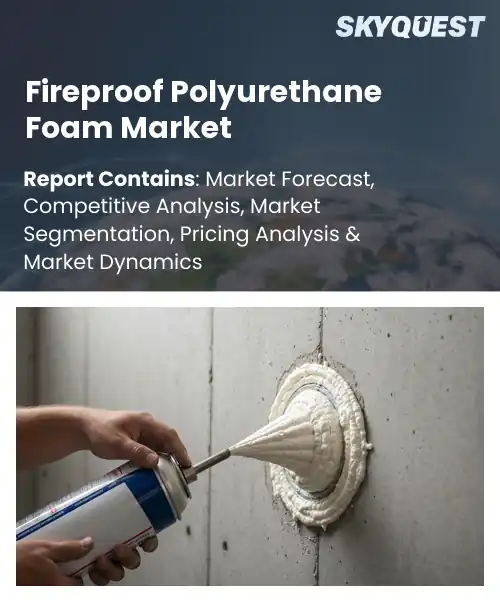
Fireproof Polyurethane Foam Market
Report ID: SQMIG15E3396
Report ID: SQMIG15E3396
[email protected]
USA +1 351-333-4748
Report ID:
SQMIG15E3396 |
Region:
Global |
Published Date: April, 2026
Pages:
157
|Tables:
117
|Figures:
77


Global Fireproof Polyurethane Foam Market size was valued at USD 50.9 Billion in 2024 and is poised to grow from USD 54.97 Billion in 2025 to USD 51.2 Billion by 2033, growing at a CAGR of 8.0% during the forecast period (2026-2033).
The primary driver of the fireproof polyurethane foam market is rising regulatory pressure for passive fire protection in buildings and transportation, and critical infrastructure, which has elevated demand for flame-retardant insulation. Fireproof polyurethane foam comprises cellular polymers with intumescent, halogen-free retardants that slow flame propagation and protect structural integrity, and it matters because better fire performance reduces casualties, property losses while meeting insurance and code requirements. The market evolved from basic polyurethane systems in industrial applications to sophisticated formulations used in high-rise construction, aircraft cabins, and oil and gas facilities, driven by retrofits after major fires and stricter international standards.Building on tightening regulations, a central growth factor is continuous materials innovation because improved formulations deliver higher fire performance, lower smoke, and compliance, thereby expanding allowable applications and procurement. R&D-driven manufacturers produce halogen-free, low-smoke spray and poured systems meeting EN, ASTM and UL standards, prompting owners of high-rise projects, aviation integrators and LNG firms to specify them for cladding cavities, cabin liners and pipe insulation. Rising adoption produces economies of scale that lower unit costs, attract suppliers, and open retrofit and modular construction opportunities across Asia-Pacific where faster certified installation reduces risk and insurance premiums and supports sustainable building certifications.
How is AI improving fire performance testing in the fireproof polyurethane foam market?
AI is transforming fire performance testing in the fireproof polyurethane foam market by combining data driven prediction with traditional laboratory practice. Key aspects include model driven formulation, mapping small scale burns to large scale behavior, and iterative experiment selection guided by machine learning. Companies use automated featurization of test curves and molecular descriptors to predict flame spread and smoke development, reducing reliance on expensive large scale trials and improving batch to batch consistency. This gives development teams faster insight, clearer risk assessment, and better balance between fire performance and application properties such as sprayability and thermal insulation, making innovation more efficient and market responsive.Huntsman September 2025, announced use of the Citrine AI platform to predict large scale test outcomes from small scale data and to prioritize experiments, saving development cycles and reducing costly full scale retesting while improving formulation reliability and accelerating compliant foam introductions for the market.
Market snapshot - (2026-2033)
Global Market Size
USD 50.9 Billion
Largest Segment
Rigid Fireproof PU Foam (Insulation boards)
Fastest Growth
Spray Polyurethane Foam (SPF)
Growth Rate
8.0% CAGR
To get more insights on this market click here to Request a Free Sample Report
Global fireproof polyurethane foam market is segmented by product type, fire rating/grade, end-use industry, technology focus and region. Based on product type, the market is segmented into Rigid Fireproof PU Foam (Insulation boards), Flexible Fireproof PU Foam (Seating/Acoustics) and Spray Polyurethane Foam (SPF). Based on fire rating/grade, the market is segmented into Class A/Class 1 Fire Rated (High Resistance) and B1/B2 Flame Retardant Grades. Based on end-use industry, the market is segmented into Construction & Infrastructure (Walls/Roofs/Seals), Automotive & Transportation Interiors, Furniture, Bedding & Upholstery and Industrial Equipment Packaging. Based on technology focus, the market is segmented into Halogen-free Flame Retardants and Intumescent PU Foam Technology. Based on region, the market is segmented into North America, Europe, Asia Pacific, Latin America and Middle East & Africa.
Spray Polyurethane Foam (SPF) segment dominates because SPF delivers a continuous, conformal barrier that both insulates and retards fire propagation in complex building geometries, improving overall structural resilience. Its on-site spray application enables rapid sealing of gaps and irregular cavities, which reduces pathways for heat and smoke. Compatibility with flame retardant chemistries and alignment with tightening building safety and energy codes further drive widespread specification and adoption.
However, Rigid Fireproof PU Foam (Insulation boards) is witnessing the strongest growth momentum as prefabricated board solutions meet increasing demand for standardized, factory produced fire barriers in new builds and retrofits. Their dimensional stability, ease of integration with cladding systems and compatibility with low emission formulations encourage manufacturer investment and open opportunities in modular construction and energy efficient building programs.
Intumescent PU Foam Technology segment stands out because it expands and forms a protective char when exposed to heat, creating an insulating layer that slows heat transfer and structural damage during a fire event. This behavior enables thinner applications while delivering improved passive protection, which helps meet stricter fire classification requirements. Its compatibility with existing polyurethane formulations and ability to enhance evacuation safety prompt broader uptake across building and industrial specifications.
Meanwhile, Halogen free Flame Retardants are emerging as the most rapidly expanding area as manufacturers respond to regulatory pressure and end user demand for lower toxicity and improved environmental profiles. Advances in phosphorus and nitrogen based chemistries boost flame resistance without halogen content, enabling green certifications and acceptance in sensitive applications, thereby accelerating product innovation and new market opportunities.
To get detailed segments analysis, Request a Free Sample Report
Asia Pacific dominance stems from a combination of concentrated manufacturing capacity, extensive downstream demand and regulatory emphasis on fire safety. The region benefits from large scale chemical production clusters that support supply continuity and cost efficiency, along with rapid urban development that drives extensive use in construction and retrofit projects. Strong domestic research capabilities enable formulation advances tailored to regional needs, while close proximity to major electronics, automotive and shipbuilding hubs sustains steady technical demand. Coordinated industry ecosystems, strategic export orientation and proactive safety standards further reinforce market leadership by aligning product innovation with practical application requirements across diverse end use sectors.
Fireproof Polyurethane Foam Market in Japan is characterized by a premium focus on quality, rigorous compliance and advanced material testing. High expectations for performance in electronics, rail and high rise construction prompt manufacturers to prioritize low smoke and high thermal stability formulations. Established certification frameworks and collaboration between research institutes and industry support iterative improvements. Demand patterns favor specialized, high reliability products and service models that emphasize technical support and long term performance verification.
Fireproof Polyurethane Foam Market in South Korea is driven by integration with heavy industry and high technology sectors, including shipbuilding and semiconductor facilities that require stringent fire protection. Domestic producers emphasize rapid innovation cycles and close client collaboration to meet exacting performance standards. The market favors solutions that combine space efficiency with high thermal resistance, and there is strong uptake in industrial and public infrastructure projects where safety and durability are prioritized alongside compatibility with automated application processes.
The rapid expansion in North America is propelled by a convergence of regulatory reinforcement, widespread retrofitting activity and sectoral demand from commercial, institutional and critical infrastructure projects. Industry players are responding with enhanced certification, integrated supply chains and partnerships with insulation and fire protection contractors to accelerate adoption. There is pronounced interest in product transparency, third party testing and compatibility with building systems, which supports procurement confidence. Innovation in formulation to address smoke management and environmental considerations, combined with robust distribution networks and contractor training programs, underpins market momentum and expands application across new construction and rehabilitation segments.
Fireproof Polyurethane Foam Market in United States reflects a mature landscape where rigorous certification and contractor networks shape procurement. Demand is concentrated in commercial, healthcare and technology infrastructure requiring dependable passive fire protection. Manufacturers focus on performance consistency, supply reliability and integration with broader insulation and firestop systems. Emphasis on product documentation, testing and field support facilitates specification by architects and engineers and supports large scale refurbishment programs as well as new construction projects that prioritize occupant safety and regulatory compliance.
Fireproof Polyurethane Foam Market in Canada is influenced by climatic considerations and extensive infrastructure across varied geographies, prompting demand for durable, energy compatible solutions. Building codes and industrial safety standards drive specification of certified products, while remote and resource sector projects create specialized application needs. Suppliers emphasize logistics resilience, technical training for applicators and formulation adaptability to meet requirements for both urban development and industrial installations, supporting steady integration into national construction and maintenance programs.
Europe is strengthening its role through a focus on harmonized standards, sustainability and technical refinement of formulations to meet demanding safety and environmental expectations. Collaborative frameworks among manufacturers, testing bodies and regulators facilitate faster alignment on performance criteria and product labeling, improving market transparency. Investment in research emphasizes reduced smoke toxicity and improved fire performance while maintaining compatibility with historic building requirements. Supply chain sophistication, emphasis on contractor competence and tailored solutions for complex renovation projects help deepen market penetration. Cross border trade and centralized certification mechanisms further enable wider adoption of advanced fireproof polyurethane foam products across diverse European markets.
Fireproof Polyurethane Foam Market in Germany is driven by engineering rigor and stringent quality expectations that favor technically advanced solutions. Industrial applications and specialized construction projects demand materials that integrate with broader passive fire protection systems. Manufacturers prioritize robust testing, precise application protocols and long term performance documentation. The market rewards suppliers who can demonstrate compliance with rigorous standards and provide engineering support for complex installations across industrial and commercial sectors.
Fireproof Polyurethane Foam Market in United Kingdom is shaped by heightened regulatory scrutiny and a strong emphasis on product transparency and certification. Refurbishment of high rise and public buildings has elevated demand for verified, high performance solutions and comprehensive installation oversight. Suppliers concentrate on traceability, third party approvals and training programs to meet evolving specification expectations. The market favors suppliers capable of supporting complex projects with clear documentation and reliable field performance.
Fireproof Polyurethane Foam Market in France combines heritage building preservation needs with modern safety requirements, creating demand for adaptable, high quality products. Regulatory frameworks and local certification practices guide specification, while architects and builders seek solutions that balance aesthetics with protection. Suppliers offer tailored formulations and technical services to address retrofit constraints and integration with insulation systems, supporting adoption across residential, cultural and commercial projects where both safety and preservation are priorities.
To know more about the market opportunities by region and country, click here to
Buy The Complete Report
Strict Fire Safety Regulations
Growing Construction And Renovation
High Raw Material Volatility
Limited Awareness Among End Users
Request Free Customization of this report to help us to meet your business objectives.
Competitive pressures in the global fireproof polyurethane foam market are driving consolidation, strategic partnerships, and material innovation. Major suppliers are using acquisitions to secure spray foam portfolios and partner with fire protection specialists, while chemical companies expedite next generation flame retardants to meet stricter regulation and supply chain risk. Examples include Huntsman’s SPF acquisitions and its partnership with No Burn, and industry investment in sustainable carbon additives.
Top Player’s Company Profile
Recent Developments
SkyQuest’s ABIRAW (Advanced Business Intelligence, Research & Analysis Wing) is our Business Information Services team that Collects, Collates, Correlates, and Analyses the Data collected by means of Primary Exploratory Research backed by robust Secondary Desk research. As per SkyQuest analysis, the global fireproof polyurethane foam market is being driven primarily by rising regulatory pressure for passive fire protection in buildings and transport, which is increasing specification of flame-retardant insulation. Growth is also supported by continuous materials innovation that yields halogen-free and intumescent formulations with better fire performance and lower smoke. However, high raw material volatility remains a key restraint, creating supply and cost uncertainty for manufacturers. Asia Pacific leads the market due to concentrated chemical production, rapid urbanization and retrofit demand, while spray polyurethane foam is the dominant segment because its conformal, on-site application provides rapid sealing, insulation and fire containment across complex geometries.
| Report Metric | Details |
|---|---|
| Market size value in 2024 | USD 50.9 Billion |
| Market size value in 2033 | USD 51.2 Billion |
| Growth Rate | 8.0% |
| Base year | 2024 |
| Forecast period | (2026-2033) |
| Forecast Unit (Value) | USD Billion |
| Segments covered |
|
| Regions covered | North America (US, Canada), Europe (Germany, France, United Kingdom, Italy, Spain, Rest of Europe), Asia Pacific (China, India, Japan, Rest of Asia-Pacific), Latin America (Brazil, Rest of Latin America), Middle East & Africa (South Africa, GCC Countries, Rest of MEA) |
| Companies covered |
|
| Customization scope | Free report customization with purchase. Customization includes:-
|
To get a free trial access to our platform which is a one stop solution for all your data requirements for quicker decision making. This platform allows you to compare markets, competitors who are prominent in the market, and mega trends that are influencing the dynamics in the market. Also, get access to detailed SkyQuest exclusive matrix.
Table Of Content
Executive Summary
Market overview
Parent Market Analysis
Market overview
Market size
KEY MARKET INSIGHTS
COVID IMPACT
MARKET DYNAMICS & OUTLOOK
Market Size by Region
KEY COMPANY PROFILES
Methodology
For the Fireproof Polyurethane Foam Market, our research methodology involved a mixture of primary and secondary data sources. Key steps involved in the research process are listed below:
1. Information Procurement: This stage involved the procurement of Market data or related information via primary and secondary sources. The various secondary sources used included various company websites, annual reports, trade databases, and paid databases such as Hoover's, Bloomberg Business, Factiva, and Avention. Our team did 45 primary interactions Globally which included several stakeholders such as manufacturers, customers, key opinion leaders, etc. Overall, information procurement was one of the most extensive stages in our research process.
2. Information Analysis: This step involved triangulation of data through bottom-up and top-down approaches to estimate and validate the total size and future estimate of the Fireproof Polyurethane Foam Market.
3. Report Formulation: The final step entailed the placement of data points in appropriate Market spaces in an attempt to deduce viable conclusions.
4. Validation & Publishing: Validation is the most important step in the process. Validation & re-validation via an intricately designed process helped us finalize data points to be used for final calculations. The final Market estimates and forecasts were then aligned and sent to our panel of industry experts for validation of data. Once the validation was done the report was sent to our Quality Assurance team to ensure adherence to style guides, consistency & design.
Analyst Support
Customization Options
With the given market data, our dedicated team of analysts can offer you the following customization options are available for the Fireproof Polyurethane Foam Market:
Product Analysis: Product matrix, which offers a detailed comparison of the product portfolio of companies.
Regional Analysis: Further analysis of the Fireproof Polyurethane Foam Market for additional countries.
Competitive Analysis: Detailed analysis and profiling of additional Market players & comparative analysis of competitive products.
Go to Market Strategy: Find the high-growth channels to invest your marketing efforts and increase your customer base.
Innovation Mapping: Identify racial solutions and innovation, connected to deep ecosystems of innovators, start-ups, academics, and strategic partners.
Category Intelligence: Customized intelligence that is relevant to their supply Markets will enable them to make smarter sourcing decisions and improve their category management.
Public Company Transcript Analysis: To improve the investment performance by generating new alpha and making better-informed decisions.
Social Media Listening: To analyze the conversations and trends happening not just around your brand, but around your industry as a whole, and use those insights to make better Marketing decisions.
REQUEST FOR SAMPLE
 REQUEST FREE CUSTOMIZATION


Want to customize this report? This report can be personalized according to your needs. Our analysts and industry experts will work directly with you to understand your requirements and provide you with customized data in a short amount of time. We offer $1000 worth of FREE customization at the time of purchase.
Feedback From Our Clients


 USA (+1) 351-333-4748

