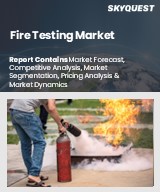
Fire Testing Market
Report ID: SQMIG20L2060
Report ID: SQMIG20L2060
[email protected]
USA +1 351-333-4748
Report ID:
SQMIG20L2060 |
Region:
Global |
Published Date: June, 2025
Pages:
195
|Tables:
99
|Figures:
76


Global Fire Testing Market size was valued at USD 8.62 Billion in 2024 and is poised to grow from USD 9.17 Billion in 2025 to USD 15.06 Billion by 2033, growing at a CAGR of 6.4% during the forecast period (2026–2033).
What Is Driving the Expansion of the Global Fire Testing Market?
The worldwide fire testing sector develops steadily because building security worries unite with powerful rules and increasing industry focus on product quality. Fire incidents in the United States during 2022 led to USD 18 billion in property damages and 3,790 civilian deaths together with 13,250 injuries as recorded by the National Fire Protection Association (NFPA). The rise of urbanization along with infrastructure expansion across emerging markets including India China and Brazil leads to increased market needs for fire protection certification testing services. The increasing demands of manufacturers within industries such as construction electronics automotive aerospace derive from consumer awareness alongside insurance requirements to prove product fire resistance.
How Are Regulatory Mandates Boosting Demand for Fire Testing Services?
A key driver of the market is the stringent enforcement of fire safety norms in construction and industrial sectors. For example, the European Union’s Construction Products Regulation (CPR) mandates fire testing for all construction materials, which has significantly boosted demand for third-party fire testing services. Similarly, the U.S. Occupational Safety and Health Administration (OSHA) and the International Building Code (IBC) require mandatory fire testing in multiple commercial applications. As infrastructure investments increase, particularly in smart cities and green buildings, the need for sustainable yet fire-compliant materials is also growing. This transition fuels innovation in testing methods and standards.
What Challenges Are Limiting Market Expansion?
However, market growth is somewhat restrained by the high cost of advanced testing equipment and the lengthy certification processes. Small and medium enterprises (SMEs), especially in developing regions, often find it challenging to meet international testing standards due to limited resources. Moreover, the lack of harmonized international standards poses a challenge for global players looking to expand across multiple regulatory jurisdictions. Delays in accreditation and testing result turnaround times can further hinder product launches in competitive industries.
Is Industry Infrastructure Keeping Pace with Demand?
In March 2023, Chart Industries, a leading provider of cryogenic equipment and process technologies, completed the acquisition of Howden, a global supplier of mission-critical air and gas handling products, from KPS Capital Partners for approximately USD 4.4 billion. This acquisition enhances Chart’s footprint in energy transition projects and expands its offerings in hydrogen and carbon capture, both of which rely heavily on cryogenic infrastructure. The move reflects growing industry consolidation and strategic positioning to meet rising demand for low-carbon technologies powered by cryogenic innovations.
Market snapshot - 2026-2033
Global Market Size
USD 8.1 billion
Largest Segment
Testing
Fastest Growth
Certification
Growth Rate
6.4% CAGR
To get more insights on this market click here to Request a Free Sample Report
Global Fire Testing Market is segmented by Service, Sourcing, Application and region. Based on Service, the market is segmented into Testing, Inspection, Certification and Others. Based on Sourcing, the market is segmented into In-house and Outsourced. Based on Application, the market is segmented into Consumer Goods & Electronics, Agriculture & Food, Chemicals, Construction & Infrastructure, Energy & Power, Industrial & Manufacturing, Medical & Life Sciences, Mining, Oil & Gas and Petroleum, Public Sector, Automotive, Aerospace & Defense, Marine & Railways, Supply Chain & Logistics and Others. Based on region, the market is segmented into North America, Europe, Asia Pacific, Latin America and Middle East & Africa.
Testing continues to dominate the global fire testing market due to increasing demand across high-risk sectors such as construction, transportation, and electronics. Testing services ensure compliance with stringent fire safety norms including ASTM E119, ISO 834, and UL 263 standards. The construction sector, particularly in North America and Europe, mandates comprehensive fire resistance testing for walls, doors, and insulation systems. In 2024, SGS expanded its fire testing services in the UK to meet rising demand driven by regulatory reforms post-Grenfell Tower tragedy. These developments highlight a strong industry shift toward verified fire safety performance.
Certification is the fastest-growing sub-segment, driven by increasing international trade and demand for globally recognized safety labels. Regulatory alignment across regions, like CE marking in Europe and FM approval in the US, is compelling manufacturers to invest in certified fire safety solutions. This growth is especially noticeable in sectors like industrial equipment and high-performance materials.
In-House fire testing services dominate due to their ability to provide real-time quality control, quicker turnaround times, and cost efficiencies in the long term. Large enterprises in aerospace and automotive sectors prefer in-house labs to streamline product development and accelerate certifications. Alco Valves, part of the Graco Group, established an in-house fire testing facility by repurposing a shipping container into a controlled fire test bay. This facility allows Alco to conduct fire safety tests in accordance with international standards such as BS EN ISO 10497 and API 607. By bringing fire testing in-house, Alco has enhanced its research and development capabilities, enabling quicker validation of fire-safe valve designs and reducing reliance on external testing services. Such control over compliance processes ensures reduced delays in regulatory approvals.
Outsourced fire testing services are gaining momentum, particularly among small and medium-sized enterprises (SMEs) and in regions lacking advanced infrastructure. The complexity of international regulations and the high capital cost of establishing certified labs are pushing companies to rely on third-party testing providers like UL and Intertek. These services offer global reach and multi-standard certifications under one roof, enabling faster market access.
To get detailed segments analysis, Request a Free Sample Report
North America continues to dominate the global fire testing market, underpinned by robust regulatory enforcement and a high concentration of industrial activities. The region strictly follows NFPA codes, UL standards, and ASTM testing protocols. In Fiscal Year 2023, the U.S. government allocated USD 36 million through the Fire Prevention and Safety (FP&S) Grant Program, which is administered by the Federal Emergency Management Agency (FEMA). This funding is part of a broader initiative to enhance community resilience and firefighter safety. The FP&S program is a component of the Department of Homeland Security's (DHS) broader strategy to strengthen national preparedness and resilience. Since its inception, the FP&S program has awarded approximately USD 852 million to support fire prevention education, training, and research aimed at improving firefighter health and safety. Moreover, the construction industry in North America was valued at USD 2.46 trillion in 2023, significantly driving demand for fire resistance testing. The presence of industry leaders such as UL, Intertek, and SGS North America provides localized testing infrastructure, while OEMs in aerospace and automotive increasingly invest in in-house labs.
The United States holds the largest share in the North American fire testing market due to stringent national codes like the International Building Code (IBC) and NFPA 285. In 2023, UL Solutions announced the expansion of its Northbrook, Illinois fire testing facility to accommodate advanced simulation systems for multi-material construction assemblies. According to data from the U.S. Bureau of Economic Analysis, the value added by the construction industry to the U.S. GDP was approximately USD 1.3 trillion in the fourth quarter of 2024, necessitating comprehensive safety validation. Meanwhile, Boeing reported a efficacy improvement in product validation cycles due to in-house fire testing, according to its 2023 investor presentation, indicating a strong shift toward internalizing compliance processes for aerospace and defense applications.
Canada is witnessing rising demand for fire testing, fueled by new building code amendments and increased investments in green infrastructure. The 2023 National Building Code of Canada (NBCC) revised fire safety parameters, especially for mid-rise wood frame construction. In the same year, Intertek expanded its fire resistance testing capabilities in Mississauga, Ontario, to meet growing local demand. Canada's construction output surpassed USD 165 billion in 2023, reflecting sustained infrastructure investments. Furthermore, the shift towards sustainable, fire-safe materials in the public sector and modular construction is encouraging manufacturers to seek certification under CAN/ULC-S101 and other fire safety protocols.
Asia-Pacific is emerging as the fastest-growing region in the fire testing market, fueled by urbanization, industrial growth, and regulatory tightening. Countries like China, India, and South Korea are aligning their building codes with international standards such as ISO 834 and ASTM E119. The region’s construction spending exceeded USD 5.11 trillion in 2023, representing over 50% of global activity. Fire incidents in high-rise buildings and manufacturing facilities have led to increased government scrutiny. Additionally, global manufacturers investing in Asia are pushing local demand for certified testing infrastructure. Outsourced service providers like TÜV SÜD and Applus+ are expanding operations across key regional hubs.
China has witnessed a surge in fire safety regulations, especially after several industrial fire incidents in 2022–2023. In 2023, the Ministry of Emergency Management introduced stricter enforcement measures under the “14th Five-Year Plan”, targeting high-risk sectors such as chemicals and electronics. That same year, in 2024, TÜV Rheinland inaugurated its largest laboratory site in China, situated in Taicang, near Shanghai. This USD 31.8 million facility spans nearly 40,000 square meters and focuses on testing electronic products, photovoltaics, e-mobility, and autonomous driving technologies. The center employs approximately 500 staff members and serves as the company's primary laboratory hub in the country, the government now mandates fire resistance testing for public infrastructure and large residential buildings, spurring growth in local and international testing partnerships.
India’s fire testing market is expanding rapidly due to smart city initiatives and industrial safety reforms. The National Building Code (NBC 2016) is undergoing amendments to mandate stricter fire resistance criteria for high-rises and metro infrastructure. In 2023, Lloyd’s Register and Bureau Veritas increased fire testing services in Mumbai and Pune to cater to growing manufacturing and real estate demands. With India’s construction sector expected to reach USD 1.4 trillion by 2025, the demand for certification to IS 3809 and IS 1641 is surging. Industrial parks and special economic zones (SEZs) are key hotspots for fire testing service expansions.
South Korea is ramping up fire safety compliance, especially in sectors like semiconductors, batteries, and high-rise commercial buildings. The Korean Fire Protection Association (KFPA) updated national fire testing protocols in 2023, closely aligning them with NFPA and ISO standards. Samsung Engineering reported investment in an in-house fire simulation lab in Suwon to meet global safety expectations. The government’s Smart City initiative, covering 80+ urban centers, mandates compliance with KFI-certified fire resistance standards.
To know more about the market opportunities by region and country, click here to
Buy The Complete Report
Stricter Fire Safety Regulations Across Industrialized Nations
Growing Demand from High-Risk Sectors like Aerospace, Automotive, and Electronics
High Cost of Setting Up Certified Fire Testing Facilities
Complexity in Meeting Multinational Compliance Standards
Request Free Customization of this report to help us to meet your business objectives.
The global fire testing market is moderately consolidated, with players focusing on strategic capacity expansion, regional penetration, and technology integration. In 2023, SGS expanded its fire resistance testing lab in Ellesmere Port, UK, in direct response to post-Grenfell regulatory reforms, allowing it to process up to 30% more test cases annually.
UL Solutions has adopted a strategy of geographic diversification—its new lab in Vietnam (2023) enables it to serve the burgeoning Southeast Asian electronics and textile industries. Meanwhile, Intertek introduced AI-powered thermal analysis tools in its North American labs, reducing turnaround time by 20%, based on their 2023 investor presentation. Partnerships are also shaping competition: Element Materials Technology partnered with Warringtonfire in 2023 to consolidate capabilities in façade system testing across Europe. These firms are not only expanding physical presence but also enhancing digital and automation capabilities to serve cross-regional, multi-standard testing demands efficiently.
Emerging Trends Shaping the Future of Fire Testing
SkyQuest’s ABIRAW (Advanced Business Intelligence, Research & Analysis Wing) is our Business Information Services team that Collects, Collates, Correlates, and Analyses the Data collected using Primary Exploratory Research backed by robust Secondary Desk research.
As per SkyQuest analysis, the global fire testing market is experiencing robust growth, driven by heightened regulatory scrutiny, rising infrastructure investments, and expanding industrial applications. Our study also reveals that key sectors such as construction, transportation, and energy are placing increased emphasis on third-party validation and certification to ensure compliance with evolving fire safety norms. Post incidents like the Grenfell Tower tragedy, governments across Europe and North America have intensified mandates, creating demand for advanced fire resistance testing. Meanwhile, Asia Pacific is emerging as the fastest-growing region, fueled by urbanization and increased adoption of international standards. Companies like UL Solutions and SGS are investing in lab expansions and technological advancements, particularly in EV battery and building material testing. The market is further supported by digital integration, such as AI-based fire behavior simulation tools, enabling faster, cost-efficient, and accurate assessments across fire testing parameters.
| Report Metric | Details |
|---|---|
| Market size value in 2024 | USD 8.62 Billion |
| Market size value in 2033 | USD 15.06 Billion |
| Growth Rate | 6.4% |
| Base year | 2024 |
| Forecast period | 2026-2033 |
| Forecast Unit (Value) | USD Billion |
| Segments covered |
|
| Regions covered | North America (US, Canada), Europe (Germany, France, United Kingdom, Italy, Spain, Rest of Europe), Asia Pacific (China, India, Japan, Rest of Asia-Pacific), Latin America (Brazil, Rest of Latin America), Middle East & Africa (South Africa, GCC Countries, Rest of MEA) |
| Companies covered |
|
| Customization scope | Free report customization with purchase. Customization includes:-
|
To get a free trial access to our platform which is a one stop solution for all your data requirements for quicker decision making. This platform allows you to compare markets, competitors who are prominent in the market, and mega trends that are influencing the dynamics in the market. Also, get access to detailed SkyQuest exclusive matrix.
Table Of Content
Executive Summary
Market overview
Parent Market Analysis
Market overview
Market size
KEY MARKET INSIGHTS
COVID IMPACT
MARKET DYNAMICS & OUTLOOK
Market Size by Region
KEY COMPANY PROFILES
Methodology
For the Fire Testing Market, our research methodology involved a mixture of primary and secondary data sources. Key steps involved in the research process are listed below:
1. Information Procurement: This stage involved the procurement of Market data or related information via primary and secondary sources. The various secondary sources used included various company websites, annual reports, trade databases, and paid databases such as Hoover's, Bloomberg Business, Factiva, and Avention. Our team did 45 primary interactions Globally which included several stakeholders such as manufacturers, customers, key opinion leaders, etc. Overall, information procurement was one of the most extensive stages in our research process.
2. Information Analysis: This step involved triangulation of data through bottom-up and top-down approaches to estimate and validate the total size and future estimate of the Fire Testing Market.
3. Report Formulation: The final step entailed the placement of data points in appropriate Market spaces in an attempt to deduce viable conclusions.
4. Validation & Publishing: Validation is the most important step in the process. Validation & re-validation via an intricately designed process helped us finalize data points to be used for final calculations. The final Market estimates and forecasts were then aligned and sent to our panel of industry experts for validation of data. Once the validation was done the report was sent to our Quality Assurance team to ensure adherence to style guides, consistency & design.
Analyst Support
Customization Options
With the given market data, our dedicated team of analysts can offer you the following customization options are available for the Fire Testing Market:
Product Analysis: Product matrix, which offers a detailed comparison of the product portfolio of companies.
Regional Analysis: Further analysis of the Fire Testing Market for additional countries.
Competitive Analysis: Detailed analysis and profiling of additional Market players & comparative analysis of competitive products.
Go to Market Strategy: Find the high-growth channels to invest your marketing efforts and increase your customer base.
Innovation Mapping: Identify racial solutions and innovation, connected to deep ecosystems of innovators, start-ups, academics, and strategic partners.
Category Intelligence: Customized intelligence that is relevant to their supply Markets will enable them to make smarter sourcing decisions and improve their category management.
Public Company Transcript Analysis: To improve the investment performance by generating new alpha and making better-informed decisions.
Social Media Listening: To analyze the conversations and trends happening not just around your brand, but around your industry as a whole, and use those insights to make better Marketing decisions.
REQUEST FOR SAMPLE
 REQUEST FREE CUSTOMIZATION


Want to customize this report? This report can be personalized according to your needs. Our analysts and industry experts will work directly with you to understand your requirements and provide you with customized data in a short amount of time. We offer $1000 worth of FREE customization at the time of purchase.
Feedback From Our Clients


 USA (+1) 351-333-4748

