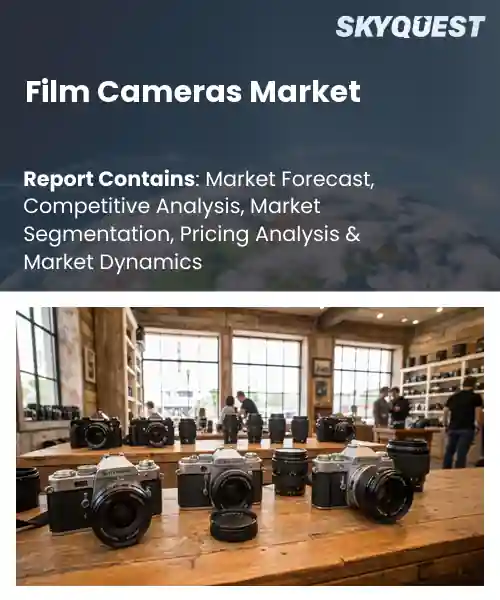
Film Cameras Market
Report ID: SQMIG25J2164
Report ID: SQMIG25J2164
[email protected]
USA +1 351-333-4748
Report ID:
SQMIG25J2164 |
Region:
Global |
Published Date: February, 2026
Pages:
157
|Tables:
176
|Figures:
79


Global Film Cameras Market size was valued at USD 327.32 Million in 2024 and is poised to grow from USD 347.94 Million in 2025 to USD 567.25 Million by 2033, growing at a CAGR of 6.3% during the forecast period (2026-2033).
The primary driver of the film cameras market is a renaissance in analog authenticity combined with niche professional demand, which has reshaped consumer behavior over the past decade. Cameras include film still pictures, movies, developing supplies, restoring film, and they exist for several reasons because they provide a very distinct look to their images (retro like), provide an actual hard copy of information, and provide a hands-on working method that digital-only operations do not provide. The increasing popularity of vintage cameras, the growing use of them in numerous small manufacturers to reintroduce newer models of cameras and film stock lines by using large manufacturers.
Building on renewed interest, supply-chain adaptation is key trend driving the global film camera sector growth because component sourcing, niche manufacturing and lab services determine market scalability. When specialty film stocks become available through boutique suppliers, photographers gain access to differentiated aesthetics, which increases demand for processing labs and drives investment in chemical recycling and small-batch emulsion. Cinema productions that require archival looks prompt rental houses to maintain analog cameras and technicians, creating revenue streams that justify reissues and aftermarket parts. Consequently, stable supply networks reduce costs and expand educational and commercial use cases, enabling wider adoption among influencers and indie filmmakers.
How is AI Influencing the Film Cameras Market?
AI is reshaping the film cameras market across three key areas. First, AI enhances digitization and restoration so analog negatives are easier to archive and share. Machine learning helps labs and consumer scanners automate dust removal, color repair and film simulation which lowers technical barriers and speeds turnaround. Ai adds hybrid workflows together with the ability of creators to use both analog and smart technology to produce nostalgic styles, eliminating manual labour and mistakes during the film production phase. The changes in the industry allow for younger photographers to gain access to more types of films, while providing the opportunity for film shops to add more value to their work by improving and increasing their ability to create the same type of tactile experience with an analog photograph.
In January 2025, Kodak Alaris refreshed its scanner lineup with upgraded image processing and workflow automation that support faster high quality film digitization and restoration. This development demonstrates how AI enabled scanning and smart processing are directly supporting market growth and operational efficiency.
Market snapshot - (2026-2033)
Global Market Size
USD 327.32 Million
Largest Segment
35mm Film Cameras
Fastest Growth
Instant Film Cameras
Growth Rate
6.3% CAGR
To get more insights on this market click here to Request a Free Sample Report
Global film cameras market is segmented by product type, category, film type, user type, price range, application and region. Based on product type, the market is segmented into 35mm film cameras, medium format film cameras, large format film cameras, instant film cameras, super 8 & 16mm film cameras, and others. Based on film type, the market is segmented into black & white film, negative color film, color transparency (slide) films, and others. Based on user type, the market is segmented into professional photographers and amateur photographers. Based on price range, the market is segmented into budget cameras, mid-range, and premium cameras. Based on application, the market is segmented into personal photography, commercial photography, wedding & event photography, cinematography, educational use, and others. Based on region, the market is segmented into North America, Europe, Asia Pacific, Latin America and Middle East & Africa.
Based on the global film cameras market share, medium format film cameras segment dominates because its larger film area and lens quality deliver superior tonal range and resolution that professional and fine art photographers prioritize, driving consistent demand for premium analog imaging. The use of this format with medium format systems and modular view cameras supports a long-term community of lenses and other equipment. Consequently, manufacturers and studios have taken a greater interest in investing in and providing support to this, which has helped cement its position as a leader in niche workflows and high-end products.
However, 35mm film cameras are emerging as the fastest growing area due to accessible entry points, abundant film choices, and a thriving secondhand market that lowers barriers for amateurs and hybrid shooters. The combination of cultural nostalgia along with cheaper ways of processing is driving rapid consumer adoption, increasing engagement from consumers and creating new service and product opportunities.
Black & white film segment dominates because its aesthetic clarity, forgiving tonality and compatibility with traditional darkroom techniques maintain strong demand among educators, artists and archival practitioners seeking expressive control and long-term stability. As a result of the format's lower chemical complexity, and its ongoing availability at workshops and institutions, brands will shift their focus to more efficient production of material, and increased development of distribution channels. Significant investments into specialized processing infrastructure, all of which will serve to strengthen the format role within the film ecosystem.
Meanwhile, color transparency (slide) film is witnessing the strongest growth driven by renewed creator interest in vivid color and projection friendly results. Advances in film chemistry and scanning workflows, together with niche editorial and cinematography demand, broaden commercial applications and stimulate new services across the analog value chain.
To get detailed segments analysis, Request a Free Sample Report
As per the global film cameras market growth, Asia Pacific dominates the global film cameras market through a combination of deep manufacturing expertise, heritage optical brands and longstanding traditions, and a vibrant analog culture that sustains demand. Regional manufacturers and boutique ateliers forge strong supply systems along with superior technical craftsmanship, allowing diverse products-from professional rangefinder to consumer-friendly formats. Urban creative communities and educational institutions spur renewed interest in film photography through local retailers and processing labs supporting aftercare and experiential services. Cross-border cooperation among designers, component suppliers, and creative entrepreneurs allows for rapid iterations on niche products. In addition, the region has developed a strong cultural interest in tangible media and has the ability to scale artisanal production into exportable products.
Film cameras market trends in Japan draws on a heritage of precision optics and established manufacturers that set global quality standards. Enthusiast communities and collectors sustain interest in legacy models and boutique releases, supported by specialist retailers and film processing labs. By collaborating with independent designers, traditional companies create one-of-a-kind, limited-edition products while continuing to perfect their designs through constant technical enhancements. However, the cultural appreciation for quality craftsmanship and the interest in fine art photography keeps hobbyists and professionals interested in the craft.
Film cameras market in South Korea reflects contemporary design sensibility and a dynamic youth culture that values analog photography. Brands that operate independently and small-scale production focus on products designed for specific purposes and small runs. This has contributed to a growing network of businesses, including film cafes, process labs, and community workshops, serving as a support structure for these types of products. There has also been a great deal of innovation in both formats and aesthetics through collaborative projects between creative collectives and manufacturers.
Based on film cameras market regional forecast, North America experiences rapid expansion in the film cameras market driven by a pronounced cultural resurgence of analog aesthetics and a broadened consumer base that includes hobbyists, creative professionals and educational institutions. A renewed demand has been created from a more robust service ecosystem comprised of small business owners who provide service support through processing, repair and specialized retail stores to facilitate the adoption and maintenance of analog photography methods. Independent manufacturers and boutique brands have leveraged the momentum of the past ten years by producing design-driven products and limited-edition releases. Photographers are adopting hybrid workflows that merge film capture and digital output, plus many of them are taking advantage of local community-initiated events, festivals and social media to create a greater visibility for the analog photography community.
Film cameras market growth in United States benefits from a diverse ecosystem that spans independent photographers and film schools which sustain professional demand and experimentation. A network of experts in the retail field, along with lab processing and repair shops, provides support for all aspects of using and maintaining equipment. Boutique and custom manufacturers work closely with artists to produce limited editions or customized pieces; festivals, events, and online communities help promote trends and allow for the creation of new analog users.
Film cameras market share in Canada is defined by tight-knit photography communities, workshops and a renewed focus on film processing and restoration services that support sustained usage. Accessible post-care is provided by independent retailers and local laboratories, while integration of analog technology into courses and exhibits is done through innovation centers and academic programs. Local festivals and collaborative projects highlight artisanal producers and specialty formats, reinforcing grassroots' demand and enabling cross-border exchange with collectors and niche retailers.
As per film cameras market regional outlook, Europe strengthens its position in the film cameras market through a blend of historical brand heritage, artisanal craftsmanship and a thriving cultural appreciation for analog photography. There are many legacy manufacturers that have serviced similar disciplines within specialist workshops across the region; however, due to the growth of the region, there are now boutique producers working with specialty formats and limited runs. There are many existing processing laboratories, repair facilities, and independent retailers that provide post-purchase services as well as access to art pieces. Cultural organizations, museums, and festivals help promote this type of work and raise the profile of this form of art amongst the artist community. The establishment of collaborative partnerships between cross-border designers, small business manufacturers and distributors facilitates sharing of knowledge and expands into new markets.
Film cameras market revenue in Germany rests on a long tradition of precision engineering and optics that supports high-quality manufacturing and restoration. Both specialist component suppliers and repair facilities cater to both legacy collectors and boutique producers. Technical refinements are promoted by vocational training and design focused companies, while trade retailers and trade shows are a venue for product launches. The emphasis on quality engineering and warranty-supported aftermarket services creates a high level of confidence from both professional and recreational users within all segments.
Film cameras market in United Kingdom benefits from a rich creative sector and cultural institutions that elevate photographic practice. Designers working independently, and boutique firms provide alternative forms and inventive design styles. The vintage marketplace also has a thriving environment that provides access to older types of film cameras and equipment. There are also programs that help with education about various types of film processing and camera repair, as well as community workshops to promote skill development in these areas.
Film cameras market in France is shaped by a longstanding artistic tradition and vibrant cultural scene that values photographic expression and experimentation. Atelier independent production companies highlight artistic design and unique formats, as well as continued preservation of legacy equipment via a network of post-production facilities and restoration services. Galleries, festivals, and markets elevate film photography to greater levels of respect and appreciation in the creative industries, and artist collaboration with manufacturer partners results in unique releases that similarly resonate with collectors.
To know more about the market opportunities by region and country, click here to
Buy The Complete Report
Rising Professional Photography Demand
Niche Consumer Community Expansion
Limited Film Supply Chain
High Consumer Transition to Digital
Request Free Customization of this report to help us to meet your business objectives.
The global film cameras market outlook exhibits a niche yet competitive landscape shaped by heritage brands and artisanal manufacturers capitalizing on analog resurgence. The main participants include Canon Inc., Nikon Corporation, Fujifilm Holdings Corporation, Leica Camera AG, and Eastman Kodak Company, all of whom compete with one another based on their brand's history and the strength of their distribution channels. For example, Fujifilm places a heavy emphasis on innovating new types of instant films; Leica utilizes a premium strategy through limited-edition products; and Kodak remains focused on maintaining continuity in film production and building an ecosystem of support for film products to guarantee continued demand for them over time.
SkyQuest’s ABIRAW (Advanced Business Intelligence, Research & Analysis Wing) is our Business Information Services team that Collects, Collates, Correlates, and Analyses the Data collected by means of Primary Exploratory Research backed by robust Secondary Desk research.
As per SkyQuest analysis, the global film cameras industry is benefiting from a renaissance in analog authenticity which serves as a key driver by rekindling interest among professionals and enthusiasts, while a second driver is the rise of hybrid analog-digital workflows and AI-enabled digitization that lower technical barriers and expand value-added lab and scanning services. A restraint remains the limited film supply chain and scarce specialized components that constrain production scalability and long-term confidence. Asia Pacific dominates the market due to deep manufacturing expertise, heritage optical brands and vibrant analog culture, and medium format film cameras lead segments because their larger film area and image quality align with professional needs.
| Report Metric | Details |
|---|---|
| Market size value in 2024 | USD 327.32 Million |
| Market size value in 2033 | USD 567.25 Million |
| Growth Rate | 6.3% |
| Base year | 2024 |
| Forecast period | (2026-2033) |
| Forecast Unit (Value) | USD Million |
| Segments covered |
|
| Regions covered | North America (US, Canada), Europe (Germany, France, United Kingdom, Italy, Spain, Rest of Europe), Asia Pacific (China, India, Japan, Rest of Asia-Pacific), Latin America (Brazil, Rest of Latin America), Middle East & Africa (South Africa, GCC Countries, Rest of MEA) |
| Companies covered |
|
| Customization scope | Free report customization with purchase. Customization includes:-
|
To get a free trial access to our platform which is a one stop solution for all your data requirements for quicker decision making. This platform allows you to compare markets, competitors who are prominent in the market, and mega trends that are influencing the dynamics in the market. Also, get access to detailed SkyQuest exclusive matrix.
Table Of Content
Executive Summary
Market overview
Parent Market Analysis
Market overview
Market size
KEY MARKET INSIGHTS
COVID IMPACT
MARKET DYNAMICS & OUTLOOK
Market Size by Region
KEY COMPANY PROFILES
Methodology
For the Film Cameras Market, our research methodology involved a mixture of primary and secondary data sources. Key steps involved in the research process are listed below:
1. Information Procurement: This stage involved the procurement of Market data or related information via primary and secondary sources. The various secondary sources used included various company websites, annual reports, trade databases, and paid databases such as Hoover's, Bloomberg Business, Factiva, and Avention. Our team did 45 primary interactions Globally which included several stakeholders such as manufacturers, customers, key opinion leaders, etc. Overall, information procurement was one of the most extensive stages in our research process.
2. Information Analysis: This step involved triangulation of data through bottom-up and top-down approaches to estimate and validate the total size and future estimate of the Film Cameras Market.
3. Report Formulation: The final step entailed the placement of data points in appropriate Market spaces in an attempt to deduce viable conclusions.
4. Validation & Publishing: Validation is the most important step in the process. Validation & re-validation via an intricately designed process helped us finalize data points to be used for final calculations. The final Market estimates and forecasts were then aligned and sent to our panel of industry experts for validation of data. Once the validation was done the report was sent to our Quality Assurance team to ensure adherence to style guides, consistency & design.
Analyst Support
Customization Options
With the given market data, our dedicated team of analysts can offer you the following customization options are available for the Film Cameras Market:
Product Analysis: Product matrix, which offers a detailed comparison of the product portfolio of companies.
Regional Analysis: Further analysis of the Film Cameras Market for additional countries.
Competitive Analysis: Detailed analysis and profiling of additional Market players & comparative analysis of competitive products.
Go to Market Strategy: Find the high-growth channels to invest your marketing efforts and increase your customer base.
Innovation Mapping: Identify racial solutions and innovation, connected to deep ecosystems of innovators, start-ups, academics, and strategic partners.
Category Intelligence: Customized intelligence that is relevant to their supply Markets will enable them to make smarter sourcing decisions and improve their category management.
Public Company Transcript Analysis: To improve the investment performance by generating new alpha and making better-informed decisions.
Social Media Listening: To analyze the conversations and trends happening not just around your brand, but around your industry as a whole, and use those insights to make better Marketing decisions.
REQUEST FOR SAMPLE
 REQUEST FREE CUSTOMIZATION
Global Film Cameras Market size was valued at USD 327.32 Million in 2024 and is poised to grow from USD 347.94 Million in 2025 to USD 567.25 Million by 2033, growing at a CAGR of 6.3% during the forecast period (2026-2033).
Do you want the two startups limited to companies that manufacture film cameras (hardware), or may they include verified startups providing film-camera ecosystem services such as community platforms, labs, or scanning services? 'Kodak Alaris', 'Fujifilm', 'Ilford Photo', 'Konica Minolta', 'Lomography', 'Voigtländer', 'Canon', 'Nikon', 'Pentax', 'Leica', 'Hasselblad', 'Rolleiflex', 'Mamiya', 'Polaroid', 'Agfa', 'Zeiss', 'Minolta', 'Yashica', 'Bell & Howell', 'Adox'
Professional photographers' continued preference for high quality film aesthetics and archival permanence stimulates demand for film cameras and related supplies. This preference encourages manufacturers and specialty retailers to maintain production lines and invest in film compatible features, sustaining product availability and market visibility. Educational institutions and commercial studios valuing distinct film characteristics also foster adoption, creating steady purchasing behavior. As industry stakeholders emphasize craftsmanship and tangible outputs, the market receives ongoing support through dedicated supply chains and service ecosystems that enable continued growth and product development.
Analog Revival In Creative Sectors: A renewed appreciation for film aesthetics is driving demand among professional and enthusiast communities, as directors, fashion photographers and independent artists seek tactile texture and tonal depth absent in digital imagery. Educational programs, workshops and social communities are elevating film literacy, while galleries and brands celebrate analog output as artisanal and prestigious. This cultural momentum supports specialty retailers, labs and manufacturers, fostering a niche market that values craft, narrative authenticity and unique visual language.
As per the global film cameras market growth, Asia Pacific dominates the global film cameras market through a combination of deep manufacturing expertise, heritage optical brands and longstanding traditions, and a vibrant analog culture that sustains demand.


Want to customize this report? This report can be personalized according to your needs. Our analysts and industry experts will work directly with you to understand your requirements and provide you with customized data in a short amount of time. We offer $1000 worth of FREE customization at the time of purchase.
Feedback From Our Clients


 USA (+1) 351-333-4748

