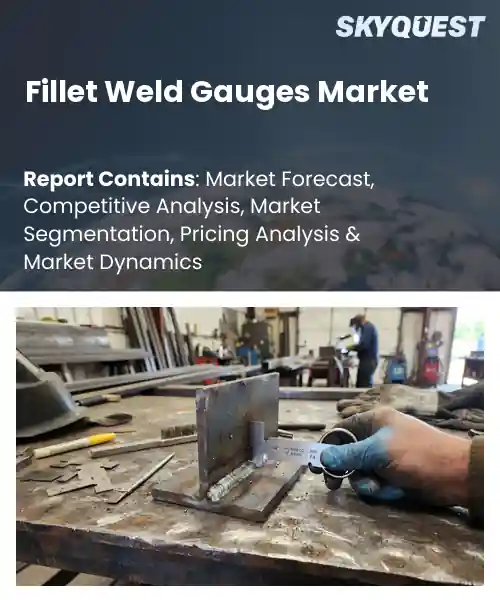
Fillet Weld Gauges Market
Report ID: SQMIG20I3738
Report ID: SQMIG20I3738
[email protected]
USA +1 351-333-4748
Report ID:
SQMIG20I3738 |
Region:
Global |
Published Date: August, 2026
Pages:
157
|Tables:
119
|Figures:
77


Global Fillet Weld Gauges Market size was valued at USD 178.0 Million in 2024 and is poised to grow from USD 187.08 Million in 2025 to USD 278.52 Million by 2033, growing at a CAGR of 5.1% during the forecast period (2026-2033).
The primary driver of the global fillet weld gauges market is the escalating demand for welded structures across automotive, construction, and energy sectors. Fillet weld gauges, which verify weld leg size and angle, are essential for compliance with safety standards like ISO 5817 and AWS D1.1; without them, manufacturers risk costly rework and regulatory penalties. Historically, the market emerged in the 1990s when computerized inspection tools began to complement measurement, but it accelerated in the 2010s as lightweight vehicle frames and offshore platforms required tighter tolerances. This evolution underscores the gauge’s role in reducing defect rates and enhancing product reliability. Building on this foundation, the next key factor propelling market expansion is the adoption of manufacturing technologies such as additive manufacturing and welding robots, which generate joint geometries that demand verification. Companies like Boeing and Siemens now integrate digital fillet weld gauges into cyber‑physical production lines, enabling feedback that shortens inspection cycles by 30 percent. This capability not only improves throughput but also reduces scrap, creating an economic incentive for manufacturers to upgrade tools. Consequently, demand for calibrated gauges with data‑logging functions is rising, opening avenues for OEMs and service providers to capture value through subscription‑based maintenance and software analytics.
How is AI-driven automation impacting the global fillet weld gauges market?
AI‑driven automation is reshaping the fillet weld gauges market by embedding intelligent sensors, computer‑vision algorithms and real‑time analytics into traditional measurement tools. These smart gauges automatically detect weld angles, record dimensions and flag deviations without manual interpretation, which speeds inspection cycles and reduces human error. The technology also enables continuous data collection that feeds predictive maintenance models, helping manufacturers anticipate tool wear and optimize calibration schedules. As welding standards become more stringent, customers value the consistency and traceability offered by AI‑enhanced devices. Early adopters report faster quality‑control loops, lower rework rates and improved compliance, making automation a key differentiator in a competitive market.In June 2024, a leading fillet weld gauge manufacturer introduced an AI‑enabled digital gauge that automatically captures weld geometry and uploads data to cloud analytics, boosting inspection efficiency and supporting market growth.
Market snapshot - (2026-2033)
Global Market Size
USD 178.0 Million
Largest Segment
Standard Fillet Weld Gauges
Fastest Growth
Bridge Cam Gauges
Growth Rate
5.1% CAGR
To get more insights on this market click here to Request a Free Sample Report
Global fillet weld gauges market is segmented by product type, material, end user, distribution channel and region. Based on product type, the market is segmented into Standard Fillet Weld Gauges, Bridge Cam Gauges and Universal Weld Gauges. Based on material, the market is segmented into Stainless Steel, Hardened Steel and Others. Based on end user, the market is segmented into Manufacturing, Construction, Oil & Gas, Shipbuilding, Aerospace and Others. Based on distribution channel, the market is segmented into Online and Offline. Based on region, the market is segmented into North America, Europe, Asia Pacific, Latin America and Middle East & Africa.
Standard Fillet Weld Gauges segment dominates because they directly address the core requirement of accurate weld bead geometry, offering straightforward readouts that align with most fabrication processes. Their simplicity reduces training time and maintenance costs, making them the preferred choice for routine quality checks. The widespread adoption across diverse industries reinforces their market leadership, while continuous improvements in calibration reliability further cement their dominance and operational consistency.
However, Bridge Cam Gauges are witnessing the strongest growth momentum as they allow quick visual checks of fillet weld angles without removing the tool, which suits high‑throughput lines. Their ergonomic form and fit with automated inspection stations accelerate adoption, fostering smart‑factory integration and expanding market opportunities.
Hardened Steel segment dominates because its superior wear resistance ensures prolonged gauge life even under rigorous inspection cycles, meeting the high durability standards demanded by heavy‑industry users. The material’s ability to retain precise dimensions after repeated stress reduces recalibration frequency, lowering total cost of ownership. Consequently, manufacturers prioritize hardened steel for premium products, reinforcing its leading position within the material hierarchy of fillet weld gauges and consistent performance.
Meanwhile, Stainless Steel is emerging as the key high‑growth area as manufacturers seek corrosion‑resistant gauges for marine and chemical environments. Advances in alloy formulations provide strength comparable to hardened steel while offering lighter weight, attracting users in shipbuilding and offshore sectors. This trend broadens application scopes and drives increased procurement, propelling overall market expansion.
To get detailed segments analysis, Request a Free Sample Report
Asia Pacific leads the global fillet weld gauges market due to a combination of advanced manufacturing capabilities, strong demand from automotive and heavy‑industry sectors, and a culture of continuous improvement in welding quality. The region benefits from a dense network of original equipment manufacturers that prioritize precision and reliability, driving adoption of sophisticated gauge technologies. Furthermore, regional trade agreements facilitate cross‑border collaboration, allowing firms to share best practices and integrate emerging digital inspection tools. The commitment to workforce training and certification ensures that operators maintain high competency levels, which further fuels market confidence. As sustainability considerations become more prominent, manufacturers in the region are also integrating eco‑friendly materials and processes, enhancing the overall appeal of fillet weld gauge solutions across diverse applications.
Fillet Weld Gauges Market in Japan benefits from a long‑standing reputation for precision engineering and a robust supply chain that supports high‑quality welding equipment. Domestic manufacturers collaborate closely with automotive and shipbuilding firms, ensuring that gauge specifications align with stringent performance criteria. Continuous investment in research and development drives incremental improvements, while a strong emphasis on training sustains skilled personnel capable of leveraging advanced measurement technologies for modern production environments today.
Fillet Weld Gauges Market in South Korea is propelled by a dynamic industrial base that emphasizes automation and high‑precision fabrication. Close ties between gauge suppliers and heavy‑industry players, particularly in petrochemical and shipbuilding sectors, foster rapid adoption of cutting‑edge inspection tools. Government initiatives supporting advanced manufacturing reinforce the ecosystem, while a culture of continuous skill enhancement ensures that technicians remain adept at implementing sophisticated gauge solutions across complex welding operations today.
Europe’s fillet weld gauges market is experiencing rapid expansion driven by stringent regulatory frameworks, a strong emphasis on product safety, and a mature manufacturing sector that values precision. The region’s engineering culture promotes adoption of advanced measurement technologies to meet demanding quality standards across automotive, aerospace, and energy industries. Collaborative research networks among universities and industry leaders accelerate innovation, while a focus on sustainability encourages integration of environmentally responsible welding practices. Additionally, well‑established distribution channels and a high level of technical expertise enable swift diffusion of new gauge solutions, reinforcing Europe’s position as a key growth engine for the global market. The commitment to continuous improvement is reflected in extensive training programs that keep engineers abreast of the latest gauge calibration techniques. Moreover, the presence of several leading gauge manufacturers within the region fosters healthy competition, driving product differentiation and value‑added services that further stimulate market momentum.
Fillet Weld Gauges Market in Germany is anchored by a robust industrial base that includes automotive, machinery, and energy sectors demanding high‑precision welding verification. German manufacturers benefit from strong engineering traditions and close collaboration with standards bodies, ensuring gauge solutions comply with rigorous quality requirements. Ongoing investment in digitalization and Industry 4.0 concepts enhances traceability and monitoring, positioning Germany as a dominant hub for advanced fillet weld gauge technology adoption across Europe.
Fillet Weld Gauges Market in United Kingdom is experiencing rapid growth driven by a vibrant aerospace and defense industry that prioritizes weld integrity. Collaborative projects between gauge suppliers and research institutions accelerate the development of inspection tools. The regulatory environment encourages adoption of precision measurement to meet safety standards, while a skilled workforce adept at advanced welding techniques supports rapid deployment. This combination fuels a market trajectory within the United Kingdom.
Fillet Weld Gauges Market in France is emerging as manufacturers adopt welding verification to enhance reliability in automotive and rail sectors. French engineering firms work with research centers to integrate sensor‑fusion technologies into gauge designs, improving accuracy and usability. Government incentives for manufacturing encourage investment in inspection equipment. As industry seeks to meet European quality directives, the French market is poised for expansion and wider adoption of fillet weld gauge solutions.
North America is strengthening its position in the fillet weld gauges market through advanced manufacturing ecosystems, a strong focus on quality assurance, and rapid adoption of digital inspection technologies. The United States benefits from a large base of aerospace, automotive and energy producers that require precise weld monitoring to stay competitive. Canada’s emphasis on sustainable industrial practices drives interest in efficient gauge solutions that lower rework and material waste. Collaborative initiatives between gauge manufacturers, research institutions and industry associations foster continuous innovation, while a skilled workforce ensures effective implementation of sophisticated measurement tools. Regulatory bodies in both countries refine inspection guidelines, encouraging higher‑resolution gauge systems. The growing focus on digital twins and predictive maintenance creates opportunities to integrate gauge data into broader asset‑management platforms, further solidifying North America’s leadership in the sector.
Fillet Weld Gauges Market in United States is driven by a diverse industrial landscape that includes aerospace, automotive, and energy sectors demanding rigorous weld quality control. Leading gauge manufacturers collaborate closely with OEMs to develop customized solutions that meet specific performance criteria. Strong investment in research and development accelerates the integration of smart sensor technologies, while a training infrastructure ensures technicians are proficient in operating measurement equipment across complex production environments.
Fillet Weld Gauges Market in Canada is shaped by an emphasis on manufacturing and a growing demand for reliable weld inspection in the oil‑gas and infrastructure sectors. Canadian gauge providers deliver devices that minimize downtime and support compliance. Partnerships with research universities drive development of sensor platforms, while government programs fund adoption of inspection tools. This ecosystem enhances the capability of Canadian industries to achieve weld quality standards with operational costs.
To know more about the market opportunities by region and country, click here to
Buy The Complete Report
Increasing Demand for Precision Welding
Adoption Of Automated Inspection Systems
High Cost Of Advanced Sensors
Stringent Calibration Certification Requirements
Request Free Customization of this report to help us to meet your business objectives.
The competitive landscape of the global fillet weld gauges market is shaped by firms expanding product portfolios and pursuing strategic collaborations. Recent activity includes manufacturers acquiring complementary technology providers to broaden measurement capabilities, while partnerships with welding equipment distributors accelerate market penetration. Companies are also investing in digital sensor integration and IoT-enabled gauges to differentiate offerings and meet evolving industry precision demands.
Top Player’s Company Profile
Recent Developments
SkyQuest’s ABIRAW (Advanced Business Intelligence, Research & Analysis Wing) is our Business Information Services team that Collects, Collates, Correlates, and Analyses the Data collected by means of Primary Exploratory Research backed by robust Secondary Desk research. As per SkyQuest analysis the global fillet weld gauges market is being propelled primarily by the rising demand for precision welding in automotive and aerospace, which pushes manufacturers to seek tighter tolerances and reliable repeatability. A second strong catalyst is the growing adoption of automated inspection systems that deliver real‑time monitoring and reduce manual error, accelerating gauge deployment on high‑volume lines. The market faces a notable restraint in the high cost of advanced sensor arrays, limiting uptake among cost‑sensitive users. Asia Pacific dominates the landscape thanks to its advanced manufacturing base and strong automotive sector, while the Standard Fillet Weld Gauges segment leads in volume due to its simplicity and broad applicability.
| Report Metric | Details |
|---|---|
| Market size value in 2024 | USD 178.0 Million |
| Market size value in 2033 | USD 278.52 Million |
| Growth Rate | 5.1% |
| Base year | 2024 |
| Forecast period | (2026-2033) |
| Forecast Unit (Value) | USD Million |
| Segments covered |
|
| Regions covered | North America (US, Canada), Europe (Germany, France, United Kingdom, Italy, Spain, Rest of Europe), Asia Pacific (China, India, Japan, Rest of Asia-Pacific), Latin America (Brazil, Rest of Latin America), Middle East & Africa (South Africa, GCC Countries, Rest of MEA) |
| Companies covered |
|
| Customization scope | Free report customization with purchase. Customization includes:-
|
To get a free trial access to our platform which is a one stop solution for all your data requirements for quicker decision making. This platform allows you to compare markets, competitors who are prominent in the market, and mega trends that are influencing the dynamics in the market. Also, get access to detailed SkyQuest exclusive matrix.
Table Of Content
Executive Summary
Market overview
Parent Market Analysis
Market overview
Market size
KEY MARKET INSIGHTS
COVID IMPACT
MARKET DYNAMICS & OUTLOOK
Market Size by Region
KEY COMPANY PROFILES
Methodology
For the Fillet Weld Gauges Market, our research methodology involved a mixture of primary and secondary data sources. Key steps involved in the research process are listed below:
1. Information Procurement: This stage involved the procurement of Market data or related information via primary and secondary sources. The various secondary sources used included various company websites, annual reports, trade databases, and paid databases such as Hoover's, Bloomberg Business, Factiva, and Avention. Our team did 45 primary interactions Globally which included several stakeholders such as manufacturers, customers, key opinion leaders, etc. Overall, information procurement was one of the most extensive stages in our research process.
2. Information Analysis: This step involved triangulation of data through bottom-up and top-down approaches to estimate and validate the total size and future estimate of the Fillet Weld Gauges Market.
3. Report Formulation: The final step entailed the placement of data points in appropriate Market spaces in an attempt to deduce viable conclusions.
4. Validation & Publishing: Validation is the most important step in the process. Validation & re-validation via an intricately designed process helped us finalize data points to be used for final calculations. The final Market estimates and forecasts were then aligned and sent to our panel of industry experts for validation of data. Once the validation was done the report was sent to our Quality Assurance team to ensure adherence to style guides, consistency & design.
Analyst Support
Customization Options
With the given market data, our dedicated team of analysts can offer you the following customization options are available for the Fillet Weld Gauges Market:
Product Analysis: Product matrix, which offers a detailed comparison of the product portfolio of companies.
Regional Analysis: Further analysis of the Fillet Weld Gauges Market for additional countries.
Competitive Analysis: Detailed analysis and profiling of additional Market players & comparative analysis of competitive products.
Go to Market Strategy: Find the high-growth channels to invest your marketing efforts and increase your customer base.
Innovation Mapping: Identify racial solutions and innovation, connected to deep ecosystems of innovators, start-ups, academics, and strategic partners.
Category Intelligence: Customized intelligence that is relevant to their supply Markets will enable them to make smarter sourcing decisions and improve their category management.
Public Company Transcript Analysis: To improve the investment performance by generating new alpha and making better-informed decisions.
Social Media Listening: To analyze the conversations and trends happening not just around your brand, but around your industry as a whole, and use those insights to make better Marketing decisions.
REQUEST FOR SAMPLE
 REQUEST FREE CUSTOMIZATION


Want to customize this report? This report can be personalized according to your needs. Our analysts and industry experts will work directly with you to understand your requirements and provide you with customized data in a short amount of time. We offer $1000 worth of FREE customization at the time of purchase.
Feedback From Our Clients


 USA (+1) 351-333-4748

