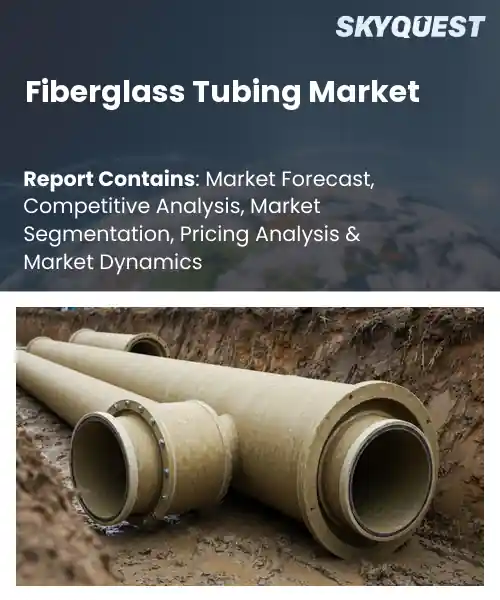
Fiberglass Tubing Market
Report ID: SQMIG20C2177
Report ID: SQMIG20C2177
[email protected]
USA +1 351-333-4748
Report ID:
SQMIG20C2177 |
Region:
Global |
Published Date: February, 2026
Pages:
157
|Tables:
209
|Figures:
80


Global Fiberglass Tubing Market size was valued at USD 5.4 Billion in 2024 and is poised to grow from USD 5.69 Billion in 2025 to USD 8.6 Billion by 2033, growing at a CAGR of 5.3% during the forecast period (2026-2033).
The fiberglass tubing industry has seen incredible growth due to the transition away from traditional materials to composite materials for industrial and infrastructure applications; those who use fiberglass tubing are able to significantly extend the lifespan of equipment and reduce cost over time. Fiberglass tubing has changed dramatically since it was first introduced as a product for small buildings, and now has been used extensively in oil and gas pipelines, marine applications (supports), electrical conduit, and wind turbine components. Advances in pultrusion and resin formulations improved quality and lowered unit costs, while stricter corrosion and safety regulations compelled operators to replace steel or aluminum in corrosive environments.
The demand for global fiberglass tubing is being driven by the growing desire for corrosion-resistant, non-conductive products in the energy and infrastructure sectors. As capacity increases and the performance of resins improves, the cost per unit decreases, and designers are now specifying fiberglass for oil and gas pipe, offshore risers, wind turbine shear webs, and telecom masts, which helps reduce both maintenance outages and electromagnetic interference. Real-world outcomes include longer pipeline service intervals on Gulf platforms and lighter automotive driveline prototypes that improve fuel economy. Those cause-and-effect shifts create opportunities for prefabricated systems, sensor-integrated tubes, and recycling-enabled supply chains.
How is Automation Improving Manufacturing Efficiency in the Fiberglass Tubing Market?
Automation is reshaping fiberglass tubing manufacturing by pairing precise pultrusion control with robotics and inline inspection to improve consistency and reduce waste. Aspects of the process include automatic resin metered out to pre-determined amounts; automated die heating controlled by computer, providing a continuous-flow process; continuous handling of fiber; and vision systems allowing for the detection of wall thickness and other surface defects. The current state shows many makers moving from manual finishing to integrated lines that shorten lead times and make custom profiles more viable.
In a market driven by demand from infrastructure and specialty applications, these systems raise product quality, reduce labor risk, and enable faster scaling. Examples include automated pultrusion lines that cut and mark tubes and robotic material handling that feeds high-speed production.
Strongwell in January 2025, introduced a new pultruded composite decking system that demonstrates how automated pultrusion and extrusion integration can enable complex profiles and scalable output while maintaining consistent quality. This development highlights how automation supports market growth by increasing manufacturing throughput and reproducibility and by reducing manual finishing and rework.
Market snapshot - (2026-2033)
Global Market Size
USD 5.4 Billion
Largest Segment
GRP Pipes
Fastest Growth
CCFRPM Pipes
Growth Rate
5.3% CAGR
To get more insights on this market click here to Request a Free Sample Report
Global fiberglass tubing market is segmented by pipe types, fiber types, pressure rating, diameter, pricing, application, distribution channel, and region. Based on pipe types, the market is segmented into GRE Pipes, GRP Pipes, FRP Pipes, CCFRPM Pipes, and Other Pipes. Based on fiber types, the market is segmented into E-Glass, T-Glass, S-Glass, R-Glass, and Others. Based on pressure rating, the market is segmented into Below 10 Bar, 10-25 Bar, 25-40 Bar, and Above 40 Bar. Based on diameter, the market is segmented into 16-48 Inches, 48-100 Inches, and above 100 Inches.
Based on pricing, the market is segmented into low, medium, and high. Based on application, the market is segmented into residential construction, water management, chemical transportation, oil & gas pipelines, cooling water systems, sewage systems, irrigation systems, marine, hydropower projects, and others. Based on the distribution channel, the market is segmented into direct sales and indirect sales. Based on region, the market is segmented into North America, Europe, Asia Pacific, Latin America and Middle East & Africa.
Based on the global fiberglass tubing market forecast, Glass segment dominates because its balanced combination of mechanical strength, corrosion resistance, thermal stability, and cost effectiveness makes it the default choice for diverse fiberglass tubing applications. Manufacturers prefer E-Glass for its compatibility with common resin systems and known fabrication processes, allowing for smoother production cycles and less variability in quality. Moreover, the ability of a large number of people to confidently specify these materials throughout the water industry, construction industry, and installed industrial pipe applications has led to widespread acceptance of these products due to experienced supply chains.
However, S-Glass is witnessing the strongest growth momentum as its superior tensile strength and impact resistance suit high-performance tubing for demanding chemical, oil, and gas applications. Engineering materials that are lightweight and durable have gained in popularity due to advances in processing and reductions in manufacturing costs. This has led to more applications for these materials, as well as generating a wider variety of high-end projects.
Oil & Gas Pipelines segment leads because the industry demands tubing materials that combine corrosion resistance, long-term mechanical integrity, and compatibility with aggressive hydrocarbons and associated chemicals. The adaptability of resin chemistry combined with fiber reinforcement allows fiberglass tubing to satisfy these criteria with a predictable operating life, even when subjected to fluctuating pressure levels and cycling between high and low temperatures. Operators prefer to utilize reliable materials that are capable of reducing long-term maintenance costs while also minimizing the possibility of leaks; as such, fiberglass tubing is now widely specified for transmission and subsea conduit systems.
However, Water Management is emerging as the most rapidly expanding application as utilities seek corrosion-resistant, lightweight tubing for distribution, treatment, and reuse systems. The fiberglass tubing suppliers have additional opportunities due to increased adoption of the products caused by advancements in the formulation of low-odour resins, ease of installation (jointing) and focus on construction infrastructure durability and reduced total cost of ownership.
To get detailed segments analysis, Request a Free Sample Report
Based on the global fiberglass tubing market analysis, the Asia-Pacific region commands the industry due to an integrated combination of strong manufacturing ecosystems, extensive downstream demand, and strategic investment in advanced materials. Robust industrial bases in sectors such as electronics, automotive, energy, and infrastructure create a sustained need for durable, lightweight tubing solutions. Proximity to raw material suppliers and scale-oriented production capabilities lower supply chain friction and support competitive pricing.
Continued focus on innovative product development, improved operational efficiency, along with cooperative partnerships between supplier companies and manufacturing companies lead to improved quality of products and more applications for those products. Supportive government policies, coupled with funding for targeted industrial programs, have also fueled increased investment in expanding production capacity and adopting new technologies within the region.
Fiberglass Tubing Market in Japan is characterized by advanced materials engineering, precise manufacturing standards, and close integration with electronics and automotive supply chains. High-performance formulations are heavily emphasized within the domestic industry through strict quality control methods to ensure that products provide reliable service within applications that have very small dimensions. There are also many opportunities for joint research projects between the research institutes and manufacturers which supports the ongoing refinement of products and their ability to meet consumer expectations.
Fiberglass Tubing Market in South Korea benefits from a strong electronics and shipbuilding ecosystem, driving demand for performance-oriented tubing and composite solutions. Locally based manufacturers concentrate on innovating processes and maximizing yield through production processes. Their focus is on ensuring that products comply with stringent requirements for durability and consistency throughout their life cycle. The manufacturers are also working closely with suppliers, fabricators, and end users to establish cooperative alliances that enable them to develop application-specific products rapidly.
North America is experiencing rapid expansion in fiberglass tubing driven by a combination of infrastructure modernization, diversified industrial demand, and emphasis on durable, corrosion-resistant materials. Through investments in advanced manufacturing, automation, and local supply chains, lead times are reduced, and products can be developed specifically for customer needs. Collaboration between engineering firms, utilities, and material innovators speeds up the specification of fiberglass products in complex applications, while strong aftermarket support and service networks help in the overall acceptance and use of fiberglass products in the marketplace. A focus on research and development and custom solutions allows suppliers to fulfill the high performance and compatibility required for the latest technologies, thereby strengthening the competitiveness of regions.
Fiberglass Tubing Market in the United States is driven by end use across energy, infrastructure rehabilitation, and industrial processing, creating demand for tailored, high-reliability tubing solutions. Manufacturers emphasize compliance with stringent industry specifications and provide added services, including custom fabrication and support. Partnerships between engineering firms and manufacturers of fiberglass tubing establish the specifications for the entire long-term performance and life cycle benefits of using a fiberglass product.
Fiberglass Tubing Market in Canada benefits from a focus on durable solutions for water treatment, oil and gas, and infrastructure projects, where corrosion resistance and low maintenance are prioritized. Utilizing the expertise of engineering consultants and contractors, domestic suppliers design their service offerings and tubing for specific applications, with an increased emphasis being placed on quality assurance through a localized fabricated products that allow them to customize projects for their customers. Canadian manufacturers of products that will be exported will have access to North American supply chains and provide for the delivery of their products to their customers as well.
Europe is strengthening its role in the fiberglass tubing market through a focus on high specification products, sustainability-oriented material choices, and deep engineering expertise that aligns with complex industrial demands. They are used in renewable energy, chemical processing, and transportation. Regulatory processes and certifications promote the adoption of durable materials that will last. Collaborative processes through technology research centers and industrial partners will mejorar la innovación. Investment in automation/precision manufacturing and quality assurance will increase competitiveness amongst suppliers.
The focus on the lifecycle of products and the ability to recycle will also differentiate European offerings during tenders and multinational projects, while providing further regional influence in technical segments of the industry. Strong linkages to global project contractors and an export-focused supply chain will expand the market reach, while the highly skilled workforce will enable custom engineering support and collaboration between end-users.
Fiberglass Tubing Market in Germany is centered on precision engineering and manufacturing that serve demanding industrial applications. To meet demanding specification requirements for chemical plants, transportation systems, and energy projects, local companies are investing in process control and materials testing and certification. Partnerships between engineering companies and technology providers have enabled the development of custom tubing solutions; suppliers with good export capabilities and integrated supplier networks help German manufacturers meet their contractual obligations with a focus on durability, performance, and compliance to specification.
Fiberglass Tubing Market in United Kingdom focuses on innovative applications across marine, infrastructure, and energy sectors where lightweight, corrosion resistant tubing delivers benefits. The suppliers focus on meeting the specific needs of their customers, providing custom designs and extensive quality control programs that comply with the requirements of your project / safety standards. The suppliers will work closely with naval architects, utilities and general contractors to assist with the early identification of fiberglass solution specifications.
Fiberglass Tubing Market in France emphasizes engineered solutions for chemical processing, transportation, and energy projects requiring corrosion-resistant, lightweight tubing. French manufacturing companies are checking the innovative materials being used, confirming superior testing methods, and establishing alliances with system integration partners in order to meet market expectations and to follow the specifications of their customers. Buyers within the manufacturing market want supplier products that are produced with specialized manufacturing processes and have complete cooperative support through all phases of the project.
To know more about the market opportunities by region and country, click here to
Buy The Complete Report
Energy Sector Infrastructure Expansion
The expansion of energy infrastructure, particularly in renewables and transmission networks, drives demand for fiberglass tubing because its combination of electrical insulation, corrosion resistance, and long service life offers system designers a reliable alternative to metallic conduits. Due to their low-maintenance nature and being able to withstand the harshest of environments, utility companies and engineers associated with EPC's are more frequently specifying fiberglass materials for their new projects or as part of upgrades/retrofitting efforts.
Lightweight Material Advantages In Transportation
Lightweight construction and high strength-to-weight ratio support increased use of fiberglass tubing in transportation applications where fuel efficiency and payload capacity are priorities. Manufacturers and vehicle integrators are looking for ways to reduce the weight of vehicles but still have a strong vehicle that will not rust and will resist vibration or break after repeated use. One of the ways designers accomplish this is by using fiberglass tubing since it has the ability to be easily shaped into complex forms and then combined with other composites to simplify assembly and minimize secondary processing.
Volatile Raw Material Availability
Manufacturers face sourcing challenges, as there is supply volatility and limited availability of critical inputs like specialty resins and glass fibres, which may affect their ability to respond quickly to customer orders and also increase the amount of time it takes to have the materials on-hand in order to meet customer commitments in relation to large scale projects. Also, the manufacturers are experiencing issues with obtaining the same consistency of quality from their suppliers along with executing long-term supply agreements, which can hinder manufacturers from expanding capacity and may result in discouraging downstream customers from use of fiberglass tubing in applications considered critical.
Regulatory and Certification Challenges
Divergent regional regulations and stringent certification requirements for materials used in safety-critical and environmentally sensitive applications can slow the global fiberglass tubing market growth by increasing time-to-market and elevating compliance costs for manufacturers. Several different authorities require approval of a product through various performance standards which adds to the complexity of developing a new product; as a result, this can discourage smaller suppliers to provide additional products due to long qualification periods. Because buyers are hesitant to switch from current established products, this can also limit any growth in demand and hinder the quick expansion of fiberglass pipe solutions on an international scale.
Request Free Customization of this report to help us to meet your business objectives.
Competitive dynamics in the global fiberglass tubing market outlook center on technology differentiation, capacity consolidation and supply chain localisation, with established manufacturers using acquisitions and targeted partnerships to secure customers and raw glass fibre supply. Examples include Rock West Composites' purchase of Performance Plastics to broaden tubing capabilities and Exel Composites' US plant expansion to reduce tariff exposure and shorten lead times.
SkyQuest’s ABIRAW (Advanced Business Intelligence, Research & Analysis Wing) is our Business Information Services team that Collects, Collates, Correlates, and Analyses the Data collected by means of Primary Exploratory Research backed by robust Secondary Desk research.
As per SkyQuest analysis, the global fiberglass tubing industry is driven by industry shifts toward lightweight, corrosion-resistant composites as a key driver, with automation in pultrusion and inline inspection acting as a second driver that boosts manufacturing efficiency and scalability. A restraint is volatile raw material availability, which can disrupt lead times and elevate costs. Asia Pacific is the largest and most influential region for fibreglass tubing manufacture, which is due to its integrated industrial systems, as well as strong downstream demand; whilst there, e-glass is the segment leader because of its combination of strength, thermal stability and cost-effectiveness. Ultimately, growth will be driven by energy and infrastructure projects, as well as their lifecycle cost savings and design flexibility will favour the adoption of fibreglass tubing.
| Report Metric | Details |
|---|---|
| Market size value in 2024 | USD 5.4 Billion |
| Market size value in 2033 | USD 8.6 Billion |
| Growth Rate | 5.3% |
| Base year | 2024 |
| Forecast period | (2026-2033) |
| Forecast Unit (Value) | USD Billion |
| Segments covered |
|
| Regions covered | North America (US, Canada), Europe (Germany, France, United Kingdom, Italy, Spain, Rest of Europe), Asia Pacific (China, India, Japan, Rest of Asia-Pacific), Latin America (Brazil, Rest of Latin America), Middle East & Africa (South Africa, GCC Countries, Rest of MEA) |
| Companies covered |
|
| Customization scope | Free report customization with purchase. Customization includes:-
|
To get a free trial access to our platform which is a one stop solution for all your data requirements for quicker decision making. This platform allows you to compare markets, competitors who are prominent in the market, and mega trends that are influencing the dynamics in the market. Also, get access to detailed SkyQuest exclusive matrix.
Table Of Content
Executive Summary
Market overview
Parent Market Analysis
Market overview
Market size
KEY MARKET INSIGHTS
COVID IMPACT
MARKET DYNAMICS & OUTLOOK
Market Size by Region
KEY COMPANY PROFILES
Methodology
For the Fiberglass Tubing Market, our research methodology involved a mixture of primary and secondary data sources. Key steps involved in the research process are listed below:
1. Information Procurement: This stage involved the procurement of Market data or related information via primary and secondary sources. The various secondary sources used included various company websites, annual reports, trade databases, and paid databases such as Hoover's, Bloomberg Business, Factiva, and Avention. Our team did 45 primary interactions Globally which included several stakeholders such as manufacturers, customers, key opinion leaders, etc. Overall, information procurement was one of the most extensive stages in our research process.
2. Information Analysis: This step involved triangulation of data through bottom-up and top-down approaches to estimate and validate the total size and future estimate of the Fiberglass Tubing Market.
3. Report Formulation: The final step entailed the placement of data points in appropriate Market spaces in an attempt to deduce viable conclusions.
4. Validation & Publishing: Validation is the most important step in the process. Validation & re-validation via an intricately designed process helped us finalize data points to be used for final calculations. The final Market estimates and forecasts were then aligned and sent to our panel of industry experts for validation of data. Once the validation was done the report was sent to our Quality Assurance team to ensure adherence to style guides, consistency & design.
Analyst Support
Customization Options
With the given market data, our dedicated team of analysts can offer you the following customization options are available for the Fiberglass Tubing Market:
Product Analysis: Product matrix, which offers a detailed comparison of the product portfolio of companies.
Regional Analysis: Further analysis of the Fiberglass Tubing Market for additional countries.
Competitive Analysis: Detailed analysis and profiling of additional Market players & comparative analysis of competitive products.
Go to Market Strategy: Find the high-growth channels to invest your marketing efforts and increase your customer base.
Innovation Mapping: Identify racial solutions and innovation, connected to deep ecosystems of innovators, start-ups, academics, and strategic partners.
Category Intelligence: Customized intelligence that is relevant to their supply Markets will enable them to make smarter sourcing decisions and improve their category management.
Public Company Transcript Analysis: To improve the investment performance by generating new alpha and making better-informed decisions.
Social Media Listening: To analyze the conversations and trends happening not just around your brand, but around your industry as a whole, and use those insights to make better Marketing decisions.
REQUEST FOR SAMPLE
 REQUEST FREE CUSTOMIZATION
Global Fiberglass Tubing Market size was valued at USD 5.4 Billion in 2024 and is poised to grow from USD 5.69 Billion in 2025 to USD 8.6 Billion by 2033, growing at a CAGR of 5.3% during the forecast period (2026-2033).
Competitive dynamics in the global fiberglass tubing market center on technology differentiation, capacity consolidation and supply chain localisation, with established manufacturers using acquisitions and targeted partnerships to secure customers and raw glass fibre supply. Examples include Rock West Composites' purchase of Performance Plastics to broaden tubing capabilities and Exel Composites' US plant expansion to reduce tariff exposure and shorten lead times. 'Future Pipe Industries', 'Sarplast', 'HOBAS Pipe', 'Augusta Fiberglass', 'FIBREX', 'Chemical Process Piping', 'Polypipe', 'Andronaco', 'Smithline Reinforced Composites', 'Flowtite', 'Superlit', 'Enduro Composites', 'Thompson Pipe', 'Fiberglass Vessel Co.', 'Plasticon Composites', 'Diamond Fiberglass', 'National Oilwell Varco', 'Amiblu Holding GmbH', 'Hebei Dongding Chemical Trade', 'Beetle Plastics'
The expansion of energy infrastructure, particularly in renewables and transmission networks, drives demand for fiberglass tubing because its combination of electrical insulation, corrosion resistance, and long service life offers system designers a reliable alternative to metallic conduits. This preference arises from reduced maintenance needs and compatibility with harsh environmental conditions, enabling utilities and EPC contractors to specify fiberglass solutions for new projects and retrofits. The material’s adaptability to custom profiles further supports adoption across evolving grid modernization initiatives and scalability.
Lightweighting Driving Design Choices: Demand for lighter structures in end-use industries is steering designers and manufacturers toward fiberglass tubing because of its favorable strength to weight ratio and design flexibility. This trend encourages integration of tubing into chassis, frames, and structural components where reducing mass enhances overall system performance and efficiency. Suppliers are adapting by offering tailored profiles, improved surface finishes, and collaborative design services, enabling faster adoption across sectors seeking performance improvements without compromising durability or cost effectiveness and sustainability objectives strategically aligned.
Based on the global fiberglass tubing market analysis, the Asia-Pacific region commands the industry due to an integrated combination of strong manufacturing ecosystems, extensive downstream demand, and strategic investment in advanced materials.


Want to customize this report? This report can be personalized according to your needs. Our analysts and industry experts will work directly with you to understand your requirements and provide you with customized data in a short amount of time. We offer $1000 worth of FREE customization at the time of purchase.
Feedback From Our Clients


 USA (+1) 351-333-4748

