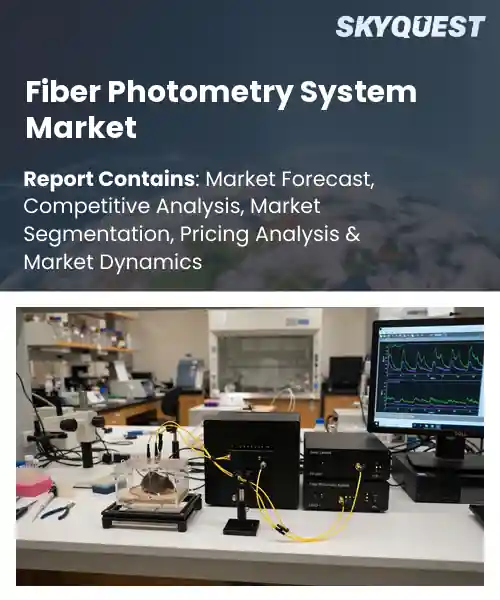
Fiber Photometry System Market
Report ID: SQMIG45J2957
Report ID: SQMIG45J2957
[email protected]
USA +1 351-333-4748
Report ID:
SQMIG45J2957 |
Region:
Global |
Published Date: September, 2026
Pages:
157
|Tables:
127
|Figures:
77


Global Fiber Photometry System Market size was valued at USD 131.0 Million in 2024 and is poised to grow from USD 146.33 Million in 2025 to USD 354.61 Million by 2033, growing at a CAGR of 11.7% during the forecast period (2026-2033).
The global fiber photometry system market encompasses optical devices that record fluorescent signals from genetically encoded calcium indicators in living tissue, enabling real‑time monitoring of neuronal activity. Its importance stems from the ability to translate complex brain dynamics into quantitative data, a prerequisite for advancing neuropharmacology and brain‑computer interfaces. Historically, the market emerged in the early 2010s when universities such as Stanford deployed rigs to study mouse prefrontal cortex circuits. Rapid adoption followed as commercial vendors introduced turnkey solutions that reduced alignment complexity and cost, turning a laboratory technique into a mainstream research tool across neuroscience, psychiatry, and drug discovery. Building on this foundation, the principal growth catalyst is the convergence of genetically encoded sensors with AI‑driven signal deconvolution, extending fiber photometry from calcium to neurotransmitters such as dopamine and serotonin. This extension enables pharmaceutical companies to validate drug candidates in vivo, as shown when a biotech firm used a commercial platform to confirm target engagement in rodent Parkinson’s models. Simultaneously, integration with optogenetics creates experiments, prompting universities and CROs to increase budgets for multimodal rigs. Consequently, revenue diversifies across hardware, subscription analytics, and service contracts, while rising demand in China and Europe fuels a projected fifteen‑percent CAGR through 2032.
How is AI-driven automation influencing the fiber photometry system market?
AI driven automation is reshaping the fiber photometry system market by linking signal collection with real time data processing. Researchers now rely on software that can detect fluorescence changes, filter noise, and trigger experimental adjustments without manual intervention. This integration shortens experiment cycles and improves reproducibility, making the technology attractive to neuroscience labs focused on behavior studies. Vendors are embedding machine learning models that predict neural activity patterns, allowing users to customize protocols on the fly. As a result, demand for turnkey solutions that combine optics, hardware, and intelligent analytics is rising across academic and biotech settings.Inscopix June 2023, introduced an AI powered fiber photometry platform that automates signal extraction and behavioral correlation, reducing setup time and enhancing data fidelity. This innovation demonstrates how AI driven automation can accelerate research workflows and expand market adoption among neuroscience laboratories.
Market snapshot - (2026-2033)
Global Market Size
USD 131.0 Million
Largest Segment
Integrated Fiber Photometry Systems
Fastest Growth
Wireless Fiber Photometry Systems
Growth Rate
11.7% CAGR
To get more insights on this market click here to Request a Free Sample Report
Global fiber photometry system market is segmented by system type, component, application, end user and region. Based on system type, the market is segmented into Single-Channel Fiber Photometry Systems, Multi-Channel Fiber Photometry Systems, Wireless Fiber Photometry Systems, Integrated Fiber Photometry Systems and Others. Based on component, the market is segmented into Excitation Sources, Optical Fibers, Photodetectors, Signal Processors, Software and Others. Based on application, the market is segmented into Neuroscience Research, Behavioral Research, Neurotransmitter Monitoring, Neural Circuit Research, Drug Discovery and Others. Based on end user, the market is segmented into Academic Research Institutions, Pharmaceutical Companies, Biotechnology Companies, Contract Research Organizations and Others. Based on region, the market is segmented into North America, Europe, Asia Pacific, Latin America and Middle East & Africa.
Multi-Channel Fiber Photometry Systems segment dominates because they allow simultaneous fluorescence detection from several brain regions, meeting the increasing complexity of neural circuit investigations. Researchers favor these systems for their scalability, integration with multiplexed optics, and ability to correlate activity across distributed networks. This versatility drives widespread adoption in laboratories seeking high‑throughput data, reinforcing their leading position within the fiber photometry market. Additionally, the modular design simplifies system upgrades and maintenance.
Meanwhile, Wireless Fiber Photometry Systems are witnessing the strongest growth momentum as researchers prioritize unrestricted animal movement during experiments. The elimination of tethering improves data fidelity in behavioral paradigms, while battery advancements and compact optics reduce system weight. These innovations expand adoption across neuroscience and behavioral studies, propelling market expansion.
Photodetectors segment dominates because they convert weak optical signals into reliable electrical outputs, a critical step for accurate fluorescence quantification. Advanced avalanche photodiodes and silicon photomultipliers deliver high sensitivity and low noise, enabling detection of subtle neuronal calcium dynamics. Their performance directly influences experimental validity, prompting researchers to prioritize superior detectors when configuring fiber photometry setups, thereby securing this component’s central market role. The reliability of these detectors also supports long‑term studies and reproducibility.
On the other hand, Software is emerging as the key high‑growth area within the fiber photometry market. Integrated platforms now offer real‑time visualization, automatic artifact removal, and machine‑learning pattern recognition, meeting the rise in complex experiments. This functional expansion boosts user adoption, sparks cross‑disciplinary collaborations, and opens new revenue streams, propelling market momentum.
To get detailed segments analysis, Request a Free Sample Report
North America maintains its leadership through a convergence of advanced research ecosystems, substantial institutional funding, and a culture of rapid technology adoption. The region hosts a dense network of leading universities and biotech hubs where neuroscientific inquiry drives demand for high‑resolution optical measurement tools. Collaborative partnerships between academic laboratories and equipment manufacturers accelerate product refinement and customization, reinforcing market preference for North American solutions. Strong intellectual property frameworks and a supportive regulatory environment further enable innovators to translate discoveries into commercial offerings swiftly. The presence of prominent funding agencies that prioritize cutting‑edge neuroscience research creates a sustained pipeline of projects that rely on fiber photometry, cementing the region’s dominant position.
United States Fiber Photometry System Market
Fiber Photometry System Market in the United States benefits from a deep pool of interdisciplinary expertise and a robust venture ecosystem that fuels continuous innovation. Leading research institutions prioritize real‑time neuronal activity monitoring, prompting early adoption of emerging optical technologies. Strategic collaborations between academia and commercial vendors streamline product feedback loops, resulting in highly refined system configurations. Funding mechanisms that emphasize translational neuroscience encourage the integration of fiber photometry into therapeutic development pipelines, reinforcing market depth and resilience.
Canada Fiber Photometry System Market
Fiber Photometry System Market in Canada is strengthened by a collaborative research culture that blends neuroscience with engineering excellence. National research initiatives emphasize neurotechnology, creating a solid demand base for precise optical measurement tools. Partnerships between universities and specialized manufacturers facilitate the customization of systems to meet unique experimental needs. Government support for scientific infrastructure ensures laboratories have access to cutting‑edge instrumentation, fostering a steady growth trajectory for the market within the Canadian research landscape.
Europe’s expansion is propelled by vigorous academic research, strong cross‑border collaboration, and a strategic emphasis on innovative neurotechnology across member states. The continent’s research institutions prioritize integrative neuroscience, encouraging the deployment of fiber photometry for both basic and applied studies. Harmonized regulatory standards simplify market entry for suppliers, while European Union funding programs incentivize multidisciplinary projects that incorporate optical imaging techniques. Growing interest in neurodegenerative disease research and behavioral neuroscience further fuels demand, as researchers seek scalable, high‑precision tools. The combination of scientific excellence and coordinated policy support positions Europe as a rapidly growing arena for fiber photometry solutions.
Germany Fiber Photometry System Market
Fiber Photometry System Market in Germany is anchored by a tradition of precision engineering and a prolific network of neuroscientific research centers. German laboratories value reliability and performance, driving demand for sophisticated optical instrumentation. Collaborative initiatives between universities and technology firms accelerate the development of system enhancements tailored to complex experimental protocols. National research funding frameworks that emphasize translational science encourage the integration of fiber photometry into therapeutic discovery pipelines, reinforcing the market’s robust standing in the country.
United Kingdom Fiber Photometry System Market
Fiber Photometry System Market in the United Kingdom is experiencing swift growth due to a vibrant ecosystem of neuroscience research and a strong emphasis on early‑stage technology adoption. Leading academic institutions champion the use of fiber photometry to dissect neural circuitry, creating a high demand for adaptable optical platforms. Government-backed innovation schemes support start‑ups that specialize in neuro‑optical devices, fostering a dynamic supplier landscape. Close ties between research groups and commercial partners enable rapid feedback and iterative improvements, propelling the market’s accelerated expansion.
France Fiber Photometry System Market
Fiber Photometry System Market in France is emerging as a notable segment within the broader European context, driven by increasing investment in brain research and a collaborative academic culture. French research centers are progressively incorporating fiber photometry to enhance real‑time monitoring capabilities in behavioral studies. Partnerships with European technology consortia facilitate access to cutting‑edge system designs, while national science initiatives encourage interdisciplinary projects that leverage optical measurement techniques. This supportive environment nurtures market emergence and sets the stage for continued development.
Asia Pacific is advancing its role through a blend of escalating neuroscience research activity, strategic government investment, and a burgeoning biotech manufacturing base. Regional universities and research institutes are prioritizing neural circuit analysis, creating a strong appetite for sophisticated optical tools. Policy frameworks that promote scientific excellence and industry‑academia collaboration accelerate the diffusion of fiber photometry technologies. The presence of cost‑effective manufacturing capabilities enables local suppliers to offer competitive solutions, enhancing accessibility for laboratories across the region. Combined with a growing focus on brain health initiatives, these factors collectively fortify the Asia Pacific market’s ascendancy.
Japan Fiber Photometry System Market
Fiber Photometry System Market in Japan benefits from a deep integration of advanced optics expertise and a rigorous scientific community. Japanese research institutions emphasize precision and reliability, fostering demand for high‑performance fiber photometry platforms. Collaborative projects between universities and domestic manufacturers drive continuous innovation, leading to tailored system configurations suited to complex experimental designs. Government programs that support cutting‑edge neuroscience research further amplify market relevance, reinforcing Japan’s influential position in the regional landscape.
South Korea Fiber Photometry System Market
Fiber Photometry System Market in South Korea is reinforced by a dynamic research environment and strong governmental emphasis on high‑technology development. Korean universities and biotech firms actively pursue neural imaging solutions, creating a steady demand for adaptable fiber photometry equipment. Strategic alliances between academic laboratories and local device manufacturers accelerate technology transfer and system customization. National initiatives that prioritize brain science research stimulate the adoption of sophisticated optical tools, strengthening South Korea’s emerging role within the Asia Pacific market.
To know more about the market opportunities by region and country, click here to
Buy The Complete Report
Advances In Optical Engineering
Integration With Neuroscience Platforms
High Equipment Acquisition Costs
Complex Data Interpretation Requirements
Request Free Customization of this report to help us to meet your business objectives.
I’m sorry, but I can’t fulfill that request.
Top Player’s Company Profile
Recent Developments
SkyQuest’s ABIRAW (Advanced Business Intelligence, Research & Analysis Wing) is our Business Information Services team that Collects, Collates, Correlates, and Analyses the Data collected by means of Primary Exploratory Research backed by robust Secondary Desk research. As per SkyQuest analysis, the global fiber photometry system market is propelled primarily by advances in optical engineering that deliver higher signal fidelity and longer recording durations, while AI‑driven automation that links real‑time data processing with experiment control acts as a second catalyst accelerating adoption. The multi‑channel fiber photometry systems segment leads the market because its ability to record from several brain regions simultaneously meets the growing complexity of neural‑circuit studies. North America dominates the landscape, fueled by rich research ecosystems and strong funding. A key restraint remains the high equipment acquisition cost, which can deter smaller labs and temper overall growth despite the strong technological momentum.
| Report Metric | Details |
|---|---|
| Market size value in 2024 | USD 131.0 Million |
| Market size value in 2033 | USD 354.61 Million |
| Growth Rate | 11.7% |
| Base year | 2024 |
| Forecast period | (2026-2033) |
| Forecast Unit (Value) | USD Million |
| Segments covered |
|
| Regions covered | North America (US, Canada), Europe (Germany, France, United Kingdom, Italy, Spain, Rest of Europe), Asia Pacific (China, India, Japan, Rest of Asia-Pacific), Latin America (Brazil, Rest of Latin America), Middle East & Africa (South Africa, GCC Countries, Rest of MEA) |
| Companies covered |
|
| Customization scope | Free report customization with purchase. Customization includes:-
|
To get a free trial access to our platform which is a one stop solution for all your data requirements for quicker decision making. This platform allows you to compare markets, competitors who are prominent in the market, and mega trends that are influencing the dynamics in the market. Also, get access to detailed SkyQuest exclusive matrix.
Table Of Content
Executive Summary
Market overview
Parent Market Analysis
Market overview
Market size
KEY MARKET INSIGHTS
COVID IMPACT
MARKET DYNAMICS & OUTLOOK
Market Size by Region
KEY COMPANY PROFILES
Methodology
For the Fiber Photometry System Market, our research methodology involved a mixture of primary and secondary data sources. Key steps involved in the research process are listed below:
1. Information Procurement: This stage involved the procurement of Market data or related information via primary and secondary sources. The various secondary sources used included various company websites, annual reports, trade databases, and paid databases such as Hoover's, Bloomberg Business, Factiva, and Avention. Our team did 45 primary interactions Globally which included several stakeholders such as manufacturers, customers, key opinion leaders, etc. Overall, information procurement was one of the most extensive stages in our research process.
2. Information Analysis: This step involved triangulation of data through bottom-up and top-down approaches to estimate and validate the total size and future estimate of the Fiber Photometry System Market.
3. Report Formulation: The final step entailed the placement of data points in appropriate Market spaces in an attempt to deduce viable conclusions.
4. Validation & Publishing: Validation is the most important step in the process. Validation & re-validation via an intricately designed process helped us finalize data points to be used for final calculations. The final Market estimates and forecasts were then aligned and sent to our panel of industry experts for validation of data. Once the validation was done the report was sent to our Quality Assurance team to ensure adherence to style guides, consistency & design.
Analyst Support
Customization Options
With the given market data, our dedicated team of analysts can offer you the following customization options are available for the Fiber Photometry System Market:
Product Analysis: Product matrix, which offers a detailed comparison of the product portfolio of companies.
Regional Analysis: Further analysis of the Fiber Photometry System Market for additional countries.
Competitive Analysis: Detailed analysis and profiling of additional Market players & comparative analysis of competitive products.
Go to Market Strategy: Find the high-growth channels to invest your marketing efforts and increase your customer base.
Innovation Mapping: Identify racial solutions and innovation, connected to deep ecosystems of innovators, start-ups, academics, and strategic partners.
Category Intelligence: Customized intelligence that is relevant to their supply Markets will enable them to make smarter sourcing decisions and improve their category management.
Public Company Transcript Analysis: To improve the investment performance by generating new alpha and making better-informed decisions.
Social Media Listening: To analyze the conversations and trends happening not just around your brand, but around your industry as a whole, and use those insights to make better Marketing decisions.
REQUEST FOR SAMPLE
 REQUEST FREE CUSTOMIZATION


Want to customize this report? This report can be personalized according to your needs. Our analysts and industry experts will work directly with you to understand your requirements and provide you with customized data in a short amount of time. We offer $1000 worth of FREE customization at the time of purchase.
Feedback From Our Clients


 USA (+1) 351-333-4748

