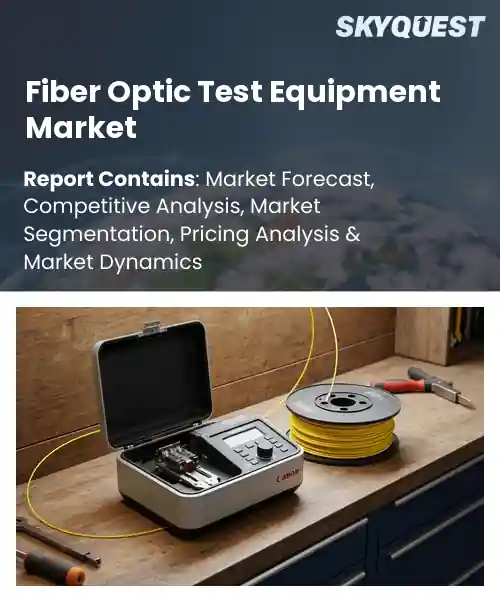
Fiber Optic Test Equipment Market
Report ID: SQMIG45J2407
Report ID: SQMIG45J2407
[email protected]
USA +1 351-333-4748
Report ID:
SQMIG45J2407 |
Region:
Global |
Published Date: February, 2026
Pages:
157
|Tables:
206
|Figures:
80


Global Fiber Optic Test Equipment Market size was valued at USD 1.4 Billion in 2024 and is poised to grow from USD 1.48 Billion in 2025 to USD 2.33 Billion by 2033, growing at a CAGR of 5.8% during the forecast period (2026-2033).
Optical fiber test equipment helps attain performance compliance, verify installations, and resolve technical issues of fibers and fiber networks. The primary driver of the optical fiber test equipment market is the increase in high-capacity data transmission, which necessitates fibre optic network upgrades. Companies that use optical fiber will benefit from reliable measurements of service quality, fewer instances of service downtime, and reduced costs compared with non-fiber services. Over time the market evolved from basic light sources and power meters to sophisticated optical time domain reflectometers as broadband, cloud services, 5G rollout created more complex links. For example, the transition from copper to fiber in metro rings required field testers to enable faster deployment.
Because network densification and higher transmission rates increase link complexity, a key trend driving the global fiber optic test equipment sector is automation and integrated testing solutions that reduce human error and accelerate validation. As operators deploy DWDM and coherent optics, the need for passive and active test suites causes vendors to develop modular platforms with remote management, which lowers technician hours and speeds to turn up in data centers and 5G cell sites. Consequently, vendors can monetize software subscriptions and cloud analytics while clients achieve predictive maintenance, illustrated by an ISP using centralized OTDR aggregation to locate faults before service impact.
How is AI Enhancing Accuracy and Efficiency in the Fiber Optic Test Equipment Market?
AI is improving accuracy and efficiency in the fiber optic test equipment market by combining smart analytics, automated inspection, and adaptive test workflows. Key aspects are image-based defect detection, machine learning classification of anomalies, and predictive scheduling of maintenance. Vendors are embedding automated inspection and remote monitoring into lab and field instruments to cope with denser networks and faster rollouts. This reduces operator error and shortens fault isolation cycles. Real world instances include automated connector microscopes, multi fiber certification systems, and cloud-based analytics that guide technicians and enable continuous process improvement, making testing more repeatable and easier to scale.
Market snapshot - 2026-2033
Global Market Size
USD 1.4 Billion
Largest Segment
Optical Time Domain Reflectometer (OTDR)
Fastest Growth
Optical Power Meter (OPM)
Growth Rate
5.8% CAGR
To get more insights on this market click here to Request a Free Sample Report
The global fiber optic test equipment market is segmented by product type, application, fiber type, form factor, network type, end use industry, distribution channel and region. Based on product type, the market is segmented into optical time domain reflectometer (OTDR), optical power meter (OPM), optical light source (OLS), optical loss test set (OLTS), optical spectrum analyzer (OSA), visual fault locator (VFL) and other product type. Based on application, the market is segmented into telecommunications service providers, hyperscale and enterprise data centers, industrial and manufacturing, energy and utilities, government and defense and others. Based on fiber type, the market is segmented into single-mode fiber and multimode fiber. Based on form factor, the market is segmented into handheld / portable, benchtop / laboratory, and rack-mounted systems. Based on network type, the market is segmented into long-haul networks, metro networks, access networks (FTTx) and data center networks. Based on end use industry, the market is segmented into telecommunications industry, data centers, cable manufacturing, research & development, and others. Based on distribution channels, the market is segmented into direct sales and distributors. Based on region, the market is segmented into North America, Europe, Asia Pacific, Latin America and Middle East & Africa.
Based on the global optic test equipment market forecast, OTDR segment dominates because instruments deliver deep diagnostic visibility along fiber links, enabling precise identification of fault locations, reflective events, and loss patterns that directly reduce troubleshooting ambiguity. Technicians' effectiveness improves with mapping link topology and characterizing splices and connectors. Advanced trace analysis and multi-wavelength capabilities build operator confidence to use OTDRs for deploying and maintaining networks and ultimately result in OTDR-based work.
Optical power meters (OPMs) are projected to be the fastest-growing product type in the global fiber optic test equipment market due to rising fiber-to-the-home deployments, 5G backhaul expansion, and increasing routine maintenance requirements. Their affordability, portability, and essential role in power measurement and insertion-loss testing drive widespread adoption across telecom, enterprise, and field service operations.
Handheld/portable segment dominates because portable instruments combine mobility, ruggedness, and intuitive interfaces that align with field technician needs for rapid verification and troubleshooting. Compact size, battery use, and simplified user workflow decrease time for setup and provide the ability to perform testing in confined spaces, which leads to an increase in the frequency of on-site diagnostics and accelerated deployment cycles driven by both ease of use from a practical standpoint and also lower logistics concerns.
Rack-mounted systems are poised to be the fastest-growing form factor in the global fiber optic test equipment market as data centers, hyperscale networks, and telecom labs demand scalable, high-density testing platforms. The ability to support multiple modules, provide automated workflows to support them, and to continue high-volume continuous validation is aligning to continue to grow with future fiber deployments.
To get detailed segments analysis, Request a Free Sample Report
As per the global optic test equipment market analysis, Asia Pacific dominance in the industry stems from a combination of deep technology ecosystems, concentrated manufacturing capabilities, proactive infrastructure investment, and strong demand from telecom, data center, and industrial automation sectors. In the region, the top countries have a well-established advanced component supplier base, testing instrument manufacturers and dense service provider ecosystem that fosters innovation and rapid scaling of production. The strategic collaboration between equipment manufacturers, research institutions, and large network operator companies enables the speedy commercialization of advanced testing solutions. The integration of supply chain and cost-effective production implies the potential for a competitive advantage for the vendors in global acquisition. The rapid deployment of fibre networks and next-generation transmission systems creates a constant state of demand for testing and measuring devices. Additionally, by specialisation, regional vendors develop high accuracy, compact, and automated testing equipment, thus maintaining their position as market leaders.
Fiber optic test equipment market in Japan is characterized by advanced semiconductor and optical component industries, strong domestic vendor capabilities, and a focus on miniaturization and high precision. The collaborative research between manufacturers and telecom organizations has allowed a quicker way to verify these new types of testing procedures. The ability of the market to provide high-quality, reliable products has created a need for reliable sources that also integrate into this new automated production process, including many different types of complex testing of high-speed transport and compact optical products, and comprehensive adherence to all applicable compliance requirements.
Fiber optic test equipment market in South Korea benefits from strong electronics manufacturing, rapid adoption of advanced networking technologies, and close ties between component suppliers and network operators. Versatile test platforms are driven largely by the need for automation, reliability in the field, and compact implementation of test instruments. Manufacturers in the country are concentrating on custom solutions for data centre and carrier-type environments. Support from collaborative ecosystems to integrate new measurement methods into production and deployment will facilitate widespread adoption of these new technologies.
North America expansion is driven by concentrated demand from cloud service providers, hyperscale data center operators, and network infrastructure modernizers that require comprehensive, high throughput test and measurement solutions. The presence of so many advanced testing equipment suppliers and such a strong number of startups continues to encourage innovation in optical transceivers, automated test hardware, and software-based measurement systems. Proximity and collaboration between equipment vendors and service providers allow for quick validation and subsequent implementation of new testing methods. The focus on serviceability, the ability to diagnose remotely, and the ability to work with a wide variety of vendor ecosystems contribute to an increased interest in modular and scalable testing systems. Regulatory emphasis on network resiliency, and enterprise investment in private networks will also continue to provide an active environment for advanced testing and aftermarket services. AI-assisted analytical capabilities and insight gained from performing edge-focused testing will improve the ability to predict maintenance needs and simplify the operational complexities associated with wide area network deployments.
Fiber optic test equipment market share in United States is characterized by demand from hyperscale cloud operators, advanced research institutions, and a strong instrument manufacturing base. Companies are making their purchasing decisions based on an emphasis on remotely diagnosing and using software-enabled analysis and automated scalable testing. Vendors place the most importance on having working networks such as multi-vendor equipment and testing at high throughputs, which assists in deploying products.
Fiber optic test equipment market in Canada is shaped by regional service providers, enterprise networking upgrades, and deployment of rural and urban fiber initiatives. The preference for field-tested ruggedized equipment, such as portable diagnostic devices, has driven demand for a greater variety of measurement instruments that can operate in a broad range of environmental conditions, supporting local integrators and global manufacturers with unique test solutions and service offerings. Additionally, the marketplace values reliability, onsite service capability, and expandable test systems that support usable carrier networks.
Europe is strengthening its position through a combination of focused research initiatives, strong industrial optics expertise, and coordinated investments in high-capacity networks across public and private sectors. Technology clusters within the Germany, UK and France, have specialized capabilities related to precision measurement, photonics manufacturing and system integration will contribute to develop robust and `field deployed' testing platforms. A focus on developing standards, interoperability and energy efficient instrumentation will allow for widespread adoption of these testing platforms by carriers and enterprise users. Accelerated validation of new measurement techniques through collaborative partnerships between equipment providers/research institutions/large telecommunications network operators. Furthermore, a growing service provider and testing centre ecosystem provides regional support and aftermarket services to strengthen the position of European offerings in global procurement decisions.
Fiber optic test equipment market in Germany leverages deep industrial optics capabilities, precision engineering, and photonics suppliers to deliver high reliability instruments. Large-scale field testing, lab-grade measurement equipment, and connections between manufacturing quality control all play a role in driving adoption. The partnership between research organizations and suppliers further helps to improve metrology methodology, processes, and standards. The marketplace also tends to be oriented towards scalable platforms that support automating and energy-efficient operations, which are important to both carriers and integrators.
Fiber optic test equipment market in United Kingdom is driven by strong research activity in photonics, a telecom services sector, and demand for compact test solutions. Suppliers focus on interoperability, remote monitoring capabilities, and field-oriented diagnostic instruments that simplify installation and maintenance. There has also been an increasing demand for platforms that provide the flexibility necessary to support testing of carrier networks and enterprise systems as well as to keep pace with changes made to existing networks.
Fiber optic test equipment market in France benefits from strong photonics research, a base of optical component suppliers, and collaboration with systems integrators. The focus of measurement at lab quality, supported by automation of testing, and designing instruments that require less energy for commercial purchase will determine the direction of purchasing decisions for metrology equipment. The market values adaptable platforms that support research workflows, carrier deployments, and varied industrial applications.
To know more about the market opportunities by region and country, click here to
Buy The Complete Report
Expansion Of Fiber Infrastructure
Rising Demand for High Precision Equipment
High Cost of Advanced Instruments
Rapid Technological Obsolescence and Upgrade Pressure
Request Free Customization of this report to help us to meet your business objectives.
Competitive landscape in the global fiber optic test equipment market analysis, is shaped by consolidation, strategic partnerships, and technology-led differentiation. Incumbents pursue acquisitions and targeted deals to capture high-speed lab test assets and sensing capabilities, for example EXFO acquiring InOpticals and Luna Innovations buying Micron Optics and OptaSense. Vendors also lock operator partnerships to deploy remote fiber test systems and expand managed monitoring services.
SkyQuest’s ABIRAW (Advanced Business Intelligence, Research & Analysis Wing) is our Business Information Services team that Collects, Collates, Correlates, and Analyses the Data collected by means of Primary Exploratory Research backed by robust Secondary Desk research.
As per SkyQuest analysis, the global fiber optic test equipment industry is being driven primarily by rapid expansion of fiber infrastructure which fuels demand for installation and maintenance tools, while automation and AI integration act as a second key driver by improving test accuracy and operational efficiency. Highly advanced tools available are also priced so high and as such, can limit the ability of many price sensitive buyers to purchase them. Asia Pacific is the leading regional market due to strong deployment and manufacturing activity, and optical time domain reflectometers (OTDRs) are used for all important capabilities at remote fault detection and remote link certification.
| Report Metric | Details |
|---|---|
| Market size value in 2024 | USD 1.4 Billion |
| Market size value in 2033 | USD 2.33 Billion |
| Growth Rate | 5.8% |
| Base year | 2024 |
| Forecast period | 2026-2033 |
| Forecast Unit (Value) | USD Billion |
| Segments covered |
|
| Regions covered | North America (US, Canada), Europe (Germany, France, United Kingdom, Italy, Spain, Rest of Europe), Asia Pacific (China, India, Japan, Rest of Asia-Pacific), Latin America (Brazil, Rest of Latin America), Middle East & Africa (South Africa, GCC Countries, Rest of MEA) |
| Companies covered |
|
| Customization scope | Free report customization with purchase. Customization includes:-
|
To get a free trial access to our platform which is a one stop solution for all your data requirements for quicker decision making. This platform allows you to compare markets, competitors who are prominent in the market, and mega trends that are influencing the dynamics in the market. Also, get access to detailed SkyQuest exclusive matrix.
Table Of Content
Executive Summary
Market overview
Parent Market Analysis
Market overview
Market size
KEY MARKET INSIGHTS
COVID IMPACT
MARKET DYNAMICS & OUTLOOK
Market Size by Region
KEY COMPANY PROFILES
Methodology
For the Fiber Optic Test Equipment Market, our research methodology involved a mixture of primary and secondary data sources. Key steps involved in the research process are listed below:
1. Information Procurement: This stage involved the procurement of Market data or related information via primary and secondary sources. The various secondary sources used included various company websites, annual reports, trade databases, and paid databases such as Hoover's, Bloomberg Business, Factiva, and Avention. Our team did 45 primary interactions Globally which included several stakeholders such as manufacturers, customers, key opinion leaders, etc. Overall, information procurement was one of the most extensive stages in our research process.
2. Information Analysis: This step involved triangulation of data through bottom-up and top-down approaches to estimate and validate the total size and future estimate of the Fiber Optic Test Equipment Market.
3. Report Formulation: The final step entailed the placement of data points in appropriate Market spaces in an attempt to deduce viable conclusions.
4. Validation & Publishing: Validation is the most important step in the process. Validation & re-validation via an intricately designed process helped us finalize data points to be used for final calculations. The final Market estimates and forecasts were then aligned and sent to our panel of industry experts for validation of data. Once the validation was done the report was sent to our Quality Assurance team to ensure adherence to style guides, consistency & design.
Analyst Support
Customization Options
With the given market data, our dedicated team of analysts can offer you the following customization options are available for the Fiber Optic Test Equipment Market:
Product Analysis: Product matrix, which offers a detailed comparison of the product portfolio of companies.
Regional Analysis: Further analysis of the Fiber Optic Test Equipment Market for additional countries.
Competitive Analysis: Detailed analysis and profiling of additional Market players & comparative analysis of competitive products.
Go to Market Strategy: Find the high-growth channels to invest your marketing efforts and increase your customer base.
Innovation Mapping: Identify racial solutions and innovation, connected to deep ecosystems of innovators, start-ups, academics, and strategic partners.
Category Intelligence: Customized intelligence that is relevant to their supply Markets will enable them to make smarter sourcing decisions and improve their category management.
Public Company Transcript Analysis: To improve the investment performance by generating new alpha and making better-informed decisions.
Social Media Listening: To analyze the conversations and trends happening not just around your brand, but around your industry as a whole, and use those insights to make better Marketing decisions.
REQUEST FOR SAMPLE
 REQUEST FREE CUSTOMIZATION
Global Fiber Optic Test Equipment Market size was valued at USD 1.4 Billion in 2024 and is poised to grow from USD 1.48 Billion in 2025 to USD 2.33 Billion by 2033, growing at a CAGR of 5.8% during the forecast period (2026-2033).
Competitive landscape in the global fiber optic test equipment market is shaped by consolidation, strategic partnerships, and technology-led differentiation. Incumbents pursue acquisitions and targeted deals to capture high-speed lab test assets and sensing capabilities, for example EXFO acquiring InOpticals and Luna Innovations buying Micron Optics and OptaSense. Vendors also lock operator partnerships to deploy remote fiber test systems and expand managed monitoring services. 'EXFO Inc.', 'VIAVI Solutions Inc.', 'Anritsu Corporation', 'Yokogawa Electric Corporation', 'AFL Global (Fujikura)', 'Fluke Networks', 'Keysight Technologies', 'VeEX Inc.', 'Kingfisher International', 'Tektronix (Fortive)', 'Deviser Instruments', 'Trend Communications', 'Corning Inc.', 'Photon Kinetics', 'Terahertz Technologies', 'GAO Tek', 'OptoTest', 'Luna Innovations', 'Tempo Communications', 'VI-Systems GmbH'
The widespread expansion of fiber infrastructure is creating sustained demand for testing tools because each new deployment and upgrade requires comprehensive installation, validation, and maintenance processes; network operators and contractors seek reliable instruments to verify link integrity, optimize performance, and troubleshoot faults across diverse environments, which encourages procurement of both portable field testers and laboratory systems; as infrastructure grows, the volume and variety of testing activities increase, prompting vendors to enhance capabilities and broaden product offerings to meet evolving operational requirements.
Asia Pacific Dominates the Global Fiber Optic Test Equipment Market


Want to customize this report? This report can be personalized according to your needs. Our analysts and industry experts will work directly with you to understand your requirements and provide you with customized data in a short amount of time. We offer $1000 worth of FREE customization at the time of purchase.
Feedback From Our Clients


 USA (+1) 351-333-4748

