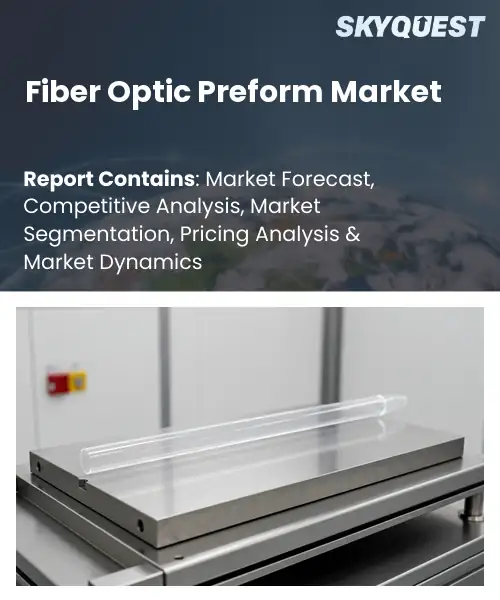
Fiber Optic Preform Market
Report ID: SQMIG45K2272
Report ID: SQMIG45K2272
[email protected]
USA +1 351-333-4748
Report ID:
SQMIG45K2272 |
Region:
Global |
Published Date: June, 2026
Pages:
157
|Tables:
97
|Figures:
76


Global Fiber Optic Preform Market size was valued at USD 7.06 Billion in 2024 and is poised to grow from USD 8.5 Billion in 2025 to USD 37.51 Billion by 2033, growing at a CAGR of 20.39% during the forecast period (2026-2033).
At the center of the fiber optic preform market lies accelerating demand for high-capacity, low-latency communications that support digital transformation. A fiber optic preform is the engineered glass cylinder drawn into telecom fiber; its purity and refractive profile determine signal loss, bandwidth and manufacturability. The market matters because preform attributes directly affect network reach, reliability and overall deployment cost, prompting network operators to source higher specification preforms for long-haul, metro and data center links. Over decades the industry progressed from rudimentary rod-in-tube practices to chemical vapor deposition methods developed by pioneers such as Corning, reducing attenuation and enabling mass deployment.
Building on the preform quality imperative, a key trend driving the global fiber optic preform sector is evolving network architecture that increases per-fiber capacity and demands specialized preforms. When hyperscale data centers and carriers adopt coherent modulation together with dense wavelength multiplexing and multicore architectures, manufacturers must supply preforms with tighter refractive index control and chemistries to achieve lower loss and higher channel counts. Consequently, investment in advanced MCVD and OVD lines lowers costs and speeds fiber-to-the-home, 5G backhaul and transoceanic rollouts. Real deployments by cloud providers and submarine cable projects show how these technical requirements convert into market opportunity and spur capacity expansion in Asia.
How is AI Enhancing Quality Control in the Fiber Optic Preform Market?
AI is improving quality control in fiber optic preform production by combining machine vision with predictive analytics to find surface defects, core concentricity issues, and refractive index anomalies early in the line. In fiber optic preform production, the quality control process has improved due to the integration of machine vision technology and predictive analytics that work together to detect any early surface flaws, core concentricity problems and refractive index discrepancies. Essential components of this process include inline optical inspection, automated defect classification, and feedback loops to drawing and polishing equipment. The growth of AI-operated datacenters is creating increased demand from users for both throughput and consistency in mass produced fiber optics. In response, manufacturers are leveraging AI technology in order to reduce manual sorting and repairing of preforms, speed up the approval process of new preform recipes, and stabilize long runs of drawn preforms.
In April 2026, SiLC Technologies introduced Eyeonic Trace Ultra a laser line scanner built for high speed industrial inspection. This AI enabled scanner supports continuous inline scanning and subtle defect detection while reducing human inspection. That capability helps preform makers scale production and improve product consistency and yield.
Market snapshot - (2026-2033)
Global Market Size
USD 7.06 Billion
Largest Segment
Outside Vapor Deposition
Fastest Growth
Plasma Chemical Vapor Deposition
Growth Rate
20.39% CAGR
To get more insights on this market click here to Request a Free Sample Report
Global fiber optic preform market is segmented by manufacturing technology, fiber product compatibility, application area and region. Based on manufacturing technology, the market is segmented into vapor axial deposition, outside vapor deposition, modified chemical vapor deposition, plasma chemical vapor deposition and others. Based on fiber product compatibility, the market is segmented into single-mode fiber preforms, multi-mode fiber preforms and plastic optical fiber preforms. Based on application area, the market is segmented into telecommunication networks, data centers, enterprise networks, industrial automation, sensors, defense infrastructure, aerospace infrastructure and others. Based on region, the market is segmented into North America, Europe, Asia Pacific, Latin America and Middle East & Africa.
Based on the global fiber optic preform regional forecast, vapor axial deposition segment dominates because it delivers highly consistent core-cladding geometry and low optical loss, enabling manufacturers to meet strict performance requirements for long-haul and high-capacity fiber production. Its mature process control, predictable material incorporation and compatibility with high-throughput drawing translate into reliable yields and cost-effective scale-up, which drives supplier preference and solidifies its leadership in the Fiber Optic Preform Market market across diverse application portfolios and strategic investments for capacity.
However, outside vapor deposition is the fastest growing manufacturing route because its flexibility supports large-diameter preforms and complex refractive index profiles. Improved deposition control and dopant processes, combined with growing demand for specialty and multicore fibers, are driving adoption and creating new application-led opportunities that broaden market potential.
Single-mode fiber preforms segment dominates because the preforms underpin long-reach, high-capacity transmission where single-mode fiber performance is required for minimal dispersion and low attenuation. Broad industry standardization and high-volume deployment in core networks and cloud interconnects create steady demand, encouraging investment in process optimization, yield improvements and supply chain maturity that reinforce leading production scale and supplier specialization in the Fiber Optic Preform Market market and strategic investments for capacity.
Meanwhile, plastic optical fiber preforms are the fastest growing product category because low cost and mechanical flexibility suit automotive, consumer and sensor connectivity. Material advances and rising demand for short-reach cost-sensitive links drive adoption, opening new use cases and supplier entry that expand addressable markets and downstream innovation.
To get detailed segments analysis, Request a Free Sample Report
As per the global fiber optic preform market share, Asia Pacific commands the industry due to a convergence of manufacturing scale, concentrated technical expertise, and strategic industry support. A long-standing group of industries allow to send raw materials to manufacture (acquisition) of raw material, prefabrication of preforms, and drawing of fibre. The continued connectivity of local suppliers and contract manufacturers means supply chains are simplified. The continual need for greater capacity in many markets encourages customisation of products and process innovations. Firms in some regions are very committed to the science of materials as well as control of manufacturing processes and quality assurance. As a result, supply competitiveness and premium quality is achieved. Public policy and relationships formed by industries promote continued growth of production and transmission of technology. The distance from critical components and transportation hubs to final product delivery decreases the total lead time required for all products shipped internationally.
Fiber optic preform market in Japan leverages advanced material science and precision manufacturing culture, supported by close industry research collaboration. Leading firms focus on making specialty preforms and high purity materials for network applications that are highly reliable and perform well in demanding conditions. Companies that manufacture these products adhere to stringent quality specifications and maintain good supply chain management. Advanced optical components and ongoing technology-driven process improvement will drive growth in domestic demand for both these types of products as well as ongoing innovation.
Fiber optic preform market in South Korea benefits from strong electronics manufacturing, advanced optical infrastructure adoption, and research and development in optical materials. Collaborations between industry partners and universities enhance innovation and quality of specialty preforming and coating compatibility for products manufactured for telecommunications and data communications industries. The focus of the market on developing agility and custom solutions encourages close collaboration with telecommunications and data communications equipment manufacturers to respond to changing network demands.
Based on global fiber optic preform regional forecast, North America is undergoing rapid expansion in the industry driven by a strong alignment between demand for high bandwidth connectivity and regional capabilities in advanced manufacturing and research and development. Development of concentrated data centers and huge enterprise networks are driving growth as well as large scale service providers who are committed to deploying fibre. The marketplace is comprised of an ecosystem, which contains numerous material suppliers and specialty manufacturers of glass and precision manufacturing equipment that allow for production at local levels with customized components. Standards for quality assurance, standardized testing protocols, and collaboration within industry consortia all help facilitate the rapid adoption of technologies. Additionally, flexible contract manufacturing and partnerships with important Original Equipment Manufacturers (OEM) enhance responsiveness to changing specifications of products and decrease the time required to develop new products.
Fiber optic preform market in United States reflects a robust combination of advanced manufacturing capabilities, extensive industrial research networks, and proximity to major data center and telecom customers. Localized manufacturing and rapid prototype creation are being more readily accomplished as a result of collaborating with specialized suppliers and manufacturers of precision equipment. With an emphasis on using a rigorous qualification process, industry consortia are working together to provide made-to-order preform solutions for high-performance applications.
Fiber optic preform market in Canada combines a focus on materials expertise, precision fabrication, and collaboration with academic research centers to advance preform technologies. They rely on a variety of specialty glass suppliers and contract manufacturers in shaping their supply chains and providing regional supply while allowing for the production of products for export. They have formed partnerships with equipment manufacturers and testing facilities to create a marketplace model based on reliability, sustainability and technological difference.
As per global fiber optic preform regional outlook, Europe is strengthening its position in the industry through coordinated industrial initiatives, emphasis on material innovation, and a network of specialized manufacturers that prioritize quality and sustainability. Advanced glass formulations, process control technologies and infrastructure for testing are produced collaboratively by national research institutions and private sector companies that provide differentiated preform offerings. Regional standards and certification systems provide reliability, produce interoperability among networks. Strategic investments will help provide production capacity in close proximity to key demand centers. Cross border partnerships and selected vertical integration will allow capture of niche segments of the market such as specialty fibers for industrial, defence and marine applications. A focus upon ecological efficiencies in production processes and use of circular supply chain practices enhances competitiveness in premium segments of the market.
Fiber optic preform market in Germany combines precision engineering, industrial automation expertise, and strong collaboration between manufacturers and research institutes. Producers focus on manufacturing very reliable preforms for industrial, automotive, and critical communication networks by emphasizing process controls and quality assurance. Reliable production is supported with a well-developed supply chain for specialty materials and precision equipment. Collaborative technology programs support the development of new glass formulations and improvements in manufacturing efficiency, thereby providing a premium application of German preforms.
Fiber optic preform market in United Kingdom benefits from strong research institutions, an innovation ecosystem, and active industry consortia that translate materials research into production. Collaboration between manufacturers and technology startups is used to develop glass compositions, coatings, and qualification protocols for subsea and urban network applications. Strong agreements for testing standards and interoperability will facilitate wider adoption of the above. Strategic partnerships with both equipment manufacturers and testing facilities provide niche specialization and allow for flexible methods of production as necessary.
Fiber optic preform market in France is shaped by optical materials research, a cluster of specialized firms, and cooperation with laboratories to refine preform compositions and production methods. Focusing on performance and specialty preforms for the telecom, marine and industrial markets, the manufacturers are putting emphasis on quality control and environmentally friendly practices. The manufacturers are also collaborating with their equipment suppliers and certifying agencies to validate their products within this evolving market geared toward technological superiority and sustainable processes worldwide.
To know more about the market opportunities by region and country, click here to
Buy The Complete Report
Rising Demand For High-Speed Connectivity
Advances In Preform Manufacturing Technology
Raw Material Supply Constraints
High Capital Investment Requirements
Request Free Customization of this report to help us to meet your business objectives.
Competitive landscape in the global fiber optic preform market outlook is driven by hyperscaler demand for lower loss and hollow core preforms, prompting concrete M&A, manufacturing partnerships and process innovation. Examples include Microsoft’s acquisition of hollow core developer Lumenisity and Prysmian’s manufacturing partnership with Relativity Networks to industrialize hollow core production. Vendors use targeted acquisitions, co manufacturing pacts and joint R&D to lock supply and IP.
Top Player’s Company Profile
Recent Developments
SkyQuest’s ABIRAW (Advanced Business Intelligence, Research & Analysis Wing) is our Business Information Services team that Collects, Collates, Correlates, and Analyses the Data collected by means of Primary Exploratory Research backed by robust Secondary Desk research.
As per SkyQuest analysis, the global fiber optic preform industry is driven primarily by rising demand for high-speed connectivity and further supported by advances in preform manufacturing technology, which enable tighter refractive control and higher yields. Growth is tempered by raw material supply constraints that can disrupt production and delay capacity expansion. Asia Pacific dominates the market thanks to manufacturing scale, technical expertise and supportive industrial policies, while Vapor Axial Deposition remains the dominant manufacturing segment due to its consistency and low optical loss. Suppliers will ultimately be able to fulfill the demand for hyperscale and data centre services by making continued investments into deposit lines and artificial intelligence enabled inspection systems.
| Report Metric | Details |
|---|---|
| Market size value in 2024 | USD 7.06 Billion |
| Market size value in 2033 | USD 37.51 Billion |
| Growth Rate | 20.39% |
| Base year | 2024 |
| Forecast period | (2026-2033) |
| Forecast Unit (Value) | USD Billion |
| Segments covered |
|
| Regions covered | North America (US, Canada), Europe (Germany, France, United Kingdom, Italy, Spain, Rest of Europe), Asia Pacific (China, India, Japan, Rest of Asia-Pacific), Latin America (Brazil, Rest of Latin America), Middle East & Africa (South Africa, GCC Countries, Rest of MEA) |
| Companies covered |
|
| Customization scope | Free report customization with purchase. Customization includes:-
|
To get a free trial access to our platform which is a one stop solution for all your data requirements for quicker decision making. This platform allows you to compare markets, competitors who are prominent in the market, and mega trends that are influencing the dynamics in the market. Also, get access to detailed SkyQuest exclusive matrix.
Table Of Content
Executive Summary
Market overview
Parent Market Analysis
Market overview
Market size
KEY MARKET INSIGHTS
COVID IMPACT
MARKET DYNAMICS & OUTLOOK
Market Size by Region
KEY COMPANY PROFILES
Methodology
For the Fiber Optic Preform Market, our research methodology involved a mixture of primary and secondary data sources. Key steps involved in the research process are listed below:
1. Information Procurement: This stage involved the procurement of Market data or related information via primary and secondary sources. The various secondary sources used included various company websites, annual reports, trade databases, and paid databases such as Hoover's, Bloomberg Business, Factiva, and Avention. Our team did 45 primary interactions Globally which included several stakeholders such as manufacturers, customers, key opinion leaders, etc. Overall, information procurement was one of the most extensive stages in our research process.
2. Information Analysis: This step involved triangulation of data through bottom-up and top-down approaches to estimate and validate the total size and future estimate of the Fiber Optic Preform Market.
3. Report Formulation: The final step entailed the placement of data points in appropriate Market spaces in an attempt to deduce viable conclusions.
4. Validation & Publishing: Validation is the most important step in the process. Validation & re-validation via an intricately designed process helped us finalize data points to be used for final calculations. The final Market estimates and forecasts were then aligned and sent to our panel of industry experts for validation of data. Once the validation was done the report was sent to our Quality Assurance team to ensure adherence to style guides, consistency & design.
Analyst Support
Customization Options
With the given market data, our dedicated team of analysts can offer you the following customization options are available for the Fiber Optic Preform Market:
Product Analysis: Product matrix, which offers a detailed comparison of the product portfolio of companies.
Regional Analysis: Further analysis of the Fiber Optic Preform Market for additional countries.
Competitive Analysis: Detailed analysis and profiling of additional Market players & comparative analysis of competitive products.
Go to Market Strategy: Find the high-growth channels to invest your marketing efforts and increase your customer base.
Innovation Mapping: Identify racial solutions and innovation, connected to deep ecosystems of innovators, start-ups, academics, and strategic partners.
Category Intelligence: Customized intelligence that is relevant to their supply Markets will enable them to make smarter sourcing decisions and improve their category management.
Public Company Transcript Analysis: To improve the investment performance by generating new alpha and making better-informed decisions.
Social Media Listening: To analyze the conversations and trends happening not just around your brand, but around your industry as a whole, and use those insights to make better Marketing decisions.
REQUEST FOR SAMPLE
 REQUEST FREE CUSTOMIZATION
Global Fiber Optic Preform Market size was valued at USD 7.06 Billion in 2024 and is poised to grow from USD 8.5 Billion in 2025 to USD 37.51 Billion by 2033, growing at a CAGR of 20.39% during the forecast period (2026-2033).
Competition in the global fiber optic preform market is driven by hyperscaler demand for lower loss and hollow core preforms, prompting concrete M&A, manufacturing partnerships and process innovation. Examples include Microsoft’s acquisition of hollow core developer Lumenisity and Prysmian’s manufacturing partnership with Relativity Networks to industrialize hollow core production. Vendors use targeted acquisitions, co manufacturing pacts and joint R&D to lock supply and IP. 'Corning Incorporated', 'Prysmian', 'Sumitomo Electric Industries', 'Shin-Etsu Chemical', 'Fujikura Ltd', 'Furukawa Electric', 'Yangtze Optical Fibre and Cable', 'Hengtong Optic-Electric', 'Zhejiang Zhongtian Technology', 'LS Cable & System', 'Nexans', 'Sterlite Technologies Limited', 'CommScope Holding Company', 'Tongding Group', 'Futong Group', 'FiberHome Telecommunication Technologies', 'Coherent Corp', 'Thorlabs', 'Belden', 'Tatung'
The growing need for high-speed connectivity across residential, commercial, and industrial sectors drives demand for fiber optic preforms because they form the core material from which high-performance optical fibers are drawn. Service providers and infrastructure developers prioritize fiber solutions that deliver capacity, signal integrity, and future scalability, encouraging procurement of advanced preforms with consistent glass quality and low defects. As network expansions target greater reach and reliability, preform manufacturers benefit from sustained orders to supply the raw materials required for large-scale fiber deployment.
Rising Demand For Dense Networks: Suppliers and service providers are prioritizing fiber preforms that enable greater fiber counts and tighter tolerances to support evolving high-density network architectures. Market focus is shifting toward designs that optimize signal integrity and manufacturing scalability while reducing footprint in urban and data center environments. Demand drivers include the need for flexible deployment, future-proofing infrastructure, and integration with advanced cabling systems, prompting collaborations across the value chain to accelerate product customization, testing protocols, and qualification processes for next-generation optical networks broadly.
Why does Asia Pacific Dominate the Global Fiber Optic Preform Market? |@12


Want to customize this report? This report can be personalized according to your needs. Our analysts and industry experts will work directly with you to understand your requirements and provide you with customized data in a short amount of time. We offer $1000 worth of FREE customization at the time of purchase.
Feedback From Our Clients


 USA (+1) 351-333-4748

