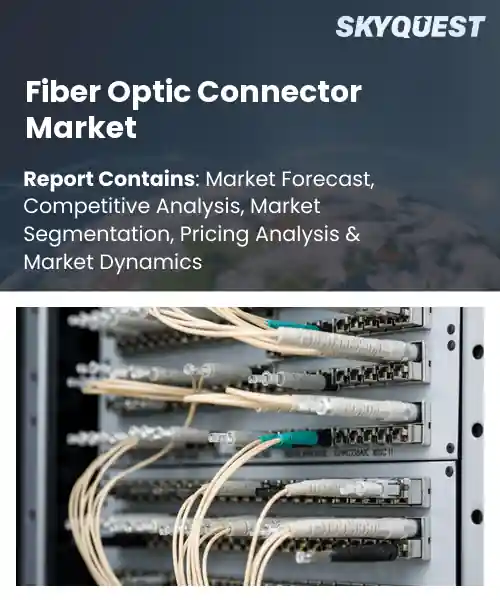
Fiber Optic Connector Market
Report ID: SQMIG45K2283
Report ID: SQMIG45K2283
[email protected]
USA +1 351-333-4748
Report ID:
SQMIG45K2283 |
Region:
Global |
Published Date: June, 2026
Pages:
157
|Tables:
179
|Figures:
79


Global Fiber Optic Connector Market size was valued at USD 5.6 Billion in 2024 and is poised to grow from USD 6.02 Billion in 2025 to USD 10.74 Billion by 2033, growing at a CAGR of 7.5% during the forecast period (2026-2033).
The fiber optics market is being heavily influenced by the demand for high-bandwidth, low-latency communication due to the expansion of data centers, 5G deployment, and increasing use of cloud computing. Mechanical and fusion connectors are used to connect optical fibers in telecom and enterprise networking they influence signal integrity and affect both downtime and the overall cost of maintenance. The fiber optics industry has developed from military and research applications to mass production as a result of the broadband boom. As an outcome, SC and LC connectors were developed into standard products for the industry. The growing trend towards modularisation and the increased use of pluggable optics drove additional demand for connectors because the operator could deploy them faster and reduce the complexity of providing field support worldwide.
In addition to this continued increase in deployments, one of the most significant factors affecting the growth of the global fibre optics connector market is standardisation and interoperability, which help to reduce the friction of integration and lower the total cost of ownership for network operators and hyperscale data centres, driving them to accelerate the upgrade of their networks. As manufacturers move towards standardisation around the LC duplex connector and also develop hardened versions of the connector, equipment manufacturers will have more opportunities to design common transceivers that will take advantage of economies of scale and reduce the number of different types of spare parts for metro and FTTH rollouts. Standardized connectors simplified fiber-to-home installs in European FTTH projects and enabled faster 5G cell site deployments by minimizing field termination errors, commercially translating into shorter time to revenue for service providers.
How is AI Improving Reliability In The Fiber Optic Connector Market?
In the fiber optic connector market outlook, AI is bolstering quality assurance by utilizing three key technologies in tandem: Machine Vision for inspection, adaptive assembly control systems that self-adjust during manufacture, and Data Analytics to connect causes of install defects back to earlier steps in the process. Key aspects of the current market include automated optical inspections capable of detecting microscopic defects, optical alignment systems that adjust themselves in real time, and analytics to correlate defects to the corresponding manufacturing process steps.
The current market is experiencing an increased density of fiber optic connectors as a result of the expansion of AI powered data centers. With increasing densities, the cost associated with a defect has increased. In this environment, AI has been leveraged by the optical connector industry to help establish standardized testing across manufacturing sites, reduce rework and enable quicker and more consistent connector terminations. Together these efforts will increase field uptime and improve the confidence and performance of the installer.
Corning, in response to the increased demand for AI powered data centers, launched its PRIZM TMT optical connector technology in March 2026 to expand its AI data center connectivity portfolio. This bolstered connector termination, ferrule alignment, and enabled past connector termination points to support faster installation/removal cycles of fiber optic connectors.
Market snapshot - (2026-2033)
Global Market Size
USD 5.6 Billion
Largest Segment
LC (Lucent Connector)
Fastest Growth
Growth Rate
7.5% CAGR
To get more insights on this market click here to Request a Free Sample Report
Global fiber optic connector market is segmented by connector type, fiber mode, cable type, application, distribution channel, end use industry and region. Based on connector type, the market is segmented into LC (Lucent Connector), SC (Subscriber Connector), ST (Straight Tip), FC (Ferrule Connector), MTP/MPO (Multi-Fiber Connectors) and Others. Based on fiber mode, the market is segmented into Single-Mode Fiber and Multi-Mode Fiber. Based on cable type, the market is segmented into Simplex, Duplex and Multi-Fiber. Based on application, the market is segmented into Data Centers, Telecommunications, CATV (Cable Television), Military & Aerospace, Industrial / Security Systems and Others. Based on distribution channel, the market is segmented into Direct Sales and Channel Sales / Distributors. Based on end use industry, the market is segmented into IT & Telecommunications, Automotive, BFSI, Healthcare, Manufacturing, Government & Defense and Others. Based on region, the market is segmented into North America, Europe, Asia Pacific, Latin America and Middle East & Africa.
The MTP/MPO connection type has been more successful than others because its multi-fiber design serves the current density and efficient deployment requirements within modern networks. Furthermore, as they enable consolidated trunking and enhanced parallel optics, they reduce the bulk of cabling, the complexity of installation and ultimately result in an operational friction decrease. Consequently, it speeds up rollouts within networks. The use of MTP/MPO design for scalable and modular designs has been heavily preferred by equipment vendors and system architects, which has driven this preference down into specification-based supply chain activities as well as broader ecosystem support, thereby driving overall market leadership.
The lowest-footprint segment of the market, the LC connector type, has experienced the most significant growth momentum, as there has been an increased demand for low-footprint, single-fiber connections in enterprise and access networks. The low-profile form factor of this type of connector and continued technology compatibility with newer transceiver modules has created new adoption patterns in hardware-constrained environments. Furthermore, continual miniaturization of connector products and standardization of interfaces creates opportunities for the launch of new product varieties and aftermarket opportunities, resulting in improved future connector sales and innovation pipeline growth.
The Data Center segment is dominating because the demands of hyperscale and cloud-based architectures require an ever-increasing level of bandwidth density, low insertion loss, and easily managed cabling systems. These operational requirements result in architects specifying high density connectors and modular multi-fiber solutions that simplify maintenance and improve link performance. In terms of procurement methods, there is a focus on interoperable, vendor neutral connectors, and the use of ecosystem tools - such as polarity management and pre-terminated cabling - further support the data center-centred design criteria that are driving the market.
Telecommunications is rapidly becoming the fastest growing market as the changing nature of networks and upgrades to access networks lead to a need to replace and diversify types of connectors. At the same time, increased demand for ruggedised, weather-proof connectors and compatibility with emerging transmission technologies are driving manufacturers to innovate and expand product offerings, as well as develop solutions that can be deployed in the field, creating future opportunities for sustained growth and aftermarket services.
To get detailed segments analysis, Request a Free Sample Report
With strong manufacturing capabilities as well as concentrated demand from large telecommunication and datacenter projects, the Asia Pacific region has the greatest combination of factors driving market growth. These strengths lead to improved production processes through vertical integration within supply chains (i.e., manufacturing companies are working together), thus increasing speed to market and reducing costs for product development; developing new products faster - through rapid prototyping and commercialization of new connector designs; helping to modernise networks via government policies, targeted infrastructure programs and assist with increasing deployments; and the availability of highly skilled engineers that allow for high volume output and provide a significant competitive advantage, at both an international and domestic level.
The Japanese Fiber Optic Connector Market is characterized by a focus on quality, precision engineering, and innovation in connector design. Demand for connectors is driven by the increasing number of advanced telecommunications networks, dense urban infrastructure, and the presence of electronics and automotive manufacturers who need reliable, compact optical interconnects. The collaboration between leading established industrial companies and research institutions supports the development of specialized connectors designed to meet the needs of demanding applications. The miniaturization, durability, and rigorous testing protocols of connectors position Japan as a global center for premium high-performance connector solutions attractive to original equipment manufacturers.
The South Korean Fiber Optic Connector Market is driven by the rapid adoption of advanced network technologies and an active electronics manufacturing environment that requires high-speed, low-loss optical interconnects. Large domestic service providers, along with global electronics exporters, support a market that values integration, performance, and compact size. Strong networks of suppliers and a supportive infrastructure to quickly commercialize new connector types allow for the rapid scale up of new connector types. The combination of highly competitive domestic markets and a strong export orientation encourages continuous improvement in cost structures and product functionality, further establishing South Korea's role as an important contributor to the global connector supply chain.
Expansion in North America is propelled by robust demand from cloud service providers, data center growth, enterprise network upgrades, and ongoing investments in broadband infrastructure. The region benefits from a mature vendor ecosystem that advances connector technologies through close collaboration with chipset and transceiver manufacturers. Emphasis on interoperability, testing standards, and quality assurance supports rapid adoption of new connector formats in critical applications. Regulatory support for broadband access and initiatives to modernize network resiliency amplify market momentum. Additionally, innovation hubs and specialized contract manufacturers facilitate the transition from prototype to volume production, enabling agile responses to evolving enterprise and carrier requirements across commercial and government segments.
Fiber Optic Connector Market in United States is shaped by significant demand from hyperscale cloud operators, telecommunications providers, and defense and enterprise applications that require high reliability and performance. The market benefits from extensive R&D activity, strong standards development, and advanced testing facilities that drive adoption of new connector solutions. Integration with optical transceivers and system level design considerations are common. A competitive landscape of incumbent suppliers and agile innovators supports a broad portfolio of connector types tailored to demanding data center and carrier environments.
Fiber Optic Connector Market in Canada is influenced by a mix of urban and remote deployment needs, with emphasis on reliability, environmental robustness, and long distance transmission performance. National infrastructure initiatives and collaboration with regional service providers create demand for versatile connector solutions suited to varied climatic conditions. Supply chain relationships with neighboring markets and focus on network resiliency support adoption of standardized connectors for enterprise and carrier networks. Local engineering expertise and partnerships with international suppliers facilitate tailored solutions for both metropolitan and rural connectivity projects.
Europe is enhancing its position through coordinated efforts in standardization, sovereign manufacturing initiatives, and investment in research that targets energy efficient and secure optical interconnects. Regional strengths include a strong industrial base that demands advanced connector solutions for automotive, manufacturing, and critical infrastructure sectors. Collaboration between operators, equipment makers, and research consortia accelerates development of interoperable connector formats and testing methodologies. Policy emphasis on supply chain resilience and sustainable production practices encourages nearshoring and quality oriented manufacturing. A focus on modularization and compatibility with broader optical ecosystems supports the region in moving from component supply toward systems level value creation in global markets.
Fiber Optic Connector Market in Germany is driven by industrial automation, automotive applications, and a strong machinery manufacturing sector that require rugged, high precision optical interconnects. Emphasis on engineering excellence and long term reliability leads to demand for connectors with stringent performance and durability characteristics. Collaboration with domestic original equipment manufacturers and research institutions fosters innovation in connector materials and assembly techniques. The market favors solutions that integrate seamlessly into industrial networks and support demanding environmental and mechanical requirements.
Fiber Optic Connector Market in United Kingdom is influenced by dense data center activity, financial services requirements for low latency connectivity, and multiple submarine cable landing points that support international traffic. Demand prioritizes interoperability, rapid deployment, and compliance with rigorous testing regimes. A vibrant services and systems integration community supports adoption of new connector types tailored for cloud and carrier networks. Research clusters and vendor consortia contribute to advancements in connector form factors and deployment methodologies that meet sophisticated enterprise needs.
Fiber Optic Connector Market in France is shaped by extensive operator led network modernization and strong domestic equipment manufacturing capabilities that require advanced connector technologies. Emphasis on national infrastructure resilience and strategic industrial sectors such as transport and energy drives demand for robust, certified optical interconnects. Collaboration between carriers, manufacturers, and research organizations supports development of connectors optimized for performance and lifecycle management. The market values solutions that balance operational reliability with sustainable production and supply chain transparency.
To know more about the market opportunities by region and country, click here to
Buy The Complete Report
Increasing Demand For High Bandwidth
Expansion Of Data Center Deployment
High Installation And Maintenance Complexity
Compatibility And Standardization Challenges
Request Free Customization of this report to help us to meet your business objectives.
Competitive dynamics in the global fiber optic connector market are shaped by consolidation, standards-driven alliances and rapid product innovation; incumbents pursue targeted acquisitions and licensing to secure IP and volume supply (Amphenol’s 2021 purchase of Halo, Marvell’s 2025 acquisition of photonics startup Celestial AI) while industry MSAs and expanded-beam developments led by 3M, Corning and US Conec are accelerating interoperability and intensifying supplier competition.
SkyQuest’s ABIRAW (Advanced Business Intelligence, Research & Analysis Wing) is our Business Information Services team that Collects, Collates, Correlates, and Analyses the Data collected by means of Primary Exploratory Research backed by robust Secondary Desk research.
As per SkyQuest analysis, the global fiber optic connector market is propelled by one key driver, rising demand for high bandwidth communications driven by data center expansion, 5G rollout and cloud proliferation, while one restraint is the high installation and maintenance complexity that limits faster uptake. The dominating region is Asia Pacific supported by manufacturing scale and large infrastructure programs. The dominating segment is MTP/MPO which addresses high-density multi-fiber requirements even as LC gains momentum for compact single-fiber use. A second driver is growing standardization and interoperability that reduces integration friction and encourages hyperscalers and carriers to accelerate network upgrades and modular deployments.
| Report Metric | Details |
|---|---|
| Market size value in 2024 | USD 5.6 Billion |
| Market size value in 2033 | USD 10.74 Billion |
| Growth Rate | 7.5% |
| Base year | 2024 |
| Forecast period | (2026-2033) |
| Forecast Unit (Value) | USD Billion |
| Segments covered |
|
| Regions covered | North America (US, Canada), Europe (Germany, France, United Kingdom, Italy, Spain, Rest of Europe), Asia Pacific (China, India, Japan, Rest of Asia-Pacific), Latin America (Brazil, Rest of Latin America), Middle East & Africa (South Africa, GCC Countries, Rest of MEA) |
| Companies covered |
|
| Customization scope | Free report customization with purchase. Customization includes:-
|
To get a free trial access to our platform which is a one stop solution for all your data requirements for quicker decision making. This platform allows you to compare markets, competitors who are prominent in the market, and mega trends that are influencing the dynamics in the market. Also, get access to detailed SkyQuest exclusive matrix.
Table Of Content
Executive Summary
Market overview
Parent Market Analysis
Market overview
Market size
KEY MARKET INSIGHTS
COVID IMPACT
MARKET DYNAMICS & OUTLOOK
Market Size by Region
KEY COMPANY PROFILES
Methodology
For the Fiber Optic Connector Market, our research methodology involved a mixture of primary and secondary data sources. Key steps involved in the research process are listed below:
1. Information Procurement: This stage involved the procurement of Market data or related information via primary and secondary sources. The various secondary sources used included various company websites, annual reports, trade databases, and paid databases such as Hoover's, Bloomberg Business, Factiva, and Avention. Our team did 45 primary interactions Globally which included several stakeholders such as manufacturers, customers, key opinion leaders, etc. Overall, information procurement was one of the most extensive stages in our research process.
2. Information Analysis: This step involved triangulation of data through bottom-up and top-down approaches to estimate and validate the total size and future estimate of the Fiber Optic Connector Market.
3. Report Formulation: The final step entailed the placement of data points in appropriate Market spaces in an attempt to deduce viable conclusions.
4. Validation & Publishing: Validation is the most important step in the process. Validation & re-validation via an intricately designed process helped us finalize data points to be used for final calculations. The final Market estimates and forecasts were then aligned and sent to our panel of industry experts for validation of data. Once the validation was done the report was sent to our Quality Assurance team to ensure adherence to style guides, consistency & design.
Analyst Support
Customization Options
With the given market data, our dedicated team of analysts can offer you the following customization options are available for the Fiber Optic Connector Market:
Product Analysis: Product matrix, which offers a detailed comparison of the product portfolio of companies.
Regional Analysis: Further analysis of the Fiber Optic Connector Market for additional countries.
Competitive Analysis: Detailed analysis and profiling of additional Market players & comparative analysis of competitive products.
Go to Market Strategy: Find the high-growth channels to invest your marketing efforts and increase your customer base.
Innovation Mapping: Identify racial solutions and innovation, connected to deep ecosystems of innovators, start-ups, academics, and strategic partners.
Category Intelligence: Customized intelligence that is relevant to their supply Markets will enable them to make smarter sourcing decisions and improve their category management.
Public Company Transcript Analysis: To improve the investment performance by generating new alpha and making better-informed decisions.
Social Media Listening: To analyze the conversations and trends happening not just around your brand, but around your industry as a whole, and use those insights to make better Marketing decisions.
REQUEST FOR SAMPLE
 REQUEST FREE CUSTOMIZATION
Global Fiber Optic Connector Market size was valued at USD 5.6 Billion in 2024 and is poised to grow from USD 6.02 Billion in 2025 to USD 10.74 Billion by 2033, growing at a CAGR of 7.5% during the forecast period (2026-2033).
Competitive dynamics in the global fiber optic connector market are shaped by consolidation, standards-driven alliances and rapid product innovation; incumbents pursue targeted acquisitions and licensing to secure IP and volume supply (Amphenol’s 2021 purchase of Halo, Marvell’s 2025 acquisition of photonics startup Celestial AI) while industry MSAs and expanded-beam developments led by 3M, Corning and US Conec are accelerating interoperability and intensifying supplier competition. 'Corning Incorporated', 'Amphenol Corporation', 'TE Connectivity Ltd.', 'Molex LLC', 'Furukawa Electric Co., Ltd.', 'Sumitomo Electric Industries Ltd.', 'CommScope Holding Company Inc.', 'Prysmian Group', 'Hirose Electric Co., Ltd.', 'Rosenberger Group', 'Radiall S.A.', 'Belden Inc.', 'Legrand S.A.', 'HUBER+SUHNER AG', 'Diamond SA', 'Foxconn Interconnect Technology', 'Luxshare Precision Industry Co., Ltd.', 'Yazaki Corporation', 'Broadcom Inc.', 'Senko Advanced Components Inc.'
The persistent growth in demand for high bandwidth services is driving widespread upgrades of network infrastructure, prompting service providers and enterprises to deploy fiber optic connectors that enable greater capacity and lower signal loss; as applications such as cloud computing, video delivery, and mobile broadband require more reliable and scalable links, connectors that support dense, low latency interconnections become essential, encouraging investment in higher performance connector types and accelerating adoption across data centers, telecom networks, and enterprise campuses due to improved interoperability and future proofing.
Edge And Access Expansion: Demand for distributed connectivity driven by edge computing and dense access networks is propelling growth in specialized connector solutions. Suppliers are prioritizing compact, ruggedized designs that facilitate deployment and simplified field servicing. Partnerships across equipment makers, integrators, and service providers are accelerating product customization and logistics. Emphasis on interoperability, reduced insertion loss, and thermal resilience is encouraging innovation around modular interfaces and tool-less installation features, enabling operators to extend fiber deeper into access networks and improve service agility and reliability.
Why does Asia Pacific Dominate the Global Fiber Optic Connector Market? |@12


Want to customize this report? This report can be personalized according to your needs. Our analysts and industry experts will work directly with you to understand your requirements and provide you with customized data in a short amount of time. We offer $1000 worth of FREE customization at the time of purchase.
Feedback From Our Clients


 USA (+1) 351-333-4748

